This newsletter covers go-to-market strategy for founders selling AI and hardware into manufacturing and industrial environments. If that’s you, or you’re investing in this space, you’re in the right place.
This series goes deeper: buyer-side knowledge that takes founders 12–18 months to learn through trial and error. This post is about finding early buyers who deploy before you’re proven and why founders don’t.
I knew Vention because when I was at Tesla in 2015, their founder Etienne came to visit me after I ordered a couple of metrology fixtures from him. We used them a lot here at Matter - Glen Turley, Head of Quality at Matter
In my specific application, we were detecting varying shades of grey, and Keyence and Cognex just couldn’t do it as well as UnitX. - Aaron, former Mfg Eng at Tesla
Glen and Aaron are the customers every founder needs, but few know how to find. In Geoffrey Moore’s Crossing the Chasm, buyers like Glen and Aaron would sit on the left side of the adoption curve: innovators and early adopters.
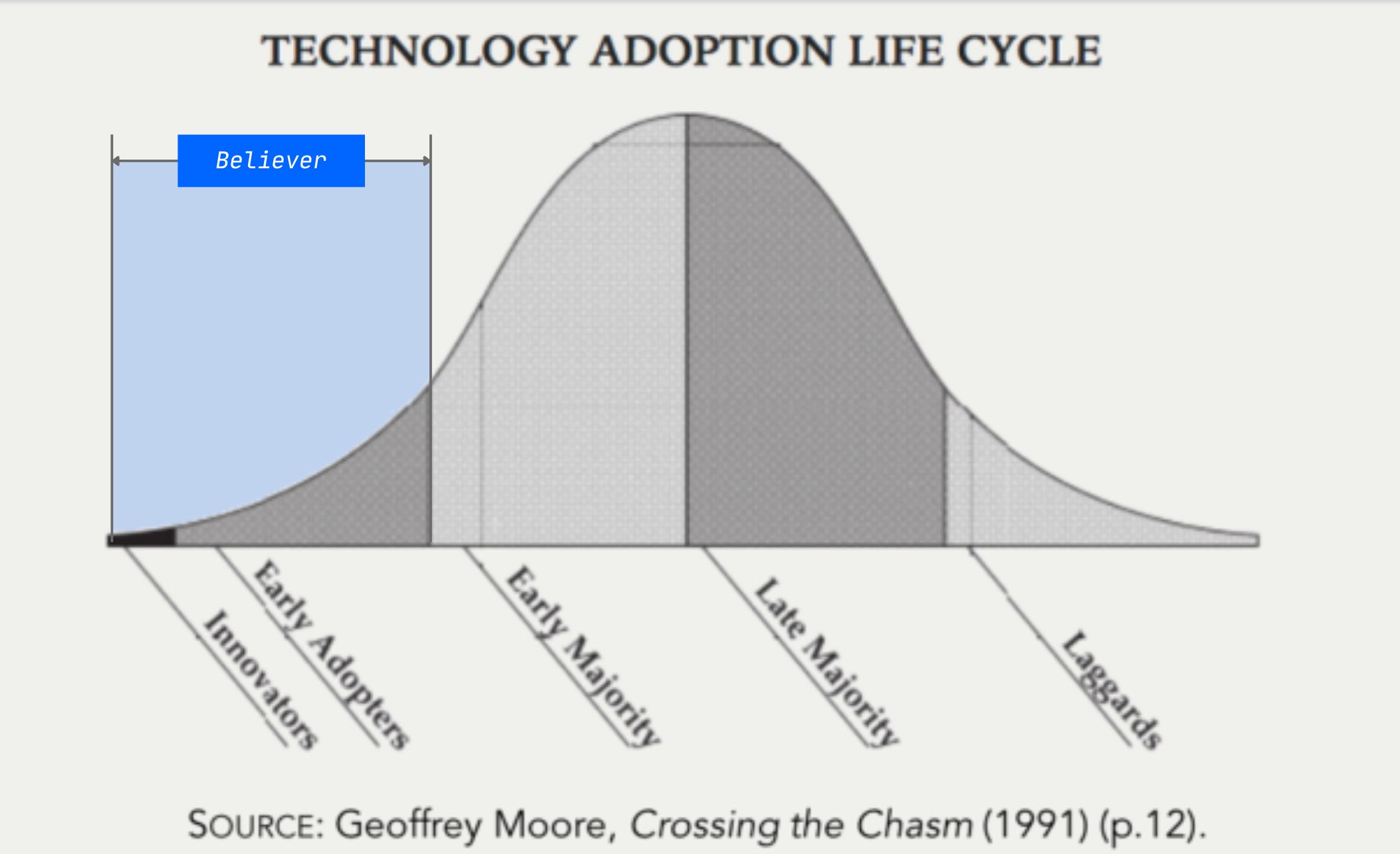
I call both groups believers because they don’t need proof that it works elsewhere. For novel technologies, they’re the only ones who matter at the start. Together, these two groups make up roughly 15% of any market. The early majority, the next 34%, won’t buy until they see proof. That proof comes from the believers. Without them, you can’t cross the chasm.
If founders can identify believers with repeatable needs and deployment patterns, they can graduate to the mainstream market. But when you run mainstream sales motions, i.e., ICP filtering, value prop messaging, cold outbound, interest comes back from across the adoption curve. It often skews toward the mainstream, precisely because your approach is mainstream.
When founders adopt a sales process that isn’t disproportionately looking for believers, this is where time leaks. When they’re not seeing enough adoption, the natural response is to scale harder: hire sales, run more outbound, fill the pipeline. But that just increases the rate at which you meet people who won’t deploy.
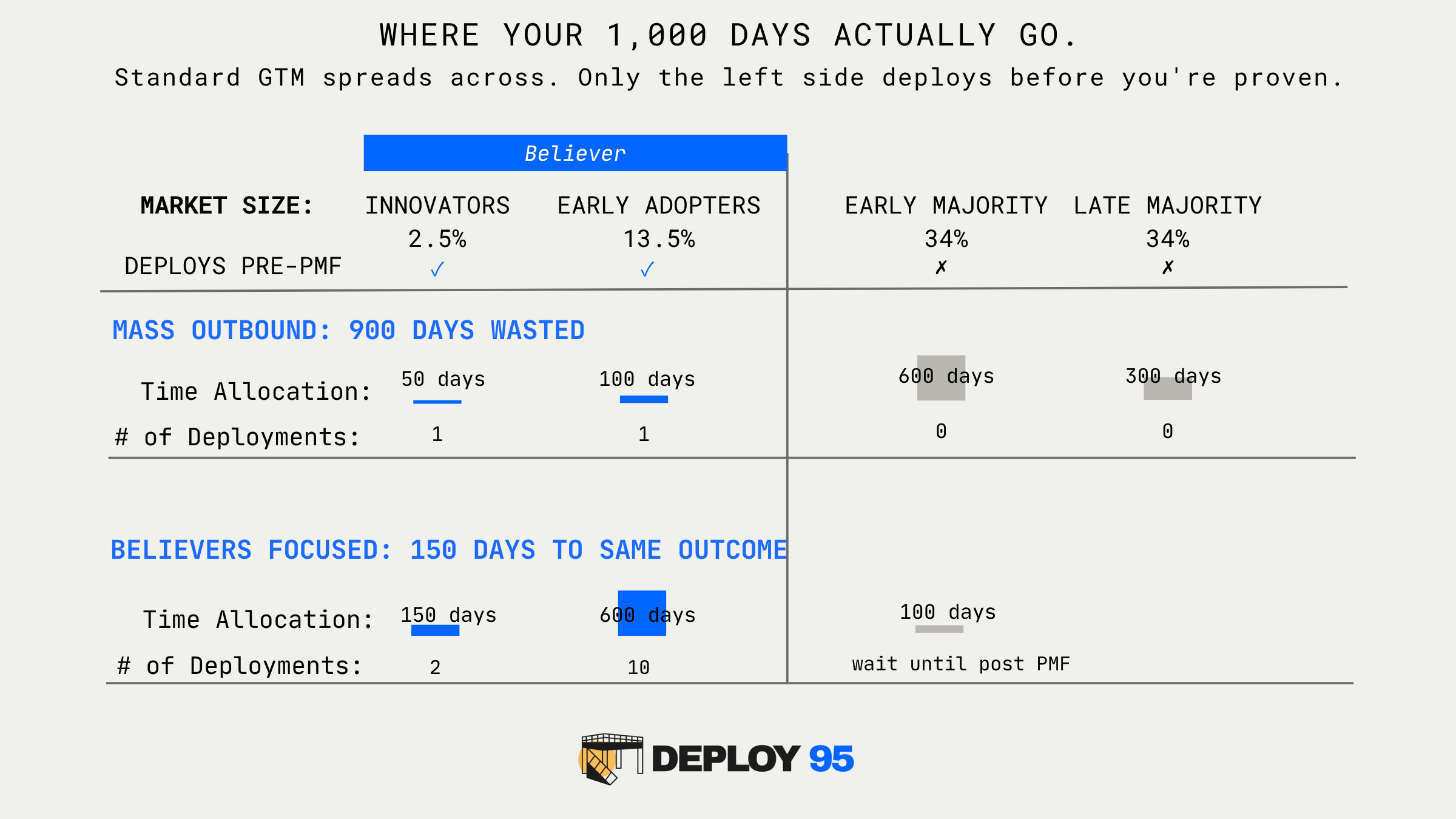
The real work is different: finding the left side of the curve, the believers who’ll ship before you’re proven.
The cost is real. When I ask founders who found PMF what they’d do differently, a surprising answer emerges: minimize time lost to wrong-fit customers. That recovery time accounts for 6–12 months, at least 20% of a typical runway.
Mapping products into different go-to-market motions could save someone six months of messing up and figuring it out eventually. — Trevor Lynn, CMO of Roboflow
I ran 20+ interviews with buyers, operators, and founders to understand where that 20% actually leaks. Three patterns emerged, each counterintuitive to mainstream GTM advice.
Founders assume the hardest part of outbound is getting a response. But the ones who respond first aren’t always the ones with urgent need, and the ones who would deploy are too busy or not in your database.
Zach runs controls engineering at a multi-generational contract manufacturer. His team of two handles everything from cradle to grave.
We are interested in innovation to stay competitive. We discover new technologies when a customer requests it or our existing vendors bring it to us. We want to know what’s innovative out there, but the tradeoff is committing the time to test it, where we’re already running tight on capacity. — Zach, controls engineering leader
When Zach says 'committing the time to test it,' he means pulling an engineer off a client project for two weeks. That engineer has three active jobs running. The test has to be worth more than what stops while he's evaluating your product.
Many multi-generational manufacturers fall into this bucket, but your typical outreach won’t reach them. GTM tools over-represent Tier 1 enterprises. The businesses in trade directories, such as the Powder Metallurgy Parts Association, are nowhere in Apollo or Sales Navigator.
I ran an analysis of 500+ manufacturing engineers on LinkedIn. Half had fewer than 500 connections. Median last profile update was two years ago, typically when they changed jobs. These are your believers.
Finding them requires methods that feel unscalable: trade association directories, distributor referrals, regional trade shows. They’re not looking where you’re selling.
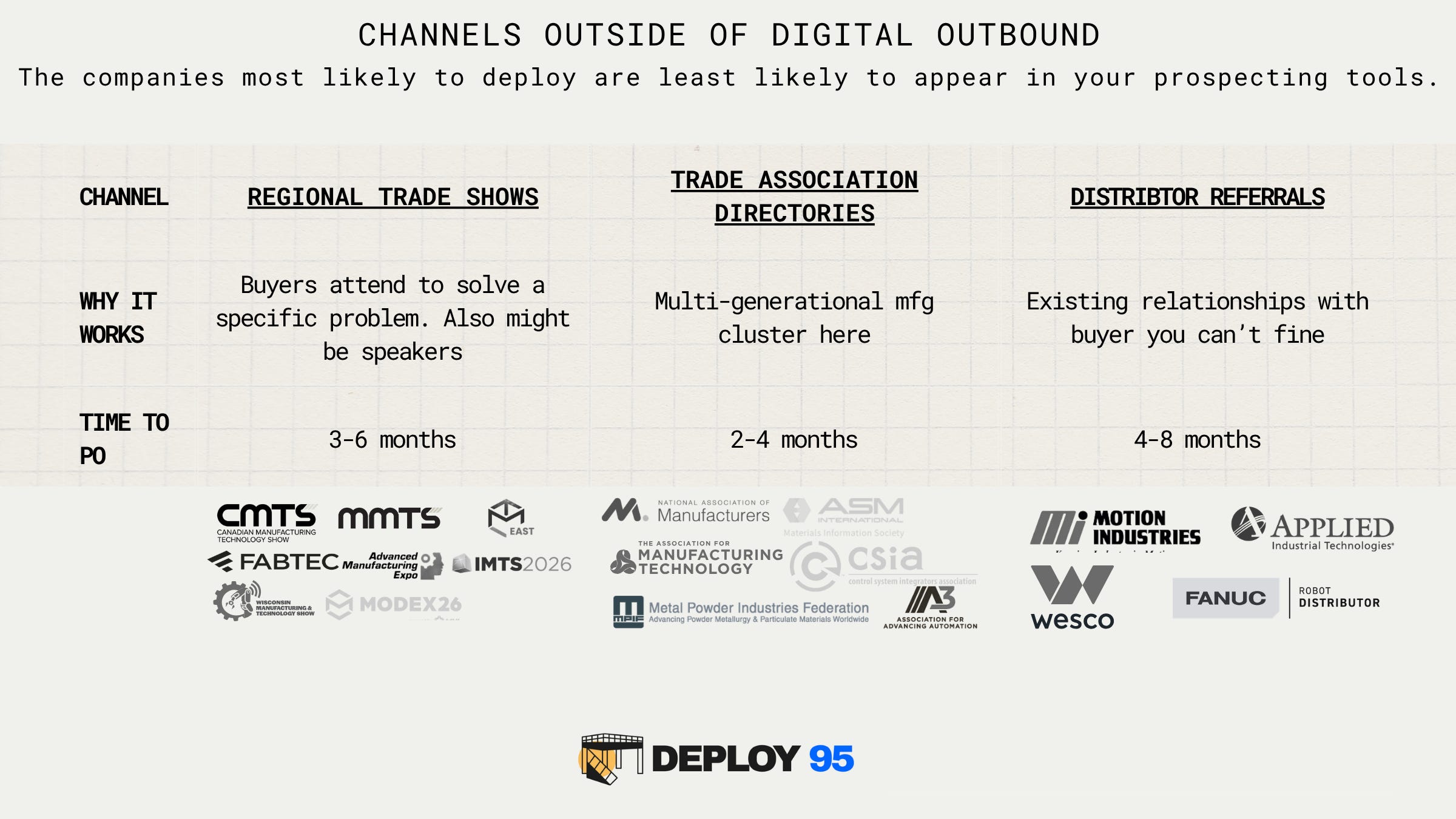
This means you need two lists. The first is strategic accounts worth the long game: larger companies with genuine white space, rollout potential across multiple sites, or newer business units exploring new processes. The second is companies that take digging to find: trade associations, regional manufacturing clusters, referrals from the shop floor. The second list is where your first POs come from.
After talking to a range of quality and operations leaders, a pattern emerged: the title isn’t the problem. The problem is that the same title means different things at different companies.
“Lots of titles that can happen within a quality organization and even just within the industry. And actually different industries mean that they’re going to mean different things…. when we say quality manager, when we say quality assurance or quality control, those are also different, depending on who you talk to.” — Anna Boyd, Quality leader, former Redwood Material, Tesla, and 3M
At the 75-person shop, the quality manager walks you to the line, watches your system run, and tells you on the spot whether it solves her problem. At the Fortune 500, the quality manager you met with sends your proposal to supplier quality, who sends it to procurement, who sends it to IT security. Each handoff adds two weeks and removes context.
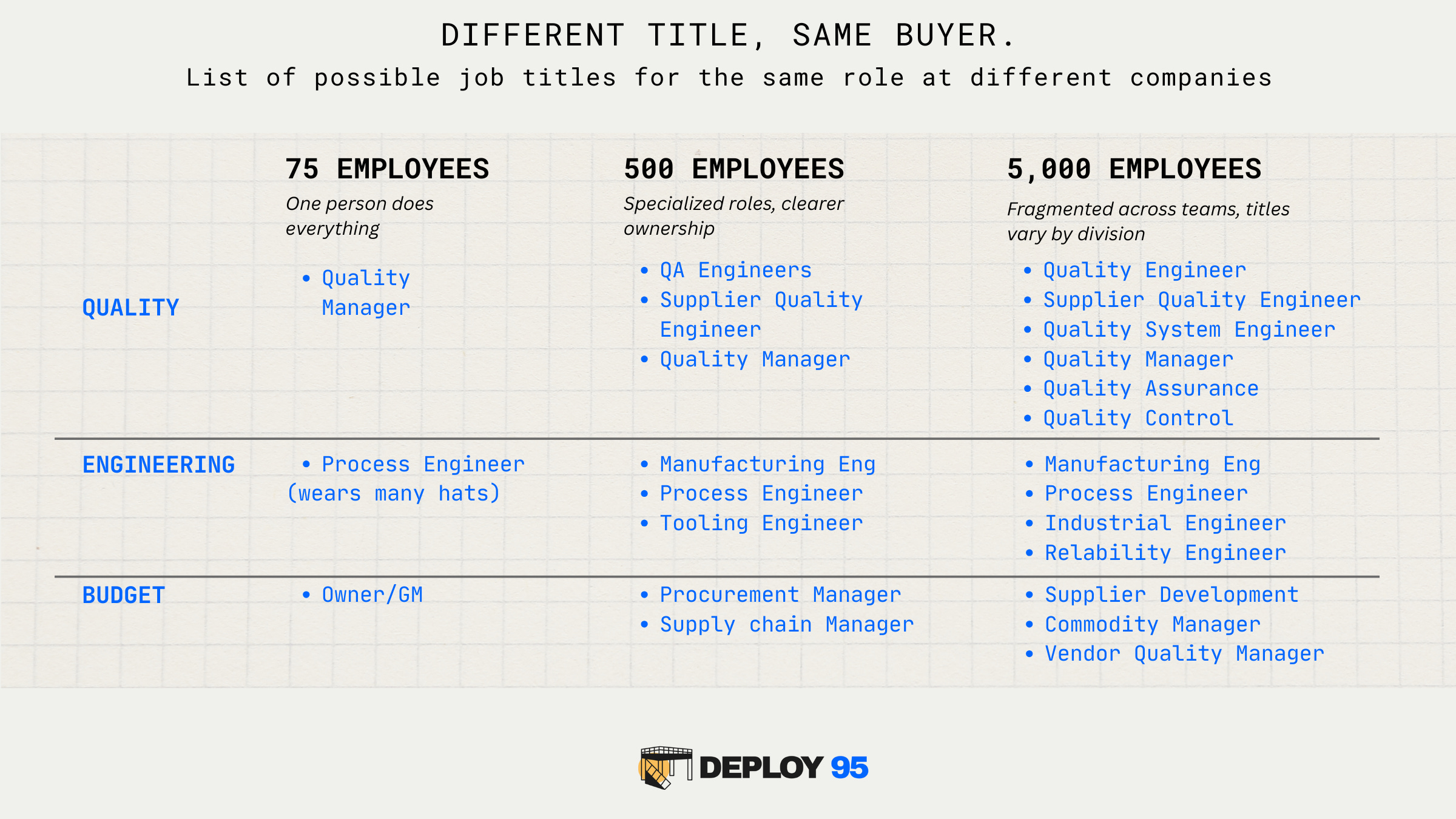
Glen Turley describes this dynamic from the inside:
“Every org is different, but there are similar characteristics. For example, if you are introducing a new sensor, the main person I’d say is the NPI manufacturing engineer. That’s the person you need to talk to. However, it is not always clear if a company has an NPI manufacturing engineer; maybe they are the process engineer, or manufacturing engineers. Sometimes, the controls engineers… It shouldn’t be like one phone call, I give up, it’s not the right one. Get them on the conversation of, can you just talk me through your org? And then maybe you’ll find the right person.”
Titles are only useful once you understand how that particular company has organized the function. You can only learn that by treating the first conversation as discovery, mapping how decisions get made so you know whether to keep investing time.
Traditional sales advice assumes a buying process exists. Qualify the committee. Map the stakeholders. Navigate procurement. The advice is about surviving a process the buyer already knows how to run.
For novel manufacturing technology, that process often doesn’t exist. The buyer has never purchased this category. There’s no committee for it. No budget line. No evaluation criteria.
We find people more often than they’re finding us. We have a need, and then we go looking for it. But we don’t know who to look for. And usually the people who make it past the spam filter are the ones who’ve already done something for us.— Raven, a quality leader at a specialty materials manufacturer
She’s searching. But she doesn’t know what to search for, how to evaluate what she finds, or how to get it approved internally. Cold outreach fails not because the pitch is wrong but because the buyer has no frame for evaluating an unknown vendor for a problem she can barely articulate.
When a buying process doesn’t exist, your job is to help the buyer create one. That means you’re guiding and helping her articulate the problem in terms her leadership will fund. You’re helping her define what success looks like so she can justify the spend. You’re helping her figure out who else in the organization needs to be comfortable before she can move.
This is a motion most VP of Sales never run. At an established company, the buyer already knows how to buy vision systems. At a startup selling a novel capability, the buyer doesn’t know how to buy because the category barely exists. The rep’s job is to co-create the buying process with the buyer.
Early believers are scattered in places you don’t expect. They don’t share the same title. They might need you to guide them through a buying process that doesn’t exist, or they might be searching for you but don’t know what to search for.
But as volume increases, you build two things: cumulative understanding, a sense of where believers cluster and where they don’t, and a muscle for pattern matching, knowing how to adapt while still evaluating whether someone is an early believer.
This contradicts the instinct to build a repeatable process as fast as possible. It lets you optimize for building proof with people who don’t require a lot of convincing. And that is what drives deployment.
The ones who will actually deploy are often at the edges: the multi-generational shop that’s not in your CRM, the NPI engineer evaluating equipment for a new line, the quality leader at a company with thin enough decision architecture that she can act on conviction.
Finding them requires archetype mapping more than industrial ICP mapping. It requires treating discovery as exploration, and going a step further into the cultural, the contextual, the story.
With limited resources, this forces a tradeoff:
Option A: Spend 18 months going deep on one firm, one use case. Maybe it works. Maybe you learn at month 17 that it was never going to work.
Option B: Spend 3 months scanning across firms, across use cases. Find the cluster where demand is real, entry is possible, and the problem is specific enough that you can solve it well. Then go deep.
The outcome of Option B is speed. You own a specific problem in less time. And because you understand it deeply, you can repeat it.
The founders who find believers fastest aren’t the ones with the best sequences or the highest outreach volume. They’re the ones who stay flexible long enough to discover where the believers actually are, and then go deep once they’ve found them.
Next in this series: the Quality function from the inside, where it sits at different company sizes, who holds budget versus influence, and why “selling to quality” requires knowing which quality you mean.
Only 5% of industrial AI pilots convert to full deployment. This newsletter is about that gap: what happens between your model and the factory floor.
Hi! I’m Trista, grew up in manufacturing, built GTM at UnitX, now helping technical founders close the gap between traction and deployment. If you’re new, start with the POC Valley Series.
If you’re building in this space, investing in it, or stuck somewhere without a playbook, let’s connect on LinkedIn. I’d love to hear from you.
Archetype Mapping — Identifying patterns in buyer behavior, context, and motivation rather than filtering by firmographic data alone. Focuses on who someone is and how they operate, not just their title or company size.
Believers — Innovators and early adopters who don’t need proof that a technology works elsewhere before deploying it. For novel technologies, they’re the only buyers who matter at the start. They make up roughly 15% of any market.
Metrology Fixtures — Devices used to hold parts in precise positions for measurement and inspection.
Multi-Generational Manufacturer — A family-owned or long-established manufacturing company, often with decades of institutional knowledge and lean teams. Frequently invisible to modern sales tools but often strong candidates for early adoption.
NPI (New Product Introduction) Engineer — An engineer responsible for bringing new products from design into manufacturing. Often the key decision-maker for evaluating new equipment and processes for upcoming production lines.
Trade Association — An organization representing companies in a specific industry, such as the Powder Metallurgy Parts Association or Metal Injection Molding Association. Their directories often surface companies invisible to mainstream sales tools.