I’ve developed a “review rubric” for ORI1 that I’m really happy with. For a given piece of information, I want to know in which category it falls for you:
A - “true & useful, AND new to me”
B - “true & useful, but NOT novel”
U - “unclear, undefined, unknowable, or just flat out wrong”
This is designed to be an “unfakeable signal of good faith”. If I can give you information that you recognize as “A”, then I am “ahead of you” on this subject; I’ve proven my expertise.
If everything I can give you is “B”, that suggests that YOU are “ahead”. If you can then turn around and give me an “A”, then that confirms it.
If you give me something that is a “U”, that could mean that you are completely on the wrong track, OR that *I* am on the wrong track. I fail to recognize the truth you present to me2.
In a typical unproductive internet interaction, both sides give each other U’s. This is a waste of time for both sides.
In a typical productive internet interaction, both sides are trying to give each other A’s, that may get interpreted as U’s. They then both continually “drop down” until they can find something that is a “B”. This represents the floor. From there, you then go up until one of you can give the other an “A”.
This is the “leveling” protocol. If they cannot give you any “A”, then there’s not much you can learn from them. This is a test that no one can cheat on.
What if someone lies about their rating? What if you tell them something that is a novel breakthrough, but they say “oh I already knew that, that’s a B for me”.
If they’re lying, it is VERY easy to detect this. You can just ask them, “oh! how did you learn about this?” They will have to tell you a source, or explain how they deduced it. The proof that they’re lying is in their inability to give YOU any A’s back.
This protocol is designed to be useful even if you are the only one who uses it. But if it starts gaining traction, then it helps everyone3.
If a notable person ranks something as “A”, but to you that is a “B”, then you now start to level them. You realize that you know things that they are only just now learning.
If that notable person ranks things as “U” that you know to be true, that shows you the edge of their frontier.
If you rank things “A”, that can surface the people who produce novel, useful insight. I’d LOVE to see who across substack for example you consider an “A”, which of their posts, what idea IN their posts was an A for you4.
The way I currently use this is to just ask someone, hey can you rate this A/B/U? And I drop this image. So I can use this over any platform.
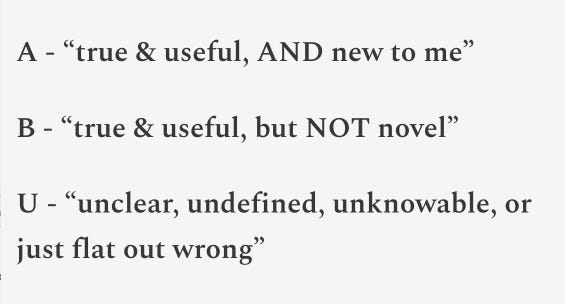
If it becomes enough of a norm you can just reference it “A/B/U”.
EDIT 1: Ꝛían Czerwinski ❦ asked if I can give a piece of information out as a test, so, here’s one:
The hard problem of consciousness is already solved - at least partially. We know that consciousness isn’t localized to the brain, first of all, it exists throughout the whole body.
It’s more accurate to say “consciousness uses the brain to compute things” than “consciousness is generated by the brain”.
(this is technically multiple ideas, you can extract one and rate it. If we were having a conversation I’d give you one at a time for you to rate)
EDIT 2: Michael Smith is an example of someone whose writing I get a lot of “A” from. His recent piece, “Subjective Science”, was a B for me (because I’ve already read his twitter threads on the same topic, but I can see how he’s laying the foundation here for his audience, and I’m paying extra attention to his writing right now)