NewHow we made a 2D renderer 2-4x faster than the most popular one
Blazing fast 2D rendering for the web.
2-4x faster than the most popular 2D web renderer, at about a seventh of its size.
– fps
Live: spryte drawing every sprite with one draw.sprites call per frame, on your device. Click it.
2-4xfaster than the most popular 2D web renderer
1.6Mmoving sprites at 60 fps on a laptop GPU
~13 kBof JavaScript, no dependencies
MITfree and open source
Measured in the open
Most sprites each library holds at 60 fps, pixel-checked before anything is timed. Run it on your device.
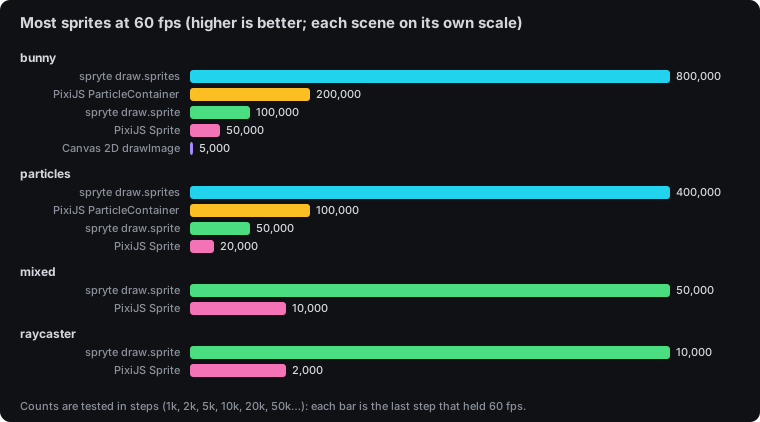
Bulk sprites
Pass a Float32Array of positions and spryte uploads it as is: hundreds of thousands of sprites, no JavaScript per sprite.
Immediate mode
No display objects to create, pool or destroy. Draw what you want each frame, in order. Your game state is the only source of truth.
Render targets and shaders
Draw into offscreen targets, then through your own fragment shaders: glow, CRT, dissolves, palette swaps.
Tiny
About 13 kB of JavaScript, no dependencies. The Canvas 2D fallback loads only on browsers without WebGL2.
Verified pixels
Every fast path is checked pixel for pixel against the simple path on a real GPU, including GPU context loss and restore.
With debuff, or alone
spryte is the renderer inside every debuff game, and a standalone MIT package for any canvas.
Not just games
spryte started in games, but anything that draws lots of moving 2D things in a browser fits.
Draw, don't manage
One renderer, one frame loop. Sprites, particles, shapes and text, batched onto WebGL2 with an automatic Canvas 2D fallback.
ts
import { createRenderer } from "spryte";

const draw = createRenderer(canvas);

function frame() {
  draw.begin("#111", 320, 180, 2);
  draw.sprite(hero, x, y, { rotation });
  draw.sprites(spark, sparks, live); // thousands, one call
  draw.text("score 42", 8, 8);
  draw.end();
  requestAnimationFrame(frame);
}
Built with spryte
Every debuff game draws through spryte.