March 23, 2026
Two Canadian pilots are dead this morning.
Their names haven’t been released yet. We know they flew Air Canada Flight 8646 out of Montreal Trudeau last night — a routine Jazz Aviation regional hop down to New York’s LaGuardia Airport. Seventy-two passengers on board, four crew members, one hour in the air. A nothing flight. The kind Canadians take to New York for a long weekend a thousand times a week.
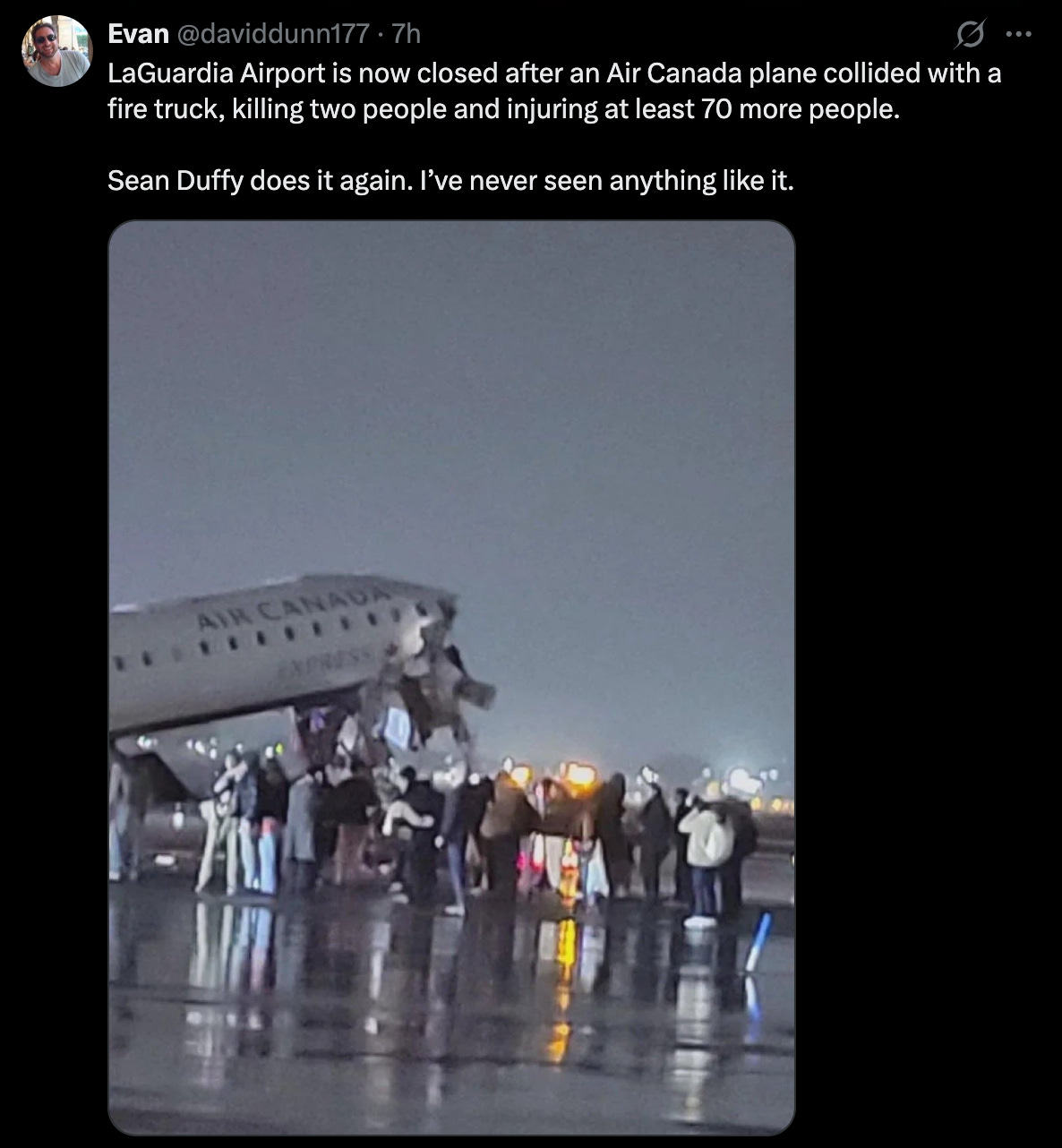
At 11:40 p.m., their plane hit a fire truck on the runway.
The cockpit was sheared off on impact.
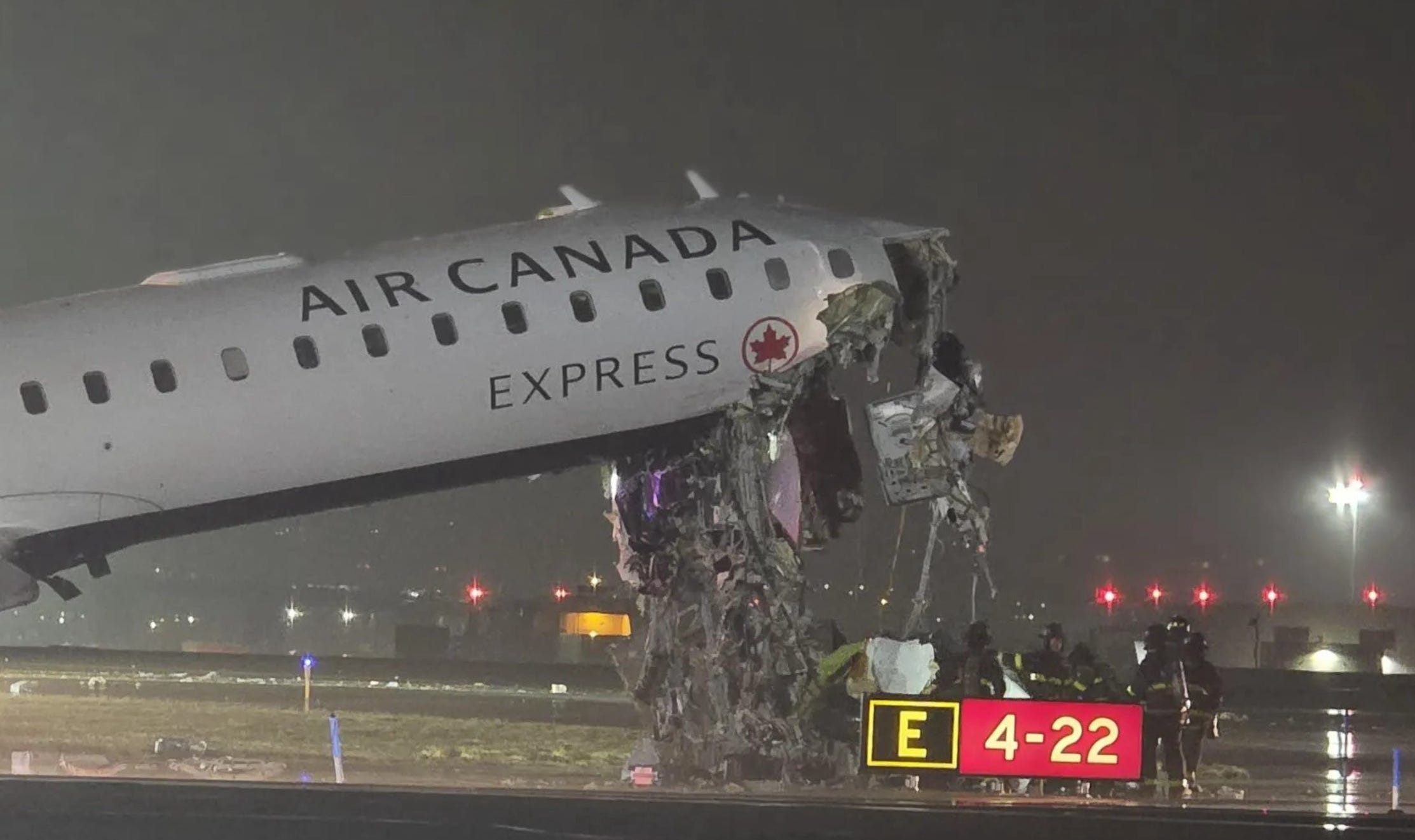
Both pilots died at the scene.
Here’s what happened, exactly.
United Airlines Flight 2384 was attempting takeoff when the crew aborted due to a warning light and reported a strange odor in the cabin that had already sickened flight attendants. The tower dispatched an Airport Rescue and Firefighting truck to respond. That truck was given clearance to cross Runway 4.
The problem? Air Canada Flight 8646 was landing on Runway 4.
The air traffic controller — who had cleared the truck across an active runway — realized what was about to happen. On the LiveATC recording, you can hear him scream it ten times.
“Stop. Stop. Stop. Truck One, stop. Truck One, STOP.”
He was too late.
The Jazz Aviation CRJ-900 hit the fire truck at roughly 130 miles per hour. The nose of the plane was gone. The two pilots — who had done absolutely nothing wrong, who had flown that plane exactly as they were supposed to — were killed instantly.
After the crash, as alarms wailed in his booth and he desperately ordered a Delta flight to abort its landing on the same runway, the controller said three words into the radio that will define this moment:
“I messed up.”
Standard procedure immediately relieved him of his position. He will be investigated. His career may be over. And none of that matters as much as the question nobody in the American government wants to answer right now:
Why was a controller managing two simultaneous emergencies on adjacent runways, alone, at midnight?
60 people were transported to the hospital. Nine remain there with serious injuries. A Port Authority sergeant and officer who were on the fire truck survived with non-life-threatening injuries.
And LaGuardia — New York’s third-busiest airport, 33.5 million passengers a year — is shut down until at least 2 p.m. today.
I know you’re tired of hearing about the American government shutdown. It ended in November. It’s over. Move on.
Except it’s not over. The wreckage is still on the runway.
The shutdown lasted 43 days — from October 1 to November 12, 2025. It was the longest in American history. And for those 43 days, every single air traffic controller in the United States worked without pay. Six days a week. Ten hours a day. Mandatory overtime. No paycheck.
Some of them started driving for Uber and DoorDash between shifts to pay rent and buy groceries. Others just stopped showing up. The Transportation Secretary — a man named Sean Duffy, who you may remember from his time as a cast member on MTV’s The Real World — acknowledged that controller retirements went from four per day before the shutdown to fifteen to twenty per day during it.
Let me translate that: the most specialized, most safety-critical workforce in American transportation was hemorrhaging its most experienced members at five times the normal rate, while the people who remained were exhausted, underpaid, and increasingly distracted by the question of whether they could keep their kids in their homes.
And the Trump administration’s official response was to post on social media demanding they “get back to work, NOW!!!”
That’s it. That was the plan.
This wasn’t the shutdown’s fault alone. The FAA was already 3,500 air traffic controllers short of its staffing targets before a single furlough notice was issued. Over forty percent of major air traffic control facilities were operating below safe staffing minimums. Controllers at understaffed facilities were already working mandatory six-day weeks before the shutdown made it catastrophically worse.
In February 2025, the Trump administration’s Department of Government Efficiency — DOGE, Elon Musk’s little vanity project — fired approximately 400 FAA employees. Not air traffic controllers specifically, but safety inspectors, systems engineers, certification staff. The people who quietly make sure the machines work and the procedures hold.
Sean Duffy’s response, when runway incursions started spiking, was to threaten to revoke pilots’ licenses.
Not to hire more controllers. Not to fix the staffing crisis his government had spent a year making worse. To blame the pilots.
In January 2025 — eleven months ago — sixty-seven people died when an Army helicopter collided with an American Airlines regional jet near Reagan National Airport in Washington. Sixty-seven people.
That crash prompted exactly the kind of serious national conversation about aviation safety that should have produced real change. Congress held hearings. Sean Duffy gave press conferences. The FAA promised a plan.
Then the government shut down for 43 days and sent 13,000 FAA workers home without pay.
This morning, there are 97 runway incursions recorded in January of this year. The skies over America are not getting safer. They are getting more dangerous. The data says so. The crashes say so. And the haunted voice of an air traffic controller screaming “stop” into a radio at midnight says so.
I want to be precise here, because precision matters.
Sean Duffy is not stupid. He is, by all accounts, a reasonably competent political operator who knows how to perform competence on television. He was a congressman. He has a law degree. He’s not a clown.
But he is a man who went from hosting The Real World: Boston to hosting Catch a Contractor to becoming the United States Secretary of Transportation — the cabinet officer responsible for the safety of every plane, train, highway, and pipeline in America — because he was loyal to Donald Trump and had nice hair.
He has no aviation background. No transportation policy background. No relevant professional experience of any kind.
He was given one of the most consequential safety portfolios in human civilization because the man who appointed him values loyalty over competence, television presence over expertise, and personal affinity over every other consideration.
Two Canadian pilots are dead this morning.
The air traffic controller who cleared a fire truck across an active runway was doing so in a system stripped of 400 workers by DOGE, demoralized by a 43-day unpaid shutdown, and chronically understaffed by 3,500 positions in the best of times.
That controller said “I messed up.”
He did. And he will carry that for the rest of his life.
But he was set up to fail by people who will face no consequences at all. Who will, in fact, hold press conferences today about aviation safety — the same people who engineered the crisis they’ll be performing concern about.
That’s between you and your risk tolerance. I’m not your travel agent.
What I will tell you is this: the American aviation system is being managed by people who view human life as a commodity, government as an obstacle, expertise as elitism, and essential workers as pawns in budget negotiations. They fired the people who keep the system safe. They starved the people who remained. And when the consequences arrived — as consequences always do — they blamed the pilots.
The NTSB is launching a full investigation into last night’s crash. That investigation will take months. It will produce a report. The report will make recommendations. Some of those recommendations will be implemented. Some won’t.
And somewhere in there, we may finally learn the names of the two people who left Montreal last night on a nothing flight to New York and never came home.
They were Canadian. They were doing their jobs. They were flying a perfectly good airplane onto a perfectly good runway.
The system that killed them was not an accident.
It was a choice.