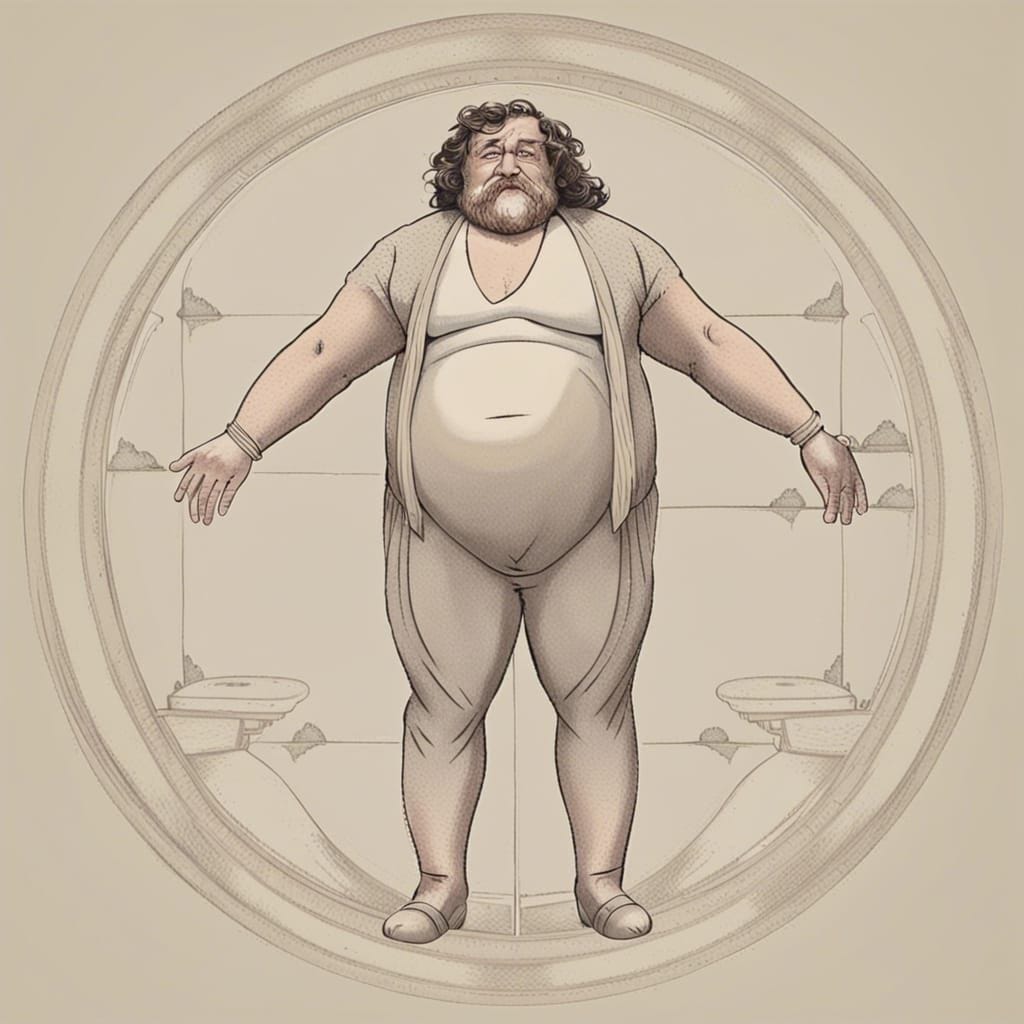
It is said that Leonardo da Vinci made the drawing of the Vitruvian Man based on the ideal body proportions of a human being. An interpretation of the time for what the ideal male body should look like. A Renaissance man. In our day and era, I propose a new Vitruvian Man. Its artist a machine. The model barely able to lift up his own arms. A crude and inhuman design. Yet perfectly describes what the daily lives of so many people’s lives have slowly become.
By the year 2030 close to half of American adults will suffer from obesity. Researchers at Harvard Chan School of Public Health find that approximately 48.9% of adult Americans will become obese by the end of the decade. A significant increase from 2020 in which it reached a historic 41.9%. [1]
This comes with a significant shift as 4 out of 5 adults will suffer from being overweight or obese. With those with severe obesity rising to one in every four adults from the estimate in 2018 of 9.6%.
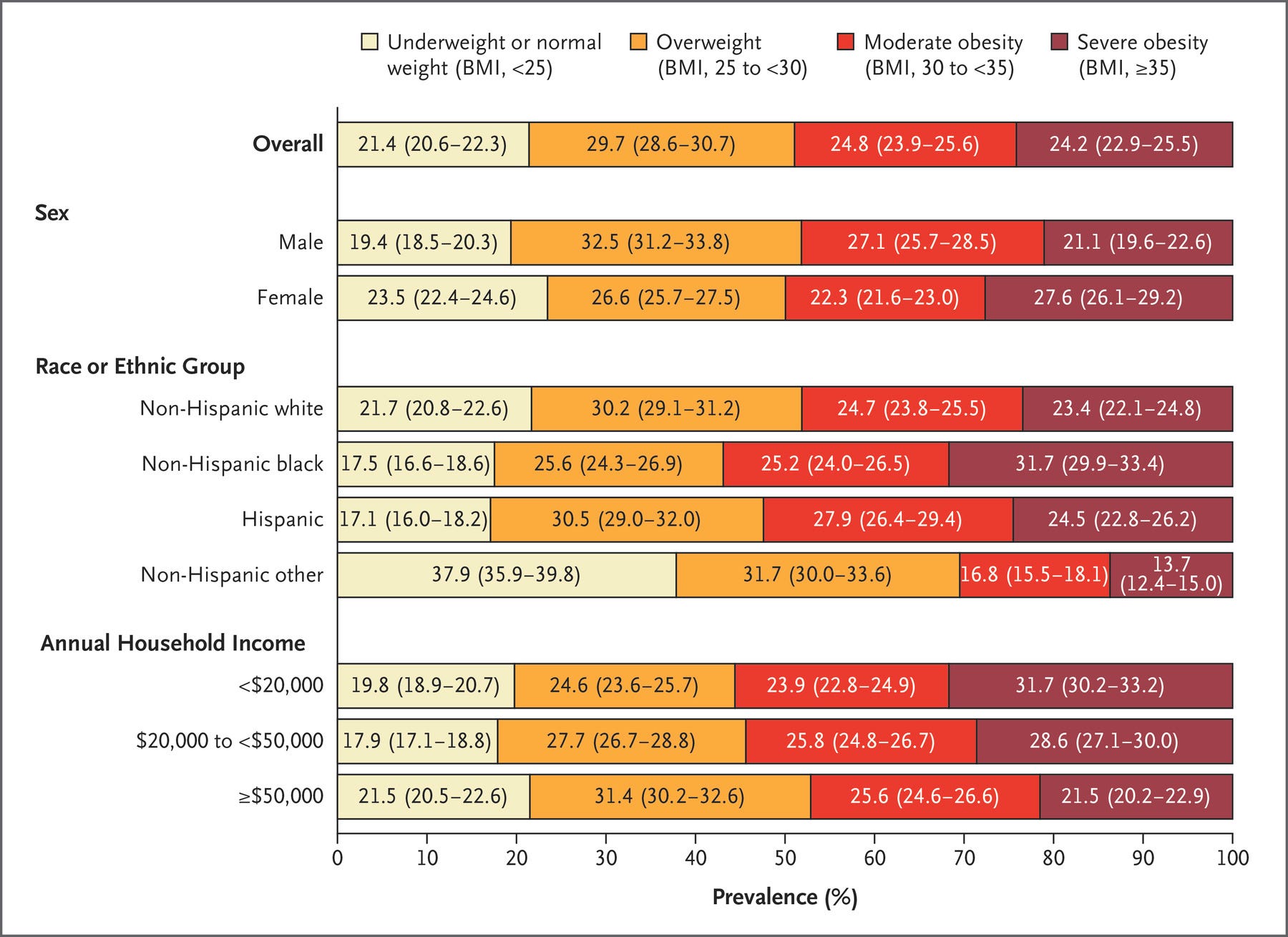
Obesity is an issue that is affects us all. From our loved ones to ourselves. It often leads to life altering conditions such as diabetes and heart disease. To the inability of people being able to carry out basic tasks in their daily lives.
In 2019 the cost of obesity on the American healthcare system was estimated to be $173 billion dollars. Without any real changes the number will likely increase exponentially in the decades to come. [2]
How is it that we’ve reached the stage where nearly half of adult Americans will be obese? It's a sudden shift but not an unexpected one. For decades now the obesity rate of Americans have been steady rising year over year.
1995-2021 Obesity Rates in the United States. Source: CDC BRFSS Annual Survey
From 1990 to 2020 the adult obesity rate has increased from an average of 12% to 42% an increase of over three and a half times in the last 30 years. While there are many factors involved in the Obesity Epidemic we’ll be focusing on the transition from childhood to adulthood. And how obesity and the modern workplace directly influences and impacts the lives of individuals.
To start off I’ll discuss childhood obesity. While the majority of obese adults were not obese as children about more than a third of American children are overweight or obese. [3] While this does tells us a few things, it’s not entirely proportional to the amount of cases of overweight and obese individuals as 3 in 4 adults are currently overweight or obese.
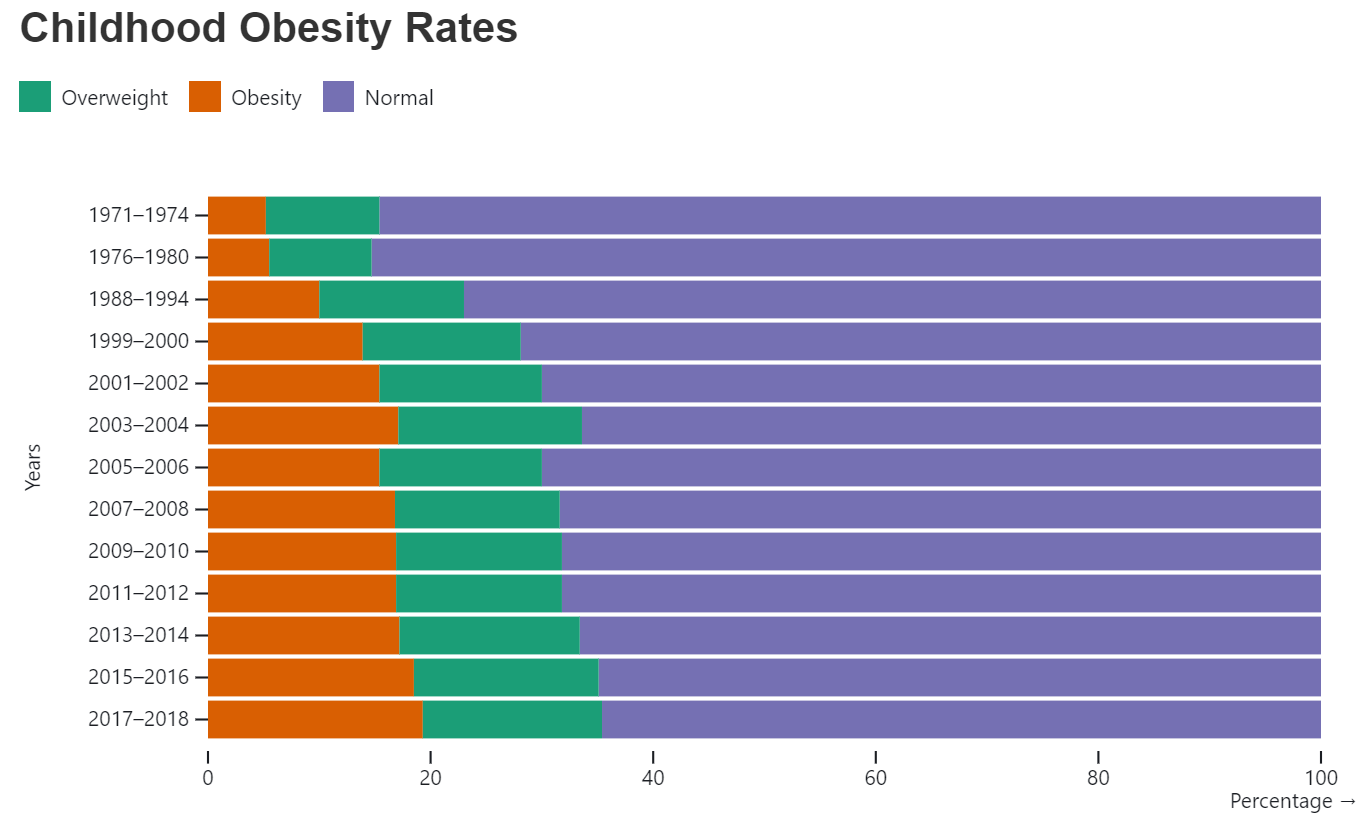
Some interesting things to note are for the past few decades the rate of childhood obesity has stayed relatively consistent with only a minor relative increases while adult obesity rates have seen a consistent increase.
Another study by Harvard Chan School of Public Health [4] talks about the outcomes of children into adulthood. Using available health data from the CDC they created over 1,000 simulations based on childhood outcomes of individuals. In doing this they were able to calculate the probability of becoming obese by age and weight group.
In it they found 57.3% of children today will be obese by the age 35. Along with this they found that childhood obesity was a strong predictor for obesity in individuals who were obese or overweight as children. However it’s not as apparent for those normal or under weight.
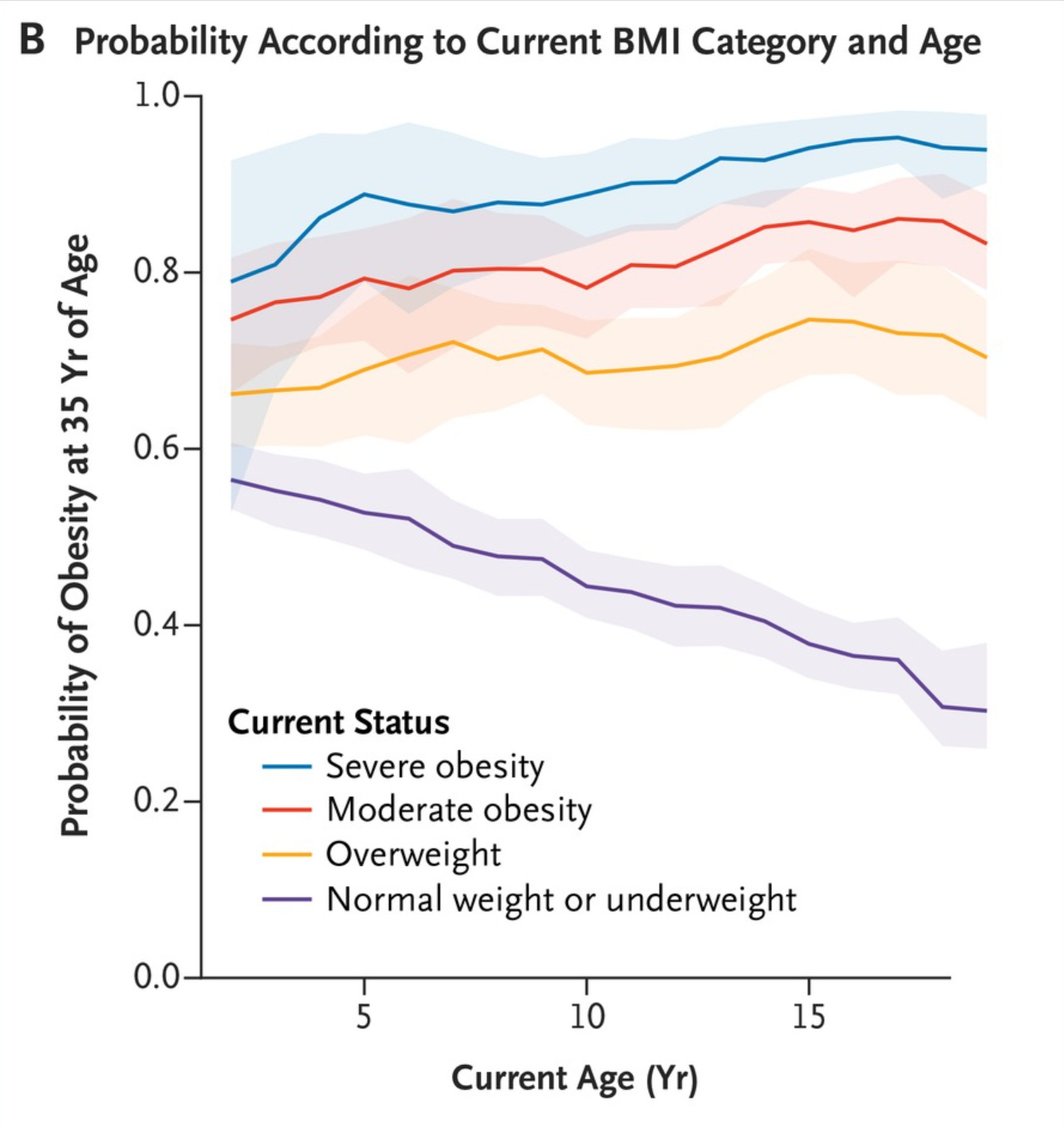
On average they found by the age of 18 for normal and underweight individuals the probability of becoming obese was around 30%. While that number may seem good only about 25% of adult Americans stay a healthy body weight.
This means for more than half of normal or underweight individuals they will become overweight or obese. So what’s going on here? How is it possible that so many American’s are gaining weight at an alarming rate from the moment they seem to reach adulthood?
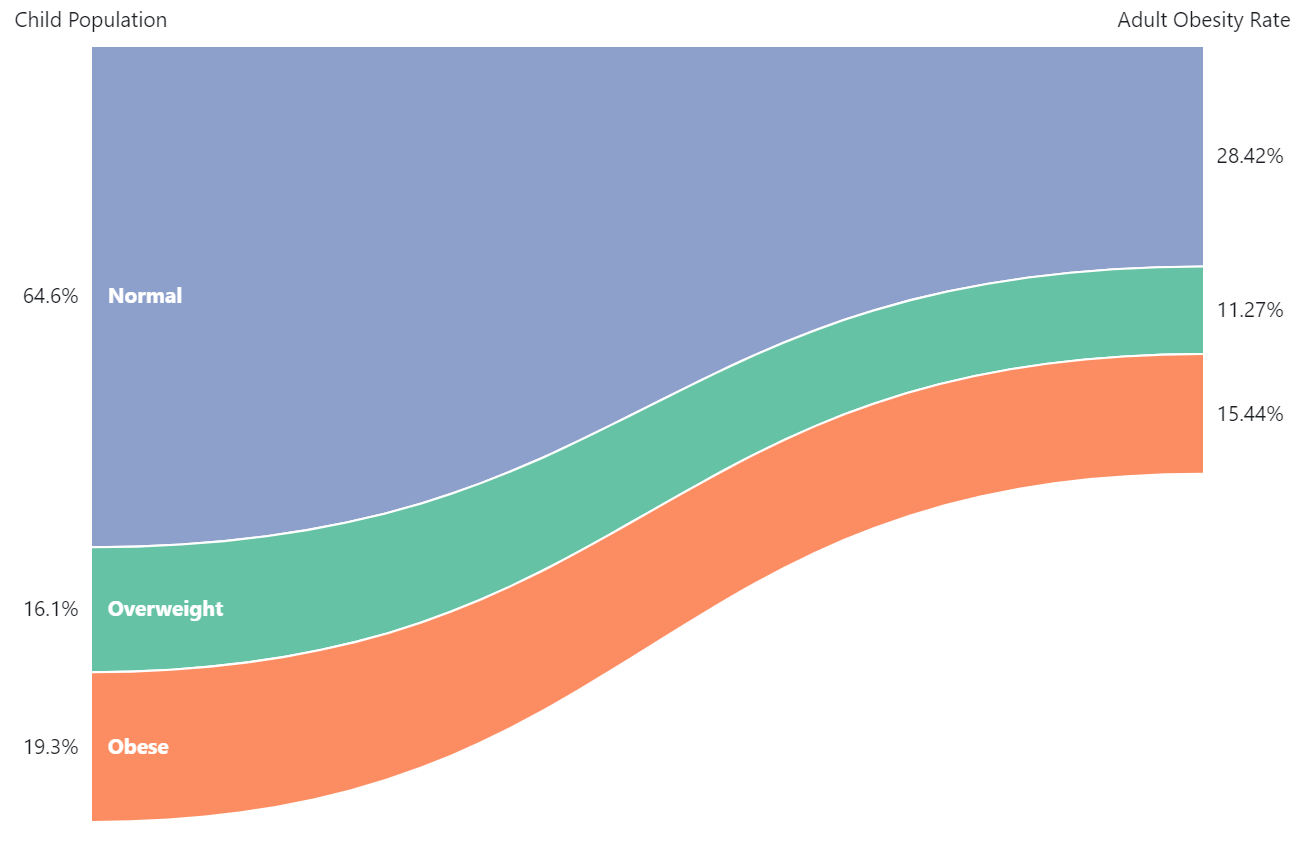
About 4 in 10 normal weight American children will become obese by the time they reach the age of 35. While childhood obesity plays a large role in the outcomes of many adults for many normal and overweight American adults the transition to obesity does not occur in childhood.
So what could be causing this uptick in obesity? Could it be the sudden transition to independent living? Or is it just built into the modern workplace? Research into obesity can be confusing but here are the things we know.
For many individuals, college is often the first time they are able to live in an independent environment. Studies have shown that over a four year period individuals often do not experience large changes in their weight during their time. With an average of only 3.5-6.5 pounds or 1.6-3.0kg. [5]
The average obesity rate for recent college graduates was around 16%. While The CDC reports that age adjusted obesity rates for college graduates was around 35% as of 2017-2020. [6] This tells us while many individuals successfully transition to independent living this is not the case as they continue on to the modern workplace.
So what’s going on? How are so many adults becoming obese over their lifetime in the modern workplace? The change is often not immediate but by the age of 35 more than half of adults become obese.
While there are many kinds of jobs and shifts for our focus today we will be talking about the most commonly occurring types of jobs. The modern day job. While it has changed somewhat in recent years with the introduction of hybrid and remote work for many roles it still remains one of the most popular types of jobs.
So what exactly is the Modern Workplace doing that’s causing this rise in obesity? While there are many factors that contribute to the rising rates of adult obesity the one thing that has stayed consistent throughout the various years it’s the schedule.
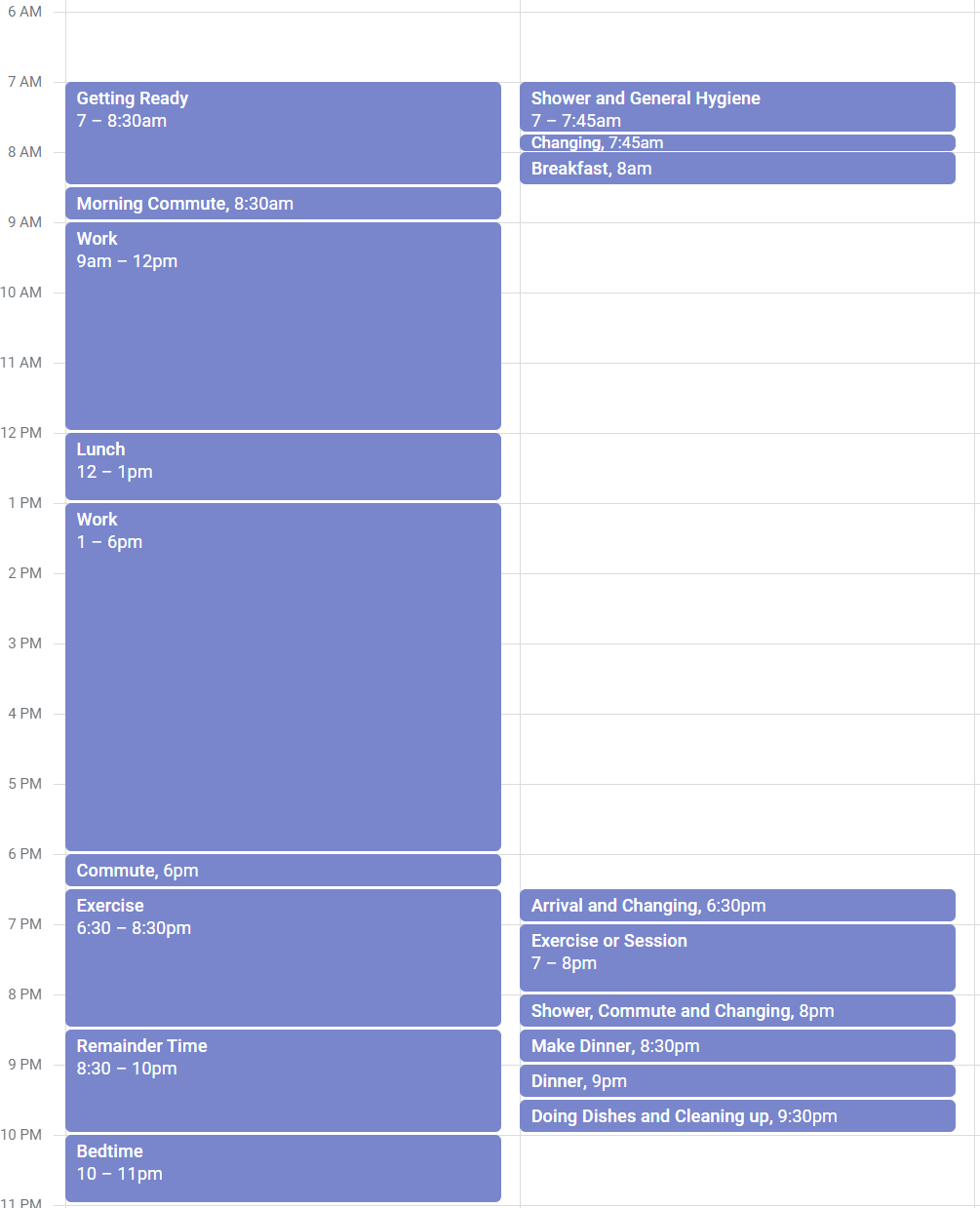
To say it simply. There isn’t enough free time in the day. Let’s look at the average schedule for a working adult that is needed to stay physically healthy and in shape. Starting from the morning an individual needs to be able to take care of themselves physically, a morning shower and general hygiene routine. From there, there need to change and make themselves breakfast before heading out for the day.
In order to maintain a physically healthy body, an individual needs to spend about an hour everyday exercising. While the CDC recommends 150 minutes a week, for children it recommends an hour a day. Similarly the Mayo Clinic recommend 300 minutes a week of moderate aerobic activity.
Now comes the problems, how long does an hour of exercise take? You might think it would only take an hour. But that isn’t really the case. Factoring in commuting to the gym, changing and showering it can take from 1.5 to 2 hours. And that’s if all you do is immediately exercise and not stop to take breaks or socialize with others.
So what does that mean? In the ideal environment doing the basic requirements to stay healthy leaves the average person with no time to spend on anything else. There is often no time for hobbies to going out and meeting with people. For many that means giving up on exercise entirely.
Even if you were able to stay consistent throughout this. For most adults having your first child often comes with the end of your fitness journey. Of the remaining free time most of it will be spent ensuring that the child it take care of. Though, often there is not even time to spend with children but for this article we will not be discussing this.
Companies and local governments can make it mandatory for employees to exercise for an hour everyday during the work. This could reduce the time needed to an hour and a half instead of an hour just by creating infrastructure for addressing this need.
It would likely create hundreds of thousands of jobs but there are often many issues with this such as pay and compensation. There could be all sorts of issues with interactions between workers and trainers. As pay inequality and close interactions between opposite gendered individuals would pose serious problems.
Even with these changes the obesity rate may not change or may change slowly due to consumption habits of individuals differing. On average Americans and Europeans consumed 3,540 calories a day. [7]
Realistically a systemic change is needed for any real change to occur. For many small businesses they would not be able to afford these services and more likely than not individuals will not reduce caloric consumption.
Along with this a set of federal level requirements for reductions in portion sizes is likely needed. In making these changes we could become healthier and have more free time as a whole. It could open a whole new world of possibilities but for now, unless a significant change is made. We’ll continue to grow bigger and fatter. As the Obesity Epidemic begins to take deep root in communities and worsening the lives of others. A change needs to be made.
[1] https://www.nejm.org/doi/full/10.1056/NEJMsa1909301
[2] https://journals.plos.org/plosone/article?id=10.1371/journal.pone.0247307
[3] https://www.cdc.gov/nchs/data/hestat/obesity-child-17-18/obesity-child.htm
[4] https://www.nejm.org/doi/full/10.1056/NEJMoa1703860#t=article
[5] https://www.ncbi.nlm.nih.gov/pmc/articles/PMC7746970/
[6] https://stacks.cdc.gov/view/cdc/106273 pg.14
[7] https://unstats.un.org/UNSDWebsite/Publications/StatisticalYearbook/