
Over the course of 60 days in 2026 I reviewed every pitch that reached my inbox, and I declined most of them. Close to a hundred rejection emails went out. Each one was a full letter: specific concerns grounded in the deck’s own numbers, followed by the questions worth answering before the next investor conversation, and a sincere wish of good luck with the raise.
Most investor passes are a single polite line. I wanted to see what happens when a pass carries real feedback. This essay documents that process: the structure of the emails, the reactions of the founders, the patterns behind the decisions, and the money behind the pitches.
Download the full analysis (PDF, 8 pages)
A pass is the normal outcome of this work. Any yes an investor gives can only arrive after a long series of nos, and an investor who says yes to a large share of inbound pitches will not remain an investor for long. The interesting question is what the nos leave behind: nothing, or something the founder can use.
Every rejection follows the same shape. A clear decision arrives in the first sentence, because founders deserve certainty more than encouragement. Numbered concerns follow, each anchored to a specific claim in the deck, so the founder can verify or refute them independently. Then come the questions that the next investor will ask anyway, offered as preparation. A genuine closing wish ends the letter, because passing on a round is a statement about fit and risk, and it says nothing about the worth of the people building the company.
This is one of the emails, with the recipient and the deck-specific details blurred:
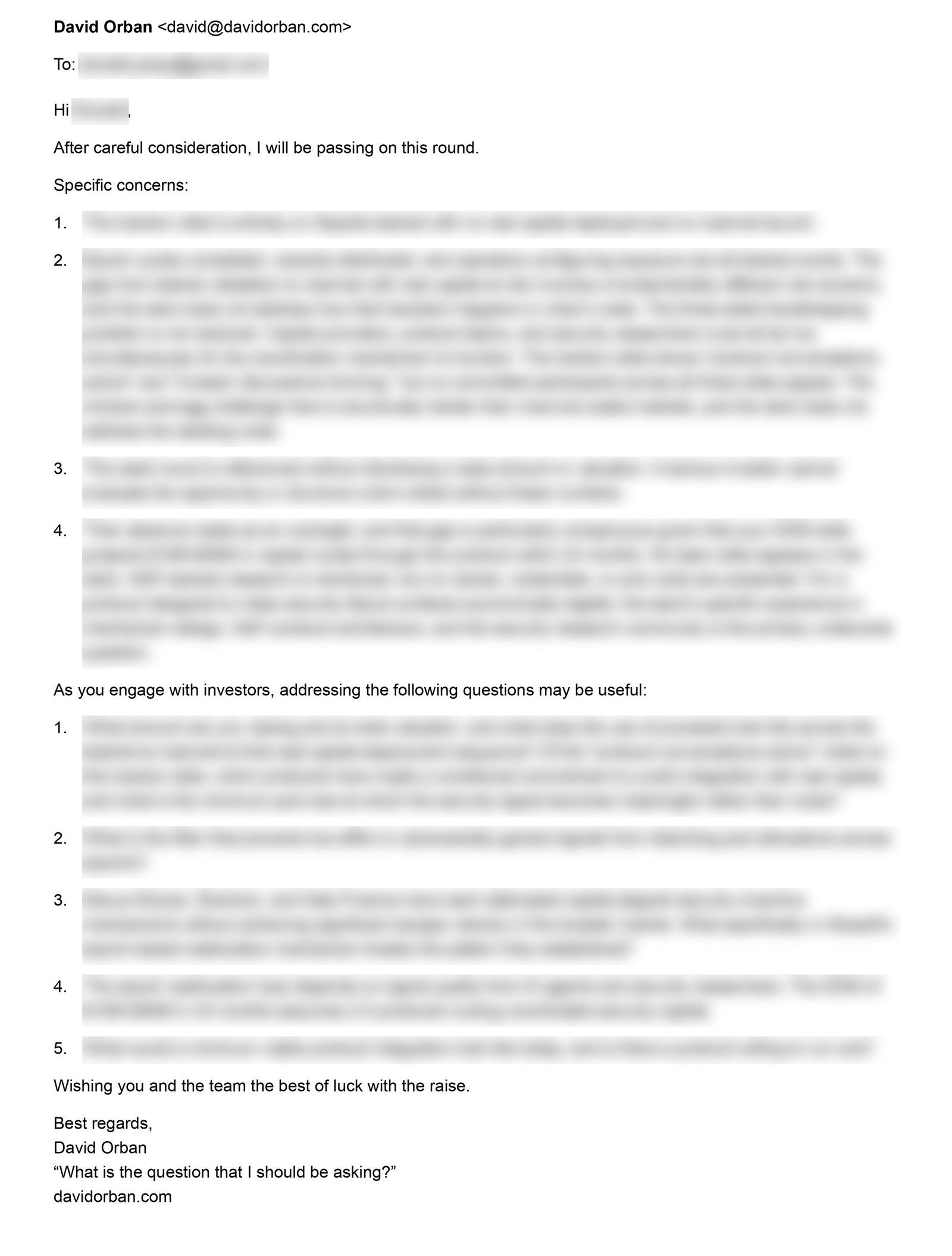
A page of deck-forensic feedback for every pitch, at this volume, is beyond what I could write by hand. I built an AI-assisted pipeline for my deal flow: each deck is read in full, its claims are checked against its own numbers and against public sources, and a draft letter is produced with the concerns and the questions. I review every letter before it goes out, and the decision to pass is mine. One founder replied that he tips his hat “to whoever set up your stack for that processing.” The stack deserves the compliment, and the judgment it amplifies stays human. The point is that the cost of giving founders real feedback has collapsed, and with it the excuse for the one-line pass.
I received a lot of positive feedback, even gratitude. Thirty-eight founders wrote back, and their replies form the most counterintuitive dataset of the whole process. A selection, verbatim:
“Thank you for providing what is easily the most analytical, constructive, and valuable feedback we have received since starting this journey.”
— Peter & Karina, HachikoBox
“Thank you for this. Genuinely. This is the most rigorous and useful piece of investor feedback we have received.”
“The feedback is impressive. That might be the top 1 feedback I ever received from anybody. I tip my hat to whoever set up your stack for that processing.”
“Most passes are one line. You gave me a page of the exact questions I need to answer before the next conversation and that is more useful than a yes with no substance.”
— Naresh Pamula, KYCpro
“A pass with no explanation is the norm. A pass with five precise, well reasoned observations is genuinely useful, and we do not take it for granted.”
— Federico De Rosa, Vibedesk
“A pass with this much rigor behind it is rare, and more useful than most soft yeses.”
— Jonathan Griffit, Co-Founder & CEO, Zooly
Several founders contested specific arguments on the merits, sometimes with good reason, and two were openly angry, one of them at the idea that an AI-assisted process had judged his company. Forty-nine founders did not reply at all. The gratitude above is real, and it is also a selection: the founders who found the letter useful were the likeliest to write back.
Many of those who replied answered the questions point by point, correcting their decks in the process. Several asked whether they could return once the gaps were closed. The lesson for investors is plain: founders absorb a hard decision well when it arrives with respect and substance.
I classified every one of those letters by the concerns it raises. The same types recur. Inflated or unverifiable traction appears in four passes out of five, unsupported projections and undefended moats in two out of three, and irreconcilable revenue numbers in more than half. Ranked by frequency:
Traction inflated or unverifiable. Pipeline, pilots, and logos presented as traction: verbal commitments and LOIs framed as contracts, free trials counted as deployments, target lists shown with customer-tier logos, testnet or simulator results presented as real-world proof.
Projections requiring unexplained step-changes. Forecasts that need a discontinuity the deck never explains: seat counts growing seventy-fold in a year, revenue quadrupling in a quarter, enterprise contracts closed inside the very runway the raise is funding.
Moat asserted, not demonstrated. The incumbents with the strongest incentive and distribution to absorb the product are framed as static or neutral, category-creation claims omit direct competitors, and failed predecessors attempting the same model go unmentioned.
Revenue numbers missing or irreconcilable. No ARR or MRR disclosed despite claimed paying customers, attribution metrics in place of revenue, no churn behind headline growth rates, and claims that contradict the deck’s own supporting tables.
The raise funds the proof, not the scale-up. The core product is still to be built: pre-MVP stacks combining several unvalidated layers, platform deliverables dated a year out, or hardware that exists only in simulation.
Round fundamentals missing or valuation unsupported. No raise amount or valuation stated, terms undisclosed mid-round, valuations benchmarked against revenue-carrying comparables without any revenue.
Team gaps for the specific execution challenge. No team slide, no technical leader on an infrastructure play, solo founders with key hires planned only after the raise, and credentials that do not match the market being sold into.
Regulatory and compliance blind spots. Lending, securities, AML, or data-privacy obligations unaddressed in the exact sectors where procurement teams check them first, and revenue engines gated on approvals not yet applied for.
Deal structure red flags. Donations framed as investment, secondaries routing the money to the founder personally, unclear issuing entities, and options presented as owned assets.
Almost every pass stacks the first two: the traction shown is softer than framed, and the forecast assumes a conversion rate that the current data contradicts. The single most decisive move in writing these emails was reconciling each deck’s headline claims against its own supporting tables. A surprising number of decks fail that test on their own numbers.
The dealflow skews heavily toward the earliest stages. Of the pitches whose stage is identifiable, pre-seed dominates, followed by seed rounds and unlabeled SAFEs.
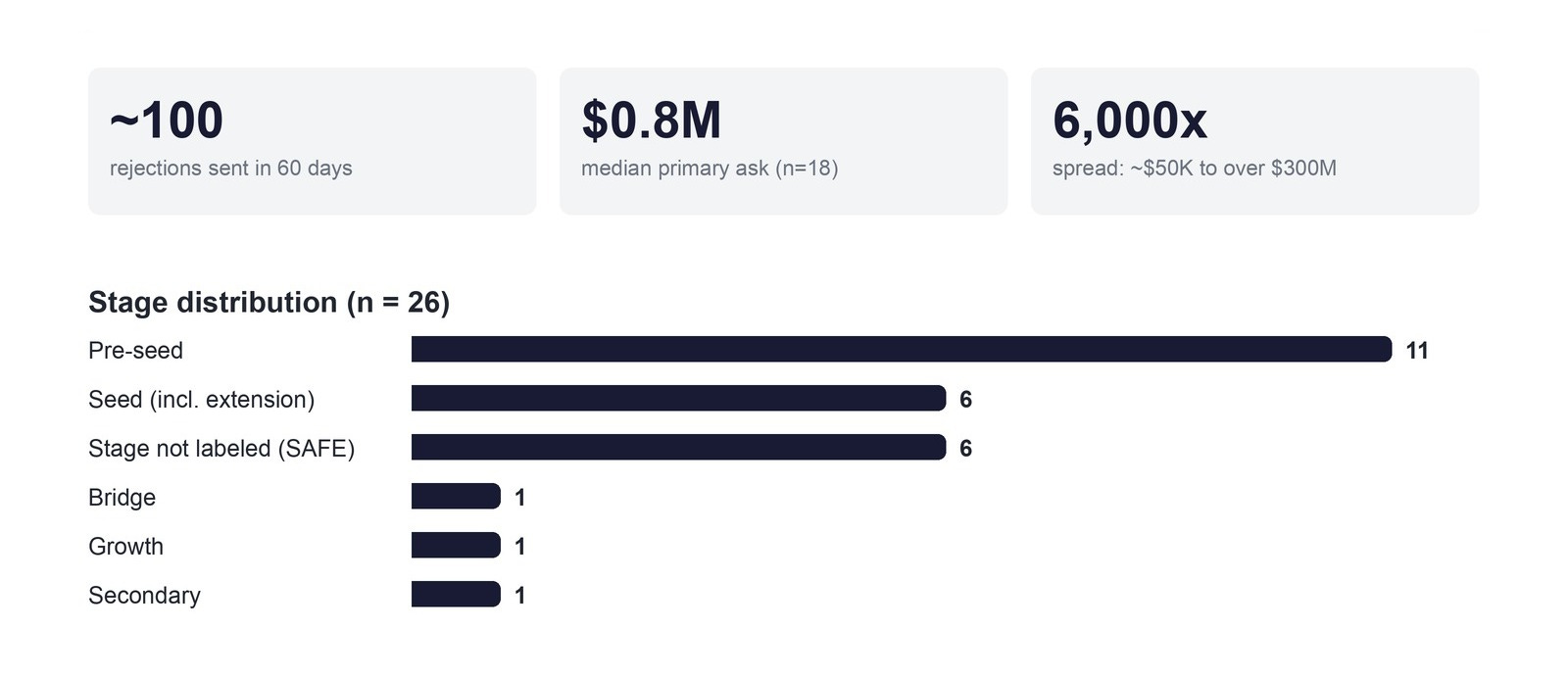
The disclosed asks span four orders of magnitude, from an angel round of about fifty thousand dollars for a messaging-commerce product to a growth round of more than three hundred million dollars for AI hardware. The median primary ask sits around $800K.
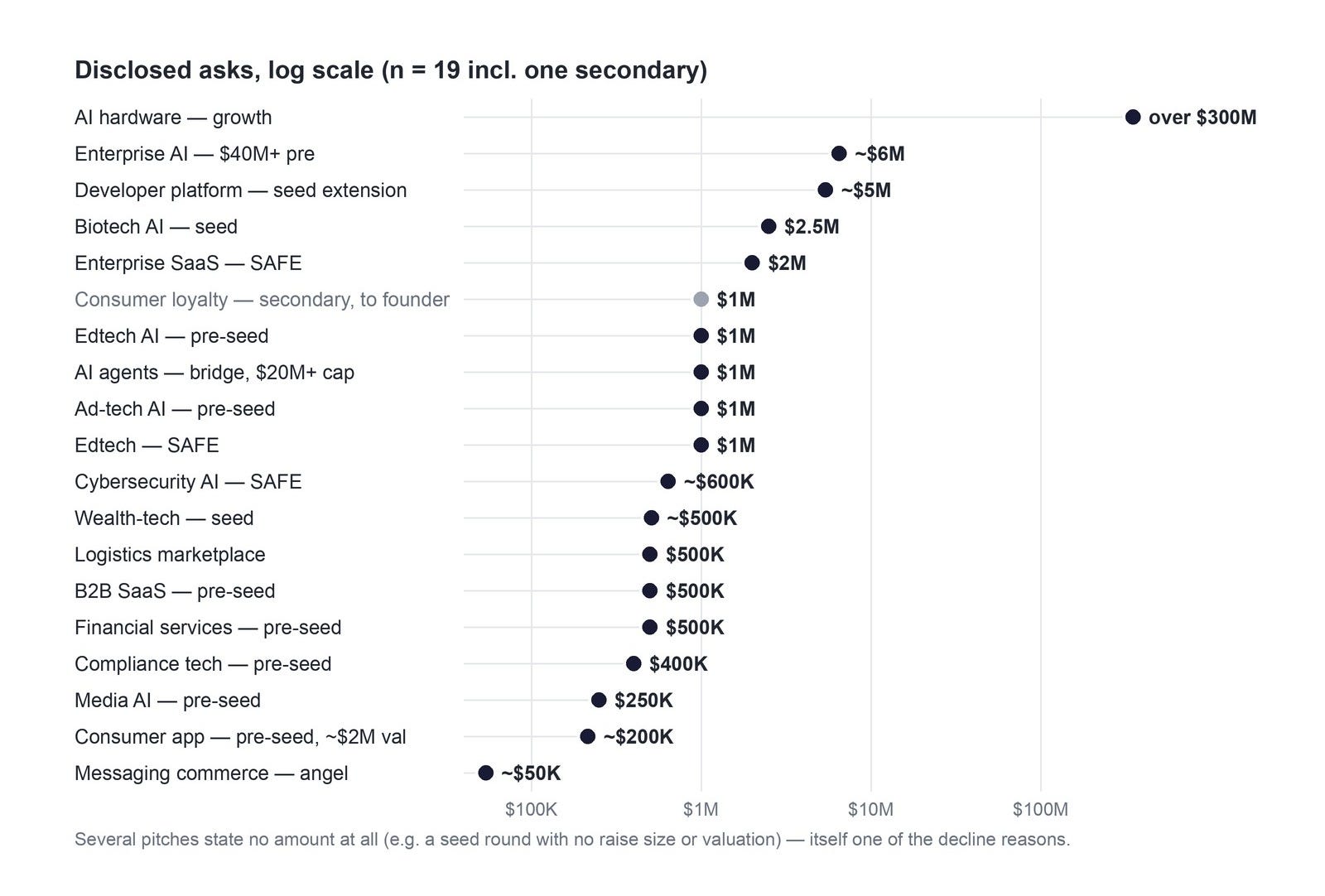
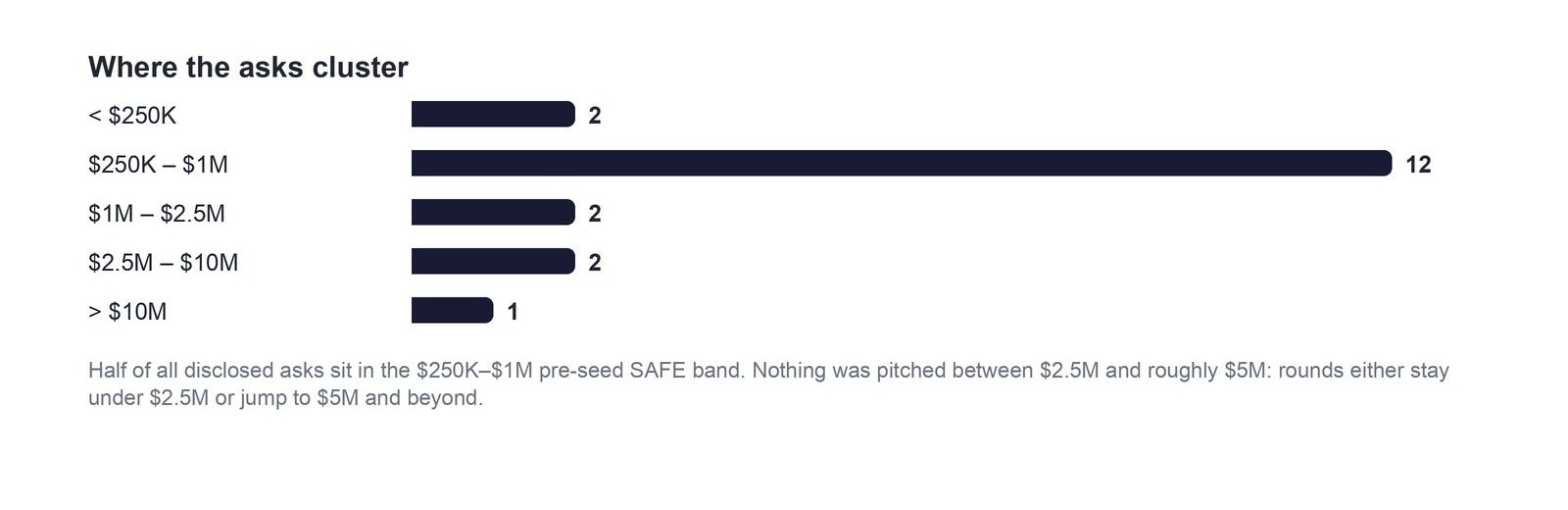
Half of all disclosed asks cluster in the $250K to $1M band, classic pre-seed SAFE territory. Nothing was pitched between $2.5M and $5.4M: rounds either stay under $2.5M or jump past $5M.
Several pitches state no amount at all, and some name no valuation while calling their round conservative. The absence of round fundamentals became a decline reason of its own.
The concerns invert into advice a founder can act on before the next pitch.
Label traction honestly. A signed contract is traction. An LOI, a verbal commitment, a free trial, or a testnet run is pipeline, and investors can tell the difference in one reading. The honest label costs you less than the discovered one.
Make your numbers reconcile. The first thing a serious reader does is check your headline against your own supporting tables. If 150 claimed deployments produce a few thousand dollars in revenue, explain the gap before the investor finds it.
Show the bridge, then the hockey stick. A seventy-fold growth target is a claim about mechanics. Show the conversion rate, the sales capacity, and the pipeline that produce it, or scale the forecast down to what your current data supports.
Name the incumbents and the dead. The platforms with the strongest incentive to absorb your product deserve a slide, and so do the companies that already attempted your model. Omitting them reads as either ignorance or concealment.
State the round on page one. Amount, instrument, valuation or cap, and use of funds. A pitch without these numbers cannot be evaluated, and their absence becomes the first concern in the pass.
Match the team slide to the hard part. Whatever your hardest execution problem is, the deck must show who on the team has done that specific thing. A missing team slide is a missing investment case.
Fund the proof before the scale. If the raise builds the thing that proves demand, say so plainly and price the round for it. Framing a proof-stage raise as a scale-up raise inverts the risk you are asking investors to hold.
Answer the regulator before the customer asks. In lending, health, security, and data products, procurement teams check compliance first. A sentence per jurisdiction beats a roadmap item marked future.
Keep the structure boring. Money should flow into the company through a standard instrument with a clear issuing entity. Anything unusual, a secondary, a donation, an option framed as an asset, needs to be disclosed up front.
My motto has been the same for decades: what is the question that I should be asking? The founders who replied to these rejections understood something that many pitch decks miss. The value of a conversation with an investor lies less in the yes or the no, and more in the quality of the questions it leaves behind. Close to a hundred times in sixty days, the most useful thing I could offer was a clear decision and a page of questions. The founders who treat those questions as a work plan will pitch better rounds, to me or to anyone else.