A claim I should probably have addressed in the book, in the list of fantastic Bitcoin claims in chapter 3: “But Bitcoin is like the early Internet!”
This is usually raised as a counterargument when someone points out Bitcoin is trash or blockchains have no practical use cases:
Ordinary person: This stuff is wack and doesn’t work.
Bitcoin advocate or blockchain salesman: Look, nobody thought the Internet was useful in 1993!
Well, actually they did, of course. The people making this claim often hadn’t been born at the time. And in any case, they’re just saying something they think sounds like an argument at that moment. But it’d be a terrible argument even if people hadn’t thought the Internet was useful then.
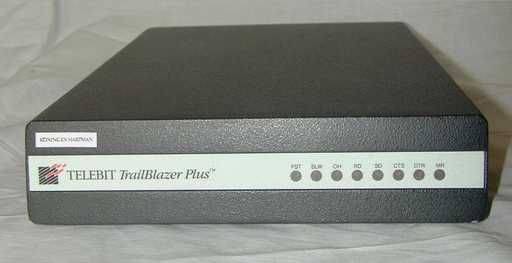
The hottest modem of 1988. You could propagate Usenet posts at nineteen thousand bits per second — over a phone line!
Origins
The earliest example I can find of the comparison is from Erik Voorhees in his article “Bitcoin — The Libertarian Introduction” in Money and State on 13 April 2012:
… this most fascinating thing to happen in the realm of anarcho-capitalist technology since the internet itself.
… Just as few people understood the power of the internet in the early ’90s, the same is true with Bitcoin. And just as with the internet, it is attracting builders and entrepreneurs all over the world.
This was just Voorhees making the comparison — not using it as a counterargument. Voorhees thinks there must have been earlier examples, but that’s the earliest either of us (or our Twitter followers) could find. But it was after this that it took off as a counterargument.
The fallacies
There’s one heck of an assumption here — that this one little technology is obviously comparable to, ooh … let’s just happen to pick the greatest revolution in human communication since the printing press!
It’s a way of assuming your conclusion: “if we compare Bitcoin to THIS HUGE THING, then it must be HUGE too!”
“But, the Internet!” was being used as a counterargument by Bitcoin advocates by 2014. Jeffrey Robinson, in BitCon: The Naked Truth About Bitcoin (US, UK), notes the honour by association, and refutes it thus:
Here’s their syllogism: Bitcoins and the Internet were both, once, newborn technologies that only a few people could believe in. The rest of the world was wrong not to believe in the Internet, which went on to reshape the planet. Therefore, the rest of the world is wrong not to believe in bitcoins which will go on to reshape the planet.
Now here’s my syllogism: Bitcoin and Sea Monkeys were both once fads that amused people for a limited amount of time. Like all fads, Sea Monkeys faded away. Therefore, like all fads, bitcoin will fade away.
What’s wrong with mine? The same thing that’s wrong with theirs. It’s idle comparison that conveniently fits an argument, but has no basis in logic. Just because one thing is criticized or praised, then succeeds or fails, there is no reason to believe that a totally unrelated thing will have the same outcome.
Bitcoin’s economics failure
The Internet, and the various protocols that made up the early Internet, solved its use cases. It was adaptable to all manner of exciting and unforeseen new use cases because it started from a foundation of basically working.
Bitcoin has failed every aspiration that Satoshi Nakamoto had for it. As I note in chapter 2 of the book, Satoshi said in his release notes for Bitcoin 0.1:
The root problem with conventional currency is all the trust that’s required to make it work. The central bank must be trusted not to debase the currency, but the history of fiat currencies is full of breaches of that trust. Banks must be trusted to hold our money and transfer it electronically, but they lend it out in waves of credit bubbles with barely a fraction in reserve. We have to trust them with our privacy, trust them not to let identity thieves drain our accounts. Their massive overhead costs make micropayments impossible.
The price is ridiculously volatile and has had multiple bubbles. The unregulated exchanges — with no central bank backing — front-run their customers, paint the tape to manipulate the price, and are hacked or just steal their users’ funds. Transaction fees, and the unreliability of transactions, make micropayments completely unfeasible.
Decentralisation held out for a surprisingly long time — but, per chapter 5 of the book, proof of work has economies of scale, so will naturally recentralise. Once ASICs came in, there were just a few huge mining pools. And the GHash pool hit 51% of mining in mid-2014.
And it’s failed comprehensively as a peer-to-peer electronic cash system.
About the only aspiration that still works somewhat is immutability — and that means the world noticing that whoops, the blockchain includes illegal pornography!
The dreams have turned out to be hype, and it’s been crippled by the practical limitations of the software and the frankly delusional ideas on economics that are baked into its structure — because all of this is based in crank ideas that don’t work.
Bitcoin’s technological failure
While new technologies are often spoken of in terms of their potential — and Bitcoin was still on its initial upward slope of excitement in 2012, so Voorhees’ passing comparison wasn’t outrageous — it’s 2018 now. You’d expect something practical that works by now.
Why not compare Bitcoin to other networks? “Bitcoin is the Apple eWorld of money!” The original electronic walled garden, that turned out to be too expensive and not very interesting.
Or compare it to other technologies — “Bitcoin is the Ford Pinto gas tank of money!” Which it frequently demonstrates.
Or, for business blockchain — “Blockchain is Nikola Tesla’s Wireless Energy Transfer Towers of money!” Complete vaporware that never worked, but it sounds cool — and keeps getting hyped by people who don’t quite understand what they’re talking about.
To be fair, Bitcoin was a clever and interesting hack — but that’s not the same as a good idea. And taking the very first cardboard and string proof-of-concept and pressing it into production is one of those ideas that never works.
Getting something that you could reasonably call a cryptocurrency — and I’m thinking here of something with the decentralisation that was part of Bitcoin’s basic pitch — without the stupid wastefulness of proof-of-work will require new computer science.
Other cryptocurrencies haven’t worked around the problem. Ethereum’s headed toward the same transaction limit brick wall that Bitcoin hit in mid-2015. Its mining pools are even more centralised than Bitcoin’s, and the attempts to move to proof-of-stake are not going well.
It’s been nine years. Nobody has a practical use case for blockchains proper.
I won’t say it’s philosophically impossible … but at this point, the burden of proof is pretty firmly with the advocates.
Sensible technological comparisons
A sensible comparison would be a technology — software that does one weird and interesting trick, using parts that already existed. My favourite comparisons for Bitcoin and blockchains are BitTorrent, Tor, Git and Freenet.
BitTorrent is very popular peer-to-peer file sharing software. You can put a file up, publicise its hash (“magnet link”) and anyone can download it — even if you go offline, as long as there’s still one complete copy available. Around 2008 and 2009, BitTorrent sharing was about a third of all Internet traffic.
Tor is a network for obscuring your web browsing. Its development was primarily funded by the US government — for their own agents to use, and for people in other countries to get around Internet censorship. Bitcoiners know of Tor as the protocol that darknet markets run over — so you can browse to a hidden black market and buy illicit goods with cryptocurrency. Tor works well and is popular for its use cases.
Git is what computer programmers store their code in. (You may have heard of Github, who supply Git hosting.) It stores the entire history of your program’s development.
Think of it as chains of changes, with cryptographic hashes of each change and of the whole tree of changes — such that the whole thing is tamper-evident, and any disk errors or malicious changes are immediately obvious.
A tamper-evident append-only ledger — that certainly sounds useful, doesn’t it? Developers also routinely sling around entire repositories of the full history.
Git gives you pretty much everything offered by the business case for blockchains. The one thing it doesn’t do is add a ridiculously wasteful proof-of-work mechanism for who’s allowed to add transactions to the blockchain repository. Multiple examples of actually useful software branded “blockchain” turn out to be simplified versions of Git.
Git was released in 2005, four years before Bitcoin — none of the good ideas in blockchains are new, and none of the new ideas have turned out to be much good.
Freenet was an early file-sharing protocol aiming at censorship resistance. Its threat model was the possible use of the Internet as a tool of surveillance and social control — per the original 1999 paper, “the Internet could lead to our lives being monitored, and our thinking manipulated and corrupted to a degree that would go beyond the wildest imaginings of Orwell.”
Convenience versus ideology
Freenet is a vastly more sensible idea than Bitcoin — it’s a simple concept, it had a real-life threat model, etc. And it still failed to gain users, because it sucked to use — it was very slow and, as a Java program in the late 1990s, very resource-intensive. The network itself rapidly filled with illegal content and puerile trash.
It turned out that not many people were into Freenet’s pitch — people want file sharing networks to share files, as easily as possible. Freenet is more technically feasible in 2018, but still has negligible traction.
Even a hugely successful idea like BitTorrent turned out to be sort of annoying and inconvenient in practice. Netflix and Spotify won over BitTorrent because they were more convenient than piracy. Convenience wins, every time.
The Internet itself wasn’t terribly convenient either at first. Dialup, expensive Internet accounts, user-hostile software — and it’s 2018 and you still have to fix your mum’s Internet at Christmas.
But what the Internet had was compelling real-life use cases. People took to email the moment it was invented. (People bought drugs over email a couple of years after it was invented.) The moment Mosaic added pictures to the World Wide Web, people got the idea and wanted that immediately.

(source)
But try telling crypto fans this:
Ordinary person: “Your weird Internet money sucks to use. It’s slow and expensive. I lost my coins by mistake and it can’t be fixed. If I get hacked it can’t be fixed either.”
Bitcoin advocate: “But everyone wants [list of ideological aims held only by weird people]! Everyone I know, anyway.”
So let’s apply the idea of convenience to payment systems. We could do a centralised payments infrastructure, that sells itself on convenience!
We could have consumer protection. And chargebacks — consumers like having chargebacks be possible. It greatly increases their confidence in a payment system.
It could be way cheaper per transaction too.
You know, I think this idea could go somewhere.
Update: from Vint Cerf, who’s no doubt just jealous he didn’t invent anything as cool as Bitcoin:
Simple flowchart: pic.twitter.com/Q2NCyOLBTH
— vinton g cerf (@vgcerf) July 19, 2018