I have a bone to pick with whoever is in charge of health care.
My main complaint at the moment concerns my eye drops, one of a variety of prescription medications I take to compensate for the fact that, as I age, my body is deteriorating like a corn dog in a hot dumpster.
I take multiple prescription medications because I have multiple doctors, more doctors than would legally fit into a standard hotel elevator. These doctors are specialists, which means they focus, laser-like, on one specific part of my body, to the exclusion of the remainder of my body. Like, if I had an appointment to see my kidney doctor, and for some reason I happened to have a hatchet embedded in my skull, it’s possible that the kidney doctor, busily entering kidney-related data into the computer, would not notice it. Or if he did, he’d tell me I should make an appointment to see a hatchet-wound specialist, lest my skull become infected, which could affect my kidneys.
(Note that I have just the one doctor caring for both of my kidneys. American doctors do not specialize in just the left or right kidney. Yet.)
When I was a youth growing up in Armonk, N.Y., 237 years ago, there were no medical specialists, at least not that I was aware of. The Armonk healthcare system consisted of Dr. Mortimer “Monty” Cohn, who had an office in a little house on Main Street (really) with a small waiting room containing a tropical-fish tank and a nurse/receptionist named Mrs. See, who was a nice lady, although she once physically prevented me from running out of the building to avoid getting a tetanus shot. Mrs. See was quicker than she looked.
Dr. Cohn did not specialize. He did everything. He delivered all four of us Barry children, and he tended to all of our subsequent medical needs, including broken bones and tonsilitis, which I got on a weekly basis. I never needed brain surgery, but If I had, I believe Dr. Cohn would have performed the operation himself — possibly in my bedroom, because he made house calls — and he’d have charged my parents $12.50, if he even remembered to give them a bill. Also back then gasoline cost 23 cents a gallon, and when you called a business you always talked to a live human being, and the music we listened to had real melodies and lyrics you could actually understa-
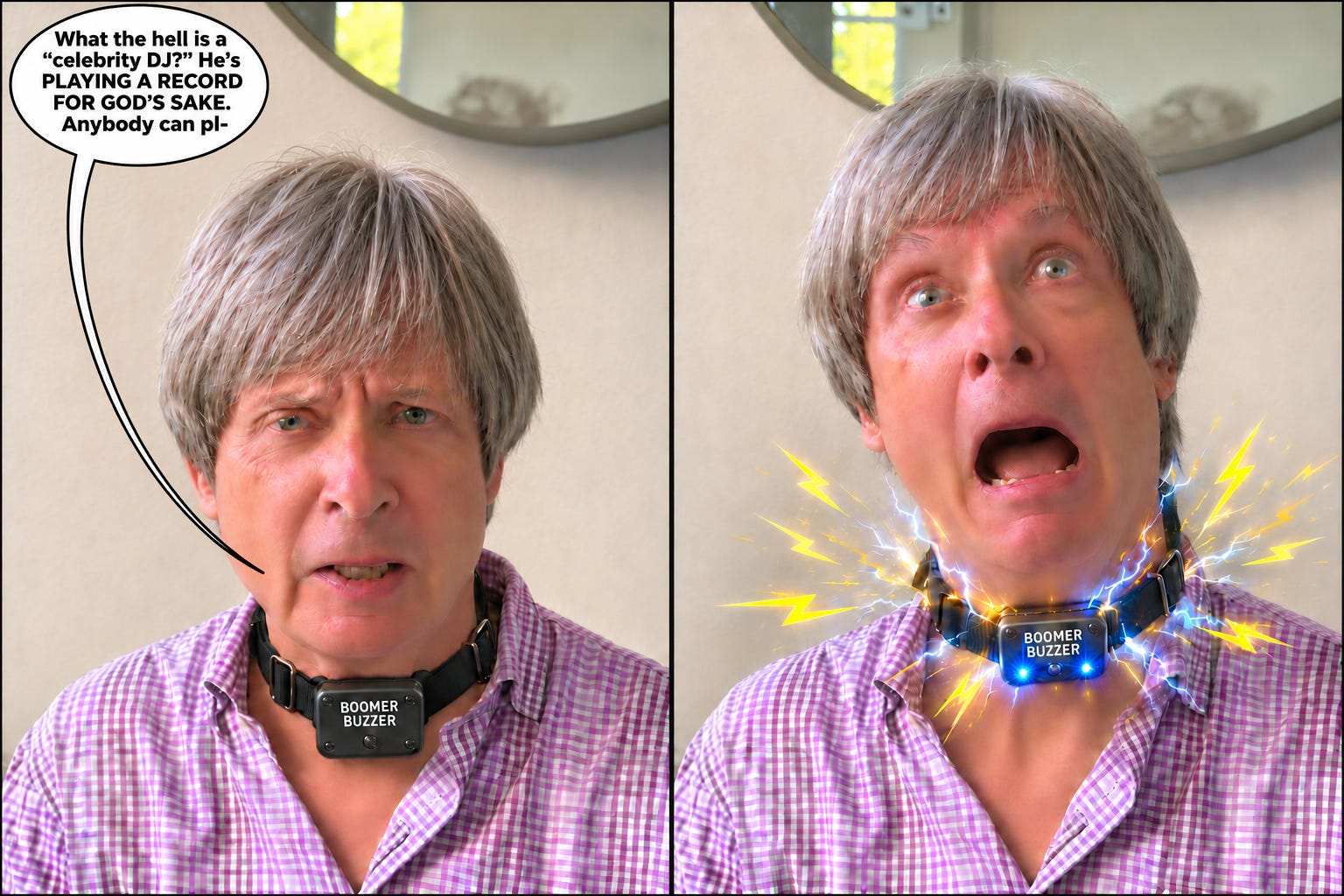
Ouch! Sorry! I was starting to launch into a Boomer nostalgia rant there. Fortunately I was stopped by my Boomer Buzzer™, which is a modified dog-training collar that my children had me fitted for when I turned 75. It uses AI to monitor my speech, and when it detects that I’m starting to spew old-fartisms, it administers a brief and usually survivable 10,000-volt electrical shock. Here it is in action:
But getting back to health care: My point is that it used to involve way fewer doctors. Also there were nowhere near as many “scans,” which are costly but vital diagnostic tools that modern medicine uses to determine whether you, the patient, are going to need more scans (yes).
There are two main kinds of scans:
-- The kind where you lie on a bed in a darkened room and a person you have never met slathers your skin with a warm lubricant, then aggressively and repeatedly wands your body, sometimes getting perilously close to third base, then abruptly leaves the room and never sends you so much as a heart emoji, let alone flowers.
-- The kind where you lie on your back on a hard medical slab and are slid into a claustrophobia-inducing metal tube, and once you’re trapped inside and can’t see what’s happening, large angry men pound on the outside of the tube with baseball bats for 25 solid minutes while a medical technician advises you through headphones to “breathe normally.”
These scans produce images of the inside of your body, which your doctors insist on reviewing with you, which is not unlike showing a diagram of a Toyota Celica transmission to a Labrador retriever, because you did not attend medical school and consequently you have no earthly idea what you’re looking it. My doctors are always showing me inscrutable images like this:

The doctors will point at some random blob of gray amidst all the other gray blobs and say something like, “As you can see, Dave, there’s some turgidity around your anterior postcollateral plectrum valve.” I always nod in a thoughtful manner, but the truth is I can never see what the doctor is talking about. There’s never anything in the image that a layperson would recognize as a clear-cut medical problem, such as:

Don’t get me wrong: I love my doctors, all 53 of them, and I appreciate all that they do for me and my various organs. The healthcare bone I want to pick today, as I stated earlier, involves my eye drops. These were prescribed by my ophthalmologist to reduce the fluid pressure inside my eyes, which is a bit too high, as you can see in this medical scan of my right eyeball:

(Full disclosure: That is not, in fact, a medical scan of my right eyeball. It’s a photograph of Jupiter taken in 1994 from the Hubble Space Telescope. As if you could tell the difference.)
The key ingredient of my eye drops is a chemical compound called “bimatoprost,” which, judging by how much it costs, is a mixture of Dom Perignon, plutonium and unicorn semen. It comes in a small plastic bottle, shown below, from which I’m supposed to squeeze one drop into each eyeball every night at bedtime:
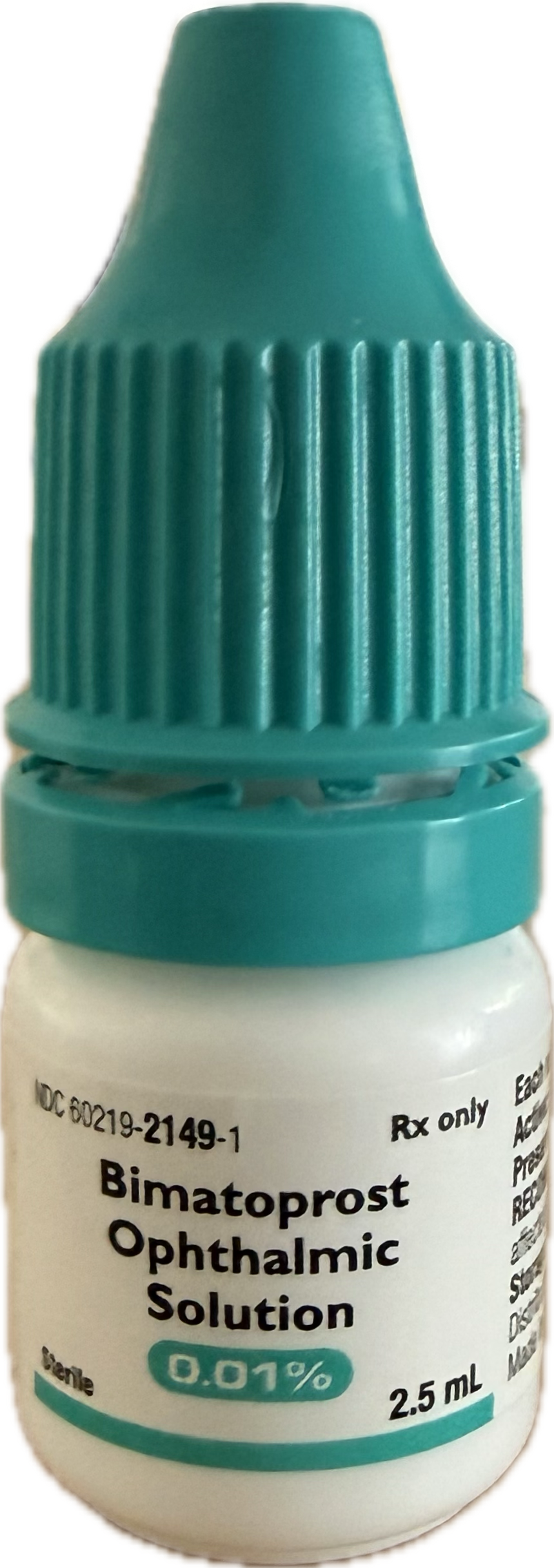
The problem — and now we are getting to the heart of the bone I am picking with our healthcare system — is that when I say the bottle is small, I mean it is tiny. The image above is misleading. To help you visualize the actual size of my bimatoprost bottle, here it is next to a standard raisin and a fruit fly:
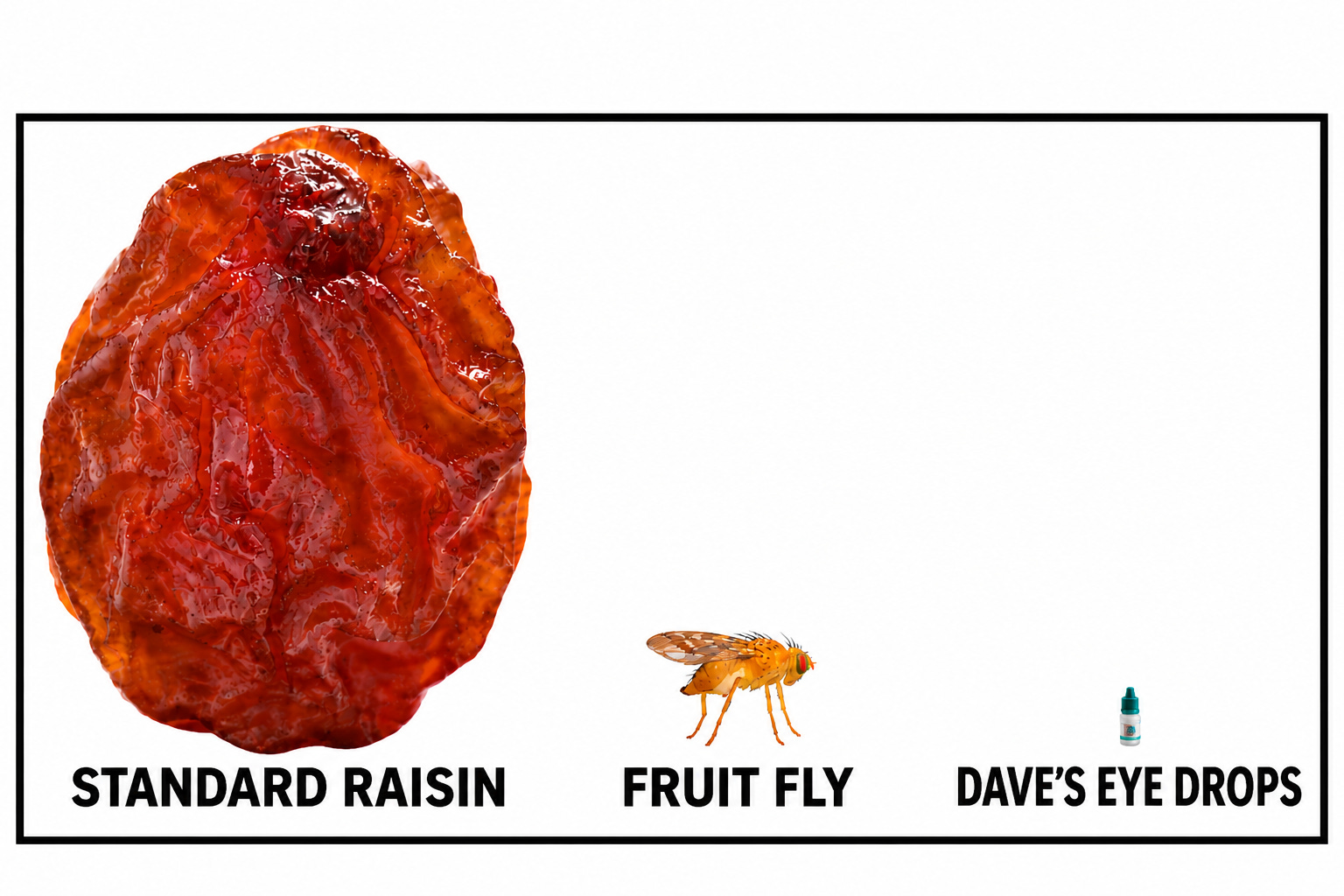
So we’re talking about a teensy bottle. And it isn’t even full when I get it from the drugstore. According to the label, it contains 2.5 ml. of bimatoprost. As an American and a patriot I of course have no idea how much “2.5 ml.” is, but I can tell you what it’s not: It’s not enough to enable me to put one drop into every single one of my eyeballs every single night for an entire month, which is how long this bottle is supposed to last.
So I live in constant fear of exhausting my bimatoprost supply. Every night at bedtime as, with shaking hands, I try to maneuver the virtually invisible squirt tip of this minuscule bottle over my eyes, trying desperately not to blink and thereby cause a king’s ransom in bimatoprost to dribble uselessly onto my eyelid, I wonder: Is this the night I run out? What happens to my eye pressure then? WILL MY EYEBALLS EXPLODE?
So this is my plea to whoever is in charge of the U.S. healthcare system: Please do something about this. Like, for starters, put more bimatoprost in the bottle. Also make the bottle bigger. Also make the writing on the bottle bigger. In fact — I speak for my generation here — make the writing on everything bigger. Especially restaurant menus. Also please make the restaurant bright enough that we can read the menus without having to turn on our iPhone flashlights and hunch over and squint at the entrees like Mole People from the Planet AARP. And for the love of God TURN DOWN THE MUSIC IN THE RESTAURANT BECAUSE WE CAN’T EVEN HEAR OURSELVES THINK, LET ALONE HAVE A CONVERSA-
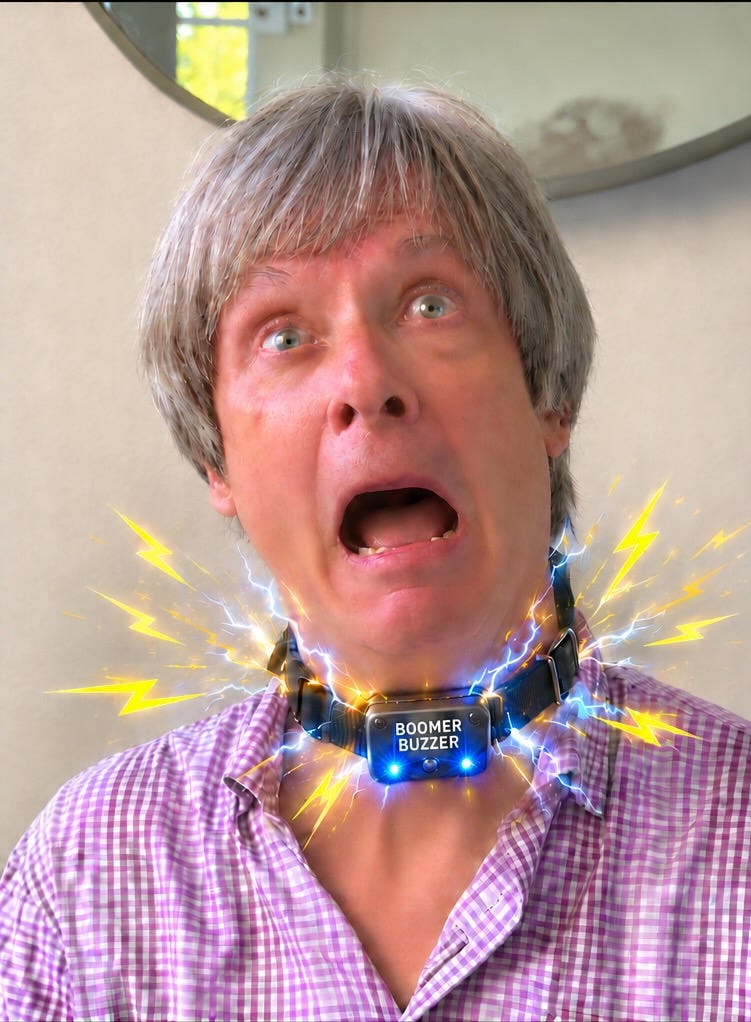
Sorry! I was Booming again. I’ll stop now and open the floor to you wise and witty paying subscribers. Today we have three scientific poll questions.