Here is the answer, before the argument. When the memory shortage ends, almost nothing happens to NVIDIA’s business.
That is not the consensus. The consensus, and Michael Burry’s trade, is that the shortage is the thing holding the AI complex up, so when it breaks, rent falls, NVIDIA’s pricing cracks, and the stock goes with it. In late September, according to Stocktwits, Burry rolled his NVIDIA short into September 2027 puts, which moves his clock toward the 2028 supply wave, exactly where that bet pays. I think it reads the business backwards, and the past two weeks are the clearest evidence yet of why.
Since October 8, the AI trade has sold off hard, on a pile of things at once: a scare over how OpenAI counts its revenue, the gap between the roughly $50 billion it keeps and the $70 billion gross everyone had been quoting, a Chinese memory breakthrough that threatens the shortage, and a hot September CPI print. By October 16, CoreWeave was down about 31% since October 7, the day before the news, and Nebius about 30%; CoreWeave’s cost of default insurance had hit a record, and some of its bonds yielded 16%. NVIDIA fell about 10%. The companies that borrowed to buy the chips took the most damage. The company that sold them took a third of it. A skeptic will say the neoclouds always fall furthest in a selloff, because they are the more volatile stocks, and that is true. What volatility does not explain is the credit signal under the price: a record on CoreWeave’s default insurance and 16% on its bonds. That is about who owes money, not about how jumpy the share price is.
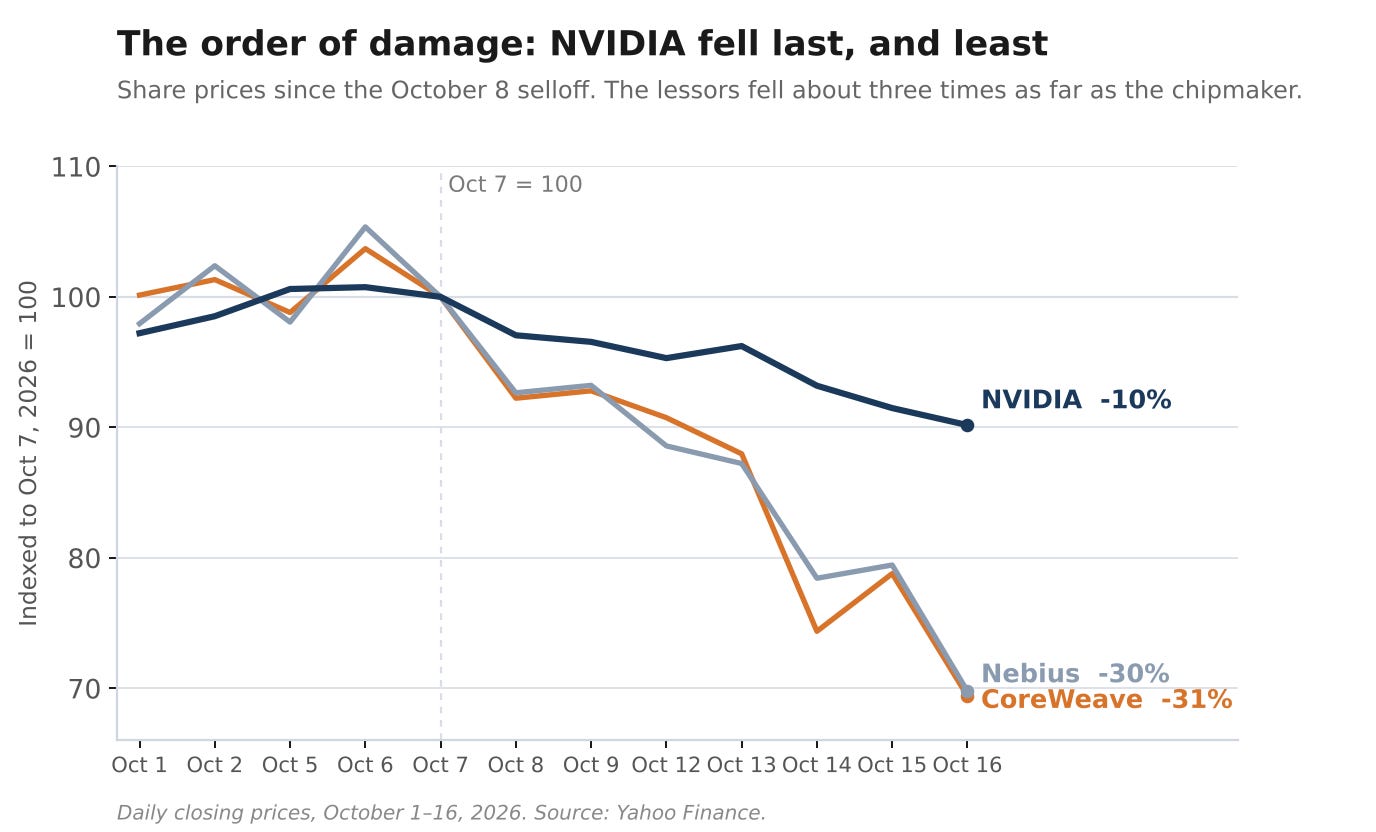
That order is the argument. NVIDIA is the largest weight in the S&P 500, so if you own an index fund you own this question, and almost everyone is answering the wrong version of it. The question is not what happens to rent when the shortage ends. It is whether the people renting the compute can keep paying, and only that reaches NVIDIA.
What happened: Since October 8, the AI trade sold off in order of who holds the financing risk. CoreWeave and Nebius fell about 30%, and CoreWeave’s default insurance hit a record, while NVIDIA fell about 10%. The trigger was a mix, but the order was the point.
Why the shortage ending barely touches NVIDIA: On the deals the neoclouds are signing now, a gigawatt of compute earns its chips back well inside their six-year life. On my conservative method, rent would have to fall by about half before a chip stops covering its cost, and rent is still rising. The building keeps its power, the cloud swaps in NVIDIA’s next chip, and NVIDIA sells every upgrade at a higher price per gigawatt.
The number that matters: Whether the labs keep paying. This week pointed both ways. Anthropic, a lab, said on a self-reported adjusted basis that it is now profitable and makes $1.70 of revenue for every $1 of compute. Meanwhile, the credit market priced a better-than-even chance, over five years, that CoreWeave, the most levered lessor, defaults.
The verdict: A hold, and a buy on weakness, on one condition. Not that the shortage lasts. That the labs keep paying.
What would prove me wrong: A neocloud that cannot refinance, OpenAI’s funding round shrinking, or ACIE revenue falling quarter over quarter. Not a markdown in what the old chips are worth.
Burry’s bet needs rent to fall, and it will. The last time a GPU shortage eased and new chips flooded in, the H100 index fell 44% in five months. It could even end sooner than the memory makers claim: a Chinese maker, CXMT, says it has a denser DRAM design shipping this year, and Acer’s chairman, a large memory buyer, argues the shortage is overstated, with inventories full and Chinese supply capping prices. I take those seriously, though both are about commodity DRAM, not the high-bandwidth memory stacked on the GPU itself, which is the part the accelerators are actually gated on and which all three big makers still call tight through 2027. Either way they do not change my answer, because the mistake is assuming the shortage ending reaches the company that sells the chips. It does not, because the scarce asset is not the chip. It is the building with power running to it.
You can see which asset is scarce in the lead times. A gas turbine ordered today is quoted for around 2031, and large transformers run 3 to 5 years (a16z’s September deck, slide 55); power and permits take years more. The chip inside is the fast part, swapped every few years. Microsoft just showed you how it values the two: on its July call, it extended the depreciation of its data centers from 15 years to 25, while it writes the servers inside them off over as little as 2 to 6. NVIDIA’s own 10-Q guarantees the “land, power, and shell” of its cloud partners’ leases. The building is the long-lived asset; the silicon is the consumable.
The neoclouds mostly rent those buildings rather than own them, which is why CoreWeave carries $16 billion of leases, and why a developer like SB Energy can plan a $50 billion listing on the shells and the power alone (a listing that stalled this month on its OpenAI concentration, which I come back to). The durable asset has its own owners now, separate from the chips inside it and the operators who fill them.
So a neocloud is a bet on a powered site, and the chip is the part it refreshes. That turns Burry’s 1968 computer-leasing analogy inside out twice. First, the old chip does not have to hold its rent, it has to be replaced, and every replacement is a sale for NVIDIA at a rising price: its revenue per gigawatt has gone from $18 billion with Hopper to $25 billion with Blackwell to $40 billion with Rubin, and the roadmap carries it to $60 billion with Feynman. Second, IBM wanted its leasing companies dead, but NVIDIA wants its neoclouds alive: it owns about 10% of CoreWeave, guarantees its partners’ leases, and is building financing platforms to funnel capital to them. The chipmaker is propping up its own lessors, and that cuts two ways. It keeps the neoclouds ordering through a scare that might otherwise freeze them, which helps NVIDIA’s sales hold up while their stocks fall. It is also the circularity the bears point at: NVIDIA now carries about $99 billion of equity stakes in its ecosystem, plus roughly $108 billion of lease guarantees behind its customers, most of it tied to a single OpenAI campus. So the same backing turns against it when a tenant fails, and that bill lands partly on NVIDIA, through the guarantees I size in the next section.
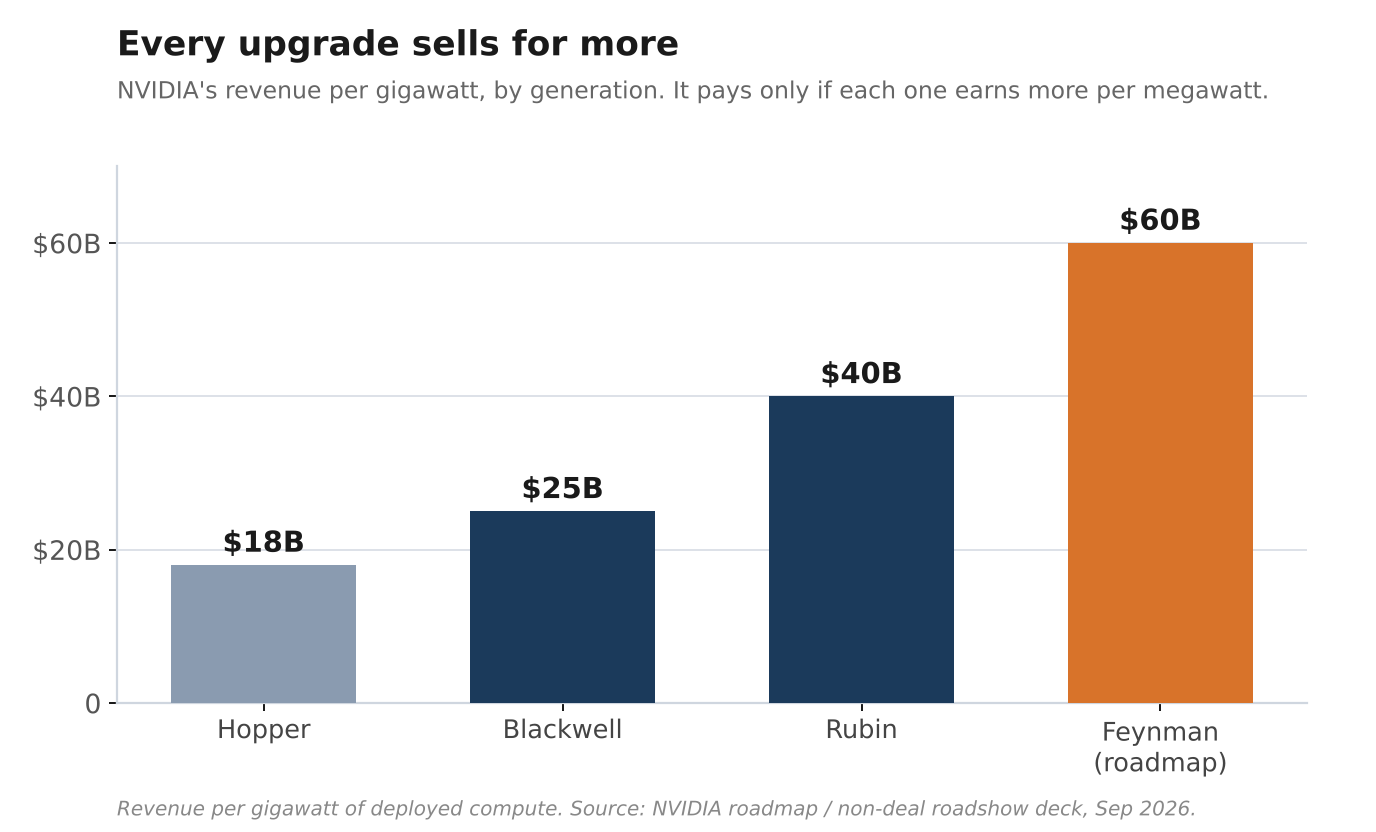
Does the refresh pay? The operators say it does. Nebius and IREN both report their multi-year deals, at $20 to $25 million per megawatt, earning the cost of the chips back in under two years, and three-year pricing is rising, not falling: IREN’s is up about 125% since November 2025, and Nebius raised list prices again on October 1. I will not lean on their two-year statement, because they do not say whether it is before or after the operating costs that take roughly 40% of rent. On the stricter net basis I used for the B200 last time, at 70% utilization, with debt that costs 10%, and after those operating costs, a chip earns its cost back inside its six-year life as long as rent does not fall by more than about half. In my last post’s worst case, half-empty clusters funded at that same 10%, the break comes nearer a third. A 44% drop, the worst the H100 has ever shown, lands inside every case but that one. The cushion is the gap between today’s rent, which is still rising, and that break-even, and it is wide. The shortage ending just removes a scarcity premium the business does not need.
One honest limit on the case I have just made. The reason an old-chip glut cannot dent NVIDIA is that power is the binding constraint, so a scarce megawatt goes to whatever earns the most running inside it, which is always the newest chip. But that argument proves someone sells into the megawatt, not that it is always NVIDIA. For a hyperscaler running its own models, the best chip per watt is increasingly its own silicon: Google’s TPUs, Amazon’s Trainium, the Broadcom accelerator OpenAI has signed for about 10 gigawatts. NVIDIA still takes every neocloud, and most of the frontier work, and the market is growing fast enough that it can lose share and still sell more. This is a slow risk, measured in share of a growing market over years, and rule 3 is where I track it. The risk that moved the stock this month is faster and narrower, and it is the subject of the next section.
NVIDIA keeps selling as long as the clouds keep buying, and the clouds keep buying as long as their customers keep paying. Follow that money and the risk splits in two. The hyperscalers, Microsoft, Amazon and Google, were about $49 billion of NVIDIA’s $89 billion of data-center revenue last quarter, and they back their buying with the strongest balance sheets in the world, even as their free cash flow thins and they lean more on debt and leases to do it. The other $40 billion, what NVIDIA calls ACIE, includes the neoclouds, which borrow to buy the chips and rent them to the labs and to the hyperscalers’ overflow, the extra capacity the giants rent when they run short of their own.
Here is the distinction that matters. The credit risk, the chance a buyer cannot pay its own lenders, sits almost entirely in that ACIE half, with the levered neoclouds. The demand risk, the chance the labs stop paying for compute, reaches both halves, because a lot of what the hyperscalers buy is to serve OpenAI and Anthropic. But the two halves fail differently. If the labs falter, Microsoft does not default, it slows its capex, so the hit reaches NVIDIA later and softer through the $49 billion, and faster and harder through the $40 billion. And for now that softer hit is only hypothetical: the hyperscalers’ own AI revenue is finally showing up, with Azure growing 41% last quarter, which makes the $49 billion sturdier. That is the first reason I am not panicking: the half most exposed to a sudden stop is the smaller half.
The filing points to diversification, not concentration. Five direct customers were 70% of NVIDIA’s receivables as of July, at 22, 14, 13, 11 and 10 percent. Two quarters earlier, in January, three customers were 56%, at 25, 18, and 13 percent. The top name fell from 25% to 22%, and the top three from 56% to 49%. What rose is the number of customers above the 10% line, from three to five, so revenue is spreading across more large buyers, not concentrating into fewer. NVIDIA does not name them; by its own categories, they are the hyperscalers and the manufacturers that assemble the racks, firms like Super Micro and Dell, not the neoclouds, and that last step is my inference, not the filing’s.
Within the riskier half, the two labs that anchor it told opposite stories this week. Anthropic, days before an IPO it is targeting for November, said it is now profitable on an adjusted basis it did not define and that it makes $1.70 of revenue for every $1 it spends on compute, though it did not say whether that compute is only the inference it sells or includes the training it pays for. Either way, it is a gross figure, counting the compute bill and not its people or its research. Treat the profit as an IPO-roadshow number, self-reported, and remember Anthropic has its own $518 billion compute commitment, but the direction is real: a lab that lost more than $8 billion last year is close to paying its own way. OpenAI is the one that still burns, planning $856 billion of compute through 2030 and expecting to burn about $278 billion before it turns cash positive, so it depends on raising money, and in the next couple of weeks it is raising into a market with higher yields and less appetite. The near-term financing risk sits with OpenAI, not Anthropic.
You could watch that risk move this week in a place that touches NVIDIA directly. SB Energy, the SoftBank developer building OpenAI’s Ohio campus, the one NVIDIA both guarantees and has put $3 billion into, stalled its roughly $50 billion listing when investors balked at the valuation and at how heavily it leans on OpenAI. That is the who-pays question showing up in a financing attached to NVIDIA’s single largest guarantee, and I am putting it in the body because it is a genuine mark against me: the funding market is starting to price the concentration I say is the real risk.
That guarantee is the balance-sheet form of this whole section. NVIDIA's 10-Q puts its maximum guarantee exposure at about $108 billion, in two very different pieces. The small piece is $3.5 billion standing behind its neocloud partners' leases. The large piece is $105 billion of credit support on the SB Energy buildout for OpenAI's roughly 4.25-gigawatt Ohio campus, and it pays out precisely when OpenAI cannot. Read the structure before the headline number. The $105 billion is a cap over the life of the leases, not a cheque written now, and not the amount at risk today, which is close to zero because almost nothing is built yet. It rises as each building comes online, the first in fiscal 2029, each one adding its own guaranteed slice, and falls again as each 20-year lease is paid down. It covers only defined portions of the lease and power payments, not the full cost of the site, and it lapses entirely if OpenAI reaches an investment-grade credit rating. NVIDIA writes a cheque only if OpenAI cannot pay. In exchange, the site runs NVIDIA chips exclusively. So $105 billion is the most this could ever cost across twenty years, not a bill that exists now. That is the point of the whole section, in NVIDIA's own numbers: if OpenAI fails, most of the damage reaches NVIDIA slowly, through a thinner order book, but this is the piece that would reach it directly, as cash it has guaranteed rather than a sale it no longer makes. It is the largest signed number in my ledger, and it is why rule 9 sits where it does. There is one more exposure, and it is the closest to Burry's actual bet: NVIDIA also backs the chips' residual value, up to 25% of a project. I sized it in my last post at up to $125 billion if fully used, none of it signed yet, and NVIDIA is shopping that risk to insurers.
The stress showed up in credit, not rent, and that gap is the tell. Rent is what you pay to use a GPU, and it is still rising because demand is strong. Credit is what these companies pay to borrow, and that is what cracked. CoreWeave’s five-year default insurance hit a record, around 1,200 basis points, which the market mechanically converts to a better-than-even chance it defaults within five years. Read that number for what it is. It is a market-implied, risk-neutral probability that bakes in a fear premium, so it runs well above the real-world odds, and it is cumulative over five years rather than a call on next quarter. It is a loud warning that still sits years from an actual default.
Its Q2 10-Q tells you what the 16% bond yield is and is not. CoreWeave carries about $36 billion of debt, plus another $16 billion of data-center leases, which are rent on buildings it does not own, not borrowed money. By my weighting of the per-facility rates the filing discloses, the debt blends to an effective rate near 8%. The 16% is the market yield on its unsecured senior notes, the slice with no collateral behind it, about $10 billion of face issued around 10% and now trading down, so CoreWeave still pays the old coupon and the 16% is only what a new buyer collects. The rest is cheaper and better secured: about $14 billion of term loans pledged against named customer contracts, including the investment-grade, Meta-backed, Blackstone-anchored facility near 6%; about $5 billion of equipment financing; and about $7 billion of convertibles at 2%. The $2.6 billion DDTL 5.5 my last post covered comes on top of those June figures. So the viral number is the most expensive, least protected slice, the one with no collateral behind it, quoted as if it were the whole company, whose real cost of debt is nearer 8%. And the near-term refinancing pressure is not even in those unsecured notes, which run to 2030 and beyond. It is in the secured term loans, the DDTLs, which amortize at about $6 billion over the next year.
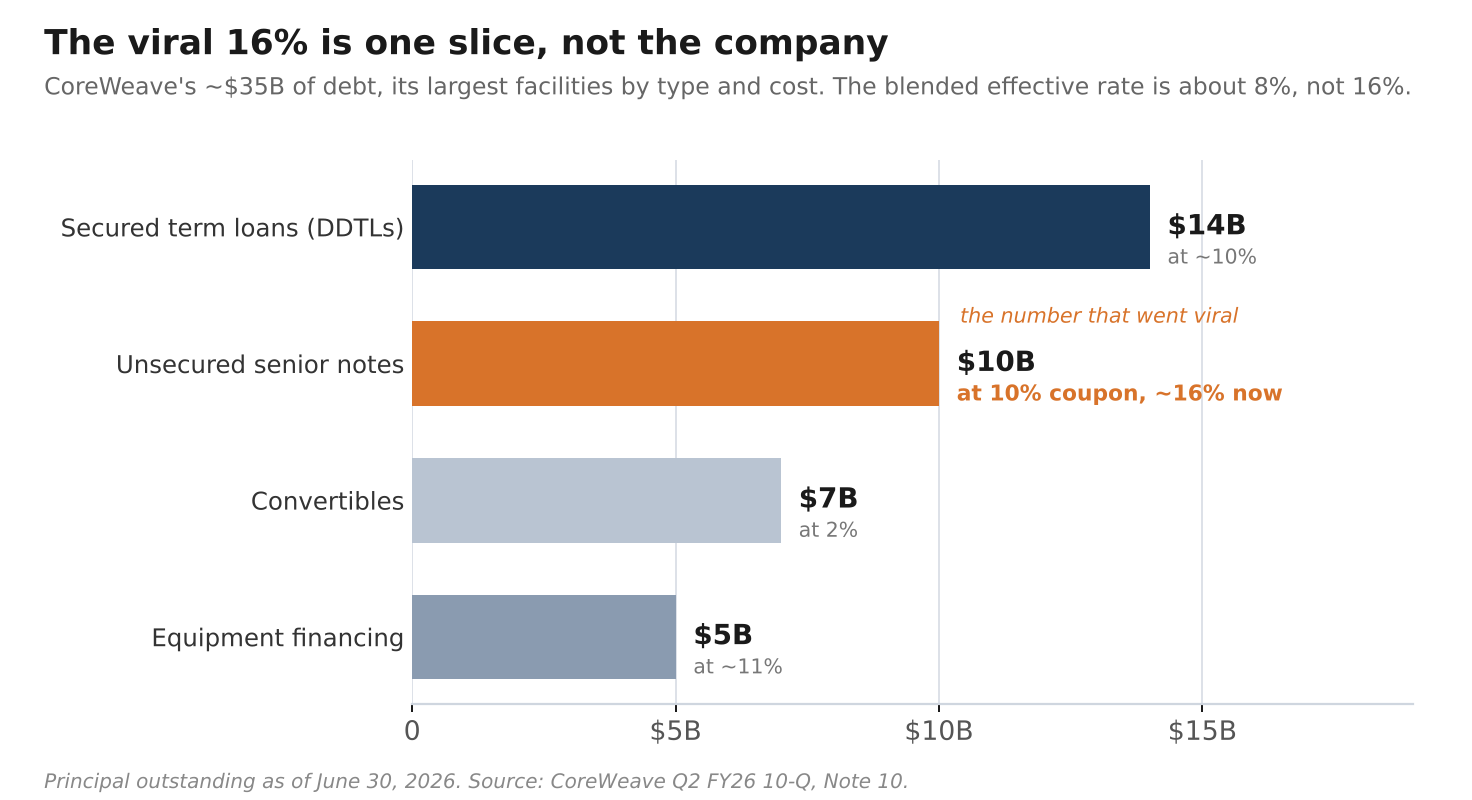
But do not wave the 16% away as a quote on bonds CoreWeave already sold. It pays something like it on the next dollar. A company this far from funding itself has to keep raising, and the price of new money sets what it can afford to build next, which is the line that runs straight back to NVIDIA’s order book. That is also why this has not tripped my financing rule yet: the rule asks whether a raise fails to clear or whether new funding costs more than the contract it funds, and so far CoreWeave’s secured deals are still clearing. A high CDS is the price of insurance, not a failed refinancing. Jensen Huang said on October 15 that CoreWeave’s capital costs are falling and that NVIDIA, which owns about 10% of it, would not bail it out; the stock bounced 6% that day and fell another 12% the next. The reassurance did not hold. This is the opposite of 2006, when the risk hid behind safe ratings. Here it is priced in daylight, and for now it is a cost of capital, not a solvency event.
This is the thing to watch, and it is why the number is credit, not rent. My last post already found the credit market “charging for the risk” rather than hiding it; this is that, louder. A neocloud that cannot roll its debt stops buying chips long before any rent index moves, so the warning comes from CoreWeave’s bonds, the size and price of OpenAI’s next raise, and ACIE revenue, which prints in November. Not from the Silicon Data tape.
Stand on one campus in Ohio and look at who NVIDIA is on it. It owns a stake in SB Energy, the developer building the site. It guarantees OpenAI’s lease on it, up to $105 billion. And the site runs NVIDIA chips exclusively. Investor, guarantor, and sole supplier, three hats on one building. It is not only Ohio: NVIDIA owns about 10% of CoreWeave, holds the $99 billion of ecosystem stakes I mentioned, and has announced $500 billion of financing platforms to move capital to the people who buy its chips. The chipmaker is helping fund its own demand.
There is a precedent for this, and it is not a happy one. In 1999, Lucent was one of the most widely held stocks in America, and to win orders it lent its own customers the money to buy its gear. The revenue looked spectacular. Then the telecom bubble burst; the customers it had financed could not pay, and Lucent lost the loans and the sales in the same breath. The stock fell about 99%. Vendor financing is wonderful on the way up and radioactive on the way down, because when it turns it hits you twice.
So is NVIDIA Lucent? The honest answer rests on one thing, and it is the same thing this whole post rests on. If the end demand is real, the circle is vertical integration, and a strength: NVIDIA has taken a stake in every layer above its chips, the labs that build the models and the clouds that run them, and got there first. If the demand was financed into being, the circle is Lucent, and the day it turns, NVIDIA takes an equity write-down, a guarantee call, and a collapse in orders in the same quarter.
Here is where 1999 and 2026 part ways. Lucent’s customers had almost no paying users. The internet had not learned to make money, so the fiber they overbuilt sat dark for a decade. NVIDIA’s customers are the opposite: the labs already earn tens of billions from people and enterprises who pay, and the product is not a promise; it is woven into software and security firms which sell today, from ServiceNow to the cyber stack. That is not proof the whole build pays off at these prices, and I put the numbers on it in the next section. It is the one thing Lucent never had, real money arriving at the far end of the circle.
So the circularity is not a separate risk to file next to the others. It is the one I have already named, now concentrated on NVIDIA itself, and the demand that would make it benign is visibly here. The circle plainly exists. Whether it turns comes down to whether the labs keep paying, which is where this was always heading.
More likely than not, yes, and the reason sits one layer above the labs themselves. AI demand is real and still compounding: Anthropic more than tripled its quarterly revenue in three quarters, from $4.7 billion to $16.8 billion, a roughly $67 billion annual pace, and turned the corner on its unit economics (FT), while OpenAI is running at about $50 billion net and projecting $70 billion by year-end. And the labs do not have to self-fund to keep paying. They have backers with every reason to keep them alive: Microsoft behind OpenAI, Google and Amazon behind Anthropic, though none is obligated to, and Microsoft has spent this year stepping back, ending Azure exclusivity in April and dropping its revenue share. The incentive is there; the backstop is softer than it looks.
So the thing that actually ends this is a funding failure, not a collapse in demand. OpenAI has to keep raising, into a market that just repriced. If a round shrinks or a lender balks, it cannot pay for the compute it has already contracted, even while demand for its products keeps growing. The squeeze is financial, and it arrives long before anyone stops wanting what that compute produces. That is why I watch the credit tape and not the rent, and why the two numbers on my dashboard are CoreWeave's next raise and OpenAI's.
So: when the memory shortage ends, what happens to NVIDIA, and is it a hold or a buy?
When the shortage ends, almost nothing happens to the business. Rent on old chips falls, the neocloud swaps in NVIDIA's next chip, which earns its cost back well inside its six-year life even after operating costs, and NVIDIA books the sale at a higher price per gigawatt. The scarcity premium comes out of the multiple, and it is happening in real time: NVIDIA trades at about 14x forward earnings, down from above 30x a year ago. That is the price of a business the market expects to slow, not one it expects to break. If the market expected a lab to fail and take a quarter of next year's revenue, NVIDIA would trade where Micron does, near 6x. It does not, even after this week. The sharper precedent is not Lucent but Cisco. Cisco had the real end demand NVIDIA has, and its business came through the dot-com crash intact. Its stock still took more than twenty years to reclaim its 2000 high, because it had traded above 100x earnings. That is the risk of overpaying for a real winner, and it is the one place NVIDIA looks safe, at 14x. And here is the number for Burry: his puts are on the stock, so they pay through the multiple, and for them to pay, the market has to put NVIDIA under 10x, close to 30% below today's price. I think it takes a lab running out of money, or a broad rate-driven de-rating that would show up in the 10-year first, to get it there. That second path is worth watching, but it is not flashing red: the 10-year is already above 5%, and NVIDIA is still at 14x, so the rate channel has pushed all year without taking it anywhere near Micron. The lab side is the one that is only now starting to be priced.
So NVIDIA is a hold, and a buy on weakness, on one condition. Not that the shortage lasts. That the labs keep paying. The shortage ending does not make it a sell; it makes it cheaper for the same earnings. A lab that stops paying is the only thing that makes it a sell, and that is the number I am watching, in CoreWeave’s bonds and OpenAI’s next raise, not in the rent on a used H100. This week cut both ways, and I weight it for NVIDIA on the side of demand: one lab moved toward profitability while rent kept rising, and the credit stress, so far, has stayed a financing problem and not a solvency one. The demand case held while the price fell, so I will take that trade, with my eyes on the credit tape, and keep some powder dry.
One caveat I owe you, because it is the bear’s best card. Gartner said this week that 80% of neoclouds will “cease independent operations” by 2030 and that $3.5 trillion of AI infrastructure is exposed to write-down. The number is real; read the phrase. It was never about which neocloud survives, because the scarce thing is the powered building, and the building stays. When a neocloud fails, a stronger operator or a hyperscaler buys its buildings and its contracts, so 80% consolidating into 20% means the survivors own more powered sites, and buy more NVIDIA chips, than the failures did apart. The transition is not free: a neocloud in a forced sale is not buying new Rubin while it is carved up; its assets change hands at a markdown, and its contracts can sit in dispute, so a wave of failures could stall NVIDIA’s order book for a stretch even if it does not shrink the end demand. The write-down lands on a neocloud's equity and debt, mostly not NVIDIA's, which is why the lessors fell about three times as far as the chipmaker this week.
One honest qualifier, because a neocloud failure does reach NVIDIA directly, not only through a slower order book. The building stays, but NVIDIA often stands behind the lease on it: that is the $3.5 billion of land-power-shell guarantees for its neocloud partners, the smaller bucket I sized earlier, and the channel rule 9 tracks when a lessor fails. Against $89 billion of quarterly data-center revenue it is manageable, a gross cap NVIDIA pays against only if a partner defaults, but it is not zero. It is still far lighter and more temporary than the hit that lands on the failed neocloud's own equity and debt, for the company that goes on selling chips into whoever owns the building next. That last step is my read of what consolidation means, not Gartner's.
Rules 1, 2, 4 and 5 carry forward from my August 28 post word for word; rule 3 I widened this month to cover inference as well as training. Rules 6 to 9 are from October 5. Rules 10 and 11 are new. I grade each as written. Rule 6 I now read alongside Rule 8, since a falling B200 index can just mean the next chip arrived rather than demand weakening.
Non-GAAP gross margin below 72% for two consecutive quarters during the Vera Rubin ramp. Set Jun 2026. Action: exit review. Not triggered. Q2 75.0%; Q4 guided 71 to 72%. One quarter below 72% is guided, so Q1 FY28 is the test.
ACIE/Hyperscale split reversing: Hyperscale reaccelerates while ACIE decelerates. Set Jun 2026. Action: exit review. Not triggered. ACIE +25% q/q vs Hyperscale +13%.
Any hyperscaler framing custom silicon as primary AI training or inference compute on two consecutive calls, combined with a sequential decline in Hyperscale revenue. Set Jun 2026, widened to inference Oct 2026, which makes it easier to trigger, not harder. Action: exit review. Not triggered, but the first half is closer than it was. Microsoft called its Maia 300 the “primary AI inference system” for its own products at the October OCP summit, and Google has pushed its TPU 8i for inference since April. That is one disclosure each, not the two consecutive calls the rule names, and it still needs the second half, a sequential decline in Hyperscale revenue, which keeps climbing.
Vera CPU shipments delayed beyond Q1 FY2028. Set Jun 2026. Action: exit review. Not triggered. Shipping to lead partners.
FY2028 revenue guide walked back below 60% growth on any subsequent call. Set Aug 28, 2026. Action: exit review. Not triggered. Guided 70%.
GPU rent: the Silicon Data B200 index for three consecutive monthly readings before September 2027, below $3.93 for a review and below $2.85 for an exit. Set Oct 5, 2026. Not triggered. About $5.86 at the latest reading I have, October 2, still well above both thresholds. Read alongside rule 8.
Memory supply: Micron, Samsung or SK hynix says memory supply and demand balance in calendar 2027. Set Oct 5, 2026. Action: exit review. Not triggered. All three still say tighter in 2027, and the two counter-signals, CXMT’s denser DRAM and Acer’s claim that inventories are full, are about commodity DRAM, not the HBM the GPUs actually need.
Lessor stress reaches the order book: ACIE revenue declines quarter over quarter. Set Oct 5, 2026. Action: exit review. Not triggered. +25% q/q in Q2; the Q3 print lands in November.
Guarantees: NVIDIA records any payment or loss under its AI cloud, land/power/shell, SB Energy or residual-value support arrangements. Set Oct 5, 2026. Action: review and resize. Not triggered, though SB Energy’s stalled IPO sits behind the largest of them.
Neocloud financing: a CoreWeave or peer neocloud refinancing that fails to clear, or a neocloud publicly guiding that its new funding costs more than its contract spread. Set Oct 18, 2026. Action: review. Not triggered. CoreWeave’s secured debt is still clearing; the stress is in the unsecured bonds. I set no yield threshold, because a neocloud that signs at a high rate has presumably modelled that the rental still covers it, so the signal is whether the deals clear at all.
Lab funding: OpenAI’s next primary raise closes below about $20 billion of the roughly $30 billion it is seeking, or at a valuation under its last round. Set Oct 18, 2026. Action: review. Not triggered. The raise is in progress into a market with higher yields and less appetite than when it began.
Burry rolled his puts toward the shortage ending, and he may get his crash in the shortage. He will not get it from the shortage, because the shortage was never the business’s risk. His puts pay only if the multiple falls under 10x, and that takes a lab running out of money, or a broad rate-driven de-rating that would show in the 10-year first. This week the market started pricing that risk in the one place it shows up first: not the rent on the oldest chip, but the cost of insuring the most levered lessor’s debt, which widened on the lab-funding worry and the rise in rates together. So watch the credit tape. If CoreWeave’s next raise fails to clear, or OpenAI’s round comes back smaller, the thesis is under stress, and I will say so here. If they clear, NVIDIA is a 14x business the market has already de-rated and still refuses to break, and I will keep buying the weakness. That is the trade.
If you are watching one number to tell me I am wrong, I would watch CoreWeave’s next raise. What is yours?
Disclosure: I hold a position in NVIDIA. This material is for informational purposes only and is not investment advice. Sources: NVIDIA Q2 FY27 10-Q and earnings call, Aug 26, 2026; NVIDIA Non-Deal Roadshow deck, Sep 2026 (p.11); NVIDIA at Goldman Sachs, Sep 10; Microsoft Q4 FY26 call, Jul 29 (Azure +41%), and FY26 10-K; Google TPU 8i announcement, Cloud Next, Apr 2026; Microsoft Maia 300 disclosure, OCP Global Summit, Oct 2026; OpenAI–Broadcom 10-gigawatt accelerator collaboration, Oct 2025; NVIDIA blog post, Aug 10, 2026; Nebius Q2 call and Reuters coverage, Aug 12; IREN FY26 call, Aug 27; CoreWeave Q2 FY26 10-Q (debt, Note 10), DDTL 4.0 release (Mar 31, 2026), CDS and bond pricing via ICE/LSEG/Bloomberg/Reuters, Oct 2026; Jensen Huang remarks, Oct 15; Silicon Data indices; Gartner, Oct 14; OpenAI projections via FT, Sep 21; Anthropic Q3 via FT/Reuters, Oct 14–16; a16z State of Markets, Sep 2026 (slide 55); CXMT and Acer memory reports, Oct 2026; SB Energy IPO via Reuters/FT, Oct 2026; Stocktwits/Benzinga on Burry, late Sep; LSEG valuation data, Oct 16, 2026.