Note to readers: I’ve been writing this piece on and off for a couple of years. It’s longer than my usual posts, and gets into some detail about shoplifting and the retail industry, but I hope you’ll agree that it’s worth it. If you like it, post it or send it to a friend! -Danny
Many decades ago, humans developed a process by which they could go into a store, pick an item off the shelf, and pay for it at the checkout counter. A few years ago, we lost it. Now you ring a buzzer, wait for an overworked employee to unlock an item that costs $5.99, and navigate the emotional complications of feeling like both a suspected criminal and an entitled ass.
The late Soviet Union was damned by the iconic image of people waiting in endless lines for scarce consumer goods. When we look back at the dying days of America, perhaps we’ll think of waiting in dots, surrounded by plentiful products locked away because our bosses fear and loathe us so much they have forgotten how selling things works.
Why has our society gone backward in this small but really annoying way? Surely there must have been an epidemic of shoplifting? No, there really wasn’t. Instead, the great lotion lockup was a corporate moral panic, which has been a disaster for their profits and for the rest of us a degrading enshittification of running basic errands.
It’s far from the most important way our lives have gotten worse, but it might be the most pointless – which makes it useful for understanding so much else about a moment in history defined by breathtaking self-sabotage.
What’s happened to going to the Walgreens or Target is a store-sized version of what’s happened to living in America. It’s the experience of being subject to the decisions of a ruling class that responds to every challenge with authoritarianism, greed, and the same levels of poise and wisdom as an inbred Pomeranian.
This story, like many others in the larger narrative of American derangement, begins with the panicked reactions to the summer of COVID and Black Lives Matter.
In the early years of this decade, retail chains announced the closure a number of urban store locations. This shouldn’t have been a surprise given that the pandemic had accelerated the shift to online shopping — and maybe CVS and Rite Aid had overreached by seemingly having stores on every other block.
But industry executives and right wing media favored a third explanation: stores were on the run from rampant crime. When Walgreens announced the closure of five stores in San Francisco, a company spokesperson blamed “organized retail crime,” helping to galvanize the recall of progressive District Attorney Chesa Boudin, and fueling a pro-policing backlash around the country.
You probably remember headlines about brazen smash-and-grabs at high end retail stores, and helpless urban business owners forced to close up shop in the face of widespread theft and perhaps civilizational collapse. What was happening, we were told, was not just a few incidents being endlessly passed around social media, or a temporary spasm of pent up pandemic aggression, but the work of dangerous new criminal syndicates.
Shoplifting no longer fits its traditional mold as a nonviolent crime perpetrated mostly by teens or substance-abusing adults. Nearly two-thirds of the retailers surveyed by the National Retail Federation said that violence associated with store thefts has risen, led by organized gangs that resell the goods they steal.
That’s from a 2022 New York Post article headlined “Shoplifting is soaring across the US – and will only get worse.” In fact it wasn’t, and it didn’t, but as most of us stayed home and doomscrolled, it certainly seemed to be.
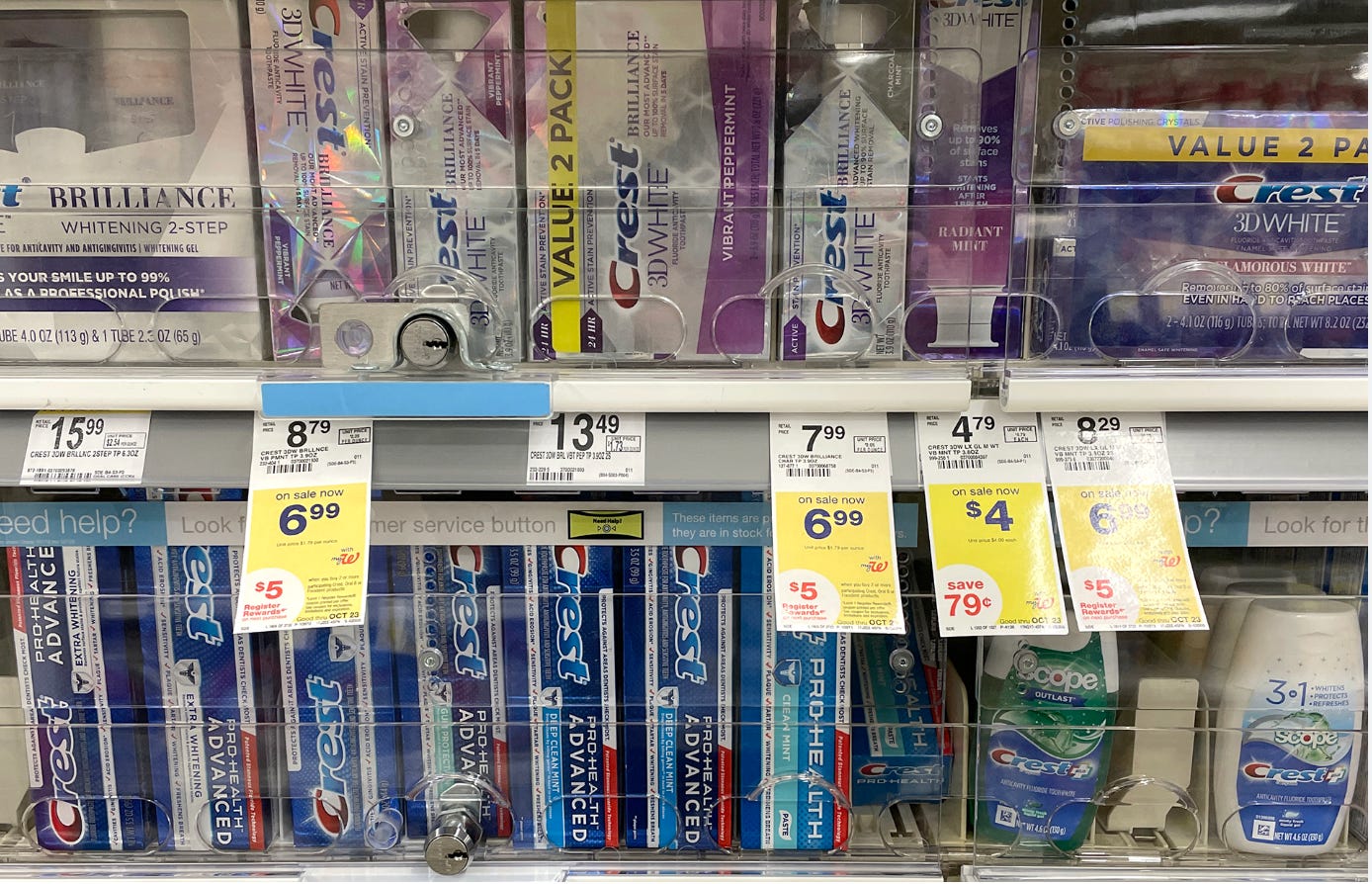
As politically impactful as store closures were, the defining image of the shoplifting panic was the lockup of toothpaste and tampons behind a plexiglass prison. My friend Amy started referring to her local CVS as “shampoo jail.” We had entered the era of mascara incarceration, of detergent detention, of — and I promise this is the last one:
the ham hoosegow
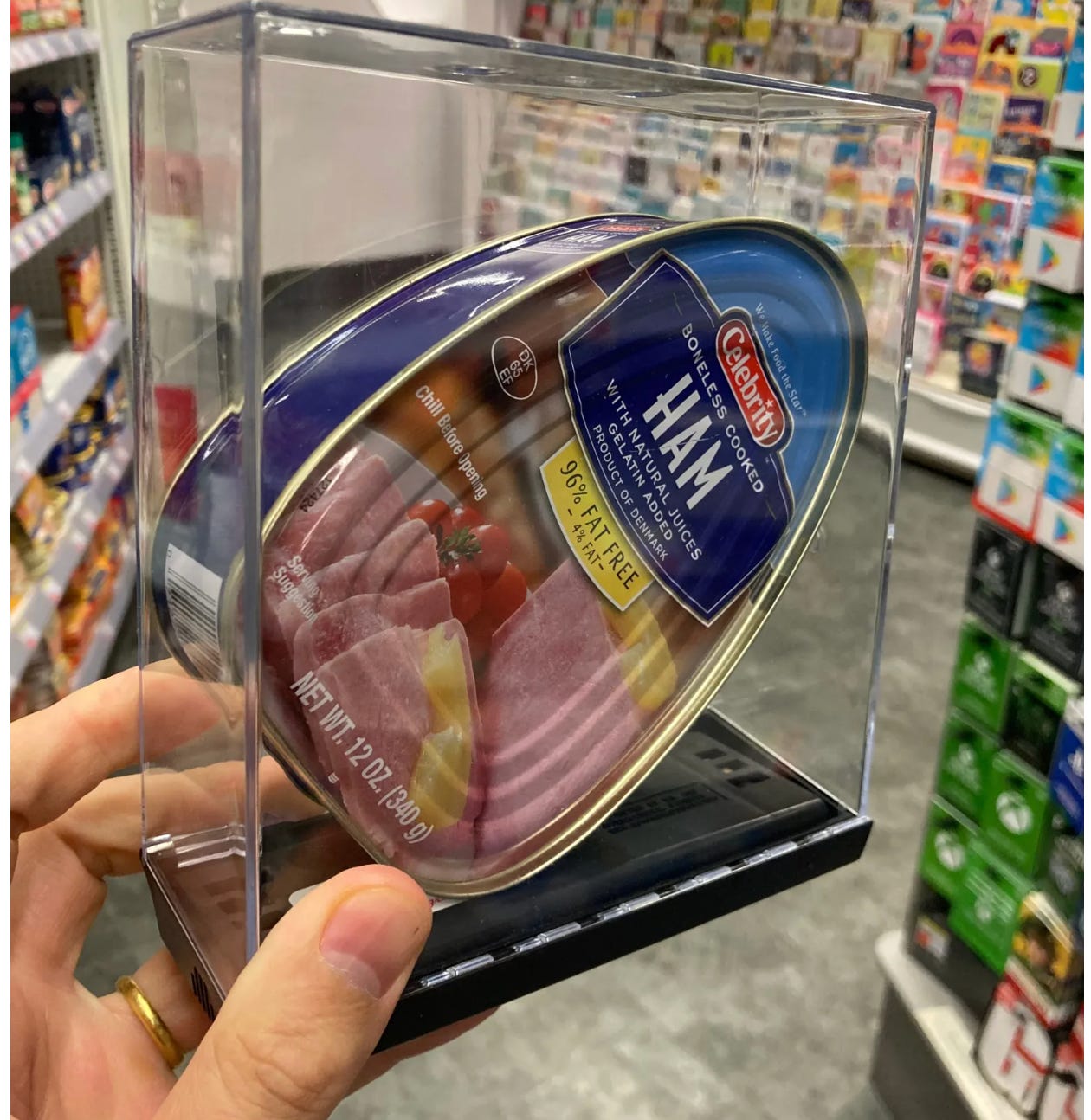
Whatever you called it, plexiglass was suddenly everywhere. During an earnings call in 2023, a Rite Aid executive said that stores were “literally putting everything behind showcases to ensure the products are there for customers who want to buy it.”
But how many of us would still want to buy products we could no longer take to the checkout counter ourselves? Some industries can get away with steadily making the customer experience worse. Airlines and a certain search engine, for example, operate as a cartel and monopoly, respectively, which means there’s little we can do about how much more they suck each year. Retail stores, on the other hand, exist in a shadow of the Bezos Behemoth, which made their decision to degrade the in-store shopping experience a disaster.
In 2024, a retail customer survey found that almost half of customers “will turn to third-party retailers like Amazon when encountering locked items.” The report also noted that untold sales are lost when plexiglass prevents customers from impulsively buying other items they encounter: “Each locked display case potentially represents lost opportunities for spontaneous sales.”
Thanks to the new policy of making it harder and more aggravating to buy things, in-store sales at retail drug stores have taken a nosedive. In early 2025, Walgreens CEO Timothy Wentworth bluntly acknowledged the industry’s own-goal: “When you lock things up… you don’t sell as many of them. We’ve kind of proven that pretty conclusively.”
Two months later, Walgreens was bought by a private equity firm after years of losses. Locking away the items it was trying sell was far from the only factor in the company’s decline, but it was widely seen as the suicidal final straw.
Given how drastically locking up products impacted company bottom lines, you would think that this strategy must have been a response to a clear and obvious increase in theft. Incredibly, it’s not clear if there was any increase at all. Yes, we all know what we “saw” (on social media) in 2020 and 2021. But there are few accompanying statistics to back it up.
Journalist Amanda Mull, who wrote a great 2021 piece in the Atlantic that is unfortunately behind a paywall, recently explained the surprising lack of hard data on The Big Take podcast:
“There’s not a lot of good data available on theft rates. Often these numbers are released by industry lobby groups and people who are trying to demonstrate a phenomenon that they believe is happening from surveys that ask retail management how they feel about shoplifting, how they feel about certain types of product loss as a threat to their business. It is very squishy. They’re asking about perception instead of asking for proof.”
To understand what data does exist, we need to distinguish between theft and shrink, the industry term for all inventory loss.
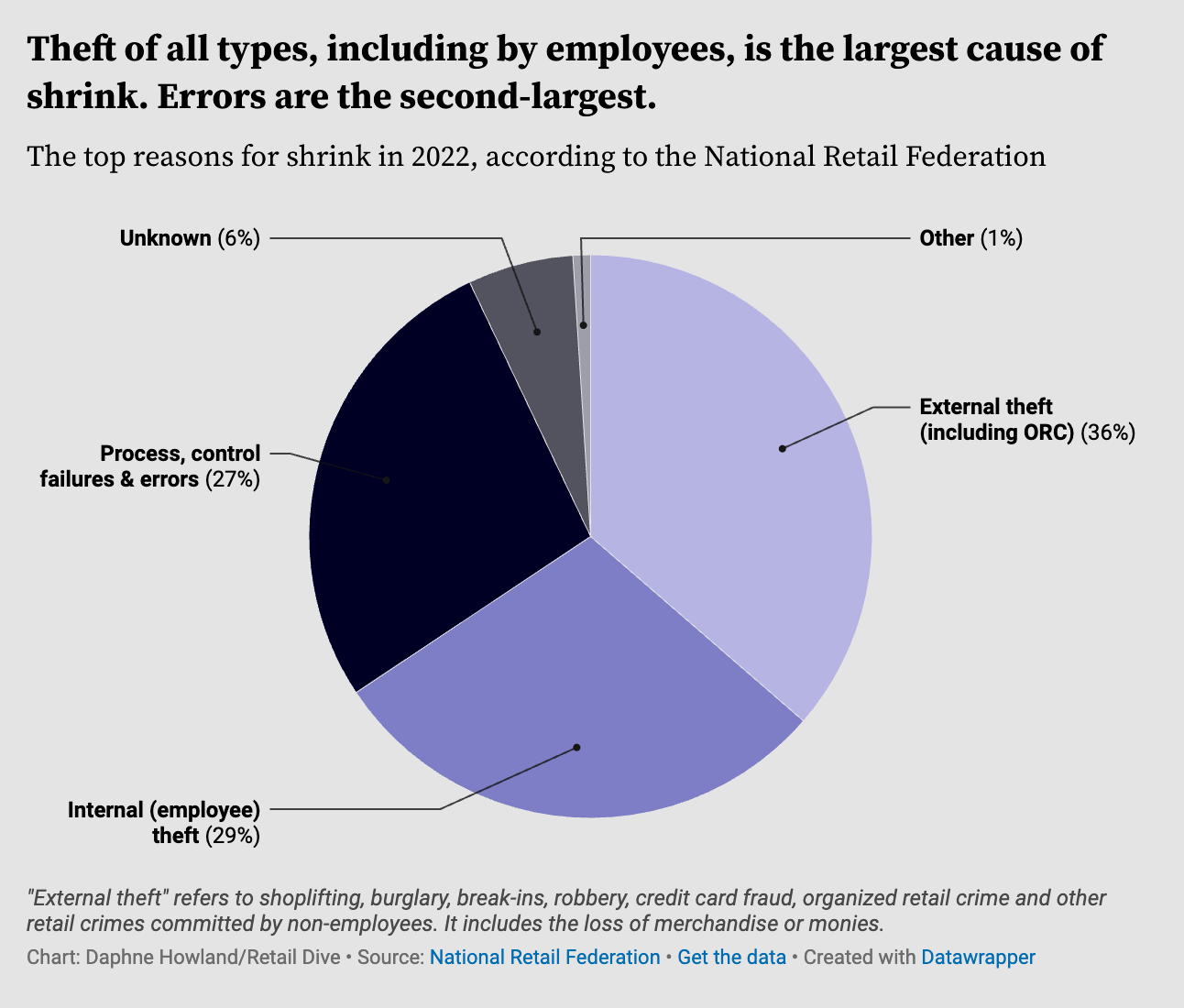
As the above graph from the industry publication Retail Dive shows, only about a third of shrink comes from outside theft, and most of the rest comes from employee theft and products being lost or damaged in any number of ways. Now let’s look at the graph below, which indicates that total shrink has barely changed over the past decade.
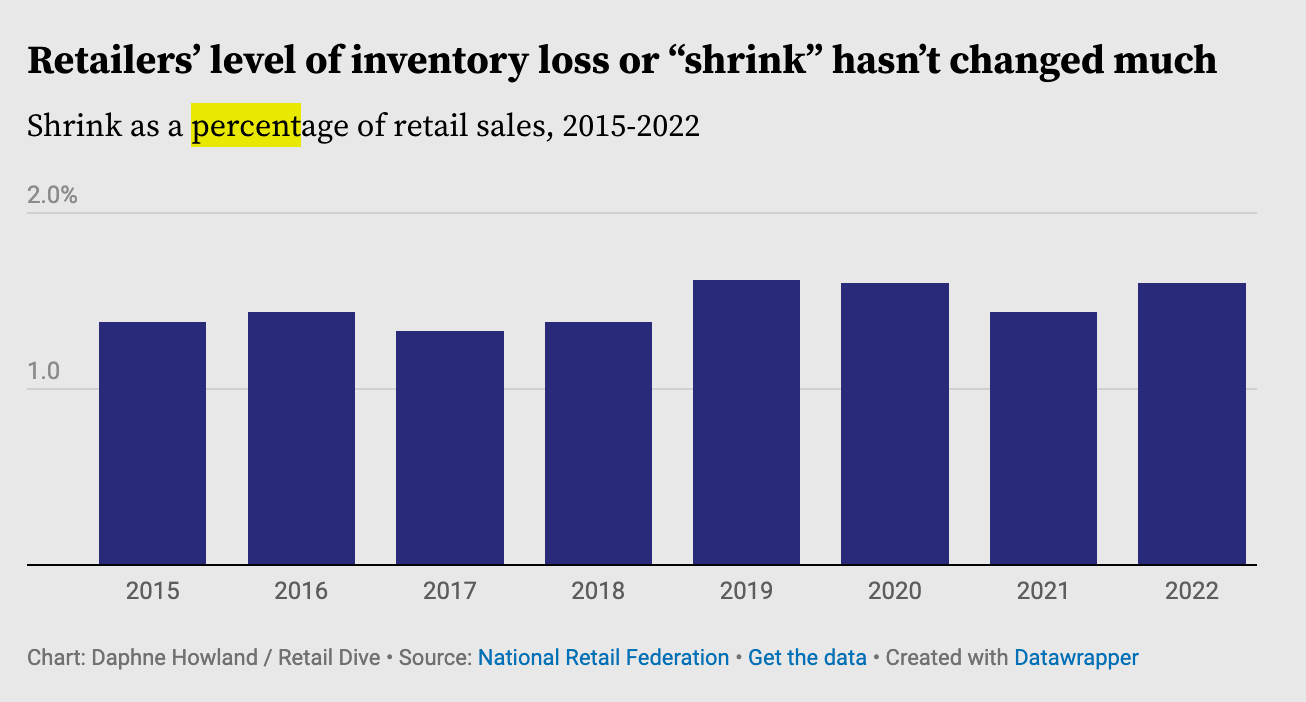
If there was a major spike in shoplifting, employee theft and/or other damage or loss must have gone down just as significantly, a highly unlikely event at any time, much less the hectic pandemic period.
So if it wasn’t based on hard data, why did the serious grownups at the head of these giant companies decide that they had no choice but to turn their stores into fortresses? Was it just frightened rich guy vibes? Yeah, kinda.
Here’s a quote from yet another executive from yet another earnings call, this one focused on Rite Aid locations in New York City (emphasis mine): “I think the headline here is the environment that we operate in, particularly in New York City, is not conducive to reducing shrink just based upon everything you read and see on social media and the news in the city.“
New York City supermarket magnate (and locally notorious right wing crank) John Castimiditis told Fortune that he thinks locking up items makes customers feel safe and reduces theft, but he doesn’t know because “this is not an exact science.” Indeed.
Much of the “science” that does exist comes from the National Retail Federation (NRF), which represents the interests of retail giants like Walmart, BJs, and Target. But in the years after 2020, the Federation added fuel to the fire with some suspiciously bizarre reporting errors (which were uncovered by the great reporting of Retail Dive reporter Daphne Howland.
To begin with, the NRF mistakenly listed all the inventory lost to shrink as being a result of “retail crime”, an obvious error that you now understand thanks to the graphs I made you read earlier. Even more egregiously, the NRF claimed that half of all retail shrink in 2021 was due to organized retail crime, which would have been truly unprecedented if true. It was not.
In fact, it’s estimated that ORC accounts for only five percent of inventory shrink. An industry economist told the New York Times that the fifty-instead-of-five percent error was comparable to “the census claiming that nearly half of the U.S. population lives in the state of Rhode Island.”
If there were temporary increases in shoplifting in different parts of the country, they were almost certainly encouraged not by Black Lives Matter protests or declining moral standards but by the industry’s ongoing drive to eliminate the most effective theft prevention solution: workers.
Industry research indicates that engaged “front-line employees” are more important for preventing shoplifting than sensors and security cameras. But employees are the one security measure that managers’ hate to pay for. This is especially in the retail industry, which for decades has reduced staffing levels and forced those who remain to endure not only low pay but “flexible” scheduling that can make it impossible to work second jobs, go to school, or have stable family lives. Here again is Amanda Mull:
“Retailers really love to reduce labor costs, and after a certain point that just means having fewer workers. When you get to that point, it becomes really hard to manage a store well. So what retailers have done is sort of retrofit stores with systems that mean in their minds that they can run stores with fewer employees. That’s what self-checkout is. And that’s what these locked up shelves are.”
Unsurprisingly, an industry already facing chronic understaffing due to crappy conditions was hit especially hard by the “Great Resignation” of 2021, leaving even fewer employees to combat shrink, either by deterring shoplifting or catching shipping errors.
Speaking of self-checkout. Have you ever been scanning your own groceries at a self-checkout and thought about how easy it would be to throw that fancy salsa in your bag without scanning it? Have you ever done more than think about it? You’re far from alone. Stores that have self-checkout have much higher rates of inventory loss than stores that don’t, and more than a quarter of people have knowingly stolen from self-checkout.
Self-checkout and locked up products may both be driven by management’s desire to reduce staffing, as Mull notes, but in combination they create a nonsensical system: have your staff walk around unlocking cases and handing customers items they will then not pay for because your staff will not be working at the checkout machines. Great plan, boss!
The retail industry has long accounted for certain levels of customer and employee theft as a predictable if unfortunate operating expense. The turn to self-checkout is a clear indication that the business is okay with increased shrink if it comes with lower labor costs. But these same people during these same years had a nervous breakdown over shoplifting that led them to adopt a security policy that was terrible for the bottom line. Why?
With the caveat that it’s impossible to overestimate the racist panic that rich guys felt at the sight of massive Black-led protests in 2020, I think the main factor was executives trying to keep their jobs.
The COVID pandemic greatly accelerated the shift from in-store to online shopping, bringing the doomsday threat of Amazon much closer to major retail chains like Target and Walgreens. I’m not sure if stores could have better weathered the crisis by making in-store shopping more appealing. What I do know is they found it easier to respond to a fake crisis, and in so doing made their real one much worse.
Remember those San Francisco Walgreens closures? The San Francisco Chronicle reported that there were actually few reported shoplifting incidents at those five stores, and added that “the timing of Walgreens’ decision led observers to wonder whether a $140 billion company was using an unsubstantiated narrative of unchecked shoplifting to obscure other possible factors in its decision.”
Others have had similar suspicions. In a 2023 note to clients, the investment firm William Blair wrote that “some more recent permanent store closures enacted under the cover of shrink relate to underperformance of these locations.”
In the summer of 2020, an online rumor spread that there would be a “loot out” in my neighborhood. When the day of the supposed event came, stores boarded up their stores for up to a mile away from the supposed target area. People scrawled hand-written pleas to not touch their “immigrant owned business.” The day came and went without incident. It was a rumor, shamefully amplified by the police and some local politicians. But I had a sinking feeling as I walked the neighborhood that day, that BLM would get the blame.
Plexiglass cases, like boarded up stores, send a powerful message of a society under siege, even when the real message should be not to trust everything we hear. Locked up goods is great propaganda for more cops, more crackdowns.
During his failed mayoral run against Zohran Mamdani, Republican Curtis Sliwa repeatedly said, “We lock up toothpaste in a drug store but we don’t lock up criminals.” It’s an effective line that connects with the feeling when we encounter plexiglass being collectively punished for the sins of a few bad apples (our mistake being to think of those apples as shoplifters rather than CEOs).
Studies show that when customers encounter locked up products, they assume it’s because there is a major theft issue. Of course we do. We may think companies are immoral, but that’s because we assume they are coldly dedicated to their bottom line, not making billion dollar decisions based on something someone sent them on Facebook.
The left has never been immune from this mistake. We often look for some rational ruling class plan where only bigotry and short-termist idiocy exist. In “The Civil War in France”, Marx was making a point about the benefits of the immediate recall of delegates when he added a comment that has aged quite poorly:
“It’s well known that companies in matters of business generally know how to put the right man in the right place and if they make a mistake to redress it.” (It’s probably the dumbest sentence he ever wrote, and the only one you’ll never hear a capitalist complain about.)
Recently, retail has been trying to quietly walk back from its lockdown folly. A Walgreens executive admitted that “maybe we cried too much” about shoplifting and organized retail crime. But once the wheels of criminalization get moving, they aren’t easy to stop.
This May, the House passed the Combatting Organized Retail Crime Act (CORCA), which would create a new center within Homeland Security that would “strengthen collaboration among federal, state, and local law enforcement agencies, along with retail crime associations, to create a cohesive strategy to combat organized retail and cargo theft.”
CORCA has been included in the Senate in the 2027 National Defense Authorization Act, so we can expect the largely non-existent issue or organized retail crime to become a federal priority. (Meanwhile, the actually existing threat of organized crime networks stealing poor people’s SNAP benefits continues to be largely ignored in states like New York.)
Equally ominous is a new system being developed by CVS, in which customers with the company app can unlock shelves from their phones. If this plan spreads throughout the industry (and of course it will), picking up a product with your own hands will become a privilege you can only have in exchange for giving more personal information to the company.
Will this be the final, camel-back-breaking, indignity? How far will we let these stores degrade us before we rise up to free the shampoo? I don’t have the answers, but I have to think that the arc of history bends back towards being able to touch a stick of deodorant.
When it does, how will the people rise up to free our imprisoned consumer goods? Maybe it will come through civil disobedience campaigns, where dozens of us ring every damn “Assistance Needed” button in the store. Or perhaps it will be the fire next time, and angry mobs people will descend in fury on the chain stores to take back our shelves, and the bosses who built all these locked cases will see that they only created more walls to be torn down.