This post represents only my own views and is not endorsed by or affiliated with Amplify in any way.
Alpha School, if you need an introduction, is a network of roughly one dozen private schools, generally charging in the range of $40,000 to $75,000 for annual tuition. According to the New York Times, Alpha School’s first campus in Austin has enrolled 250 students across K-12, which, using some napkin math, puts their total student enrollment somewhere in the low thousands.
Even though Alpha School currently serves a student population the size of a suburban high school, it has become the focus of ongoing national news coverage, including profiles in the New York Times and the Washington Post, interviews on national television, visits from the United States Secretary of Education, and guest appearances by founder MacKenzie Price and principal Joe Liemandt on countless podcasts and edtech industry events.

Media coverage of Alpha School has generally focused on its claim that it educates children much faster than traditional models, specifically that it helps students “grow 2.6 times faster than peers on nationally normed MAP tests” and do it in two hours instead of six. If the Alpha School founders are clear about anything, it is their conviction that traditional schooling models waste student time. “Don’t waste my 12 years, because that’s what you’re doing,” Joe Liemandt told the No Priors podcast. “And, we all know, you sit in class 95% of the time is wasted.” The remainder of an Alpha School student’s day is spent on projects where they learn public speaking, leadership, entrepreneurship, and other life skills.
Alpha School claims these gains are possible because:
They use a digital platform to deliver learning resources they claim are personalized by AI to meet a student’s exact needs.
They transform the role of a teacher from someone who helps kids learn domain content to someone who motivates them to engage with the digital platform.
They employ motivational strategies that include paying students for academic success.
Alpha School calls this schooling model “2 Hour Learning.”
While traditional public schools are generally required to enroll any student within their geographic boundaries, private schools can select and reject students with much more latitude. How does Alpha School select students? Here is what I could gather from Alpha School application pages and founder interviews. (I reached out to Alpha School’s press contact asking for clarification on their selection process and other matters and didn’t receive comment. I’ll update if they respond.)
Alpha School students must have parents wealthy enough to afford tuition that generally ranges from $40,000 to $75,000, though in the case of their Brownsville, TX, campus, their tuition is $10,000.
Alpha School students must participate in a “Shadow Day,” which runs up to five hours for kindergarten students and then “at least one full day” for older students.
Alpha High students must submit a video and a take-home assignment.
Alpha School students must have parents engaged enough to adopt a non-traditional schooling model, complete the application process, participate in an interview, facilitate their kid’s attendance to the Shadow Days, etc. Price, in particular, is quite clear that the Alpha School model requires engaged parents. “What makes the whole world go around is parents,” Price told cognitive scientist Dan Schwartz. “I think an engaged parent is kind of the number one best thing.”
Alpha School students must be self-motivated to attend Alpha School. They can withdraw from this application process and these expectations at any point without their parents’ knowledge. “I’ll meet the kid, and I’m like, listen, kiddo, this is up to you,” says MacKenzie Price five minutes into this podcast. “This is not about your parents. This is about you. So, like, blink twice if this isn’t what you’re interested in. And I will let your parents know, like, sorry, I didn’t approve them to come in or whatever, because it is so important that the student be driving this interest.”
Alpha School students must be “functioning within a typical range of ability and independence,” according to their application.
Alpha School students must not have been “expelled, suspended, dismissed, or asked to withdraw from any school due to behavioral or disciplinary reasons,” also from their application.
Alpha School students, according to admissions director Wilkinson, must have an “ability to give and receive feedback” and must “uplift one another” and “add to the culture that we have at Alpha.”
Alpha School students must be “coachable.” In her Hard Fork interview, MacKenzie Price says they’re looking for kids who have “coachability,” an attribute which she defines in various ways. On Hard Fork, she defines it as “excited to engage in this model.” On the LiberatED podcast, she defines it as “an ability to become growth-minded students and are they willing to take feedback.”
Price and Liemandt are correct that public schooling doesn’t operate according to the 2 Hour Learning model, a fact which they lament. It is also true that the public schools Price and Liemandt criticize cannot select students like Alpha School can. The school down the street from me cannot deny admission to a kid who doesn’t seem coachable enough, for example.
So how important is the model and how important is the selection process? Can we separate them? What would happen if you took the Alpha School model of schooling and applied it to a non-selective school? It is exciting that Alpha School has done exactly this. On the Hard Fork podcast, Price responded to questions about selection effects by saying, “this year, we’re even rolling out schools that are free for students to go to,” setting up an interesting quasi-experiment.
The Arizona State Board for Charter Schools approved a charter for Unbound Academy in December 2024 and the school opened Fall 2025. It just completed its first full year.
In their charter application, Unbound Academy claimed a direct connection to Alpha School. They named MacKenzie Price their board director and president. They described 2 Hour Learning as their schooling model, naming “AI-driven adaptive learning technology,” “condensed core academic learning,” “afternoon workshops for life skills development” as constituent parts, along with teachers reconceived as guides. Unbound Academy further invited the comparison to Alpha School in its charter application, claiming to “bring these capabilities, previously only available at high price point private schools, to the public charter student in Arizona.”
Unbound Academy’s enrollment application is, by law, much less selective than Alpha School’s. A parent doesn’t have to attest that their student is neurotypical, able-bodied, and well-behaved. They only have to meet the much lower bar of geographic residency. Furthermore, as a public charter school, Unbound Academy is free to parents.
How would Alpha School work if you split away the model from the selection process? Let’s check back in on Unbound Academy and see the results of this quasi-experiment.
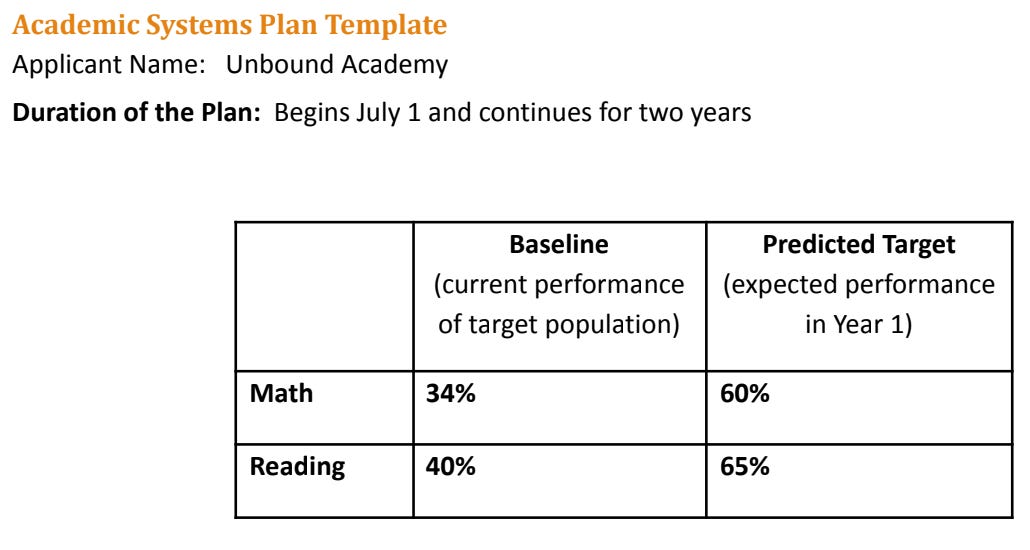
Keeping with the claims of its parent school, Unbound Academy promised strong academic results to the state school board (p. 79):
Our ultimate target is 90%+ averages on the [Arizona’s Academic Standards Assessment] testing. We believe that will take 2-3 years to achieve. We have set the year 1 target at approximately half of the gap between the current expected performance and the 90% target. We believe this to be achievable based on results of our affiliate schools.
As a public school, Unbound Academy has requirements for transparency that exceed those of Alpha School. For example, Unbound Academy must advertise the meetings of its board of directors, post board minutes, and make materials available to the public, which is how I found this running slideshow of highlights for its board.
In that slideshow you’ll see testimonials from parents and kids. You’ll see field trips to baseball games and kids appearing on podcasts. You’ll also see that Unbound Academy’s 2025-26 assessment scores underperformed not just its predicted targets above, but also the Arizona state averages and even the original baseline performance of its target population.
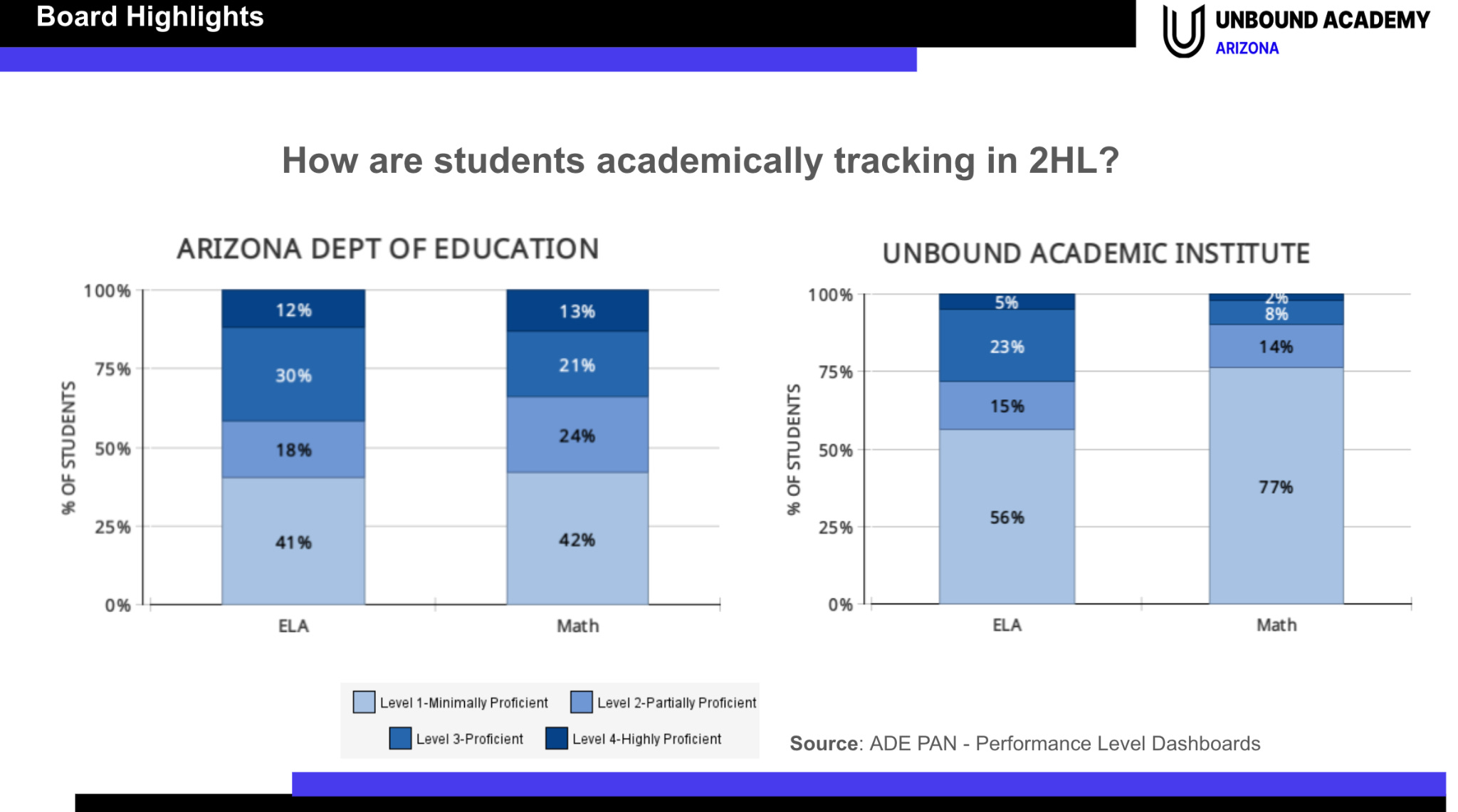
Unbound Academy projected 60% proficiency in math off a baseline of 34% and ended the year with 10% compared to an Arizona state average of 34%. They projected 65% proficiency in ELA off a baseline of 40% and ended with 28% compared to an Arizona state average of 42%.
It is possible that Unbound Academy’s actual student body came in with much lower achievement than the baseline they predicted in their charter application. It is likely they’ll post higher proficiency numbers in their second year of operation, growing student learning in some bounded capacity, like many schools.
But Alpha School has not become nationally famous for its claims to grow student learning in some bounded capacity. It has become famous for the claims of its founder and principal that student learning is “limitless” and, indeed, that the Alpha School model will take students to the outer edges of academic achievement.
The Alpha School team set their own performance target for Unbound Academy’s first year. In their application, they claimed they only needed to import their 2 Hour Learning model into public schools, not their selection process. The result was a drastic underperformance of their own targets.
What can public schools, administrators, and teachers learn from Alpha School? Unbound Academy offers us only a quasi-answer but it is the best one available. Their poor outcomes shouldn’t be the last word on 2 Hour Learning but they should be the loudest. Their outcomes indicate that it is far harder to make successful students than it is to select them in advance.
Correction. I misattributed the quote "I’ll meet the kid, and I’m like, listen, kiddo, this is up to you. This is not about your parents. This is about you. So, like, blink twice if this isn’t what you’re interested in. And I will let your parents know, like, sorry, I didn’t approve them to come in or whatever, because it is so important that the student be driving this interest” to Alpha School admissions director Cara Wilkinson instead of Alpha School founder MacKenzie Price. I regret the error.