Why the AI bubble argument misunderstands both bubbles and AI
September 5, 2025
Listen to the argument instead
There's a popular argument going around that goes something like this:
- PERSON1: "AI is a bubble."
- PERSON2: "No, it isn't. Bubbles are when things turn out to be hype, and they get proven wrong and die."
- PERSON1: "No, it just means that it's overinflated, like the .com bubble. We still have the internet don't we?"
This sounds like a good argument, but I don't think it is.
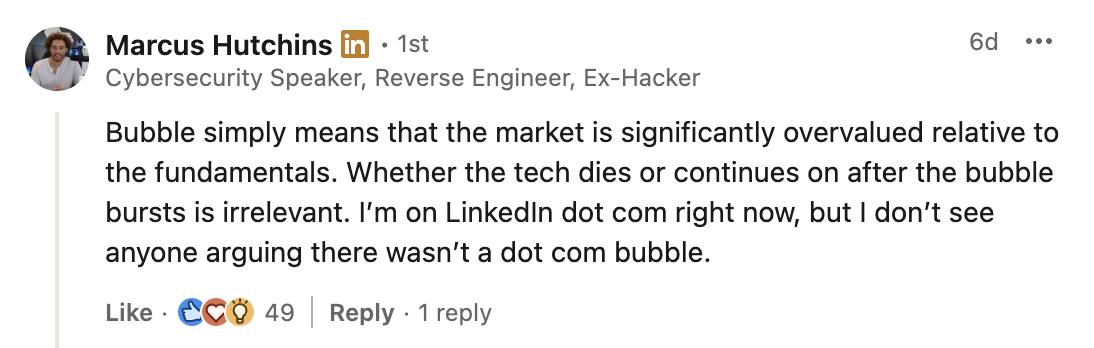
From a recent LinkedIn interaction
The problem with using the word "bubble"
Notice that we're using the word "bubble" here. What does that mean?
People who think AI is a bubble could say:
- it's "overheated", or
- it's "inflated"
- or any other term indicating significant hype
But they're not using those terms. They're saying "bubble."
So, what does that mean, actually?
What is the single most defining characteristic of a bubble? Like...in real life.
Bubbles pop.
That's the whole thing with bubbles. When you go into nature, do you see bubbles that expand and contract and survive?
No. They pop. It's like their main thing.
Here's my offer of a cleaner explanation for bubbles and whether or not something applies.
A bubble is a false belief with tons of investment that will soon be proven wrong.
The .com thing was a bubble, and it popped.
But the false belief was not that The Internet™ would blow up and be popular. That's where the confusion is.
The .com bubble was the false belief that if you took your struggling business to the internet, you would instantly become rich.
That is the belief that popped.
The AI analog
So, the trick with this whole AI bubble discussion is to find the false claim.
What is the false belief about AI that people have, that they're overinvesting in, which will retroactively be seen as foolish after it pops?
Is it like the .com example where everyone believes if you just "add AI" to what they have, they'll instantly become millionaires? Maybe. Maybe a year or two a go. But most of those people have already collided with reality.
That bubble already popped for most in 2023/2024.
No. I think what most anti-AI people like Marcus (Hutchins, and Gary Marcus as well) actually see as the bubble beleif, is the following position (which I hold, btw):
- Modern AI (or gen AI, or whatever you want to call it) will lead to foundational change in how business is done
- It will displace tens or hundreds of millions of knowledge workers in the next 3-10 years
- It will force us to rethink not just the current labor-based economy, but the whole concept of human work and usefulness itself
If you talk to somebody who thinks AI is a bubble, this is what they usually mean.
So the question isn't whether tons of starry-eyed AI investors who have no real idea what's going on will lose money. It's already happened, it's happening now, and it will continue. It'll be a bloodbath of too-early and otherwise ill-advised investments. Everyone knows that. That's not the real argument.
The debate is about whether this tech is going to transform business, the economy, and society.
It comes down to whether you think that belief—and all the investment going in behind it—is a bubble. And that, as a false belief, it will pop.
Summary
- Bubbles aren't overheating or hype cycles; they are false beliefs about reality that everyone eventually figures out were false
- We use the bubble metaphor in business because—like real bubbles in nature—we care if the beliefs and investments are going to pop or not
- People claiming AI is a bubble need to clarify which claim they're talking about
- If they're talking about the 2023-2024 "chatbots = rich" argument, that's a bad argument because hardly anyone believes that anymore
- But if they think the bubble is the idea that AI will cause foundational change in business, the economy, and human work, then—in my opinion—they're just wrong
My recommendation:
Start by pinning down the claims being made, and see if any of them qualify as a guaranteed-to-pop false belief to the other person.