Life update! New job! Big shift! More here if you are curious. And more to come…
I can’t get this out of my head.
I was doing book research recently, and I learned about a “secret” group inside a company called the Right But Early Club. The basic idea of the Right But Early Club, if I understand correctly, is to serve as a support group (of sorts) for people who are “right” (we’ll discuss this more in a bit), but who tend to be “too early” when it comes to bringing up issues, calling out problems, offering solutions, etc.
Ever since I learned about this, it has been ringing in my ears. I’ve been telling everyone about it and have learned as much from people’s responses as I did in the original interview.
I think we can all relate, in some way, to the *feeling* of seeing something before other people see it, or being “right” before other people have arrived at the solution we believe is right. I’d divide that into two feelings and one decision: 1) seeing it, 2) it sticking in your head and permeating your thoughts, and 3) doing something or saying something. We’ve also been on the other side, being peppered by people who were confident they were right, knowing that technically they were (at least partially), but also knowing it was too early. To quote a VP friend, “I see plenty of things that I know will break, but I’m able to filter them out so I can focus on today’s problem.”
Signal detection and attention gating are both important cognitive abilities.
The puzzle is that many RBEC people (or more accurately people in the RBEC mode, because we can be many things in different contexts) are unusually strong at the first and taxed by the second. Organizations need the first while (many people working inside them) disproportionately rewarding the second.
When I describe the RBEC in other contexts and ask what people think, I often end up really triggering some people. “Those are the people who just bring problems!” “It is easy to be right about problems!” “Sure, but do they do something, or do they just sit in their support group complaining?”
I think this is important for a couple reasons. Primarily because how deep the tensions run.
First is that some people can’t seem to let go of the idea of rightness without reward or effectiveness. “They must be bad at communicating the solution!” The idea that there is a group of people in an org with the right answer who aren’t being rewarded or heard is immediately translated as an individual problem because the formula, based on certain world and work views, doesn’t compute. And let’s be honest, it is kind of threatening
Imagine if the CEO knew that there was a club internally filled with people who were correct at figuring out which projects would fail, which campaigns would flop, which hiring decisions would cause material harm, but that somehow no one listened? Pissed! But that explains the immediate rationalization and blame. It has to be the person, right? Or a group of people—the middle managers hiding good ideas.
On the RBE side, you experience very strong feelings around fairness, acknowledgement, and sensitivity to people glossing over disagreement. You may notice not only that something is wrong, but also who is being asked to absorb the cost of everyone else’s convenience. A quick “let’s move on” can feel less like pragmatism and more like a refusal to acknowledge what is actually happening. This can make it difficult to let an issue go, especially when the disagreement seems consequential or when the people with the least power are the ones expected to adapt.
Notice the core identity clash here. It strikes all the way to how they view competence.
For the RBEC person, competence may feel like: I notice what others are missing. I trace consequences. I protect the system from preventable harm. I don’t look away just because the problem is inconvenient or premature. Their identity is partly bound up in foresight, coherence, vigilance, stewardship, and intellectual honesty.
For the Right Now person, competence may feel like: I know there are a thousand possible problems. My job is to decide what matters now, create movement, make tradeoffs, and not let hypothetical future concerns paralyze us. Their identity is partly bound up in agency, focus, pragmatism, prioritization, momentum, and responsibility for outcomes.
(Note: We can be both of these people depending on the context)
As I mentioned earlier around signal detection and attention gating, it isn’t that either identity is right or wrong, it is more that many organizations need both capacities but are structured to reward only one of them. They need people who can detect weak signals, trace consequences, and notice what others are missing, but they also need people who can filter, prioritize, and act without being overwhelmed by every possible future problem. The tension emerges when the organization treats one capacity as competence and the other as dysfunction, rather than recognizing that both are necessary at different moments.
There’s a big stereotype that people in the RBEC take “being right” very seriously vs. achieving some sort of outcome they care about. That happens, sure, but I think it happens less than people think.
Let’s differentiate a smug “we’re right before anyone will accept the truth” kind of vibe and a “Yeah, we accept there is probably a timing issue, and that acting too soon might be premature, and that we struggle with raising these issues when we’re working from pattern matching and signals that might not easily translate.”
At least in my experience, people who are right but early often have a mix of skill and experience in the domain and are strong in cognitive abilities like pattern recognition, systems thinking, and counterfactual reasoning (stemming from both their skill/experience and natural wiring).
They may also be particularly tuned to issues around justice, equity, or preventing pain, which heightens the emotional connection. They also don’t find it as easy to filter out noticing, and therefore know they bring things up prematurely. All to say that the smug vibe stereotype may reflect some situations—I’ve been on both sides of the “accept the truth” dynamic—but it doesn’t reflect all, or most situations in my experience. These are people with normal egos, normal career identities, etc. who, for various reasons, find themselves in the RBEC.
Part of being right but early is acknowledging that mere “rightness” is not enough. Context dictates why something is right. Say there’s no senior leader with the express responsibility to improve X. Being right that X needs to be improved, or being right about how to improve X, doesn’t do us much good. Or say that a founder’s world view will kill any effort that feels like [something they don’t like]. Right Now is also relative to the other fires that are burning or questions begging for answers. No one sees it all. Companies often have elephants in the room commanding a ton of attention among leaders that no one knows about.
Right != Right Now OR Right Here.
I think what is fascinating about this is that you could have a company holding two truths: that it might not be taking advantage of or harnessing a certain population’s ability to be right earlier, AND that the people who are right earlier have their own set of issues and challenges that they are dealing with.
They may understand that they are not being as effective as they could, AND at the same time there are environmental factors limiting their effectiveness. They realize they can be right and wrong at the same time.
What stands out most to me about the RBEC is the idea of people leaning into their quirks and situation and building community connections. To me, that shows a very high level of maturity in the situation. In most organizations, you are lucky enough to meet a small group of people who share your experience, who you can trust enough to admit being “right but early” as a mix of a shared experience and a shared challenge.
Whenever I go to conferences, I am blown away by how deep the conversations get. It is as if people haven’t had a single moment to “speak freely.”
A final thought. I shared a draft of this piece, and someone responded, “Oh, I’ve been in one of those, like a gripe club!” And I think that’s sort of the heart of my curiosity right now. “Gripe club” doesn’t do it justice, IMHO. That still diminishes the skills and strengths of the people involved—and the tension they are navigating.
Being right but early.
If any of this resonates, maybe you should set up a RBEC in your company?
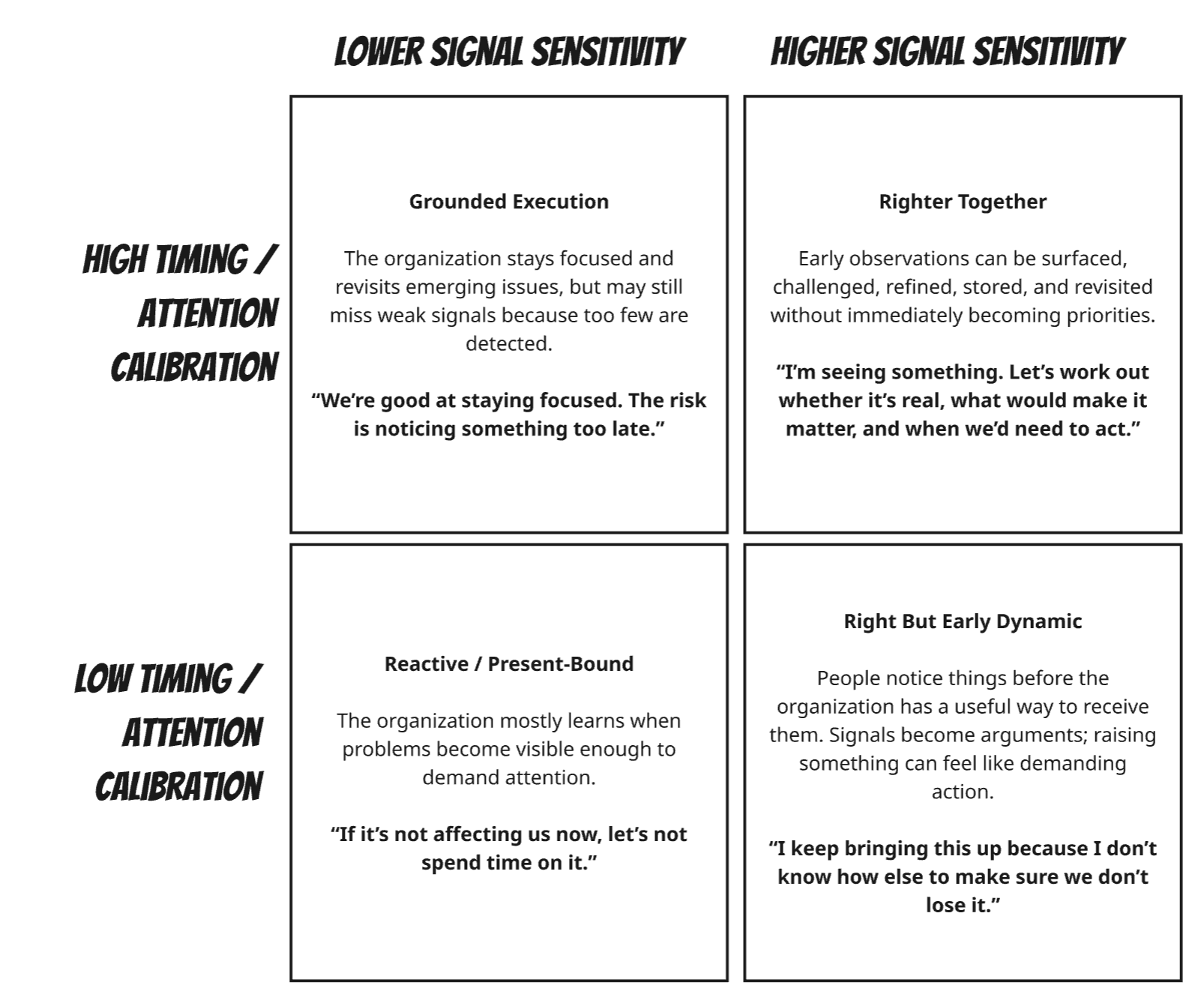
Say you’ve done that…there might be a path forward for everyone. You still want and need a RBEC. But there could be other options…
The goal isn’t to create a company where the Right But Early people are listened to more because they are secretly right. That just creates another version of the same problem. The goal is to create conditions where people can be righter together.
There is a huge difference between bringing up something early and demanding that everyone act on it early. But many organizations don’t provide much space between those two things. You raise a concern, and suddenly the group is debating whether to stop the project. You point out a weak signal, and people respond as if you’ve recommended changing the strategy. You notice a pattern, and now you’re expected to prove the whole thing.
Under those conditions, bringing something up early becomes expensive for everyone involved.
What if, instead, there were ways to say, “I think I’m seeing something. I’m not sure yet. I don’t think we need to act on it right now, but I think it is worth noticing.” Now other people have something to participate in. They can add evidence, challenge the pattern, connect it to something they’re seeing, or help establish what would need to happen for the issue to become more important. The Right Now people don’t have to surrender the present, and the Right But Early people don’t have to pretend they didn’t notice the future.
This seems like an important organizational capability. Companies need ways to revisit things when new evidence arrives. Otherwise, the only choices are “do something about this now” or “stop talking about it,” which is a pretty terrible way to learn.
And I suspect this changes the RBE dynamic itself.
If people know there is somewhere for an early signal to go, they may feel less compelled to keep pushing it. They don’t have to win the argument today in order to prevent the observation from disappearing. At the same time, other people get to participate in making the observation better. Maybe the person is right. Maybe they’re directionally right but wrong about the mechanism. Maybe they’re right about the problem but wildly early about the timing. Maybe someone else sees a constraint they don’t see.