


» Press Info, Summary, Contact
Report: How thousands of companies monitor, analyze, and influence the lives of billions. Who are the main players in today’s digital tracking? What can they infer from our purchases, phone calls, web searches, and Facebook likes? How do online platforms, tech companies, and data brokers collect, trade, and make use of personal data?
By Wolfie Christl, Cracked Labs, June 2017.
Contributors: Katharina Kopp, Patrick Urs Riechert.
Illustrations: Pascale Osterwalder.
In recent years, a wide range of companies has started to monitor, track and follow people in virtually every aspect of their lives. The behaviors, movements, social relationships, interests, weaknesses and most private moments of billions are now constantly recorded, evaluated and analyzed in real-time. The exploitation of personal information has become a multi-billion industry. Yet only the tip of the iceberg of today’s pervasive digital tracking is visible; much of it occurs in the background and remains opaque to most of us.
This report by Cracked Labs examines the actual practices and inner workings of this personal data industry. Based on years of research and a previous 2016 report, the investigation shines light on the hidden data flows between companies. It maps the structure and scope of today’s digital tracking and profiling ecosystems and explores relevant technologies, platforms and devices, as well as key recent developments.
While the full report is available as PDF download, this web publication presents a ten part overview.
In 2007, Apple introduced the smartphone, Facebook reached 30 million users, and companies in online advertising started targeting ads to Internet users based on data about their individual preferences and interests. Ten years later, a vast landscape of data companies has emerged that consists not only of large players such as Facebook and Google but also of thousands of other businesses from various industries that continuously share and trade digital profiles with each other. Companies have begun combining and linking data from the web and smartphones with the customer data and offline information that they have been amassing for decades.
The pervasive real-time surveillance machine that has been developed for online advertising is rapidly expanding into other fields, from pricing to political communication to credit scoring to risk management. Large online platforms, digital advertising companies, data brokers, and businesses in many sectors can now identify, sort, categorize, assess, rate, and rank consumers across platforms and devices. Every click on a website and every swipe on a smartphone may trigger a wide variety of hidden data sharing mechanisms distributed across several companies and, as a result, directly affect a person’s available choices. Digital tracking and profiling, in combination with personalization, are not only used to monitor, but also to influence peoples’ behavior.
„You have to fight for your privacy or you will lose it“
Eric Schmidt, Google/Alphabet,
2013
I. Analyzing people
Scientific studies show that many aspects
of someone’s personality can be inferred from data on web searches, browsing
histories, video viewing behaviors, social media activities, or purchases. For example, sensitive personal attributes such
as ethnicity, religious and political views, relationship status, sexual
orientation, and alcohol, cigarette, and drug use can be quite accurately inferred from someone's Facebook likes. Analysis of social network profiles can
also predict personality traits such as emotional stability, life satisfaction,
impulsivity, depression and sensationalist
interest.
Analyzing Facebook likes, phone data, and typing patterns
Similarly, personality traits can be
inferred from information about the websites
someone has visited, as well as from phone
call records and data about mobile app usage. Browsing history can reveal information about
someone’s occupation and educational level. Canadian researchers have even
successfully calculated emotional states
such as confidence, nervousness, sadness, and tiredness by analyzing typing
patterns on a computer keyboard.
II. Analyzing people in finance, insurance and healthcare
The results of today’s methods of data mining and analytics rely
on statistical correlations with certain probability levels. Although they may predict
attributes and personality traits significantly above chance, they are naturally
not accurate in every case. Nevertheless, such methods are already used to sort,
categorize, label, assess, rate, and rank people not only for marketing
purposes, but also for making decisions in highly consequential areas such as finance,
insurance, and healthcare, among others.
Credit assessment based on digital behavioral data
Startups such as Lenddo, Kreditech,
Cignifi and ZestFinance already utilize data from
social media, web searches, or mobile phones to calculate someone’s creditworthiness
without actually using data related to financial transactions. Some also draw
on information on how someone fills out an online form or navigates
on a website, the grammar
and punctuation of one’s text messages, and the battery
status on said individual’s phone. Some companies even include data about
someone’s friends
on a social network in calculating credit scores.
Cignifi, which calculates credit scores
from the timing and frequency of phone calls, sees itself as the “ultimate data monetization platform for mobile
network operators". Large companies, including MasterCard, the mobile
network provider Telefonica, the credit
reporting agencies Experian
and Equifax, as well as the Chinese search giant
Baidu,
have started to partner with such startups. The larger-scale application of
such services is particularly on the rise in the countries of the global south,
as well as for vulnerable population groups in other regions.
Conversely, credit data also flows into online
marketing. On Twitter, for example, marketers can target ads by the
predicted creditworthiness of Twitter users based on data from the consumer data broker Oracle. Going a step
further, Facebook has registered a patent
for credit assessment based on the credit ratings of someone’s friends on a
social network. Nobody knows whether it plans to turn this total integration of
social networking, marketing, and risk assessment into reality.
„We feel like all data is credit data, we just don’t know how to use it yet“
Douglas Merrill, founder of ZestFinance and former chief information officer at Google,
2012
Predicting health based on consumer data
Data companies and insurers are working on
programs that use information on consumers’ everyday lives to predict their
health risks. For example, the large insurer Aviva, in cooperation with
the consulting firm Deloitte, has predicted individual
health risks, such as for diabetes, cancer, high blood pressure and
depression, for 60,000 insurance applicants based on consumer
data traditionally used for marketing that it had purchased from a data
broker.
The consulting firm McKinsey has helped
predict the hospital costs of patients based on consumer data for a “large
US payor” in healthcare. Using information about demographics, family
structure, purchases, car ownership, and other data, McKinsey stated that such “insights
can help identify key patient subgroups before high-cost episodes occur”.
The health analytics company GNS Healthcare
also calculates individual
health risks for patients from a wide range of data such as genomics,
medical records, lab data, mobile health devices, and consumer
behavior. The company partners with insurers such as Aetna,
provides a score that identifies
“people
likely to participate in interventions”, and offers to predict the
progression of illnesses and intervention outcomes. According to an industry
report, the company
“ranks patients
by how much return on investment” the insurer can expect if it targets them
with particular interventions.
LexisNexis Risk Solutions, a large data
broker and risk analytics company, provides a health
scoring product that calculates health risks, as well as expected
healthcare costs for individuals, based on vast
amounts of consumer data, including purchase activities.
III. Large-scale collection and use of consumer data
Today’s
dominant online platforms – above all Google
and Facebook – have extensive information on the everyday lives of billions
of people around the globe. They are the most visible, the most pervasive, and,
aside from intelligence contractors, online advertisers, and digital fraud
detection services, perhaps the most advanced players in the personal data and analytics industry.
Many others operate behind the scenes and beyond public attention.
At its
core, online advertising consists of
an ecosystem of thousands of companies focused on constantly tracking and
profiling billions of people. Every time an ad is displayed on a website or in
a mobile app, a user’s digital profile has just been sold to the highest bidder
in the milliseconds before. In contrast to these new practices, credit reporting agencies and consumer data brokers have already
spent decades in the business of personal data. In recent years, they started
combining the extensive information they have about people’s offline lives
with the user and customer databases operated
by large platforms, online advertising companies, and myriads of
other businesses across many industries.
Data companies have extensive information on billions of people
Facebook
has profiles on
Facebook users
Google
has profiles on
Android users
Apple
has profiles on
iOS users
Experian
has credit data on
people
Equifax
has data on
people
TransUnion
has data on
people
Acxiom
has data on
people
cookies and mobile devices
it manages
consumer profiles for clients
Oracle
has data on
mobile users
provides access to
“unique” consumer IDs
Facebook uses at least 52,000
personal attributes to sort and categorize its 1.9 billion users by, for
example, their political views, ethnicity, and income. In order to do so, the
platform analyzes their posts, likes, shares, friends, photos, movements, and
many other kinds of behaviors.
In addition, Facebook acquires data on its users
from other companies. In 2013,
the platform began its partnership with the four data brokers Acxiom, Epsilon, Datalogix
and BlueKai, the latter two of which were
subsequently acquired by the IT giant Oracle. These companies help Facebook
track and profile its users even better than it already does by providing it
with data collected from beyond its platform.
IV. Data brokers and the business of personal data
Consumer data brokers play a key role in today’s personal data industry. They
aggregate, combine, and trade massive
amounts of information collected from diverse online and offline sources on
entire populations. Data brokers collect publicly available information and buy
or license consumer data from other companies. Generally, their data stems from
sources other than the individuals
themselves, and is collected largely
without consumers’ knowledge. They analyze data, make inferences, sort
people into categories, and provide thousands of attributes on individuals to
their clients.
The profiles that data brokers have on individuals include not
only information about education, occupation, children, religion, ethnicity,
political views, activities, interests and media usage, but also about
someone’s online behaviors such as web
searches. Additionally, they collect data about purchases, credit card
usage, income and loans, banking and insurance policies, property and vehicle
ownership, and a variety of other data types. Data brokers also calculate scores
that predict an individual’s possible
future behavior, with regard to, for example, someone’s economic stability
or plans to have a baby or to change
jobs.
Some examples of data on consumers provided by Acxiom and Oracle
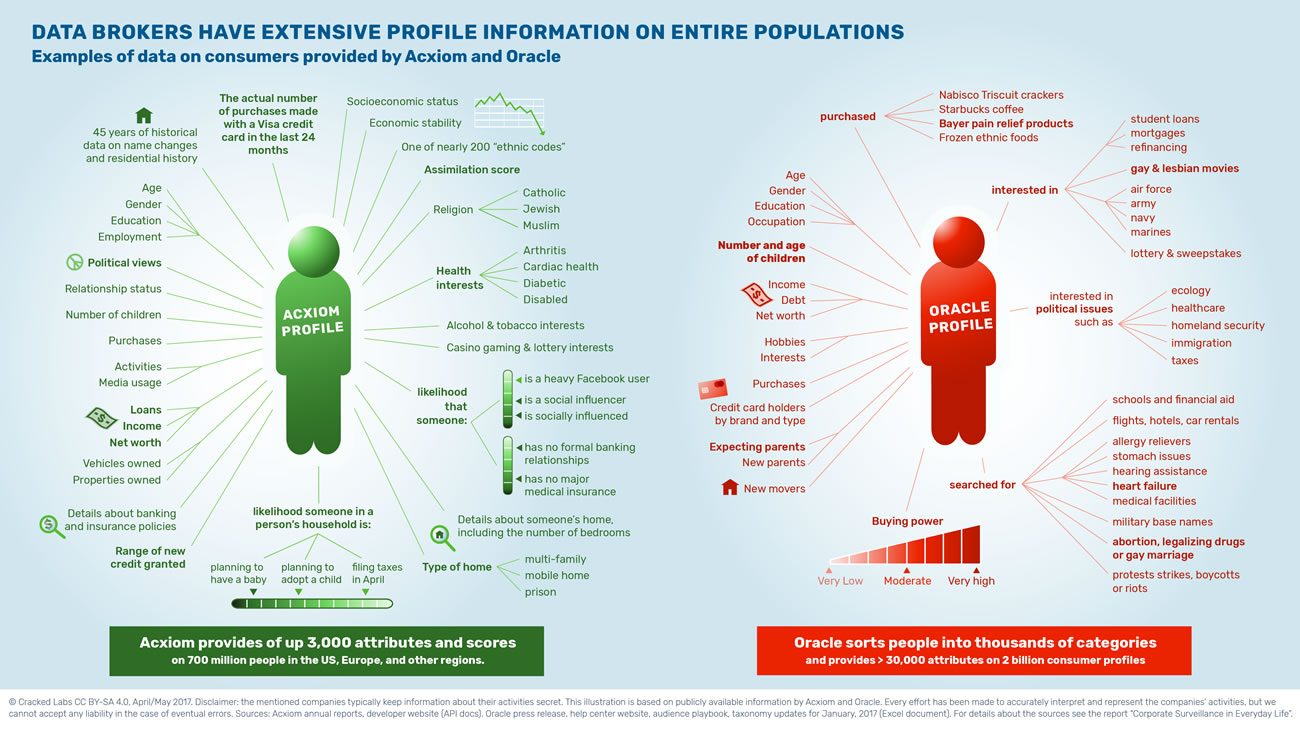
Examples of data on consumers provided by Acxiom and Oracle (as of April/May 2017). Sources see report
Acxiom, a large consumer data broker
Founded in
1969, Acxiom runs one of the world’s largest commercial databases on consumers.
The company provides up to 3,000
data elements on 700
million people from thousands
of sources in many countries, including the US, the UK, and Germany. Initially
a direct marketing firm, Acxiom developed its centralized consumer database in
the late 1990s.
With its Abilitec Link system
the company runs a kind of private population register in which every person,
household, and building receives a unique
ID. The company constantly updates its database with information about births and deaths, marriages and divorces,
name and address changes, and, of course all kinds of other profile data.
When asked about a person, Acxiom provides,
for example, one of 13 religious
affiliations including “Catholic”, “Jewish” and “Muslim”, and one of nearly
200 ethnic
codes.
Acxiom
sells access to its extensive consumer profiles and helps clients find, target,
identify, analyze, sort, rate, and rank people. The company also directly
manages 15,000 customer databases
with billions
of consumer profiles for its clients, including for large banks, insurers,
healthcare organizations and government agencies. Besides marketing data
services, Acxiom also provides
identity verification, risk management, and fraud detection services.
Acxiom and its data providers, partners and services
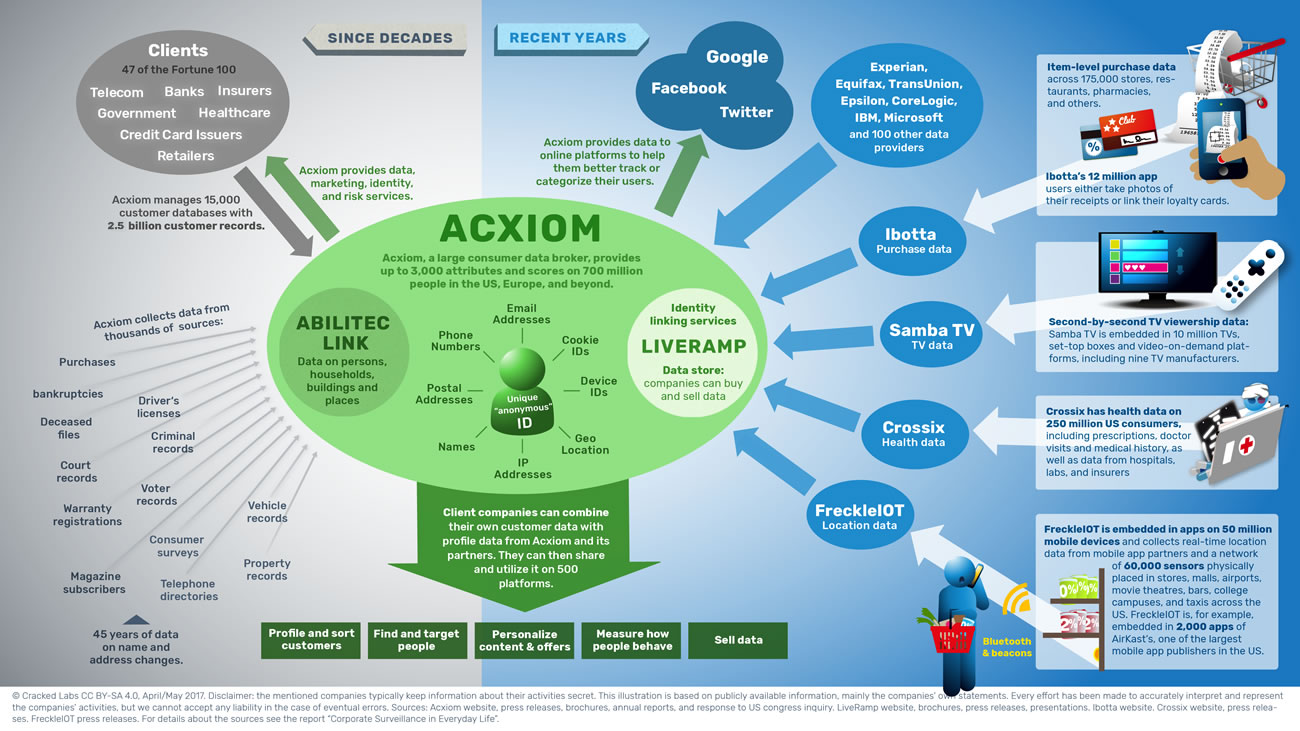
Acxiom and its data providers, partners, and clients (as of April/May 2017). Sources see report
Since the acquisition
of the online data company LiveRamp in 2014, Acxiom has made major efforts to connect
its decade-spanning data repository to the digital world. Acxiom was, for
example, among the first data brokers to provide additional information to Facebook, Google, and Twitter in order
to help the platforms better track or categorize users based on purchases and
other behaviors that the platforms were still not able to track.
Acxiom’s LiveRamp connects and combines digital profiles across hundreds of data and advertising companies.
At the core lies its IdentityLink system,
which helps recognize individuals and link information about them across databases, platforms, and devices based on email addresses, phone numbers, smartphone IDs, and other identifiers. While the company promises
that linking and matching happens in ”anonymized”
and “de-identified” ways, it also states that it is able to “connect
offline data and online data back to a single identifier”.
Companies
that have recently been promoted as data
providers by LiveRamp include the credit
reporting giants Equifax, Experian, and
TransUnion. Furthermore, many digital
tracking services that collect data from the web, mobile apps, and even sensors placed throughout the
physical world provide LiveRamp with data. Some
of them use LiveRamp’s data store, which allows
companies to “buy
and sell valuable customer data“. Others provide data to let Acxiom and LiveRamp recognize individuals and link the recorded
information with digital profiles from other sources. Perhaps most concerning
is Acxiom’s partnership
with Crossix, a company with extensive health data on 250 million US consumers. It is listed as one of LiveRamp’s
data providers.
„anyone who captures data on consumers has the potential to be a data provider“
Travis May, General Manager of Acxiom's LiveRamp,
2017
Oracle, an IT giant enters the consumer data business
By
acquiring several data companies such as Datalogix, BlueKai, AddThis, and CrossWise,
Oracle, one of the world’s largest business
software and databases vendors, has recently become one of the largest consumer data brokers as well. In its data
cloud Oracle aggregates 3
billion user profiles from 15
million different websites, data from 1
billion mobile users, billions of purchases from grocery chains and 1,500
large retailers, as well as 700
million messages from
social media networks, blogs, and consumer review sites per day.
Oracle aggregates data on billions of consumers
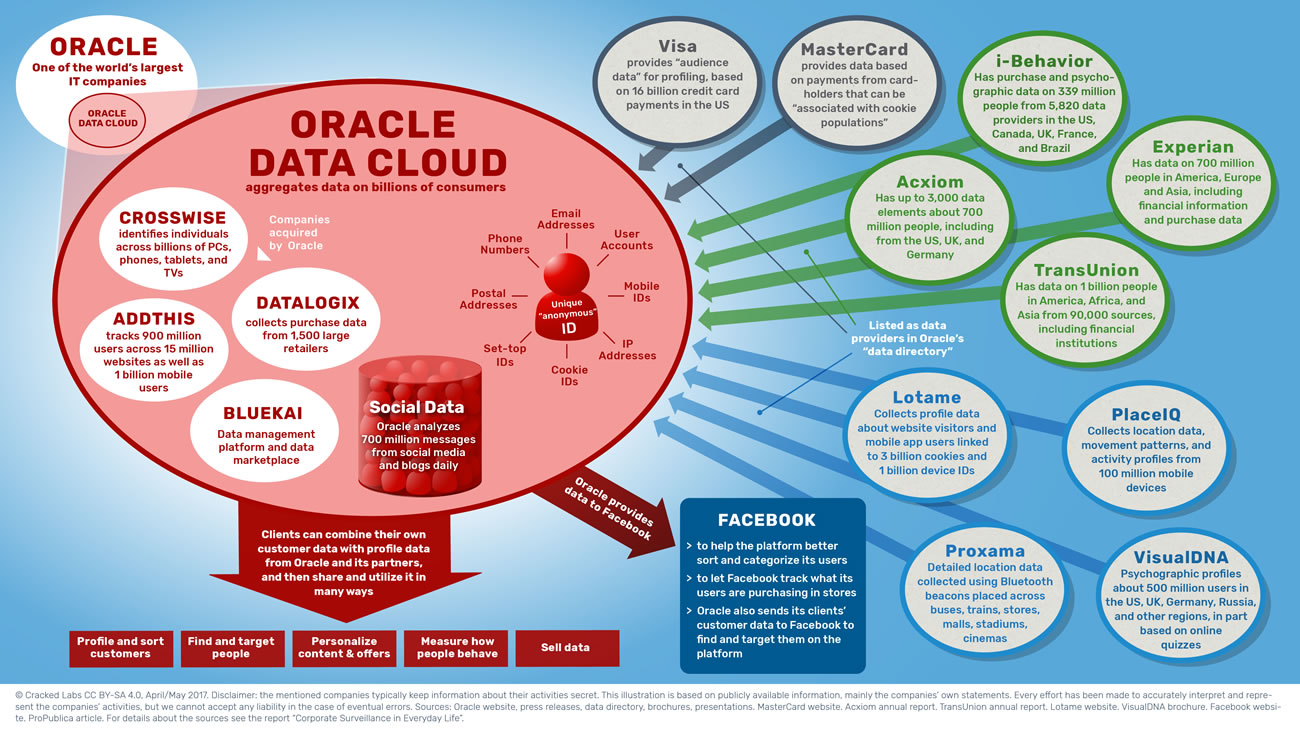
Oracle and its data providers, partners and services (as of April/May 2017). Sources see report
Oracle
lists nearly 100 data providers in its data
directory, including Acxiom and
credit reporting agencies such as Experian
and TransUnion, as well as companies that track website visits, mobile app
usage, and movements, or that collect data from online quizzes. Visa and MasterCard are listed as data
providers, too. Together with its partners, Oracle provides over 30,000
different data categories that may be assigned to consumers. Conversely, the
company shares data with Facebook
and helps Twitter calculate the
creditworthiness of its users.
Oracle’s ID Graph identifies and combines user profiles across
companies. It
“unites all interactions” across databases, services and devices to
“create one addressable consumer profile” and
“identify customers and prospects everywhere”. Other companies can send match
keys based on email addresses, phone
numbers, postal addresses, and other identifiers to Oracle, which will then
synchronize them to its
“network of user and statistical IDs that are linked together in the Oracle ID Graph”.
Although the company promises to only use anonymous
user IDs and anonymous
user profiles, these still refer to certain individuals and can be used to recognize
them and to single them out in many life contexts.
Generally,
clients can upload their own data about
customers, website visitors, or app users to Oracle’s data cloud, combine it with data
from many other companies and then transfer and utilize it on hundreds of other
marketing and advertising technology platforms in real-time. They can use it
to, for example, find and target
people across devices and platforms, personalize
interactions, and eventually, to measure
how consumers respond after having been addressed and affected on an
individual level.
V. Real-time monitoring of behaviors across everyday life
Online
platforms, advertising technology providers, data brokers, and businesses in
all industries can now monitor, recognize, and analyze individuals in many
situations. They are able to learn what people are interested in, what they did
today, what they are likely to do tomorrow, and how much they might be worth as
a customer.
Data about people’s online and offline lives
A wide
range of companies has been collecting information on people for decades.
Before the Internet, both credit bureaus and direct marketing agencies were major points of integration between data flowing from different sources. A
first big step into systematic consumer surveillance occurred in the 1990s
through database marketing, loyalty programs, and advanced consumer credit
reporting. Following the ascent of the Internet and online advertising in the early
2000s and the rise of social networks, smartphones, and online advertising in
the late 2000s, we now see the traditional consumer data industry
integrating with the new digital tracking and profiling ecosystem in the 2010s.
Mapping data collection on consumers
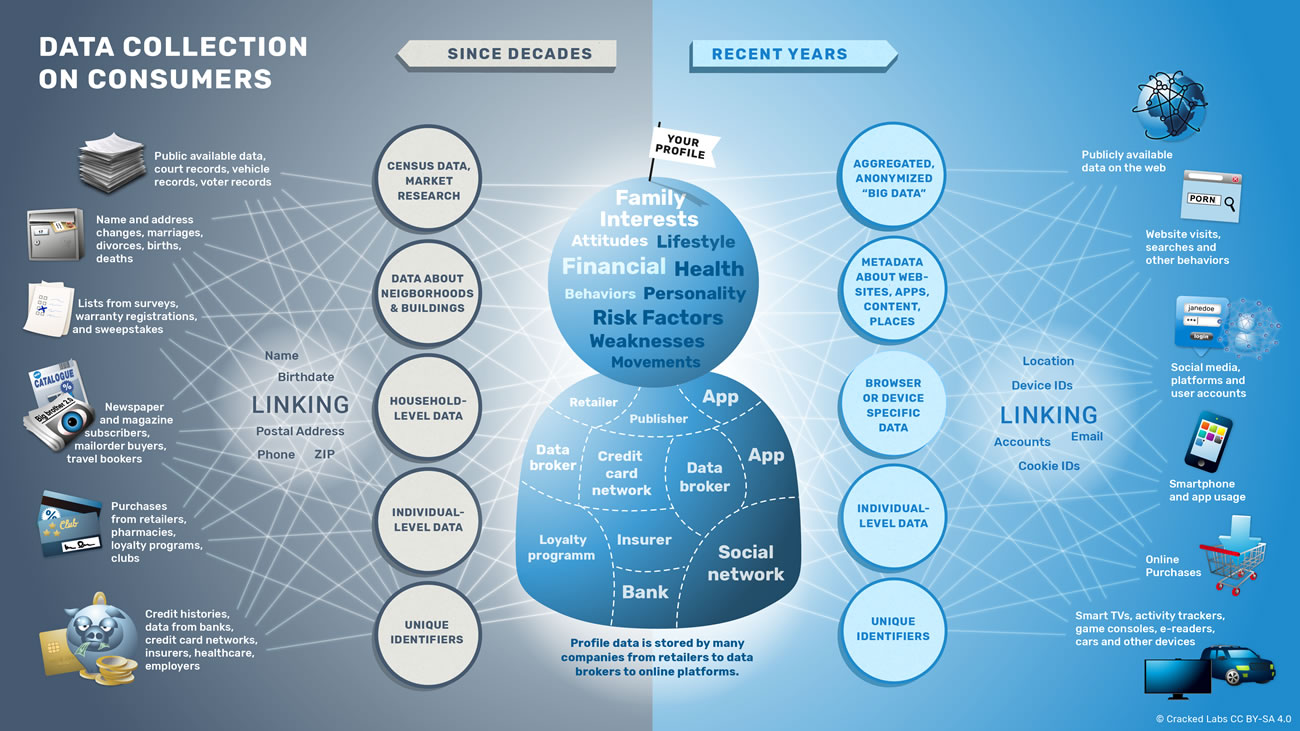
Different levels, realms and sources of corporate consumer data collection.
Consumer data brokers and other firms have long been acquiring
information on newspaper and magazine subscribers, book and movie club members,
catalog and mail order buyers, travel agency bookers, seminar and conference
participants, and consumers filling out warranty card product registrations.
The collection of purchase data from loyalty
programs has also long been an established practice in this regard.
In addition
to data directly gathered from individuals they have been using, for example,
information about the types of neighborhoods and buildings people are
living in to characterize, label, sort, and categorize people. Similarly,
companies now profile consumers based on metadata about the types of
websites they surf, the videos they watch, the apps they use, and the
geographic locations they visit. In recent years, the scale and depth of
behavioral data streams generated by all sorts of everyday activities, such
as web, social media, and device usage, have risen rapidly.
„That’s No Phone. That’s My Tracker“
New York Times,
2012
Ubiquitous digital tracking and profiling
One major
reason that corporate tracking and profiling has become so pervasive lies in
the fact that nearly all websites, mobile app providers, and many device vendors
actively share behavioral data with other companies.
A few years
ago most websites began embedding
tracking services that transmit user data to third parties into their
websites. Some of these services provide visible functionality to users. When a
website shows, for example, a Facebook like button or an embedded YouTube
video, user data is transmitted to Facebook or Google. Many other services
related to online advertising remain hidden, though, and largely serve only one
purpose, namely to collect user data. It is widely unknown exactly which kinds
of user data digital publishers share and how third parties use this data.
At least
part of these tracking activities can be examined by everybody; by installing
the browser extension Lightbeam,
for example, one can visualize the hidden network third-party trackers.
A
recent study examined one million
different websites and found more than 80,000
third-party services that receive data about the visitors of these
websites. Around 120 of these tracking services were found on more than 10,000 websites, and six companies monitor users on more than 100,000 websites,
including Google, Facebook, Twitter, and Oracle’s BlueKai. A study on 200,000
users from Germany visiting 21 million web pages showed that third-party
trackers were present on 95% of the
pages visited. Similarly,
most mobile apps share information on their users with other companies. A 2015 study
of popular apps in Australia, Brazil, Germany, and the US found that between
85% and 95% of free apps and
even 60% of paid apps connect to third parties that collect personal
data.
An interactive map of hidden
third-party tracking services on Android apps created by researchers from
Europe and the US can be explored at: haystack.mobi/panopticon.
In terms of
devices, smartphones are perhaps the
biggest contributors to today’s ubiquitous data collection. The information
recorded by mobile phones provides detailed insights into a user’s personality
and everyday life. Since consumers generally need to have a Google, Apple, or Microsoft account to
use them, much of the information is already linked to a major platform’s
identifier.
Selling user data is not restricted to website and mobile app
publishers. The marketing intelligence company SimilarWeb, for example,
receives data not only from hundreds
of thousands of direct measurement sources from websites and apps, but also
from desktop
software and browser extensions. In recent years, many other kinds of
devices with sensors and network connections have entered everyday life,
from e-readers and wearables to smart
TVs, meters, thermostats, smoke alarms, printers, fridges, toothbrushes, toys,
and cars. Like smartphones, these devices give companies unprecedented
access to consumer behavior across many life contexts.
Programmatic advertising and marketing technology
The online advertising industry has become a pioneering
force in developing sophisticated technologies that monitor and track
people, as well as ones to combine and link profiles across the digital world.
Most of
today’s digital advertising takes place in the form of highly automated
real-time auctions between publishers and advertisers; this is often referred
to as programmatic advertising. When a person visits a website, it sends
user data to a variety of third-party services, which then try to recognize the
person and retrieve available profile information. Advertisers interested in
delivering an ad to this particular person due to certain attributes and
behaviors make a bid. Within milliseconds, the highest-bidding
advertiser wins and places the ad. Advertisers can similarly bid on user profiles and ad placements
within mobile apps.
For the
most part, however, this process does not take place directly between publishers and advertisers. The
ecosystem consists of a plethora of different kinds of data
and technology providers interacting with each other, including ad
networks, ad exchanges, sell-side platforms, and demand-side platforms. Some of
these specialize in tracking and advertising alongside search results,
general ads on
the web, mobile
ads, video
ads, social
network ads, or ads within games.
Others focus on providing data, analytics, or personalization services.
To profile
web or mobile app users, all parties involved have developed sophisticated
methods to accumulate, compile, and link information from different companies
in order to follow individuals across
their lives. Many of them collect or utilize digital profiles on hundreds
of millions of consumers, their web browsers, and devices.
Many industries are joining the tracking economy
In recent
years, businesses in many industries have started to share and utilize data on
their users and customers at a massive scale.
Most retailers
sell more or less aggregated forms of purchase
data to market research companies and consumer data brokers. The data
company IRI, for example, accesses data from more than 85,000
grocery, mass merchandise, drug, club, dollar, convenience, liquor, and pet
stores. Nielsen states that it collects sales information from worldwide 900,000
stores in more than 100 countries.
The large
British retailer Tesco has
outsourced its loyalty and data activities to a subsidiary company, Dunnhumby,
whose slogan is “transforming
customer data into customer delight”. When Dunnhumby acquired the German ad
technology company Sociomantic, they announced
that Dunnhumby will “combine its extensive insights on the shopping preferences
of 400 million consumers” with Sociomantic’s “real-time data from more than 700
million online consumers” to personalize and evaluate advertising.
Mapping the commercial digital tracking and profiling landscape
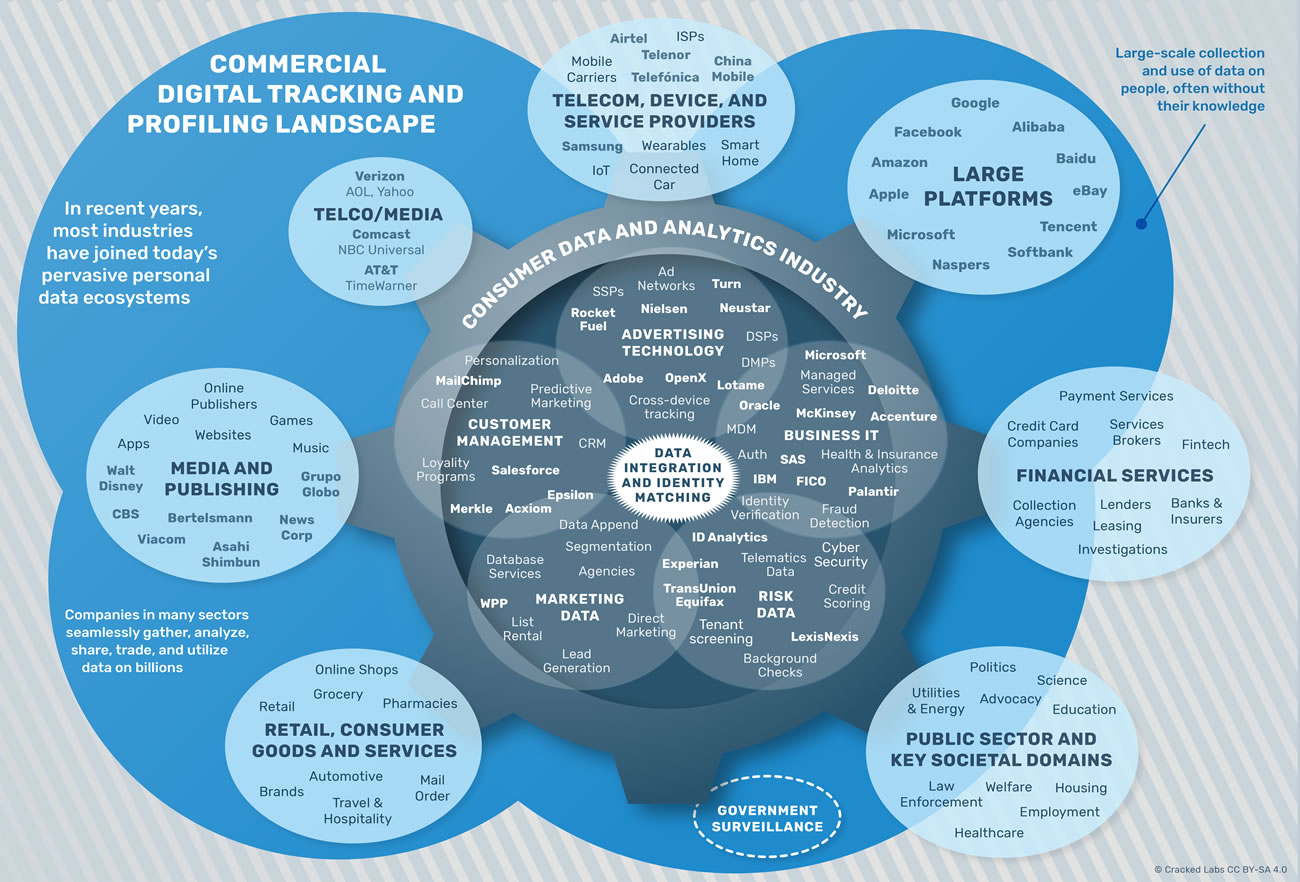
In addition to the large online platforms and the consumer data and analytics industry, businesses in
many industries have joined today’s pervasive digital tracking and profiling ecosystems
Large media
conglomerates are also deeply embedded in today’s tracking and profiling
ecosystems. For example, Time Inc.
has acquired Adelphic,
a major cross-device tracking and ad technology company, as well as Viant, a
company that claims to have access
to over 1.2 billion registered users. A prominent example of a digital
publisher that sells data on its users is the streaming platform Spotify. Since 2016, it shares insights
on their users’ mood, listening and playlist behavior, activity and location
with the data division of the advertising giant WPP, which now has access to
“unique listening preferences and behaviors of Spotify’s 100 million users”.
Many large telecom
companies and Internet Service Providers have acquired ad technology and
data companies. For example, Millennial Media, a subsidiary of Verizon’s AOL, is a mobile ad platform
collecting data from more than 65,000 apps from different developers, and
claims to have access
to approximately 1 billion global active unique users. The Singapore-based
telecom corporation Singtel acquired
Turn, an ad technology platform that gives marketers access to 4.3 billion addressable device
and browser IDs and 90,000
demographic, behavioral, and psychographic attributes.
Like
airlines, hotels, retailers and companies in many other industries, the financial
services sector started to aggregate and utilize additional customer
data with loyalty programs in the 1980s and 1990s. Companies with related,
complementary target groups have long been sharing certain customer data with
each other, a process often managed by intermediaries. Today, one of these
intermediaries is Cardlytics, a firm that runs reward programs with 1,500 financial
institutions such as the Bank of America
and MasterCard. Cardlytics promises
financial institutions that it will “generate new revenue streams using the
power of [their] purchase data”. The company also partners with LiveRamp, the
Acxiom subsidiary that combines
online and offline consumer data.
For MasterCard, selling products and
services created from data analytics might even become its core business given that information
products, including sales of data already represent a considerable and
growing share of its revenue. Google
recently stated that it captures approximately
70% of credit and debit card transactions in the United States through “third-party
partnerships” in order to track purchases, but did not disclose its sources.
„It’s your data. You have the right to control it, share it and use it how you see fit.“
How the online data broker Lotame addresses its corporate clients on its website,
2016
VI. Linking, matching and combining digital profiles
Until
recently, advertisers who used Facebook, Google or other online ad networks
could target individuals based only on their online behavior. However, a few years
ago data companies began providing ways to combine and link digital profiles
across platforms, customer databases, and the world of online advertising.
Connecting online and offline identities
In 2012, Facebook started allowing companies to upload
their own lists of email addresses and phone numbers to the platform. Although
these addresses and numbers are converted into pseudonymous
codes, Facebook can directly link this customer data from other companies
with Facebook user accounts. In this way, companies can, for example, find and target exactly those persons
on Facebook that they have email addresses or phone numbers on. They could also
selectively exclude them from targeting or let the platform find people with
similar attributes, interests, and behaviors.
This is a powerful feature, perhaps more powerful
than it seems at first glance. It allows companies to systematically connect
their own customer data with Facebook’s data. Moreover, it also allows other
advertising and data vendors to synchronize with the platform’s databases and
tap into its capacities, essentially providing a kind of real-time remote control for Facebook’s data universe. Companies
can now capture highly specific behavioral data, such as a click on a website,
a swipe in a mobile app or a purchase in a store, in real-time, and tell
Facebook to immediately find and target the persons who performed these
activities. Google
and Twitter
launched similar features in 2015.
Data management platforms
Today, most
advertising technology companies continuously pass various forms of
codes referring to individuals onto each other. Data management platforms allow
businesses in all industries to combine
and link their own data on consumers, including real-time information about
purchases, website visits, app usage, and email responses, with digital profiles provided by myriads third-party data
providers. The combined data can then be analyzed, sorted and categorized, and
used to address certain people with certain messages on certain channels or
devices. A company could, for example, target a group of existing customers
that visited a certain page on its website, and are predicted to become valuable customers, with personalized content
or a discount – either on Facebook, in a mobile app, or on the company’s own
website.
The
emergence of data management platforms marks a key moment in the development of pervasive commercial behavioral tracking. With
their help, businesses in all industries across the globe are able to
seamlessly combine and link the data they have collected about their customers
and prospects for years with billions of profiles collected within the world of
digital tracking. Companies running such platforms include
Oracle, Adobe, Salesforce (Krux), Wunderman (KBM Group/Zipline), Neustar,
Lotame, and Cxense.
„We will serve ads to you based on your identity, but that doesn't mean you're identifiable“
Erin Egan, chief privacy officer at Facebook,
2012
Identifying people and linking digital profiles
To monitor
and follow people in many situations of their lives, combine profiles on them,
and always recognize them as the same individuals again, companies collect a wide
range of data attributes that identify them in some way.
Because of
its ambiguity a person's legal name has always been a bad identifier for data collection.
The postal address, in contrast, has
long been, and still is, a key attribute that allows combining and linking data
about consumers and their families from different sources. In the digital
world, the most relevant identifiers used to link profiles and behavioral data
across different databases, platforms, and devices are email addresses, phone numbers, and unique codes that refer to
smartphones or other devices.
User account IDs of the large platforms such as Google,
Facebook, Apple, and Microsoft also play an important role in following people
across the Internet. Google, Apple, Microsoft,
and Roku
assign “advertising IDs” to
individuals, which are now widely used to match and link data from devices
such as smartphones with other information from all over the digital world. Verizon
uses its own identifier to track users across websites and devices. Some large
data companies such as Acxiom, Experian,
and Oracle have introduced globally
unique IDs for people, which they use to link their decades-old consumer
databases and other profile information from different sources with the digital
world. These corporate IDs mostly
consist of two or
more identifiers that are attached to different aspects of the online and
offline life of someone and can be linked to each other in certain ways.
Identifiers used to track people across websites, devices and areas of life
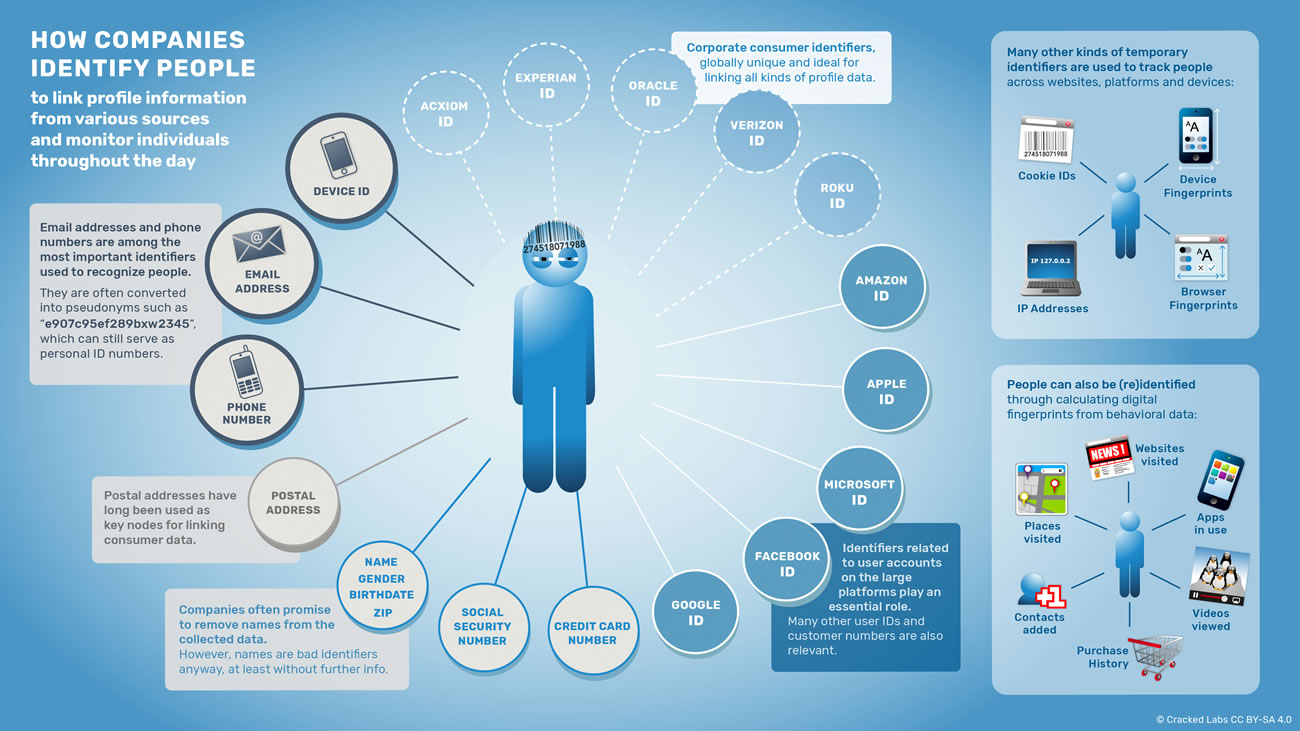
How companies identify consumers and link profile information about them. Sources see report
.
Tracking
companies also use more-or-less temporary identifiers, such as cookie IDs
that are attached to users surfing the web. Since users may disallow or delete
cookies in their web browser, they have developed sophisticated methods to
calculate unique digital fingerprints
based on various attributes of someone’s web browser and computer. Similarly,
companies compile fingerprints for devices such as smartphones. Cookie
IDs and digital fingerprints are constantly
synchronized between different tracking services, and then linked with
other, more permanent identifiers.
Other
companies provide cross-device tracking services that are based on using
machine learning to analyze large amounts of data. For example, Tapad, which has been acquired by the
Norwegian telecom giant Telenor, analyzes data on 2
billion devices around the globe and uses behavioral and relationship-based
patterns to find the statistical chance that certain computers, tablets,
phones and other devices belong to the same person.
“Anonymous” profiling?
Data
companies often remove names from their extensive profiles and use hashing
to convert email addresses and phone numbers into alphanumeric codes such as “e907c95ef289”. This allows them to
claim on their websites and in their privacy policies that they only collect,
share, and use “anonymized” or “de-identified” consumer data.
However,
because most companies use the same deterministic processes to calculate these
unique codes, they should be understood as pseudonyms that are,
in fact, much more suitable for identifying consumers across the digital world
than real names. Even if the profiles companies share with one another only contain “hashed” or
“encrypted” email addresses and phone numbers with each other, a person can still be recognized again
as soon as he or she uses another service linked with the same email address or
phone number. In this way, even though each of the tracking services involved
might only know a part of someone’s profile information, companies can follow and interact with people at an
individual level across services, platforms, and devices.
„If a company can follow and interact with you in the digital environment – and that potentially includes the mobile phone and your television set – its claim that you are anonymous is meaningless, particularly when firms intermittently add offline information to the online data and then simply strip the name and address to make it ‘anonymous’.“
Joseph Turow, marketing and privacy scholar in his book “The Daily You”, 2011
VII. Managing consumers and behaviors, personalization and testing
Based on
the sophisticated methods of linking and combining data across different
services, businesses in all industries can utilize today’s ubiquitous
behavioral data streams to monitor and analyze a wide range of consumer
activities and behaviors that might be relevant to their business interests.
With the
help of data vendors, companies try to capture as many touchpoints
across the whole customer
journey as possible, from digital ones to in-store purchases, direct mail,
TV ads, and call center calls. They try to record
and measure every interaction with a consumer, including on websites,
platforms, and devices they do not control themselves. They can seamlessly
collect rich data about their customers and others in real-time, enhance
them with information from third parties, and utilize the enriched
profiles within the
marketing and ad technology ecosystem. Today’s consumer data management platforms allow
for the definition of complex sets of
rules that dictate how to automatically react to specific criteria such as
certain activities, people, or some combination thereof.
Consequently,
individuals never know whether their
behavior triggered a reaction from any of these continuously updated,
interconnected, opaque networks of tracking and profiling, and, if so, how this
affects the options they get across communication channels and life situations.
Tracking, profiling and affecting people in real-time
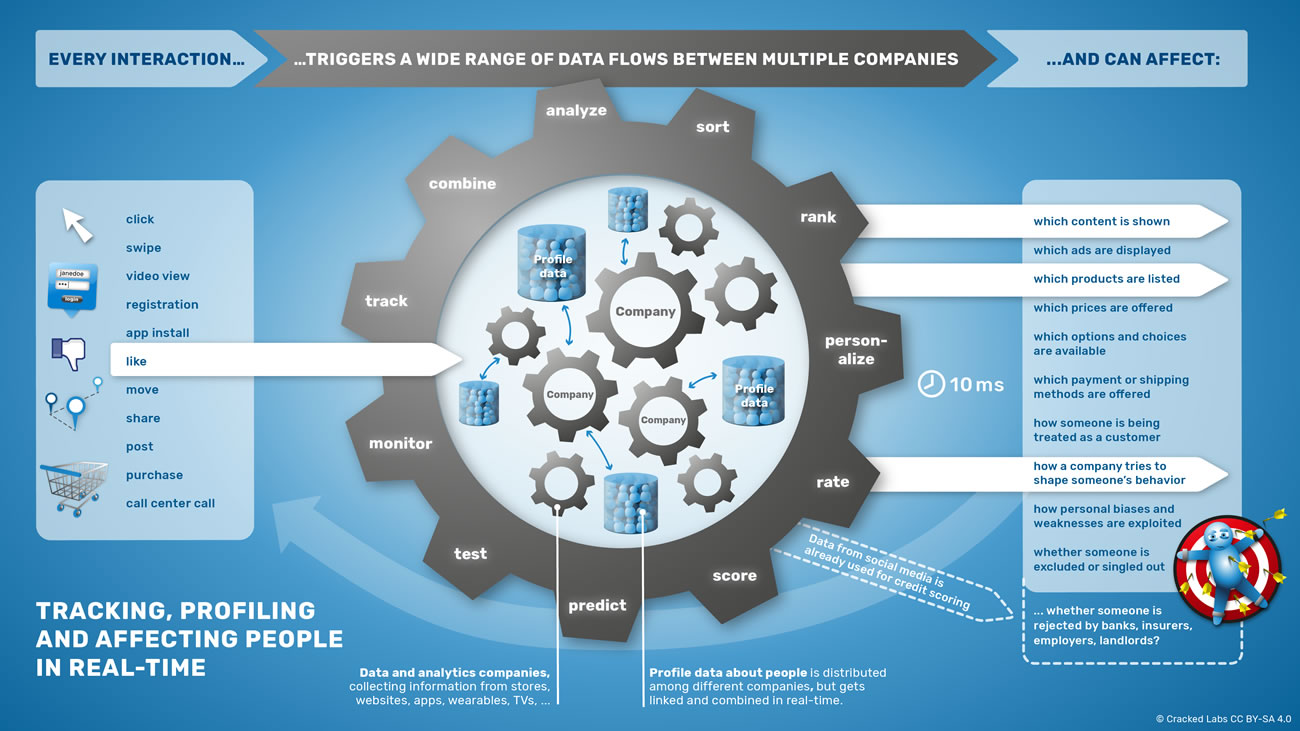
Every interaction triggers a wide range of data flows between multiple companies.
Mass personalization
The data
streams that are shared between online advertisers, data brokers, and other
companies are not only used to display precisely targeted ads on websites or
within mobile apps to users. They are increasingly used to dynamically personalize the contents, options, and
choices offered to consumers on, for example, a company’s website. The data
technology firm Optimizely, for instance, can help personalize a website for first time
visitors, based on digital profiles on those visitors provided by Oracle.
Online
stores might, for example, personalize how someone is addressed, which products are displayed
prominently, which discounts are
offered, and even the prices of products or services can differ based on who is
visiting a website. Online fraud detection services assess users in real-time
and decide which payment and shipping
methods someone sees.
Companies have developed technologies to constantly calculate and rate
someone’s potential long-term
value based on information about a said person’s
browsing, search, and location history, as well as app usage, product purchases, or friends on a social network.
Every
click, swipe, like, share, or purchase might automatically influence how someone is treated as a customer,
how long someone has to wait when calling a phone hotline, or whether someone
is excluded from marketing efforts or services at all.
„The rich see a different Internet than the poor“
Michael Fertik, founder of reputation.com,
2013
Three types of technology platforms play an important role for this
kind of instant personalization. First, companies use advanced Customer
Relationship Management systems to manage their data on
customers and prospects. Second, they use Data
Management Platforms to connect their own data to the digital
advertising ecosystem, and gain additional profile information about their
customers. Third, they can use Predictive Marketing Platforms, which
help them compile the right
message to the right person at the right time by calculating how to persuade
someone by exploiting personal biases and weaknesses.
The data
company RocketFuel, for example, promises its clients to “bring
together trillions of digital and real-world signals to create individual
profiles and deliver personalized, always-on, always-relevant experiences to
the consumer”, based on 2.7 billion unique
profiles in its data store. RocketFuel says that it “scores
every impression for its propensity to influence the consumer”.
The
predictive marketing platform TellApart,
which belongs to Twitter, creates a customer value score
for each shopper and product combination, a “compilation of likelihood to
purchase, predicted order size, and lifetime value”, based on “100s of online
and in-store signals about a particular anonymous customer”. Subsequently,
TellApart helps automatically assemble content such as “product imagery, logos,
offers and any metadata” for personalized ads, emails, websites, and offers.
Personalized pricing and election campaigns
Similar
methods can be used to personalize prices in online shops by, for example,
predicting how valuable someone might be as customer in the long term or
how much someone is probably willing to pay in a moment. Strong evidence suggests
that online shops already show differently
priced products to different consumers, or even different prices for the
same products, based on their individual characteristics and behaviors.
A similar field is the use of personalization during election campaigns. Targeting voters with personalized
messages that are
adapted to their personality and to their political views on certain issues has
already raised massive
debates about the potential for political
manipulation.
Utilizing data, analytics, and personalization to manage consumers
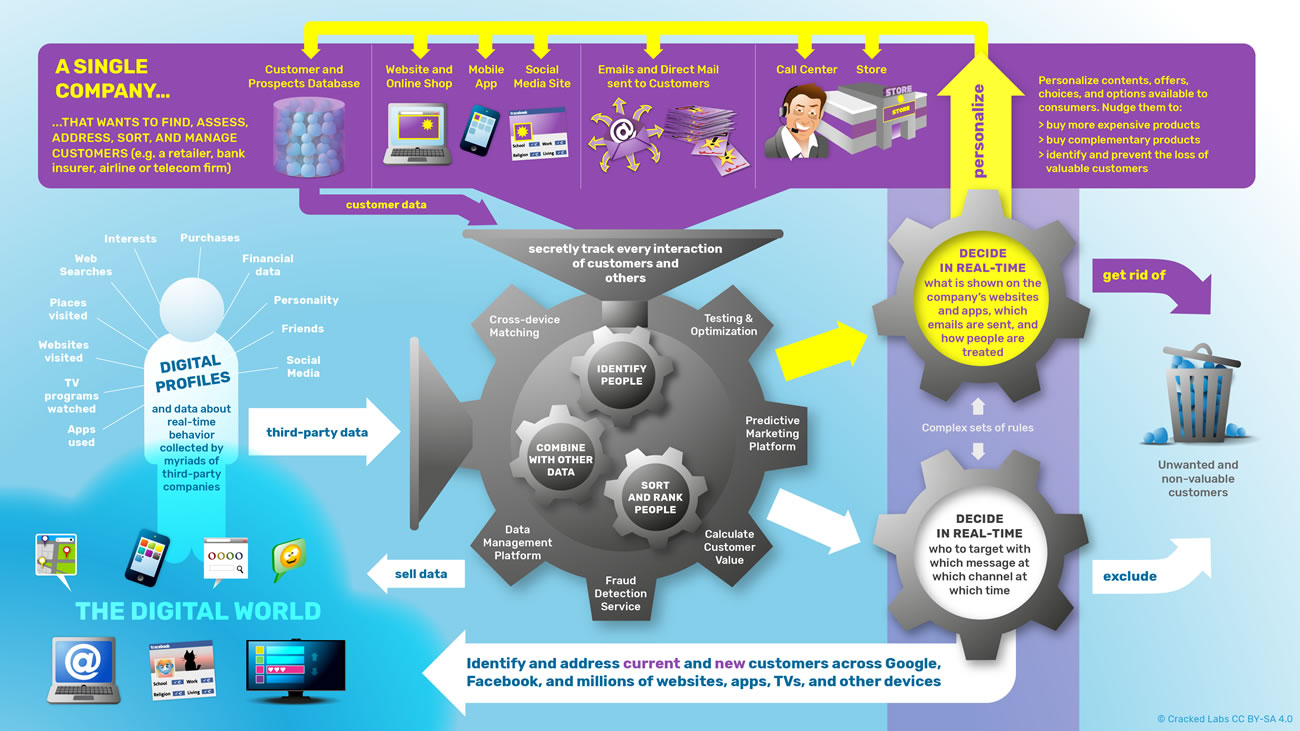
Businesses in all industries can utilize today’s networks of digital tracking and profiling
to find, assess, address, sort and manage customers.
Testing and experimenting on people
Personalization
based on rich profile information and pervasive real-time monitoring has become
a powerful tool set to influence
consumer behavior such as visiting a website, clicking on an ad,
registering for a service, subscribing to a newsletter, downloading an app, or
purchasing a product.
To further
improve this, companies have started continuously experimenting on people. They
conduct tests with different variations of functionalities, website designs,
user interface elements, headlines, button texts, images, or even different
discounts and prices, and then carefully monitor and measure how different
groups of users interact with these variations. In this way, companies systematically optimize their ability to
nudge people into acting how they want them to act.
News
organizations, including large outlets such as the Washington
Post, use different versions of
article headlines to test which variant performs better. Optimizely, one of
the major technology providers for such tests, offers its clients the ability to
“experiment broadly across the entire customer experience, on any channel, any
device, and any application”. Experimenting on unaware users has become the new normal.
Facebook stated
in 2014 that it runs “over a thousand experiments each day” in order to
“optimize specific outcomes” or “inform long-term design decisions”. In 2010 and 2012,
the platform conducted experiments on millions of users and showed that manipulating
Facebook’s user interface, functionalities, and displayed content can significantly increase voter turnout
for groups of people. The platform’s notorious mood experiment on
nearly 700,000 users involved secretly manipulating the amount of emotionally
positive and negative posts in users’ news feeds, which ended up influencing how many emotionally positive
and negative messages the users then posted themselves.
After
massive public criticism of Facebook’s experiments, the online dating platform OkCupid released a provocative blog
post defending such practices, stating that “we experiment on human beings”
and “so does everybody else”. OkCupid reported on an experiment wherein they
had manipulated the “match” percentage shown to pairs of users. When they
showed a 90% match to actually bad-matching pairs, these users exchanged
significantly more messages with each other. OkCupid claimed that when they
“tell people” they are a “good match”, they “act as if they are”.
All these
ethically highly questionable experiments clearly demonstrate the power of data-driven personalization to influence behavior.
VIII. Dragnet – everyday life, marketing data and risk analytics
Data about
people’s behaviors, social relationships, and most private moments is
increasingly applied in contexts or for purposes completely different from
those for which it was recorded. In particular, it is increasingly used to make
automated decisions about individuals
in crucial areas of life such as finance, insurance, and healthcare.
Risk data for marketing and customer management
Credit
reporting agencies and other key
players in risk assessment in fields such as identity verification, fraud
prevention, healthcare and insurance analytics mostly also provide marketing
solutions. Furthermore, most consumer data brokers trade many kinds of
sensitive information – e.g. about an individual’s financial situation – for
marketing purposes. The use of credit scores for marketing purposes to either
focus on or exclude vulnerable population groups has evolved into products that
unify marketing and risk management.
The credit
reporting agency TransUnion
provides, for example, a product for data-driven
decisions in retail and financial services that allows clients to
“implement marketing and risk strategies tailored for customer, channel and
business goals”, including credit
data and promising “unique insights into consumer behavior, preferences and
risk”. Companies can let consumers “choose from a suite of offerings that are
tailored to their needs, preferences and risk profile” and “evaluate a customer
for multiple products across channels, and then only present the offer(s) that
are most relevant to them, and profitable” for the company. Similarly, Experian provides a product
that combines “consumer credit and marketing information that is compliantly
available from Experian”.
„Surveillance is not about knowing your secrets, but about managing populations, managing people“
Katarzyna Szymielewicz, Vice-President EDRi,
2015
Online identity verification and fraud detection
In addition
to the real-time surveillance machine that has been developed within online
advertising, another forms of pervasive
tracking and profiling has emerged in the fields of risk analytics, fraud detection and cyber security.
Today’s online
fraud detection services use highly invasive technologies to evaluate billions of digital transactions
and collect vast amounts of information about devices, individuals, and
behaviors. Traditional vendors in credit reporting, identity verification,
and fraud prevention have started to monitor and evaluate how people surf the
web and use their mobile devices. Furthermore, they have started to link digital behavioral data with the vast
amounts of offline identity information that they have been collecting for
decades.
With the
rise of technology-mediated services, verifying consumer identities and
preventing fraud have both become increasingly important and challenging
issues, especially in light of cybercrime and automated fraud. At the same
time, today’s risk analytics systems have aggregated giant databases with sensitive information on entire populations.
Many of these systems cover a wide range of use cases, including proof of
identity for financial services, assessing insurance and benefits claims,
analyzing payment transactions, and evaluating billions of online transactions.
Such risk
analytics systems may decide whether an application or transaction is accepted or rejected or which payment
and shipping options are available for someone during an online transaction.
Commercial services for identity verification and fraud analytics are also used
in areas such as law enforcement and
national security. The line between commercial applications of identity and
fraud analytics and those used by government intelligence services is blurring more and more.
When people
are singled out by such opaque systems, they might get flagged as suspicious and warranting special treatment or investigation
– or they may be rejected without explanation. They might get an email, a phone
call, a notification, an error message, or the system may simply withhold an
option without the user ever knowing of its existence for others. Inaccurate
assessments may spread from one system to another. It is often difficult or impossible to object to
such negative assessments that exclude or deny, especially because of how hard
it is to object to mechanisms or decisions that someone does not know about at
all.
Examples of online fraud detection and risk analytics services
The cyber
security firm ThreatMetrix processes data on 1.4
billion “unique user accounts” across “thousands of global websites”. Its Digital Identity
Network captures “millions of daily consumer transactions including logins,
payments and new account originations”, and maps the “ever-changing
associations between people and their devices, locations, account credentials,
and behavior” for identity verification and fraud prevention purposes. The
company partners with
Equifax and TransUnion. Its clients include Netflix,
Visa,
and firms in fields such as gaming, government services, and healthcare.
Similarly,
the data company ID Analytics, which was recently acquired by Symantec,
runs an ID
Network with “100 million identity elements coming in each day from leading
cross-industry organizations”. The company aggregates data on 300 million
consumers, including on
sub-prime loans, online purchases and credit card and wireless phone
applications. Its ID
Score evaluates digital devices, as well as names, social security numbers,
and postal and email addresses.
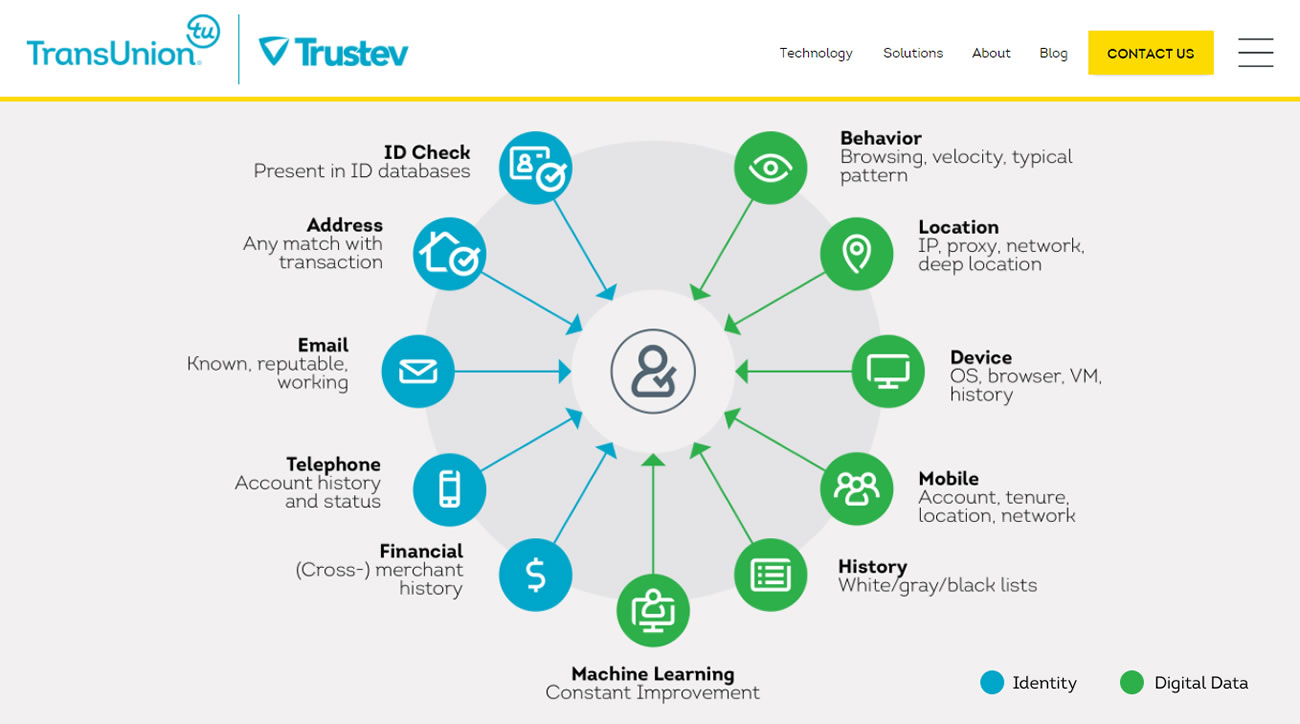
Trustev, an online fraud detection company
based in Ireland, which was acquired by the credit reporting agency TransUnion
in 2015, evaluates
online transactions for clients in financial services, government, healthcare,
and insurance, based on the analysis
of digital behaviors, identities, and devices such as phones, tablets, laptops,
game consoles, TVs, and even refrigerators. The company offers corporate
clients the ability to analyze how
visitors click and interact with websites and apps, and uses a wide range of data to assess
users, including phone numbers, email and postal addresses, browser and device
fingerprints, credit checks, transaction histories across merchants, IP
addresses, mobile carrier details and cell locations. To help “approve future
transactions” every device receives a unique
device fingerprint. Trustev also offers a social
fingerprinting technology that analyzes social media content, including “friend list analysis” and “pattern
identification”. TransUnion has integrated
Trustev technology into its own identity and fraud solutions.
Trustev uses a wide range of data to assess people, according to its website:
Screenshot of Trustev’s website, June 2, 2017 © Trustev
Similarly,
the credit reporting agency Equifax states that it has data on nearly 1
billion devices and can validate “where a device really is and whether it
is associated with other devices used in known fraud”. By combining
this data with “billions of identity and credit events to find suspicious
activity” across industries, and with information about employment and about relationships
between households, families and associates, Equifax claims to be able to
“identify devices as well as individuals”.
I am not a robot
Google’s reCaptcha product actually provides
similar functionality, at least in parts. It is embedded into millions of
websites and helps website providers decide whether a visitor is a legitimate
human being or not. Until recently, users had to solve several kinds of quick
challenges such as deciphering letters on a picture, choosing objects in a grid
of pictures, or simply clicking on an “I’m not a robot” checkbox. In 2017,
Google introduced an invisible
version of reCaptcha, explaining
that from now on “human users will be let through” without any user interaction in contrast to “suspicious ones and
bots”. The company doesn’t disclose which kinds of user data and behaviors it
uses to identify
humans. Investigations suggest
that Google doesn’t only use IP addresses, browser fingerprints, the way user’s
type, move their mouse, or use their touchscreen "before, during, and
after" a reCaptcha interaction, but also several of Google’s cookies. It is not clear whether people without
user accounts face a disadvantage, whether Google is able to identify specific
individuals rather than only “humans”, or whether Google also uses the data
recorded within reCaptcha for purposes other than for bot detection.
Digital tracking for advertising and fraud detection?
The
ubiquitous streams of behavioral data recorded for online advertising
increasingly flow into fraud detection systems. The marketing data platform Segment,
for example, offers clients easy ways to send data about their customers,
website, and mobile app users to many different marketing technology services,
but also to fraud detection companies.
One of them is Castle,
which uses “customer behavioral data to predict which users are likely a
security or fraud risk”. Another one, Smyte, helps “prevent scams,
spam, harassment and credit card fraud”.
The large
credit reporting agency Experian
offers a cross-device tracking service that provides universal
device recognition across mobile, web, and apps for digital marketing. The company promises to reconcile
and associate their client’s “existing digital identifiers”, including
“cookies, device IDs, IP addresses and more”, providing
marketers with a “ubiquitous, consistent and persistent link across all
channels”.
Experian’s
device identification technology comes from 41st parameter, an online fraud detection company that Experian acquired
in 2013. Based on 41st parameter’s technology, Experian also offers a device
intelligence solution for fraud
detection during online payments, which “establishes a reliable ID for the
device and collects rich device data”, “identifies every device on every visit
in milliseconds” and “gives unparalleled visibility into the person behind the
payment”. It is not clear whether
Experian uses the same data for its device identification services in fraud
detection and marketing.
IX. Mapping the commercial tracking and profiling landscape
In recent years, pre-existing practices of
commercial surveillance have rapidly evolved into a vast landscape of corporate
players that constantly monitor entire populations. Some actors in today’s pervasive tracking
and profiling ecosystem, such as the large platforms and other companies
with large numbers of customers, have a unique position in terms of the
scale and depth of their consumer profiles. Nevertheless, the data used to make
decisions on people in many areas of life is mostly not held in one place, but rather
assembled from several sources in real-time, as needed.
A wide range of data
and analytics companies in marketing, customer management and risk analytics
seamlessly gather, analyze, share, and trade consumer data as well as combine
it with further information from thousands of other companies. While the data
and analytics industry provides the means to deploy these powerful technologies,
businesses in many industries equally contribute both to intensifying the
amount and detail of the collected data and the ability to utilize it.
Mapping the commercial digital tracking and profiling landscape
In addition to the large online platforms and the consumer data and analytics industry, businesses in
many industries have joined today’s pervasive digital tracking and profiling ecosystems
Google and Facebook, followed by other large platforms such as Apple, Microsoft, Amazon
and Alibaba have unprecedented access to data about the lives of billions of
people. Although they have different business models and therefore play
different roles in the personal data industry, they have the power to widely dictate
the basic parameters of the overall digital markets. The large platforms mostly
restrict how other firms can directly obtain their data; in this way, they
force them to utilize the platform’s data on users within their own
ecosystems and gather additional data from beyond the platforms’ reach.
Although the large multinationals in
different sectors that have frequent interactions with hundreds of millions of
consumers are in a somewhat similar position, they not only acquire consumer
data collected by others, but often also provide data. While parts of the
financial services and telecoms sectors, as well as crucial societal areas
such as healthcare, education, and employment, are subject to stronger privacy
regulation in most jurisdictions, a wide range of companies has started to
utilize or contribute data to today’s networks of commercial surveillance.
Retailers
and other companies that sell products and services to consumers mostly also
sell data about their customers’ purchases. Media conglomerates and digital publishers
sell data about their audiences, which is then utilized by companies in most
other sectors. Telecom and broadband providers have started following
their customers through the web. Large companies in retail, media and telecom have
acquired or are acquiring data, tracking, and advertising technology firms.
With Comcast acquiring NBC Universal, and AT&T most likely acquiring Time
Warner, the large telecoms in the US are also becoming giant publishers,
creating powerful portfolios of content, data, and targeting capabilities. With
its acquisition of AOL and Yahoo, Verizon also became a “platform”.
Financial institutions have long used data on consumers for risk management, such as
credit scoring and fraud detection, as well as for marketing, customer acquisition,
and retention. They supplement their own data with external data from credit reporting
agencies, data brokers and marketing data companies. PayPal, the biggest
name in online payments, shares personal information with more than 600
third parties including other payment providers, credit reporting agencies,
identity verification and fraud detection companies, as well as with the most
advanced players within the digital tracking ecosystems. While credit card
networks and banks have shared financial data on their customers with risk data
providers for decades, they have now started selling transactional data
for marketing purposes.
A myriad of smaller and larger firms
providing websites, apps, games, and other applications are closely
connected to the marketing data ecosystem. They use services that allow them to
easily transmit data about their users to hundreds of third-party services.
Many of them sell their users’ behavioral data streams as a core part of their
business model. Even more worryingly, companies that provide new kinds of
devices such as fitness trackers also seamlessly embed
services that transfer user data to third parties.
The pervasive real-time surveillance
machine that has been developed for online advertising is rapidly
expanding into other fields including politics, pricing, credit scoring, and
risk management. Insurers all over the world have started to offer their
customers programs involving
real-time tracking of behaviors such as car driving, health activities, grocery
purchases, or visits to the fitness studio. New players in insurance
analytics and financial technology predict individual health risks based on
consumer data, as well as the creditworthiness of individuals based on
behavioral data on phone calls or web searches.
Consumer data brokers, customer management companies, and advertising agencies such as
Acxiom, Epsilon, Merkle or Wunderman/WPP play a major role in combining and
connecting data between platforms, multinationals, and the advertising
technology world. Credit reporting agencies like Experian that provide
many services in very sensitive fields such as credit reporting, identity
verification and fraud detection also play a major role in today’s pervasive
marketing data ecosystem.
Particular large companies that provide data,
analytics, and software services have been named as “platforms” as well. Oracle,
a large database and business software provider, has become a consumer data
broker in recent years. Salesforce, the market leader in customer
relationship management that is managing the customer databases of millions of
clients, yet having many customers each, has acquired
Krux, a major data company connecting and combining data all over the digital
world. The software company Adobe also plays an important role
in profiling and advertising technology.
In addition, most major companies in business
software, analytics and consulting, such as IBM, Informatica, SAS, FICO,
Accenture, Capgemini, Deloitte, and McKinsey, or even intelligence and
defense firms such as Palantir, also play a significant role in the
management and analysis of personal data, from customer relationship management
to identity management to marketing to risk analytics for insurers, banks, and
governments.
X. Towards a society of pervasive digital social control?
This report finds that the networks of
online platforms, advertising technology providers, data brokers, and other businesses
can now monitor, recognize, and analyze individuals in many life situations.
Information about individuals’ personal characteristics and behaviors is
linked, combined, and utilized across companies, databases, platforms, devices,
and services in real-time. With the actors guided only by economic goals, a data
environment has emerged in which individuals are constantly surveyed and
evaluated, categorized and grouped, rated and ranked, numbered and quantified,
included or excluded, and, as a result, treated differently.
Several key developments in recent
years have rapidly introduced unprecedented new qualities to ubiquitous
corporate surveillance. These include the rise of social media and networked
devices, the real-time tracking and linking of behavioral data streams, the
merging of online and offline data, and the consolidation of marketing and risk
management data. Pervasive digital tracking and profiling, in combination with
personalization and testing, are not only used to monitor, but also to
systematically influence people’s behavior. When companies use data
about everyday life situations to make both trivial and consequential automated
decisions about people, this may lead to discrimination, and reinforce
or even worsen existing inequalities.
In spite of its omnipresence, only the tip
of the iceberg of data and profiling activities is visible to individuals. Much
of it remains opaque and barely understood by the vast majority of people. At
the same time, people have ever fewer options to resist the power of this
data ecosystem; opting out of pervasive tracking and profiling has
essentially become synonymous with opting out of modern life. Although
corporate leaders argue that privacy
is dead (while caring
a great deal about their own privacy), Mark Andrejevic suggests that people do indeed
perceive the power asymmetries of today’s digital world, but feel “frustration
over a sense of powerlessness in the face of increasingly sophisticated and
comprehensive forms of data collection and mining”.
In light of this, this report focused on
the actual practices and inner workings of the contemporary personal data industry.
While the picture is becoming clearer, large parts of the systems in place
still remain in the dark. Enforcing transparency about corporate data practices
remains a key prerequisite to resolving the massive information asymmetries
between data companies and individuals. Hopefully this report’s findings will
encourage further work by scholars, journalists, and others in the fields of
civil rights, data protection, consumer protection, and, ideally, also of
policymakers and the companies themselves.
In 1999, Lawrence Lessig famously predicted
that left to
itself, cyberspace will become a perfect tool of control shaped primarily by
the “invisible hand” of the market. He suggested that we could “build, or
architect, or code cyberspace to protect values that we believe are
fundamental, or we can build, or architect, or code cyberspace to allow those
values to disappear”. Today, the latter has nearly been made reality by the
billions of dollars in venture capital poured into funding business models
based on the unscrupulous mass exploitation of data. The shortfall of privacy
regulation in the US and the absence of its enforcement in Europe has actively
impeded the emergence of other kinds of digital innovation, that is, of
practices, technologies, and business models that preserve freedom, democracy, social justice, and
human dignity.
On a broader level, data protection
legislation alone will not mitigate the consequences that a data-driven world
has on individuals and society, whether in the US or Europe. While consent and choice are crucial
principles to resolve some of the most urgent problems of intrusive data collection,
they can also produce an illusion
of voluntariness. Besides additional regulatory
instruments such as anti-discrimination, consumer protection, and competition
law, it will generally require a major collective effort to realize a
positive vision for a future information society. Otherwise, we might soon end
up in a society of pervasive digital social control, where privacy becomes – if
it remains at all – a luxury commodity for the rich. The building blocks are already
in place.
Further reading:
- A more comprehensive take on the issues covered
in the web publication above, as well as references and sources, can be found
in the full report, available as a PDF
download.
- The 2016 report "Networks of Control" by Wolfie Christl
and Sarah Spiekermann, which the current report is largely based on, is
available as a PDF download and as a printed book.
The production of this report, web materials, and illustrations was supported by the Open Society Foundations.