You remember the first month your salary crossed a number that once felt mythical.
You checked your bank balance more than you needed to. You imagined the relief it was supposed to bring. The conversations you would finally stop having in your head about whether you were falling behind.
For a while, it worked. The number quieted something in you.
But not completely.
Because the feeling that surfaces on Sunday evenings is not about ambition. It is not hunger for more. It is something thinner and harder to name. It is the awareness that the entire structure of your life depends on a system you do not control.
You tell yourself that everyone feels this.
But not everyone notices it.
When the promotion came, it felt like confirmation. A new title. A larger scope. Slightly more money. People asking for your input instead of just your execution.
You expected the anxiety to fade with seniority.
It did not.
Your calendar filled up. Your responsibilities increased. Your compensation adjusted. But the core structure remained untouched. You were still renting your time. You were still operating inside frameworks you did not design. Your authority extended only as far as your access badge allowed.
If the badge stops working, so does the authority.
That realization never fully leaves you.
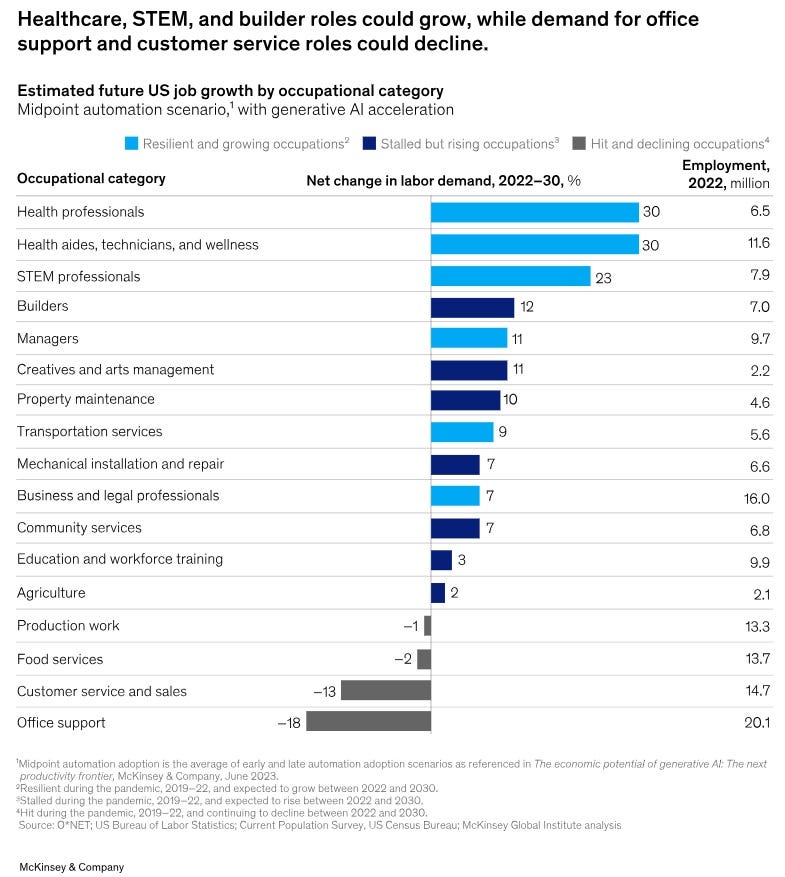
You read about automation the way people read about distant weather systems. Interesting. Relevant. But not immediate.
Then you started noticing the tools. AI drafting reports. AI summarizing research. AI assisting analysis. What once took you hours now takes minutes with the right prompts.
Consulting firms estimate that close to a third of current work activities could be automated within this decade, and much of it sits squarely inside white-collar cognitive roles. The kind performed by educated, well-paid professionals who believed their thinking was insulation.
You are not being replaced as a human being.
Your tasks are being evaluated for efficiency.
And tasks are easier to substitute than identities.
You are good at what you do. You know this because you have evidence. Reviews. Bonuses. Recognition. Increased scope.
But competence inside someone else’s system does not equal leverage.
Between 2022 and 2024, hundreds of thousands of workers in technology and knowledge sectors were laid off globally. Many were high performers. Many were well compensated. Entire teams disappeared not because they lacked skill, but because they were cost centers during a recalibration.
High income can make you feel powerful.
On a balance sheet, it can also make you expensive.
You know this. Even if you do not say it out loud.
There are moments when you imagine the email. The meeting invite. The calm voice explaining “organizational changes.”
You immediately calculate how long you could last without income. You reassure yourself with savings projections. You remind yourself that you are capable and would find something else.
But beneath the logic sits a sharper question.
If the structure disappeared tomorrow, what would remain that you fully control?
For years I tried to answer that question by accumulating more knowledge. More certifications. More frameworks. I thought clarity would remove the unease. It did not. The shift came when I stopped pretending insight was the issue and built Accountability AI for Men as an external spine, something that forced me to confront where I was hiding behind busyness instead of building ownership.
The problem was never awareness.
It was avoidance.
Replaceable does not mean someone else can do your job tomorrow.
It means the system does not depend on you in a way that changes its trajectory.
When AI tools compress the time required to produce analysis, strategy, and documentation, companies do not reward you for finishing faster. They raise expectations. Or they reduce headcount. Efficiency rarely translates into personal insulation. It usually translates into structural optimization.
And optimized structures shed excess weight.
You feel this even if you cannot articulate it.
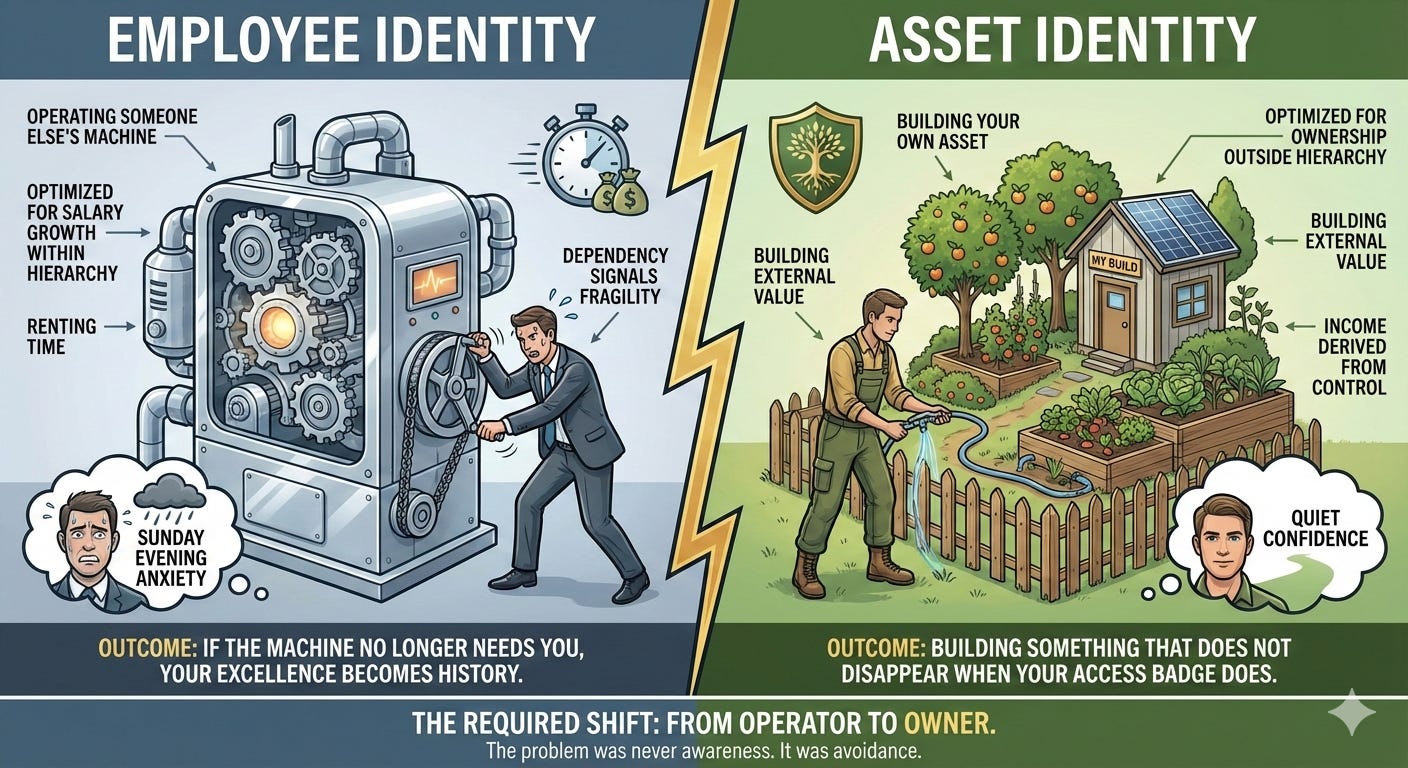
This is the contrast you live inside.
Your income signals strength. Your dependency signals fragility.
You have optimized for salary growth within a hierarchy. You have not optimized for ownership outside of it. The former looks impressive. The latter is quiet and harder. It requires building something that does not disappear when your access does.
That is why the anxiety remains.
Because somewhere in you, there is an understanding that you have spent years becoming excellent at operating a machine that is not yours.
And if the machine no longer needs you, the excellence does not negotiate.
It simply becomes history.
That is what you feel on Sunday evenings.
Not ambition.
Exposure.