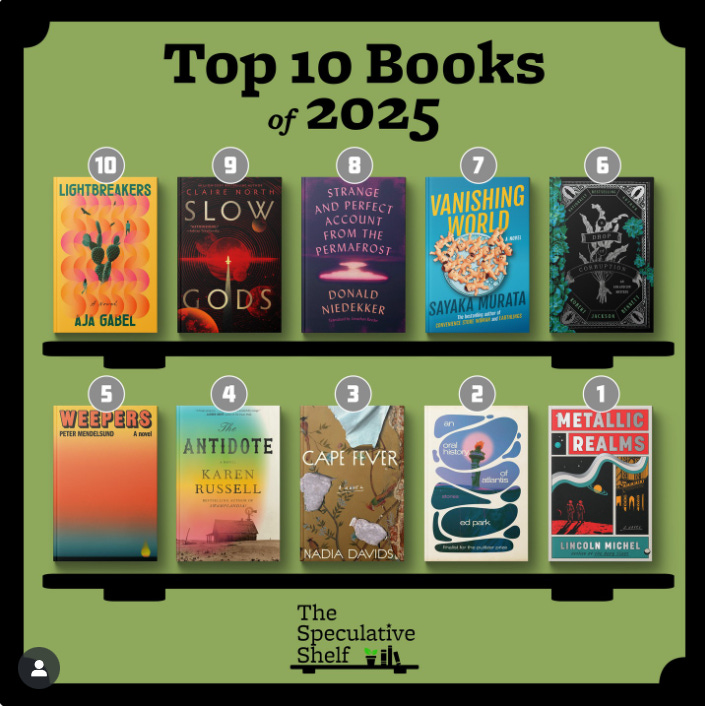
In personal writing news, I was very honored to see Metallic Realms atop The Speculative Shelf’s Top 10 Books of 2025 list. It’s a great list that includes some of my favorites of the year like Ed Park’s The Oral History of Atlantis. If you need a present for a loved one who enjoys comic novels, space adventure tales, and/or weirdo narrators, maybe Metallic Realms would make a good present this holiday season?
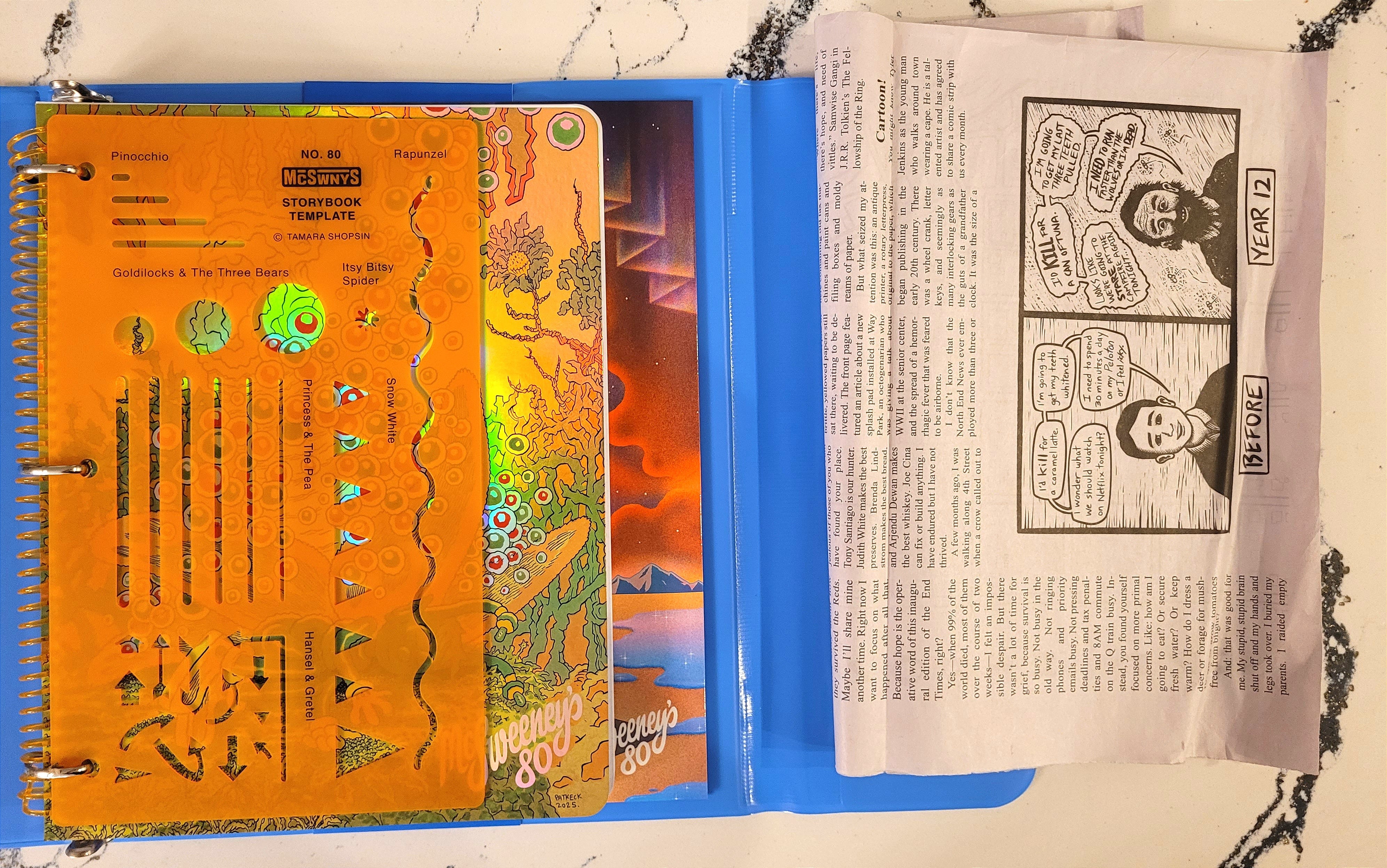
Yesterday, I got two pieces of mail that were completely different approaches to making books as art objects. The first was the new issue of the McSweeney’s magazine, which is designed as a 1980s Lisa Frank-style school binder complete with a spiral notebook, plastic geometric ruler, and more. The second was the first installment of Benjamin Percy’s apocalyptic-novel-as-serialized-newspaper The End Times (that will include contributions from Stephen King), which I interviewed Percy about a few months ago.
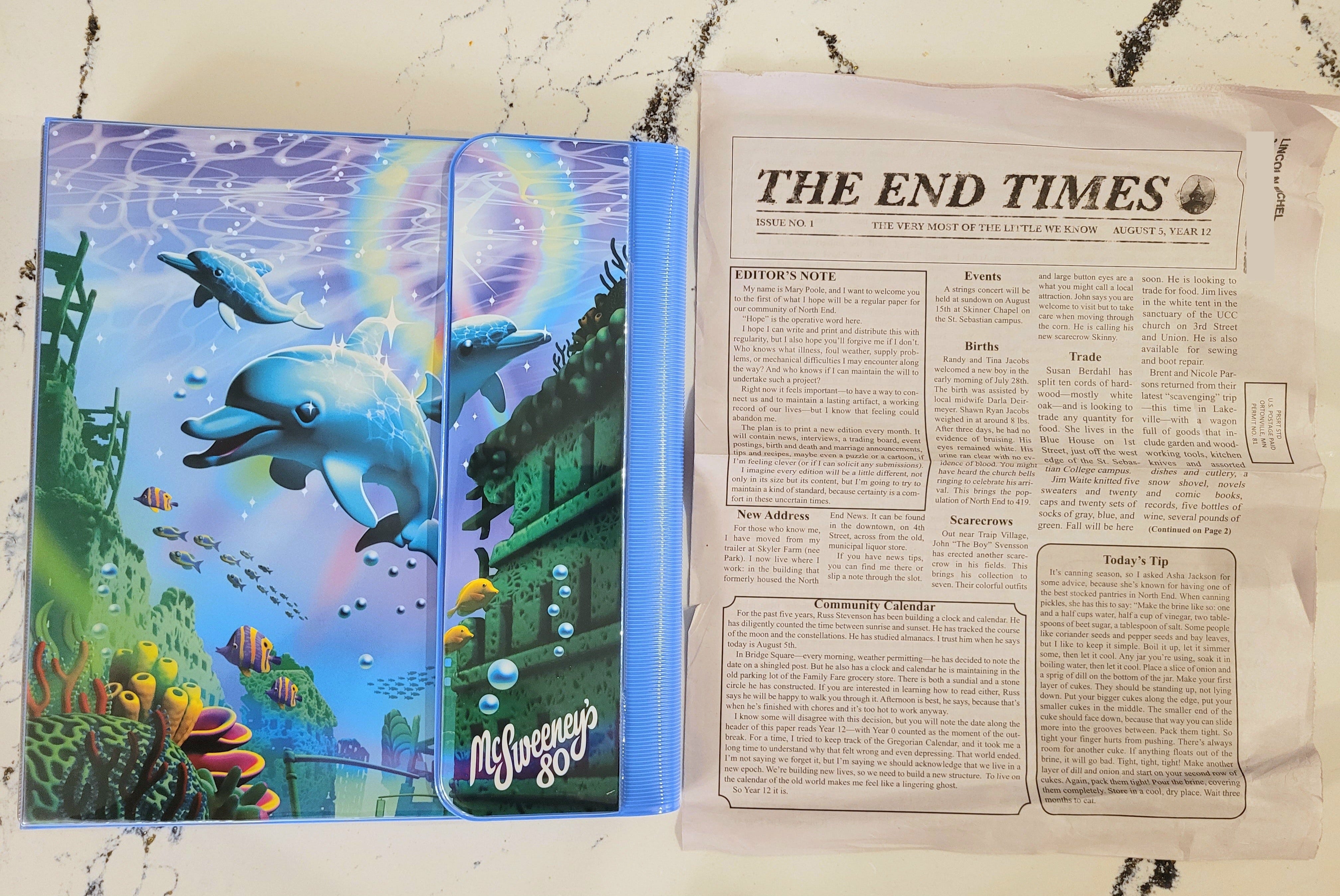
I was excited to receive both not just because I paid for the subscriptions, but because they are interesting physical objects in an age when much of my reading is done on a cellphone or laptop screen. There is a flatness to online writing. Every Substack looks more or less the same. This is partly practical—the text needs to be readable on a phone, tablet, or laptop—and partly the nature of digital media. Cover art is reduced to a thumbnail. Liner notes disappear. The texture of a painting is lost. Etc. Everything feels a bit flatter and more ephemeral online. (And that’s not even getting into the flatness of LLM text, which Sam Kriss explored in an excellent NYT essay this week.) At the same time, most printed books and especially most literary magazines tend to look pretty similar and feel disposable. These two projects represent different approaches to making a book (or “book”) unique, one maximalist and the other minimalist.
McSweeney’s has been making unique issues since they began in the late ‘90s. They’ve had issues as boxes of pamphlets and lunchboxes, issues with embroidered covers or multiple monster slipcases. (I have a story in that last one.) Even if the formats can get a bit whimsical—I don’t have any particular nostalgia for Lisa Frank school binders myself—I’ve always admired how McSweeney’s puts in the effort to make their issues unique artistic objects that you want to keep on your shelves. Benjamin Percy’s novel, which is being mailed out in regular installments, is another way to do this. It was a nice surprise in the mailbox between the bills and unasked-for catalogs.
Receiving these on the same day made me think about how I’ve long been waiting for publishing to focus on the physical object aspect of books. When the Kindle came out, a lot of critics expected books to go the way of the CD or the DVD. They thought physical books might die out in a few years. I disagreed—and got some comments calling me a “luddite” or “dinosaur”—for a few reasons, one being that we physically interact with books when we read in a way we don’t while watching a movie or listening to music. The experience of the paper, font size, weight of the book, etc. is part of the experience of reading a book. That’s not true for e.g. a CD file versus a high-quality stream. (Speakers and headphones are a different story.) Anyway, I was right about this and physical books continue to dominate book sales while ebooks have actually flatlined.
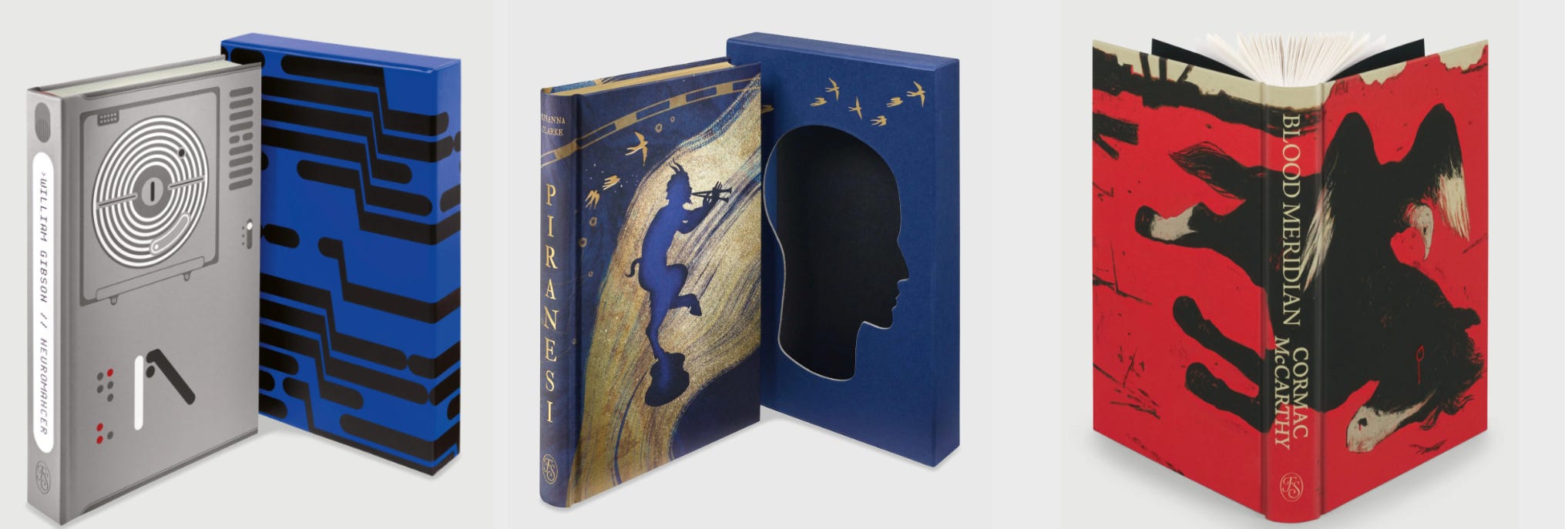
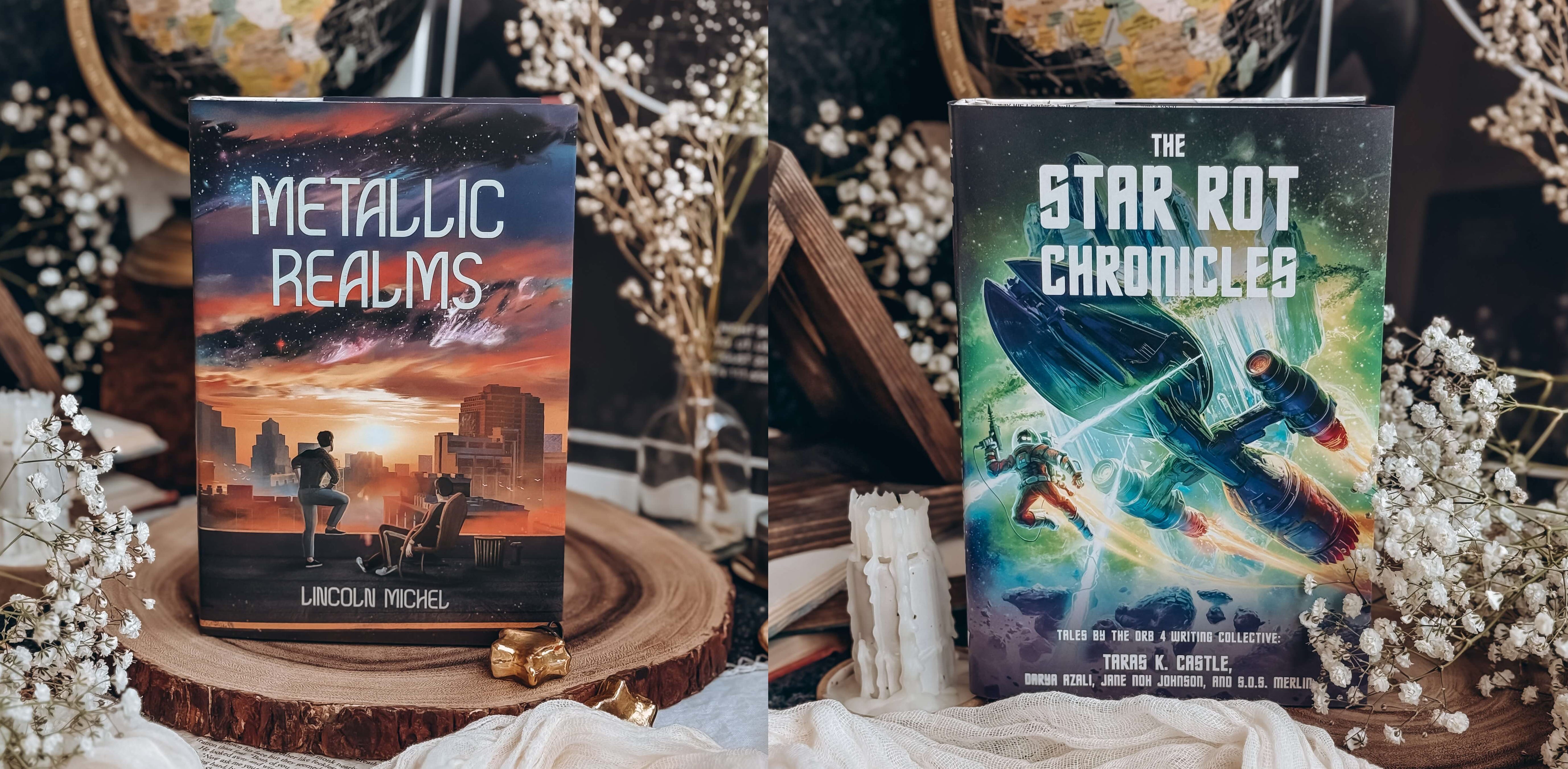
But another prediction I had back then, which hasn’t really panned out, was that publishers would increasingly focus on the book-as-object as a means of enticing readers away from ebooks and audiobooks. This does exist. Some very popular authors get special editions, like RF Kuang’s Katabasis pre-order deluxe edition this year. Those are still rare from the traditional publishers. OTOH, there are companies that produce special dust jackets for existing books and others like Folio Society and Fabelistik that produce expensive limited editions of popular books. There is a large and growing subscription box market, which often includes deluxe editions. I was lucky enough to have Metallic Realms receive one of these with OwlCrate. I have to say they really went all out with a reversible dust jacket, edge stamping, and more. It looks and feels great. These subscription box editions are near Folio quality, but much cheaper since the companies have a guaranteed number of sales with subscriptions. (You can sometimes buy editions, like mine, individually too.)
It doesn’t require expensive deluxe editions to make a book feel unique as a physical object. This fall I read Strange Houses and Strange Pictures by Uketsu, who is a phenomenon in Japan for writing picture-based mysteries. Strange Houses includes many blueprints and Strange Pictures centers on drawings.
I increasingly buy editions with small trim sizes that fit into my pockets. These are normally cheaper than standard-sized paperbacks and hardcovers. I think a lot of readers feel similarly. At least, I often see people pining for mass market paperbacks (MMPs) and my assumption is the real nostalgia is—outside of price—for smaller trim sizes and perhaps the cool pulpy covers those often had. MMPs themselves were a kinda crappy reading experience. They were printed on cheap, thin paper making the ink on the reverse side visible. The spines were always cracking, and pages would not infrequently get torn out. But the trim size was great. In the pre-smartphone age, I used to always carry a MMP around in a jacket pocket to read on the subway.
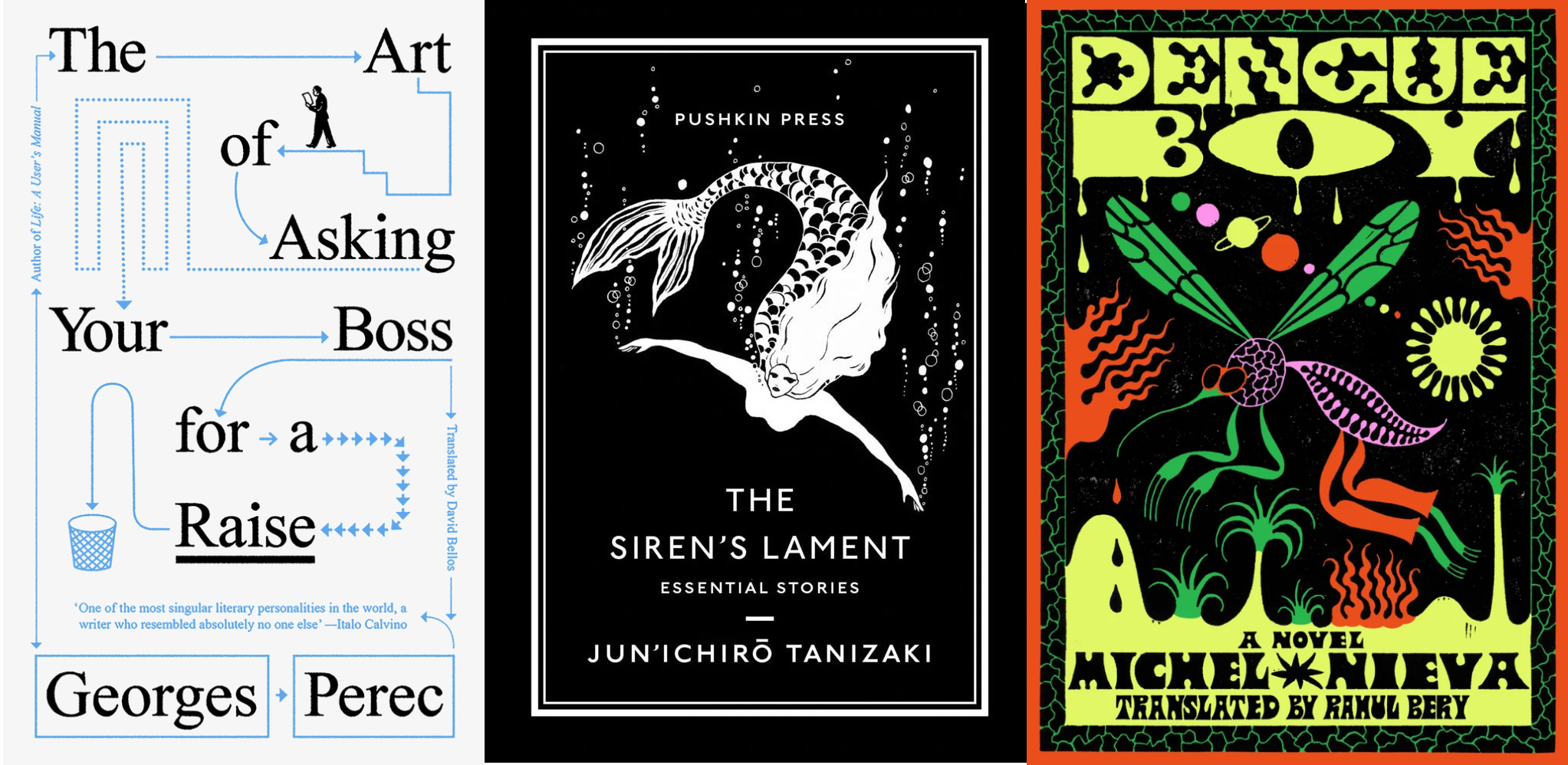
And I still like to fit a book in my pocket. MMPs are basically dead—largely replaced by ebooks for thrifty book buyers—but there are a lot of publishers (especially independent ones) who are producing lovely books in smaller trim sizes. The last one of these fits-in-pocket books I read was The Art of Asking Your Boss for a Raise by Georges Perec (trans. by David Bellos), which inspired my post on “Short Little Difficult Books.” Two others I read and loved this year were The Siren’s Lament by Jun’ichiro Tanizaki (trans. by Bryan Karetnyk) and the gonzo science-fiction novel Dengue Boy by Michel Nieva (trans. by Rahul Bery).
Another reason I find myself reaching for these portable books instead of my phone when I’m on the subway is, well, AI. It’s clear that the internet is already flooded with LLM slop text, and I see no sign the tide can be turned back. It soon may be difficult to find human-authored text at all on your phone or laptop. While LLM text is printed too, it is rarer. It costs essentially nothing for a spammer or scammer to send out a deluge of AI slop on the internet. Even a tiny cost for printing physical material adds up quickly. It makes me want to read physical things. When I talked to Benjamin Percy earlier this year about his novel-as-newspaper, he spoke to this:
I’m no Magic 8 Ball, but I suspect that with the rise of A.I., people will seek out more real things. A concert. A play. An open mic. A shadow puppet show. Something made with hands and voices. That’s my desire anyway, and maybe I’m not alone, since people have been responding so positively to The End Times.
Let’s all get our fingers stained with ink.
Obviously, I’m not telling writers to abandon online writing. I’m posting this on Substack after all. But I think this may be an era in which authors can both be online and also try different experiments and unique projects that can only exist in the physical world.
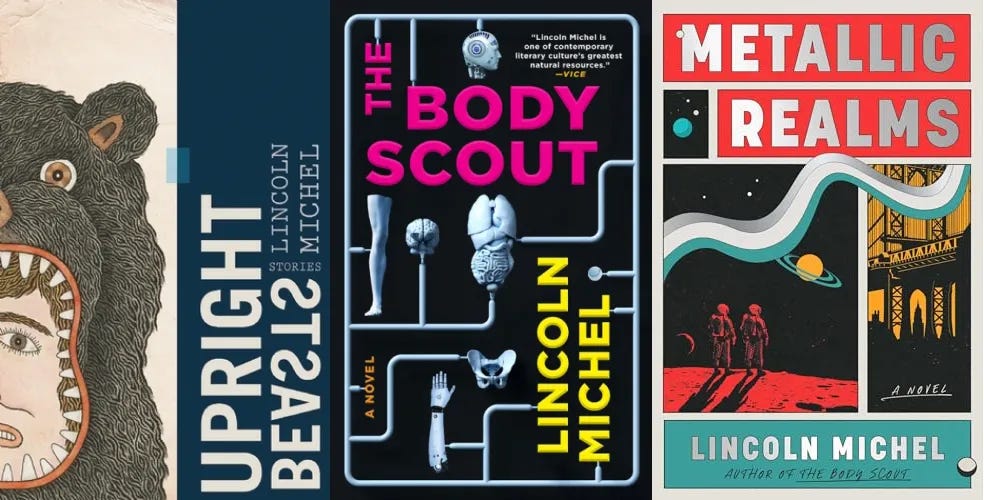
My new novel Metallic Realms is out in stores! Reviews have called the book “brilliant” (Esquire), “riveting” (Publishers Weekly), “hilariously clever” (Elle), “a total blast” (Chicago Tribune), “unrelentingly smart and inventive” (Locus), and “just plain wonderful” (Booklist). My previous books are the science fiction noir novel The Body Scout and the genre-bending story collection Upright Beasts. If you enjoy this newsletter, perhaps you’ll enjoy one or more of those books too.