[Note: I will be speaking at COMMUNIA Salon: The Rodin Case, on October 13, 2026]
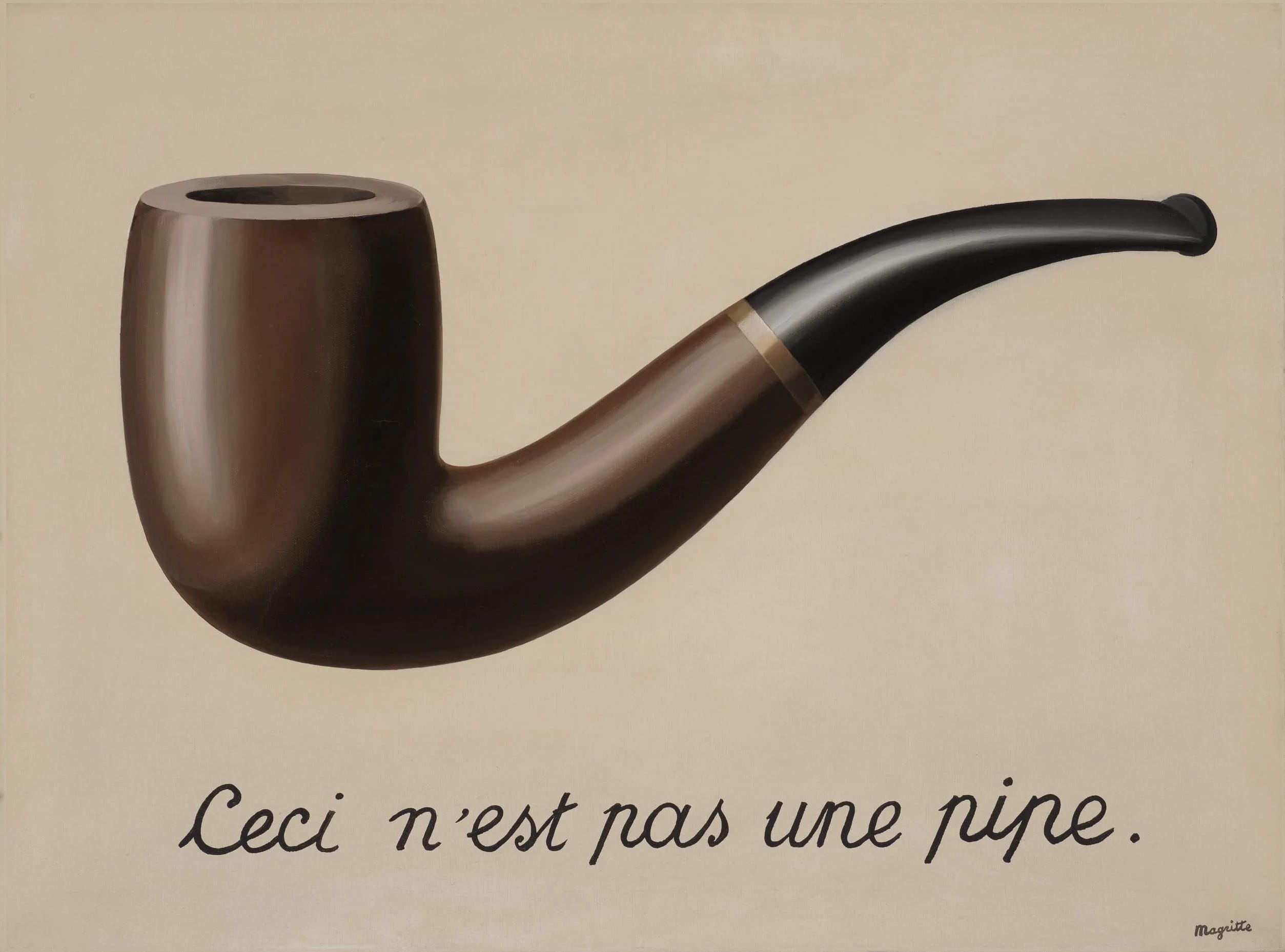
When France’s highest court for administrative justice hears your eight-year freedom of information case, and the court’s own legal analyst directly invokes surréalisme to argue that “sometimes a document is not a document,” you know you’re about to get wrecked.
In 2017, I began writing to the Rodin Museum requesting that it identify and grant public access to 3D scans of Auguste Rodin’s sculptures, some of the most well-known and widely copied public domain cultural heritage works in the world. The museum’s administrators responded with a sustained campaign of lies, weaponized incompetence, and open lawlessness.
When Paris-based civil rights advocate Alexis Fitzjean Ó Cobhthaigh took up my case and sent the museum a formal request for its 3D scans, its senior directors quietly sought legal analysis from the French government’s own Commission on Access to Administrative Documents (CADA). The CADA’s opinion was in my favor, finding that the museum’s scans were undoubtedly administrative documents and therefore must be made accessible to the public. The museum’s director did not dispute the CADA’s analysis, but she confided to the Ministry of Culture, in writing, that she planned to ignore French freedom of information (FOI) law and make me take her to court.
In 2019, we filed suit in the Administrative Tribunal of Paris, where open culture and digital rights advocacy organizations Communia, Wikimédia France, and La Quadrature du Net joined me as co-plaintiffs. We were all represented by Fitzjean Ó Cobhthaigh, who had advised us that while the facts and law were on our side, we still faced an uphill battle, since the judges would be extremely deferential to the Rodin Museum and would grant it the benefit of any doubts. He was certainly correct, but I did not anticipate that in both the Paris court and, later, on appeal in the Conseil d’État, the judges would not only tolerate the Rodin Museum lying but would reward them for it. I did not imagine that showing them how the museum had lied to them on multiple issues would have absolutely no effect on its credibility on other issues. I did not expect that the Conseil d’État itself would not only decline to hear our testimony and evidence but would take up the task of inventing and promoting new, nonsensical arguments and falsehoods the museum itself had never dared to raise.
During litigation in the Paris tribunal, the Rodin Museum baselessly insinuated that I was a would-be criminal counterfeiter while pleading its own technological illiteracy and failure to preserve the documents in its care. The museum claimed that even with the help of (unnamed) outside experts it couldn’t figure out how to use its own scan documents. It dissembled about which sculptures it had scanned and falsely asserted that its written applications for public funding to produce those scans were non-existent.
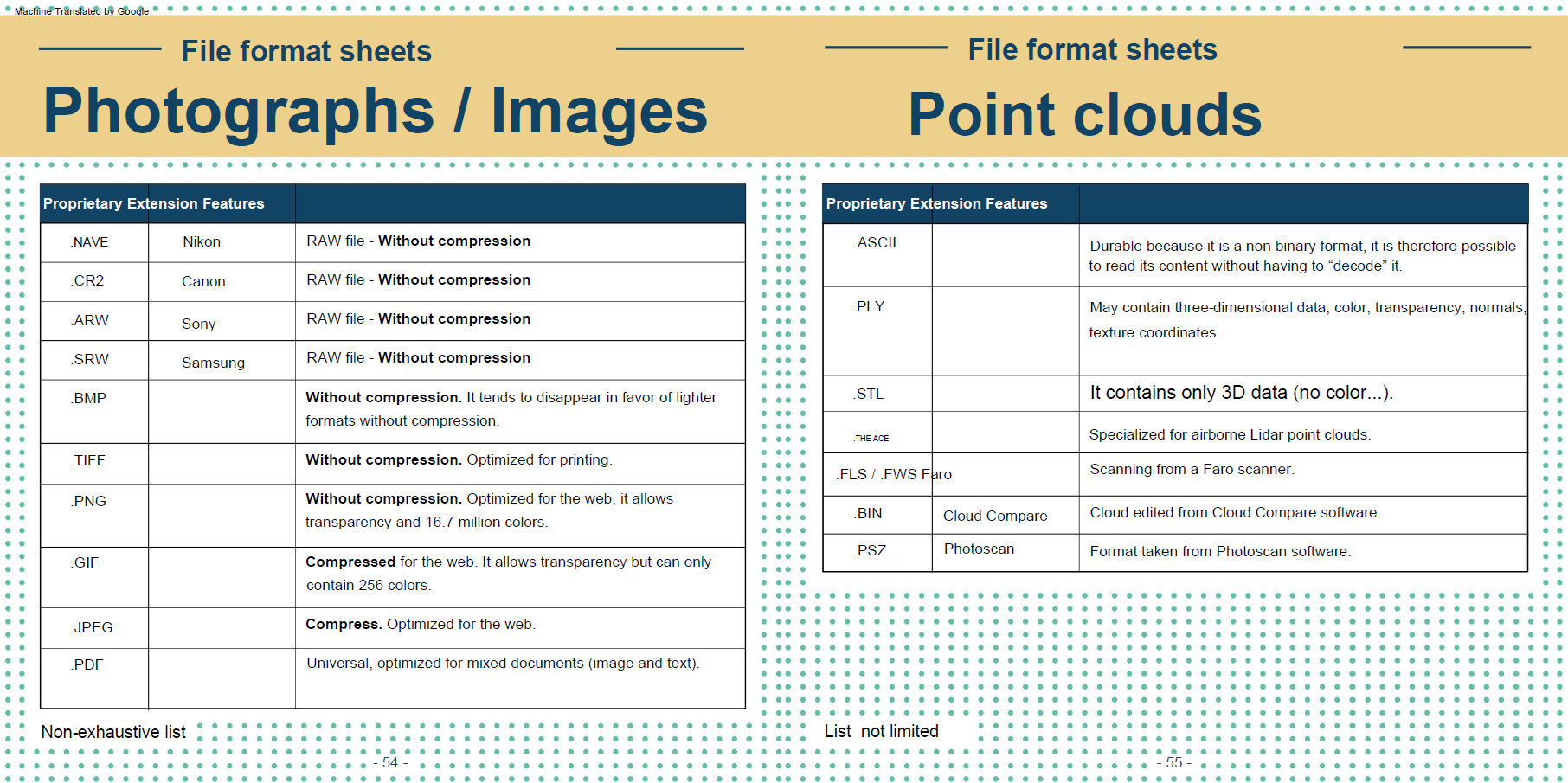
It is no exaggeration to say that the Rodin Museum lied outright to the Paris court about the few scans it reluctantly admitted to holding. It claimed that its ultra high-resolution, state-of-the-art laser-scanned 3D point cloud documents, which are in open plaintext formats that are routinely used in the digitization and cultural heritage fields, were so technologically mysterious, and of such poor quality and so incomplete as to be virtually impossible to even visualize, and were thus unusable even by the museum itself.
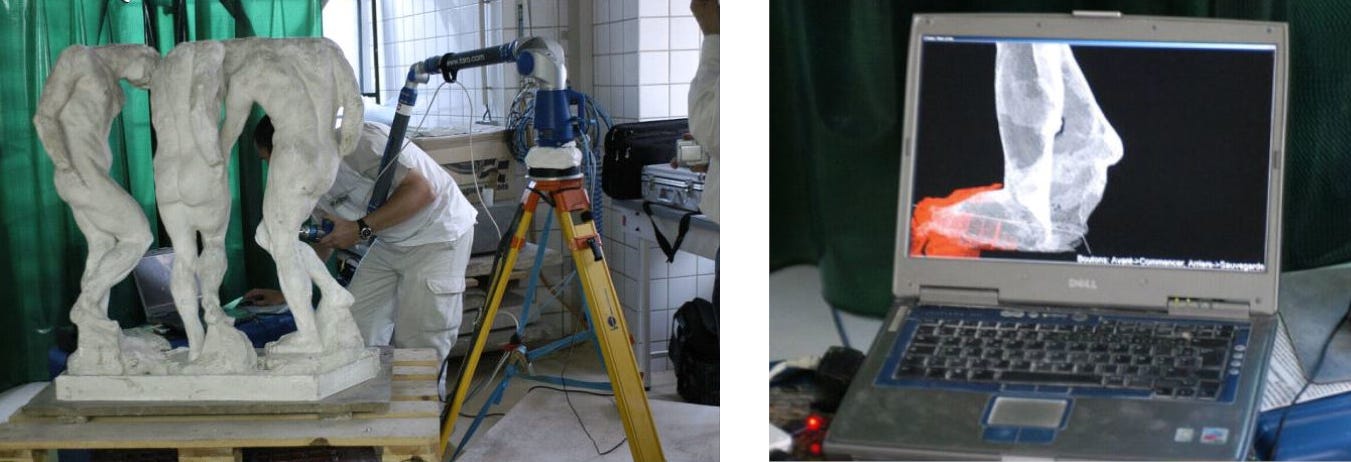
Images of the museum’s point cloud documents that I obtained from third parties illustrate the museum’s fraud on the public and the court:

The Rodin Museum’s funding applications, which we forced the ministry to disclose in a separate FOI procedure and presented in court, also made the museum’s lies and misappropriation of public funds perfectly clear.
Not content merely to tell simple, substantive lies, the Rodin Museum submitted increasingly absurd and disjointed legal briefs to the court. For example, it simultaneously claimed that its scans were unusable and that they could be used by counterfeiters. In one brief, the museum confirmed that it held a scan of Les Trois Ombres, then in the next brief denied the sculpture had ever been scanned. (We replied with a photograph of the museum’s subcontractors scanning the sculpture.)
The Rodin Museum argued that they should benefit from every possible exception to French FOI law, even if they were mutually exclusive and had no connection to the facts of the case. We refuted them all.
The Paris court rejected all of the museum’s arguments relating to trade secrecy, counterfeiting, its business model and revenue, and intellectual property. In December 2023, the court ruled that 3D scans in a variety of formats were administrative documents and therefore must be made available to the public. In a significant victory for open culture, the judges directly ordered the museum and ministry to give me those scans and to compensate me €1,500 for my trouble.
But the Rodin Museum and the Ministry of Culture simply ignored the court’s order. To be clear, they did not appeal it, they ignored it.
Worse, the Rodin Museum’s buffoonish hand-waving about 3D scan technology apparently confused or impressed the judges, who ignored our world-class expert’s testimony on point clouds. In their decision, the judges improvised a novel exception to French FOI law, ruling, without any discernable legal basis, that 3D scan point cloud documents in open, plaintext formats could be withheld from the public.
In late 2023, we appealed that point cloud exception in the Conseil d’État, France’s highest court for administrative justice, where representation by specialist avocats au Conseil d'Etat et à la Cour de cassation is mandatory. Represented by Fitzjean Ó Cobhthaigh’s colleagues at the law firm SCP Marlange - de La Burgade, we detailed the lower court’s serious procedural and legal errors and its obvious misunderstanding of point cloud documents.
We presented testimony from experts in academia and industry and the arts.
We showed the high court that cultural heritage programs the world over routinely use and publish point cloud documents that the Rodin Museum claimed were unusable, and that the French government publishes petabytes of open source point cloud documents from its aerial 3D scan surveys of the entire French territory.
Our appeal explained to the court how point cloud documents are produced, and showed that the French government itself had spearheaded the development of free, open source software for viewing and using them.
We referred the court to the Ministry of Culture’s own published guidance on the proper formatting, use, and accessibility of open format point cloud documents in the cultural heritage sector.
None of this mattered.
In its reply to our appeal, the Rodin Museum reiterated to the high court its fantastical lie that point cloud documents are fundamentally unintelligible, citing as its sole authority the speculative musings of the lower court’s rapporteur public (the court’s own legal analyst).
The rest of the Rodin Museum’s briefs in the Conseil d’État were equally inept and detached from reality, so much so that we thought they might have been too stupid to warrant a response, and we seriously considered letting the case proceed to a decision without replying. But we felt a duty to create a record that repudiated the museum’s claims point-by-point to convince the judges of the absurdity of the museum’s misrepresentations. Also, we hoped to create the possibility that the high court judges might feel embarrassed to credit the museum's nonsense.
It didn’t work.
In the days leading up to our hearing, the high court sent us a short notice that it was, on its own initiative, raising an entirely new argument on the museum’s behalf, on which it was likely to decide the case, an argument the museum itself had not suggested: that point cloud documents were not even administrative documents.
We submitted a reply, but we could only guess at what we were rebutting since, in its wisdom, the court had not disclosed the basis of its new argument. We reiterated that the Rodin Museum’s publicly funded scans had clearly been made within the context of its public service mission, and that by all legal standards, precedents, and CADA analyses, they were clearly administrative documents. And we reminded the court of the well-established, conventional nature of point cloud documents.
At our hearing in early December, 2025, the high court’s rapporteure publique began her presentation by reminding the judges of René Magritte’s surrealist painting The Treachery of Images (This is Not a Pipe), and explained that “sometimes a document is not a document.”
For additional dramatic effect she then read aloud the definition of “document” from the Dictionnaire de l’Académie française, then stumbled over her words when she seemed to realize it very clearly argued against her position. She asserted and continuously reiterated that point cloud documents are neither documents nor administrative documents. She offered her own assessment, too ludicrous for the museum to have suggested, that it would be too burdensome for the museum to deliver copies of its point cloud documents to me—documents it had already gathered and been sitting on for eight years. The rapporteure publique recited a variety of supposed exceptions to FOI law that did not fit the facts of the case and had already been examined and rejected by both the CADA and the lower court, and were not even subjects of the appeal. These included moral rights, trade secrecy, commercial reuse, counterfeiting, and economic competition, for example, the last of which drew approving nods from the judges. It was as if by merely naming these, without any evidence, relevance, or reasoning, she was presenting the judges with a buffet of options from which they could choose to reject our appeal.
In our opportunity to briefly respond with oral arguments, we directed the court’s attention to the example point cloud document we had submitted that morning: if anyone cared to look at it, it would demonstrate that it was, in fact, a document. We could have also quickly drafted and submitted a follow up written brief immediately after the hearing, but that seemed pointless. We had already said everything that could have possibly been said.
Our entire eight-year effort up to that point had generated argumentation, replies, testimony, correspondence, imagery, and hard-won evidence, which the court had compiled into a dossier more than 800 pages long. The public is not permitted to read that dossier, and in light of the way it handled our case, it appears that no one at the Conseil d’État has read it either.
The Conseil d’État issued its written decision a few weeks after the hearing, and it went well beyond what its rapporteure publique had suggested. It ruled that the Rodin Museum’s 3D scans of cultural heritage works are legally indistinguishable from physical reproductions. The museum’s scans are not administrative documents but part of its inalienable collection, and French FOI law is therefore inapplicable.
By implication, the high court’s ruling means that the government’s own FOI experts at the CADA had repeatedly erred in their analyses in my favor, as had the Paris court. Our earlier victory on other 3D scan formats was effectively undone. There would be no need for the Rodin Museum and Ministry of Culture to heed the lower court’s order that they had already chosen to violate.
The Conseil d’État judges noted that since FOI law did not apply, there was no need to consider the facts or circumstances of the case.
The judges threw out our appeal, ordered me to pay €3,000 to the Rodin Museum, and did not even bother to send me written notice of their decision.
While I’m disappointed in the court’s decision, I am proud of our work, and I appreciate how the case resolving this way achieves a strange sort of perfection.
We had begun this project by asking for permission to access publicly funded digitizations of public domain cultural heritage works, then asserting our rights to them, and methodically following every rule and procedure and official channel, and relying on the law and the truth. Confronting the Rodin Museum and Ministry of Culture with these, despite a multi-billion euro resource disadvantage, we forced them to explain and defend their policies, reasoning, and outlook, and they could not do it.
Like the Rodin Museum, other arms of the Ministry of Culture talk a good game about digitization and accessibility, but refuse to deliver. French FOI law looks good in principle, but in practice it can easily be abused by a hostile and lawless administration to exhaust petitioners’ resources and create indefinite delays until, in the final hour, a deus ex machina intervention delivers the outcome it wants.
In this case, that outcome is for the preservation, dissemination, and benefits of digitization of France’s cultural heritage to be entrusted to the care of unaccountable administrators who prize secrecy and exclusivity over accessibility, who lie without shame, who are shielded by the law but unconstrained by it, who forgo even the appearance of adhering to its procedures and orders, and who don’t hesitate to shift from proclaiming their authority to pleading their incompetence and illiteracy whenever it suits them.
The court has upheld this tableau surréaliste, but no one can justify it.
Cosmo Wenman is an open access activist and CEO of Concept Realizations, LLC. He lives in San Diego. He can be reached at cosmowenman.com and cosmo.wenman@gmail.com
Copyright 2026 Cosmo Wenman
On 13 October, 14:00 to 15:00 CEST, join us for a new COMMUNIA Salon exploring the French “Rodin case” and a deceptively simple question at the heart of access to cultural heritage: Should 3D scans of works in the Public Domain be freely available for reuse, including for commercial purposes?
During this COMMUNIA Salon, we will unpack the legal twists and turns of the Rodin case and discuss what the decision means for the Public Domain, cultural heritage institutions and the people who want to access and reuse our shared cultural heritage.
Cosmo Wenman, Alexis Fitzjean ó Cobhthaigh, Benjamin Jean (INNO3) and Brigitte Vézina (Creative Commons) will discuss the case, with COMMUNIA member Camille Françoise moderating.