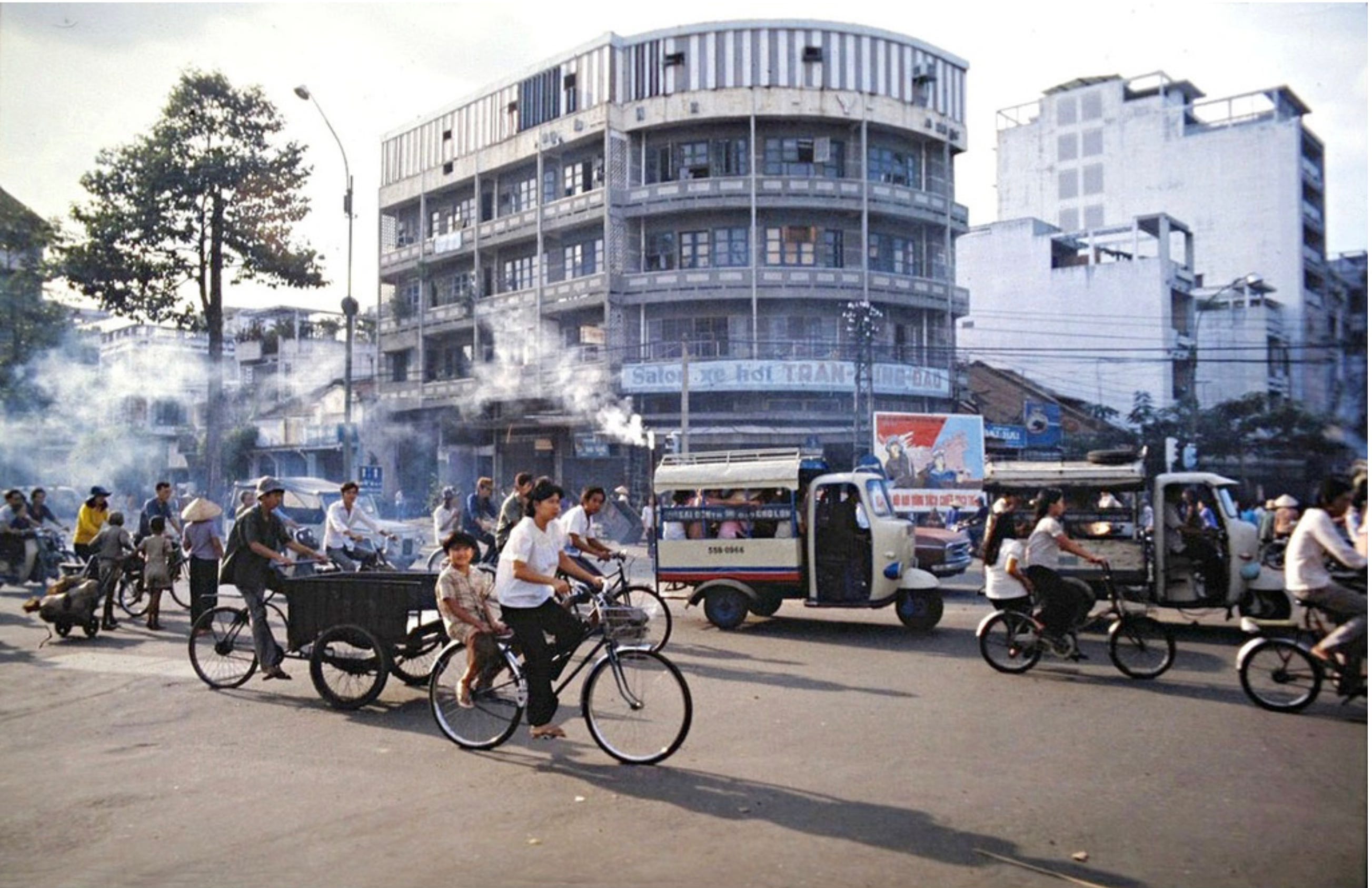
April 25, 1975
For weeks, the end has been inevitable. It is only a matter of time. Soon North Vietnamese forces will arrive and take control of the city. Well aware they are about to witness history and land front-page bylines around the world, the press corps – those who have chosen to stay or fly in for the endgame – are more excited than nervous. When a young English journalist by the name of James Fenton enters the garden of the Hotel Continental, he has to chuckle. It looks like a host of the old Indochina hands have returned and drinks have clearly been taken. Adding to the buzz, there is even a celebrity guest. Puffing on a Dunhill through his TarGard filter, and wearing one of his signature “American on-vacation” shirts, Hunter S. Thompson is holding court, surrounded by admirers1.
When Fenton joins another table, everyone is talking about the secret password, in reality more of a coded message – the one an American diplomat claims will be broadcast from the embassy when it is time to go.
First there will be an announcement: “The temperature is 105 and rising!”
And then? “White Christmas” will be played.
Schmaltzy, incongruous, and unseasonable. How utterly absurd, thinks Fenton.
For days, the Americans have been removing their colleagues and friends, along with their families, and themselves, from Saigon. With so many rushing to the exit, the journalists who remain, or who have just returned, like Fenton, inherit new possessions and even new jobs. By the end of April 28, Fenton, who has just turned 26, discovers he’s now the bureau chief of The Washington Post.
All in a day’s work.
Fenton duly arrives at ‘his’ bureau to find a charming farewell note from the recently departed staff. Still on deck is a young Vietnamese fellow who shows Fenton how to open the petty cash drawer. Fenton noses around for a minute and is relatively pleased to discover there is a nice bathroom, plenty of interesting books, and a bottle of Polish vodka in the icebox.
Just as he sits down to write his first dispatch as “bureau chief,” David Greenway, an American correspondent for the Post, calls from the US embassy. He and his colleagues are stuck, he says. Nobody has come for them, and the embassy staff are getting nervous that the place might be shelled. “Oh, and do you want the car keys?” They have left the Volkswagen by the embassy gate, if Fenton wants to fetch it.
All across town, vehicles are being handed over. The owner of an American steakhouse tosses the keys to his Jeep to AP reporter Matt Franjola, one of a small number of American journalists to stay. Another AP reporter, the Kiwi Peter Arnett, acquires a car with diplomatic plates from a departing Japanese friend. A bunch of newsmen leaving in haste, without time to settle their hotel bills, offer those staying behind everything of value in their rooms, if they will kindly pay the rent.
Returning to his office that evening in his newly acquired Volkswagen, Fenton finds a note from his Vietnamese assistant informing him that the office might be looted by deserters from the ARVN (Army of the Republic of Vietnam), so he has taken the petty cash home for safekeeping (Fenton never sees him again).
Unfazed by that, though still feeling a little frazzled, Fenton figures he deserves a stiff drink. So he goes to the icebox to grab the Polish vodka. It turns out to be water.
When Fenton heads to the Caravelle Hotel on April 29, he finds the remaining members of the press corps at the rooftop restaurant from where they will have a clear view of the final act that’s already underway. Somewhere near the airport, an ammunition dump is exploding. Great flames rise and subside, rather like the fiery furnace depicted in Hieronymus Bosch’s vision of hell, Fenton thinks grimly.
“Operation Frequent Wind,” a most unfortunate euphemism, numerous journalists on the rooftop have agreed, has been underway all day. As each of the “Jolly Green Giants” lifts off and corkscrews into the sky, the noise of their engines thunders across the city, spreading and intensifying the sense of panic on the streets.
In the distance, there is another thunderous rumble. The first monsoonal clouds of the year threaten to burst, adding to the theatre of the occasion. But eventually, the skies grow still and darkness falls. So, is that it?
After a short dreamless sleep, Fenton rises before the sun and walks to the abandoned US embassy, where looting has just begun. The streets outside are already littered with typewriters and reams of files. Several cars have been stripped.
Inside, papers, brochures, and reports are strewn everywhere. A group of old women are taking powdered milk from a kitchenette. They stop in horror at the sight of Fenton, so he pretends to be looting himself, lest he be mistaken for a stray American trying to sheriff his turf.
On the first floor, as he makes his way to the exit, clutching a bundle of books he randomly picked up – The Stages of Economic Growth, a Vietnamese-English dictionary, and a thick, tabbed briefing on rural pacification – Fenton sees a framed quotation from T. E. Lawrence:
“Better to let them do it imperfectly than to do it perfectly yourself, for it is their country, their war, and your time is short.”
Still on the roof at this moment are the very last US Marines, eleven in total. They are about to board the very last American chopper to leave Vietnam. Such is the frenzy below that they throw tear gas grenades into the crowd, which disperses, along with Fenton, in a flood of tears.
By the time he returns to the roof of the Caravelle, Fenton can still see artillery firing, an indication that the battle lines are drawing closer. Two flares go up, one red, one white. A communication between the two armies? Someone says the white flare has been fired by ARVN forces. It signals surrender.
One of the waiters sitting by the radio then turns to the foreign journalists and announces: “That’s it. The war is over.”
Within seconds, down on the street below, Fenton sees a waiter scurrying out of the Continental to hastily hoist the French flag, in the hope it will protect the building from whatever happens next. “Vive la France, eh,” says one of Fenton’s peers.
Across the river, white flares begin to rise in large numbers. Soon the tanks of the People’s Army of Vietnam will be rolling down Norodom Boulevard, followed by columns of victorious troops in celebratory mood. They are probably only a couple of miles from the gates of the Independence Palace, where “Big Minh,” the six-foot, 90-kilo Dương Văn Minh, the general who has only been president for two days, waits to formally concede. The journalists at the Caravelle are already packing up and on the move, sensing they should head towards the palace to capture the very final scene.
It’s only after they leave that the restaurant staff notice the sole civilian staring forlornly toward the southern horizon, beyond which an unseen US carrier is about to set sail with the last evacuees.
When a waiter asks him if he is French or perhaps Canadian, he replies: “No, no, I’m an American.”
“American?”
“Yeah, I’m from New York.”
“Are you a journalist?!”
“Um, no, I’m a truck driver, for the US Post Office.”
Two of the waiters exchange glances. One says nothing. The other chuckles, shakes his head, and more out of concern for himself and his colleagues than the American, says: “You know, I don’t think it’s safe for you here.”
“Holy shit – why are you flying in here today?” a US soldier had asked the mail truck driver, whose name is Gerald (Jerry) Posner.
“I’m here to get my wife,” he told the soldier in a panicked Tân Sơn Nhứt Airport on April 28. “She’s in the delta.”
“Well, good luck, buddy, but I’m telling you now, you don’t have time – the Viet Cong are a day away from the city. You know that, right?”
After an equally bemused taxi driver deposited him at the Opera House, Posner, a former vet who did back-to-back tours of duty from 1970 to 1972, checked into the Caravelle, the first hotel he saw. He then explained to the concierge that his wife, Tú Thị Nhàn, was back in her hometown, hoping to be advised how to get there in a hurry. He showed the concierge a picture of Nhàn, as if that might help.
“Sir, all foreigners have been strongly advised not to travel anywhere, not even across the city,” the concierge told Posner. “It is extremely dangerous outside Saigon. In all the confusion, you could be shot by either side or attacked and robbed by thieves.”
Posner hadn’t visualised any of this as he flew across the Pacific. He had never seen Saigon in a state of duress. He had also never experienced any kind of danger in Vietnam. His time as a soldier had mostly been dull and uneventful, sitting on base and battling boredom in Long Bình Combat Base, day after day, month after month, with the odd highlight, seeing Johnny Cash perform, for one; hitting the winning run in an East versus West Coast grudge match of (drunken) softball, another. But his days of R&R proved to be blissful once he met Nhàn, yes, over on Plantation Road, at a bar, but a nice one – the kind where the girls just flirted with homesick young men like Posner.
Their dates were old fashioned, like something he’d seen in an old movie from the ’50s. Holding hands in the cinema, strolling by the river, going for coffee and sundaes at ice cream bars, riding around on Nhàn’s Honda, stealing a kiss when they could.
Posner had been completely smitten from the first time he chatted with Nhàn, but when the lonely nights in the barracks felt unbearable, he realised he was a man in love. So, before he left Vietnam in the cool season of ’72, they took a walk in the zoo, fed nuts to the elephants, posed for a picture, and admired the birdsong at the aviary. Then, when they were sitting by the pond, under the shade of a giant banyan, Posner popped the question: “What do you say we just get married, Nhàn? You could come and live in the States with me.”
And so she did.
In April 1972, Posner returned to the US and soon got a job at the post office as a truck driver. Nhàn arrived in July, on the hottest day of the year, with the thermometer hitting 94 degrees and the water hydrants spraying the streets.
“This is how Brooklyn does the Wet Season. Kind of romantic, right?” grinned Posner.
Posner and Nhàn then lugged her suitcases up the stairs to a pokey studio on the fifth floor. “Not quite as romantic, but it’s home,” said Posner. “And as long as the AC doesn’t go on the fritz, we’ll survive the summer….”
He worked hard to help her settle, but Nhàn longed for her homeland, especially when Posner was at work. When word of a family crisis came in the form of a letter, she insisted on flying back to Vietnam in ’73. Fatefully, she kept delaying her return until it was too late. For reasons Posner never fully understood, she was stuck.
After receiving a letter from her in late March, Posner started to make urgent arrangements and eventually flew to Saigon via Bangkok, dreaming of his heroics the whole way there, only to fall very short on his rescue mission. A streetwise Saigonese guy might have paid his way through the cordon, but Posner had also been burdened with a favour, trying to find the two children of an old friend, a fellow former serviceman now back in New Jersey. He managed to find the children, and their mother, but was unable to get them inside the embassy, let alone near a helicopter on April 29.
Feeling like a failure on all counts, Posner ended up walking alone down Tự Do Street from the cathedral to the Caravelle, where on the morning of April 30, he watched the last chopper disappear into the glaring sunlight of a new day.
Not exactly how he’d imagined it would all play out, to say the least.
After the last chopper takes off just before 8am on April 30, the journalists on the Caravelle’s rooftop leave in a flurry and scramble toward Norodom Boulevard, from where they expect to see the victorious troops marching down the city’s ceremonial heart. James Fenton would end up not only witnessing the final scenes – he would get to ride on the back of a tank as it rolled through the fallen gates of the palace.
But Posner, now alone with the staff, does not know what he should be doing. Could he really be the only American left in Saigon? The waiters certainly think so.
As it turns out, he is not. In the first days after April 30, nearly everything shuts down and the remaining Westerners, mostly French, in the Tự Do area keep a low profile. But soon people begin venturing out again, businesses reopen, and an informal census begins.
One day at Givral, which is serving its usual pastries and soupe chinoise, Posner bumps into Fred Rivera, a contract aircraft maintenance man who had been working for Lear-Siegler in Biên Hòa, an hour northeast of Saigon.
Rivera missed the evacuation mainly because he did not realise how quickly things were collapsing. When he finally reached Saigon, he took one look at the “shitshow” around Tân Sơn Nhứt on April 29 and turned back into town, where he began drinking. When he woke on April 30 with a pounding headache, he looked out from his room at the Miramar Hotel, saw the army trucks, tanks, and North Vietnamese troops, and went straight back to bed.
Also mooching around the Tự Do area is Joseph (Joe) Brickman, the affable tour operator and owner of the now-customerless Vietnam Tourist Bureau. A dual citizen, half British, half American, Brickman returns to his office each day, where he drinks Tetley tea, a habit he inherited from his English mum, and debates with himself whether or not it was a good idea to stay in Saigon. At this time, he is in two minds. On one hand, he could be arrested and wrongly accused of espionage or whatnot. On the other hand, if the war is truly over, tourists might soon return, and with any luck, the bars and massage parlours would soon reopen. As the only foreign tour operator in the city, he would be well placed to turn a tidy profit. An optimist by nature, Brickman concludes it will all work out just fine.
In the early weeks of May, Brickman first runs into Rivera, then the disconsolate Posner, fast running out of money, and then another hapless case, William Smith. Like Posner, Smith is a lovelorn ex-GI who returned to the US and found work. He is employed by Greyhound in Chicago, or at least he was.
In March, Smith travelled to Danang, liberated on March 29, to find his sweetheart but after discovering she’d already got married, the brokenhearted Smith took a train all the way to Saigon. “You two guys, a match made in heaven!” Brickman remarks with a broad smile. “The last true romantics in a world gone mad.”
Unsure of how long they will be in Saigon, Smith and Posner quickly agree to share a room to save on costs.
On a morning walk from the Saigon River up to Notre Dame Cathedral, Brickman next meets Frederick Gulden, a 52-year-old Chicagoan and the chief architect for a company contracted to AID, the American economic assistance organisation.
Gulden tells Brickman he spent April 29 trying to get his Vietnamese employees out. The embassy staffers had agreed to evacuate them, but had not followed through on their promise. His nineteen American colleagues all left, but Gulden did not consider leaving until he had accounted for his Vietnamese staff. In the end, due to the chaos at the embassy, he failed to get anyone out, including himself.
Exhausted, he returned to his apartment on Hàn Thuyên Street, overlooking the palace, only to realise he had lost his key. When he rang the bell, his housekeeper opened the door, immediately shrieked as if she had seen a ghost, and slammed the door in his face.
Still carrying his overnight bag, Gulden cut his losses, walked down Tự Do and checked into the Miramar, where he slept for ten hours straight.
Also in the Tự Do area is Ford Thomsen, a former contract worker with RMK-BRJ, the American engineering consortium responsible for building much of the US military infrastructure in Vietnam.
Thomsen missed the evacuation as he was ‘waylaid’ in the Delta. He tells Gulden that he was trying to rescue employees but tells Brickman that he was trying to blow up ammo sites. Perhaps he was doing both. Either way, he’s now living in an apartment at 3 Tự Do with his Vietnamese girlfriend, who is so stunningly attractive that Brickman chirpily refers to Thomsen as “The luckiest guy in town – no wonder we hardly ever see him.”
After establishing a small network of American strays in his neighbourhood, the irrepressibly chipper Brickman then suggests to the others that they pool some piastres for the purchasing of food and drinks. “If everyone chips in a monthly fee, we can get better deals, stretch supplies out, and share a few drinks, what do you say?”
Already dreaming of this collective’s potential, Brickman starts spitballing names and quickly decides on the Foreigner’s Club of Saigon.
“Hey, do any of you guys play tennis?”
Having decided to stay to document the aftermath of the war in Saigon, the Australian combat cameraman Neil Davis is, like all foreigners in the city, unsure of what’s happening.
Technically, for now, the southern state still exists. Saigon is not yet officially named Ho Chi Minh City, and the restructuring of the country after its reunification is still to be figured out. Like many high-profile politicians or military figures, Big Minh, having handed over the keys to the Independence Palace, is keeping out of sight, although apparently he would not be hard to find – he is just a few blocks away, living in his villa where he spends his days tending to his orchids.
As gasoline is in short supply, and what remains is being sold at inflated prices, Davis takes more walks than he ever did before, noting how locals sit in cafes, as there is nothing much else to do. Also idle, as their universities are closed, scores of students take to the streets, not to protest anything but to clean up. They sweep the roads, plant new trees, and help clear away the masses of barbed wire that used to surround every government building and installation, including the Independence Palace.
Although there is an air of uncertainty around the city, Davis also observes plenty of camaraderie on the streets. The cyclo drivers used to hurl insults at the bar girls, and the girls always returned fire. But now they are all chatting like old friends. Here and there, entrepreneurialism has also returned to the streets. On Huỳnh Thúc Kháng, a few of the old black-market stalls have resurfaced, in some cases with more goods than they previously had. Davis buys a few bottles of a pretty decent-looking French wine, selling for twenty cents a bottle. There are also scores of office equipment items, IBM dictating machines and typewriters, plundered from American offices, and hundreds of stereo sets and cameras. For the months of May and June, delicious Đà Lạt strawberries and vegetables are also plentiful in Saigon, but eventually they abruptly disappear on “orders from Đà Lạt authorities,” a disappointed Davis is told.
One day, when lugging his camera gear around town, Davis is accosted by security forces and then reprimanded by a furious official who threatens to confiscate all of the Australian’s equipment or throw him in jail.
Unable to shoot film, the chastened Davis begins to write down his observations that will eventually be shaped into an essay for the New Yorker, which is keen to publish one last “Letter from Saigon,” a series that stretches back to 1963.
Nine thousand miles away in New York, the veteran journalist Robert Shaplen, who wrote most of those letters, and his editor discuss what direction they might pull Davis’ dispatches in. They are both struck by the same detail. Davis claims there may be more than 50 American civilians still in Saigon. Two-thirds of this community, mostly made up of former contractors and former civilian workers for the Defense Attache’s Office, are living at a Red Cross Hospitality House downtown. There they get a weekly rice ration and an allowance of ten thousand piastres a week for supplemental food and miscellaneous expenses. They buy their own non-essentials, beer, cigarettes, and so on. Without anything to do, they play a lot of tennis. And drink. But all in all, life is not too bad, reckons Davis. Just incredibly boring.
Besides Brickman, Smith, Posner, Rivera, and Gulden, all living in their old apartments or hotels around Tự Do, there are other stray figures still orbiting the city. After a passable pasta lunch at the Corsican-owned Valinco on Thái Lập Thành Street, Davis runs into Larry Feigon, a shaggy-haired, bearded drifter – a true hippie.
As they stand beneath the drooping branches of a weeping fig in the small park, not far from the Opera House, its thin limbs hanging in a loose tangle overhead, Feigon casually tells Davis he has just spent a few weeks in jail.
“What happened, mate?”
“I was just walking around too much, they said. But I guess they didn’t like the look of me – no different from the States.”
Davis also hears talk of an American man working as a cyclo driver. At first the Australian dismisses the tale as pure fantasy, or a total crock of shit, in his own words. But then one day, Davis spots him with his own eyes, right outside the Post Office, riding along on his cyclo. Tight trousers, a white jockey cap, and bare to the waist, he almost looks like a typical cyclo driver, except he is clearly not Vietnamese.
Davis, who on this occasion is driving in his car, now running on a rather dubious-looking and foul-smelling yellow Russian petrol, pulls to the side of the road and jumps out to hail him. But the western cyclo driver shakes his head and pedals on, as if, Davis guesses, he is avoiding foreigners.
A week or so later, Davis returns to his office as a Vietnamese colleague is rushing out the door. “There he is!” Sure enough, pedalling along the road is the American cyclo man.
Davis’ colleague runs down the road and jumps into the cyclo’s seat. “Hey, are you American?” he asks in English. But the reply comes in Vietnamese: “Tôi là người Việt Nam.”
His responses are desultory at best, but over a few blocks, the passenger learns the cyclo driver works every other day, as he shares the cyclo with another guy. He makes 1,500 piastres each time, just about enough to get by, as he pays two hundred piastres to rent the vehicle. Still speaking Vietnamese, he admits it was “việc vất vả” (hard work) at first, but he wanted to keep on doing it and stay in Vietnam.
At the end of the ride, Davis’ colleague pays him, a little over the odds.
“OK?”
“O.K.”
On June 5, 1975, the Suez Canal reopens, eight years after the Six-Day War.
A few weeks later, Mozambique gains independence from Portugal and Indira Gandhi declares a national emergency in India, suspending civil liberties.
And in Saigon?
Life goes on.
The rainy season takes hold of the city’s rhythms, soft golden mornings, brooding afternoons, spikes of humidity, downpours followed by cool and breezy evenings. From time to time the afternoon is interrupted not just by a deluge but by the sound of a robbery. The “cowboys,” or cao bồi as the locals say, somehow still manage to find gasoline for their motorbikes and will snatch anything of value, however small, from an unsuspecting pedestrian.
Some of the central streets are renamed. Tự Do becomes Đồng Khởi, John F. Kennedy Square becomes Hòa Bình Square. In the same area, sidewalk stands do a brisk enough trade. Quite a few are run by former lawyers, accountants, and clerks that once worked in offices. Some have hauled bars, stools, and settees from their homes and set up shop, serving coffee, cakes, beer, and soft drinks.
Davis meets one woman whose parents left the country and whose brothers’ whereabouts are unknown. Her family used to have a plantation near Long Bình base as well as houses in Saigon and at Nha Trang, but now she is alone in Saigon, living with strangers and running a stand right outside the Air France office, still open and profiting nicely from the monopoly it is enjoying beneath the Caravelle. She calls herself Salong, so Davis and her customers christen the stand Chez Salong. Right next to her spot, a former bar girl has her own stand. Their clientele is a mix of one and all, former businessmen, white collar workers, peasants, and ex-soldiers.
One day at Chez Salong, Davis hears of a rumour, a purported miracle no less: a weeping Virgin Mary outside a Đa Kao church. The statue is said to be shedding tears. When Davis visits the church, the priest does not even play it down. See for yourself, he says. When Davis joins the crowd to witness its eyes looking moist and dripping, he is almost impressed, but the authorities quickly arrive on the scene and threaten to destroy it unless the crowd disperses. In a day or so, the rumours come to an abrupt halt.
“It just needed to be cleaned,” Davis’ colleague confirms later with a shrug. “It was just weeping from all the pollution.”
But with fewer cars and more bicycles in the streets, the smoggy air partially clears through the months of June and July. Meanwhile, the horse races at Phú Thọ, the racing ground built by the French back in 1911, that had kept on going until the end of the war, are abolished. The track, which was always covered with weeds anyway, is soon overgrown. As a result, cockfights become the most common way to have a flutter – illegal, of course, but often overlooked.
In terms of entertainment, the old movies from the West are gone, and in their place are propaganda films, mostly made in Hanoi. A few of these, such as the story of the victory at Điện Biên Phủ in 1954, initially attracted large audiences, although now the theatres are less crowded with less and less new films to watch. The opera house hosts regular shows, often Italian and Russian operas, performed by handsome young North Vietnamese tenors. The tickets are cheap, so it attracts a mixed crowd of once well-off Saigonese, poor people, all dressed casually in simple shirts, slacks, and sandals, and groups of officials, also wearing sandals.
Through the summer, the airlift for French citizens gets underway. Some of the better-off French businessmen and plantation owners have apparently been hoarding the cash they have, whether in piastres, francs, or dollars. How much they manage to spirit out of the country is anyone’s guess. But group by group, they leave, and one by one, the long-running French restaurants, such as Aterbea, Ramuntcho, and Valinco, all close down.
In mid-August, Davis also receives word that his time in Saigon is up. On his second to last day, he takes a walk, first down to the waterfront where international ships have begun to come into the harbour again, mostly flying Russian, Eastern European, or Scandinavian flags, and bringing a wide assortment of cargoes, including petroleum products.
The next afternoon, Davis departs on a plane bound for Bangkok with over two dozen Americans, most of whom were staying at the Red Cross.
A week later, on August 11, 1975, the US vetoes the admission of Vietnam to the UN.
Ten days after that, on August 21, 1975, NASA’s Viking 1 spacecraft takes off from Cape Canaveral, next stop Mars.
And in Saigon, life goes on.
So, how many American stay-behinds are now left?
The man to ask is Richard M. Mielke, known as Mike to family and friends.
Living on Thái Lập Thành Street2 with his Vietnamese wife Misty and their toddler daughter, Madalene, both American citizens, Mielke is a volunteer worker for Voices in Vital America (VIVA), the Los Angeles based not-for-profit that makes bracelets (in the US) to raise funds to find MIA soldiers or POWs.
Mielke is also a retired Special Forces NCO and former US government employee, a professional background that perhaps makes him rather suspicious in the eyes of the new authorities, but every time he has been questioned, a regular occurrence, Mielke, an easy going, charming man who has more than a few Vietnamese phrases that always get a smile, has convinced them that he is no spy.
But knowing the info will one day be of use to the US Department of State, Mielke is still doing his best to get a headcount on the American civilians who remain in and around Saigon. When he meets Brickman, who looks like he has run a marathon after being bested on the tennis court by the surprisingly spry 52-year-old Gulden, Mielke agrees to stop by Brickman’s office.
“I might be the only man who can make a proper cup of breakfast tea in the city, you know, it’s the Brit in me. If only we had some fresh milk,” says Brickman, later that afternoon, in his office.
While waiting for his tea to cool, Mielke reveals he has compiled a list of all the American stay-behinds, many of whom are unknown to Brickman.
There is a retired man by the name of Leonard D. Judson, now living full time at the Red Cross. Judson, who had been content living in Danang until March of ’73, suffers from severe cataract problems and is legally blind.
Also living at the Red Cross is Maurice J. Bauhahn, a 30-year-old medical technician from Grand Rapids. Previously employed at the Seventh Day Adventist hospital in Saigon, Bauhahn, a fluent Vietnamese speaker, now works for the Red Cross and, according to Mielke, wants to stay in Vietnam.
Mielke also knows of Teresa Reed, a young nun or religious worker of some kind. No one is exactly sure what she does, or did, or where she even lives, as she avoids all Americans.
Then there is Yuan L. Ching, a native of Hawaii, who, due to his Asian looks, was tear gassed by US Marines as he tried to board a helicopter on April 29, even though he had been staying in the embassy three days prior to evacuation. Previously a Singapore-based engineer, Ching says he spent 23 years with the US Navy as a merchant seaman. He came to Vietnam on a contract but stuck round as he fell for a local girl. According to Mielke, a still furious Ching now wants to stay in Vietnam, apply for citizenship, and help rebuild the country.
Then there is Clifford Randolph, a retired builder and contractor, who Mielke suspects became a little too fond of the good life in Saigon. On April 29, he simply did not have the wherewithal to get to the embassy in time or deal with all the confusion. In other words, he was probably hammered drunk.
Then there is Sherman Bennett of Grand Rapids, Michigan, a former radio engineer being investigated for an auto accident that led to a fatality in 1974. In the meantime, he lives at the Red Cross, plays a lot of tennis, and seems quite content with his lot.
Mielke also knows of Kelly Tuback, a volunteer with CARE who lives with his Vietnamese wife; and then there’s Frances Starner, described by Mielke as a “communist friendly” journalist affiliated with Pacific News Service. As of August 1975, she is the only known North American journalist in the city, but in an effort to get along with the new authorities, she has informed them she is ‘definitely not working.’
Outside of Saigon, there is yet another American who doesn’t want to leave. Paul Horton, a former member of the International Voluntary Services, lives and works at a mental hospital in Biên Hòa. In the early ’70s, Horton suffered severe head injuries when he was hit by a military truck. A fluent speaker of Vietnamese, he went back to the States for a period of convalescence but returned to Vietnam, where he works at the Vietnamese mental hospital near Saigon.
There he tends a small farm, taking care of pigs and other animals, training patients in farming, and earning about fifteen thousand piastres a month. He lives in a small room, and has only a few clothes, but he’s apparently a happy camper and plans to apply for Vietnamese citizenship.
And then there is a name Brickman knows well – Richard (Dick) Hughes, yet another fluent Vietnamese speaker, although he does not wish to stay in Vietnam. A former actor from Pennsylvania, the handsome Hughes was a conscientious objector. Rather than wait to be drafted, he flew to Vietnam anyway, arriving in ‘68 on a journalist’s visa. Within days, he became preoccupied by the city’s street children, many of whom were living rough, using drugs, and prone to acts of thievery, even pimping.
They inspired Hughes and his friend, the anti-war journalist Don Ronk, to create the Shoeshine Boys Project, renting a home at the corner of Phạm Ngũ Lão and Bùi Viện. Over the years, the project grew, providing housing and job training to around 2,500 homeless children across numerous homes in Saigon and even Danang.
In the build up to April 30 in ‘75, Hughes refused to leave. Rooted in the community, he did not feel personally threatened, but he also did not want to be associated with the Americans who fled. At the same time, Hughes wanted to hand over the project to ensure it continued and the children would be looked after. In fact, that has always been his plan. For him, the change in leadership in Vietnam has not changed anything.
Like many of the stay-behinds, there is likely some suspicion that he might be linked to the CIA but Hughes is simply too intelligent to be mistaken for an intelligence operative. He is clear and candid in every conversation he has with the new authorities, who are continually impressed by his command of their language and ability to switch from southern to northern tones.
Rounding out Mielke’s list are a handful of individuals he has not met in person: Phong Filler, the legally adopted and naturalised American son of Lt. Col. Charles L. Filler of Newport News, Virginia, remains in Saigon, where he recently married a Vietnamese woman who works at the post office; Michael Bailey, a four-year-old US passport holder, the son of an American living in Utah – the kid is in Saigon with his Vietnamese mother, who has never left Vietnam; Miyako Phi Lan, a Vietnamese Japanese painter married to an American; Max Ediger and James Klassen, two Mennonite workers, both of whom have apparently chosen to remain in Vietnam voluntarily to continue God’s work.
Not on Mielke’s list, as he does not know their names (and he knows they may not exist), but he has heard the rumours: an American Buddhist monk, said to have been living in Châu Đốc before the fall, now reportedly in Cần Thơ, and two junkies, assumed to be deserters, are said to be living in an alley off Trương Minh Giảng, not far from the old Soul Alley, a short 200-yard back street that, at its peak in the early ’70s, was reputed to harbour between 300 and 500 Black AWOLs and deserters.
Then there are the wilder stories, a small colony of perhaps ten Americans, all married to Vietnamese, living together in rough conditions some two hundred kilometres northeast of Saigon, the local population convinced they are all CIA agents.
It is the kind of tale that Mielke loves to hear – and discretely tell. But when Brickman passes it on to Gulden, the Chicagoan architect rolls his eyes: “Give me a break, Brickman. Those VIVA guys are professionally obliged to peddle that junk. How much dough have they made by now?”
Through the tail end of the rainy season in ’75, Mielke spends much of his time ducking deluges and taking his wife Misty around the city on their Honda Cub, buying whatever food they can and whatever household supplies they can afford. They mostly exist on an unchanging menu of rice, fish or pork, and vegetables, but for Thanksgiving they manage to get a ngan, a kind of goose. With some effort, Mielke also pulls together a rough mulled wine, stretching a bottle with sugar, bits of citrus peel, and whatever spices he can find. The bird is roasted as best they can manage, the skin crisping unevenly, but when served with rice and a simple greens dish, it makes for a tasty festive spread.
Wherever he goes in the city, Mielke still draws attention. He smiles and exchanges greetings in Vietnamese while sitting on the bike. As Misty moves through markets and shops, she eavesdrops as she goes. Northern Vietnamese women, newly arrived in Saigon, many coming to reunite with families they have not seen since 1954, speak freely among themselves. Sometimes they point at Mike, waiting outside, under a tattered awning or a wonky canopy.
“That’s an American,” one might say to another.
“We thought all the Americans were up North,” the other would reply.
Could there really be Americans in the North? Over time, Misty picks up more random snippets. One woman is heard telling others there is even a community of 200, near the Chinese border. Some with families. Farmers, it is said. Basket-weavers. Men making sandals from discarded Firestone and Goodyear tyres. They are described as settled, even content.
Mielke knows how these stories sound, extremely far-fetched, but he still sees it as his duty to take note of everything his wife hears. After all, who knows? On three occasions, Misty sees a man on Saigon television, presented as a real American who defected and joined the National Liberation Front. He does not speak. Perhaps he is French, Russian, or Bulgarian, Mielke says to his wife. It’s impossible to tell.
The only thing Mielke can be mostly sure of is his list of Americans who remain in Saigon. So, knowing it will be of use to American intelligence, he returns to it regularly, crossing off the names of those who have apparently left, such as the journalist Frances Starner, the drifter Larry Feigon, the four-year-old Michael Bailey, and the two Mennonites.
It’s now December, ’75, and there are, he estimates, just over two dozen Americans.
When Misty asks him how long they will all be stuck in this strange limbo, Mielke shrugs: “Time will tell, honey, but anyway, what’s another year?”
The New Yorker issue featuring Neil Davis’ Letter from Saigon hit the newsstands back in early October (1975), helping the story of the American cyclo driver to spread its wings far and wide. Based in Bangkok, the Aussie spends New Year’s Eve getting drunk in a lively bar near Phetchaburi road with a bunch of journalists and pals, all of whom he met in Saigon and, like him, now live in the Thai capital, a post-Vietnam refuge for all kinds of old Indochina hands, ex-military men, former Green Berets, fixers, stringers, rogues and scoundrels.
The bar they’re in is the kind of watering hole where every table has its own version of the war, and if you stick around, you will likely hear a wild tale or two about Americans being held in POW camps in Laos, none of which convince the journalists, who are far too sceptical and clued-in to buy any of it.
“Aye, Neil, I loved your piece in The New Yorker, man…”
“Hope they paid you what they pay Shaplen…”
“Didn’t know you could write so well, mate. Not one spelling mistake!”
“Bloody good yarn, Neil, really…”
Davis grins, takes it all in, lifts his bottle of Singha to say cheers.
“...but hate to tell ya something… that cyclo driver you saw?”
“Yeah?”
“He was French.”
“Fuck.”
“Don’t sweat it, as the old saying goes, when the legend becomes fact…”
“Print the legend.”
Dry season is underway, and after a pleasant but all too fleeting cool period, the repetitive heat makes the days rather monotonous for the Americans who remain in Saigon. Christmas Eve and Christmas Day prove harder for some. Posner finds himself dreaming of a white Christmas, just like the ones he used to know. Teresa Reed attends mass and sings hymns at Tân Định Church. Smith and Rivera get plastered. Gulden goes easy on Brickman but still beats him in three straight sets. The Americans at the Red Cross are treated to a fish hotpot shared with rice and wilted greens, which they wash down with an old French Bordeaux that’s gone a little sour.
No one bothers to celebrate New Year’s. They are all in bed by 10, and through the month of January they get used to existing in a city that no longer knows what to do with them. They are not even of much interest anymore. When they meet, they ask each other the same question in different ways. Why are we still here? How much longer will we be here? They are aware that all of Vietnam’s continued efforts to join the United Nations have been vetoed by the US.
“So what does that mean?” asked Posner when he heard the news.
“It means we’re stuck here until the US decides to be nice again,” Gulden told him plainly.
During Tết, which falls on January 31 of the solar calendar, the Americans feel even more invisible, especially in the first few days of the holiday, when locals are busy following the moon, admiring flowers, and visiting places of worship – churches, pagodas, temples – as well as family and friends.
Through February and March, the heat rises day to day, the trees start thinning, and leaves are swept into brittle drifts along the pavements. The Americans, without even realising it, take on a few Saigonese habits. Rather than sit in their suffocating rooms, they try to catch a breeze on the street whenever they can; they eat lunch before midday, then they sleep for an hour. Without much option, they get used to the food; in some cases they grow to like it.
Over at the Red Cross, Ching looks forward to his morning noodles, hủ tiếu or phở, and develops a fondness for cháo lòng, rice porridge served with offal and a chunk of blood jelly. Posner begins to appreciate the subtle flavour of bánh mì stuffed with giò, the stuff he calls bologna. Teresa Reed arguably eats best of all, having been permitted to cycle each day to the Sisters of St Paul of Chartres Convent, where she now practises her French, reads in the library and studies acupuncture, and where the sisters cook a spread of vegetarian dishes for lunch every day.
Every morning Gulden strolls from his room to Givral where he orders his cà phê sữa đá and smears a croissant with a pale but passable butter. Over in Phạm Ngũ Lão, Hughes continues his own routines, working with social workers, helping to slowly ingratiate them to the children who remain in the house on the corner of Phạm Ngũ Lão and Bùi Viện. He sometimes kills his own sleepy afternoons in a nearby café where local men smoke constantly and take turns reading the newspaper. One day, when he gets talking to a local journalist, Hughes is told that slandering the American people in writing, books, essays, news reports, and cartoons or illustrations is now a punishable offence under the new censorship rules.
“But it’s all right to say nasty things about the US Government,” says the journalist.
“Cũng dễ hiểu thôi3,” says Hughes softly but seriously.
Sometimes, either at Red Cross International or in the Tự Do area, the American stay-behinds will chitchat to trade rumours, or simply fret with one another. Malaria, now running rife in southern Vietnam, is a concern for all. From time to time they are called in, questioned, held for a few hours or longer. Even the irrepressible Brickman, who can usually talk his way out of anything, disappears for six weeks, although some of his fellow Americans suspect he may have been reprimanded for trying to arrange ‘entertainment’ for some Russian visitors. He eventually returns thinner and finally ready to admit he probably won’t get to cash in as the only foreign tour operator in town. Most distressingly, he also discovers he’s all out of Tetley’s tea.
One day, when Smith walks down to the river, it looks like the floating branches are going upstream, bits of debris and flotsam drifting against the current, as if everything is moving in the wrong direction. When he tells Rivera and Posner they just laugh.
“Sheesh, what time did you start drinking today?” says Rivera.
“Well, can’t drink all day if you don’t start first thing in the morning, right?”
By late April, the scorching midday heat is unbearable. Any movement feels excessive. From time to time, tempers fray on the tennis court and afterwards there isn’t much camaraderie. With sodden shirts, they storm off. Even if they don’t squabble, post-match conversations quickly trail off. The only excitement is sparked by a nostalgic conversation about the American food they miss. A lifelong angler, raised fishing in the Rockies, Rivera dreams of a fresh pan-fried rainbow trout, its pink flesh flaking under a squeeze of lemon, crisped in butter with a scattering of parsley. Posner salivates at the thought of a pastrami sandwich or a plain old bagel. Smith would give his eye teeth for a proper American cheeseburger, or just a thick slice of meatloaf. Even Gulden gets a little misty-eyed when they talk about deep-dish pizza.
But then, one afternoon, a low roll of thunder moves across the city. The first monsoonal rains of the year arrive, rinsing the dust from the leaves and cooling the streets.
For a moment, everyone stops and listens to the pleasing thrum of the pelting rain.
It has been over a year now. Sometimes it feels like it’s been a lot more than a year. Time has dragged its feet but there is, at least, one indication of bureaucratic progress.
In May, Gerald Posner is reunited with his wife Nhàn. Others’ hopes are dashed. Y. L. Ching, Horton, and Bauhahn each have their applications for Vietnamese citizenship denied, an indication that they are ultimately going to have to leave.
Meanwhile, Sherman Bennett is taken to jail, having been deemed guilty of negligent driving in the auto incident. And Gulden, now out of patience for pretty much everything under the sun, presses an immigration official for answers and receives only a neat deflection: “I’m sorry your country has not done more to help you.”
“Nicely played shot, my friend – right down the line. A clean winner.”
In the end, it all happens in a hurry. On July 30, all of these American civilians are told they are leaving in two days.
Sure enough, just over 48 hours later on August 1, 1976 (with two exceptions), they find themselves on an Air France flight bound for Bangkok. After take off, as a steward works her way down the aisle, offering glasses of water, Mike Mielke unbuckles his seatbelt and walks slowly down the aisle, steadying himself as the aircraft levels out over the Mekong Delta. He moves from row to row, glancing at faces, taking a note of who he sees, and asking for the names of those he doesn’t know. After months of keeping his list, of adding names, crossing others off, he can’t help conducting one final roll call – old habits and all that.
At the front of the plane is a cluster of Vietnamese-born, naturalised Americans. Among them is Mrs. Huynh Thi Buu, in her early thirties, travelling with her two children. Nearby sits Trieu Kien Cuong, a technician in his early twenties, with his Vietnamese wife. Close by is Linh Dam, 69, of Chinese descent, whose daughter is waiting in California.
In the next row, Nguyen Hoang sits with his wife and child. Beside them is Mrs. Lan Thi Ragan, in her mid-thirties, who had returned to Vietnam to retrieve her child while her husband remained in the States. Bao Kien Man, a trader, and Bao To, a teacher, round out the group 4. Mielke introduces himself to all, passes around his card, and says he hopes they will keep in touch.
Closer to the middle of the plane, Mielke sees Sherman Bennett sitting by the window, staring out at the winding rivers below. He has a broad smile on his face, though he has lost his tan, having come straight from jail after serving two months and twenty-seven days for the auto accident he caused.
Across the aisle is an unfamiliar face – it belongs to Herman A. McDonald, a 36-year-old from San Rafael, California, who is traveling with his wife and child. He tells Mielke that he spent months hiding in An Nhon Province, working in rice fields and fishing in the rivers before finally being detained for a period. But when he was released, they let him return to his wife’s village, where he was prepared to stay, indefinitely, maybe even forever: “We had everything we needed, just living off the fat of the land, like they say.”
Further back sits Andrew Tsurugi Kagi, a 40-year-old Hawaiian, with his Vietnamese wife and their children. Mielke is fascinated to learn that Kagi had managed to persuade local authorities to let him stay in Vung Tau, the southern coastal town, where he worked, very happily, at a fish farm.
Nearby Kagi is Jose Rios, a 61-year-old Air Force contractor from Puerto Rico, traveling with his wife from Tây Ninh, who apologises to Mielke for her two fractious toddlers. “It’s gonna be a long trip to San Juan,” grins Rios, “But I can’t wait to get there!”
In the rows behind them are some very familiar faces. Mielke notes an elated Posner, seated with his wife Nhàn, Rivera, Smith, Tuback, Horton, Bauhahn, and Gulden. He also gets to meet the more elusive Miyako Phi Lan, the Vietnamese-Japanese painter and sculptor, who will be reunited with her husband in New York.
Toward the back of the plane is a middle-aged woman, apparently named Susan Canton, about whom little is known, and she evades Mielke’s eye so he leaves her in peace. She is seated beside Phong Filler, the adopted son of a US Army lieutenant colonel. Then on the back row is 39-year-old William Cooper of Denver, who admits he has kept a low profile for the last 15 months as he had mostly been in jail; Mielke privately assumes he is CIA, but then perhaps Cooper5 assumes Mielke is, too. Behind Cooper is 29-year-old Perry Pollard, a native of Richmond, Virginia, who is also traveling with his Vietnamese wife and children.
Before returning to his wife and daughter, Mielke chats with another passenger he has never met, a teenager called Tom Ziminske traveling with his Vietnamese mother. The 16-year-old explains that after his father died in 1967, he had returned to Saigon with his mother. Though a US citizen, no one had arranged for his evacuation, so in the end, they got stuck.
“Well, son – now you know, you weren’t the only one,” says Mielke, making a quick mental note of who is not there.
Brickman, he has been told, is already in Bangkok, surely dreaming of his next entrepreneurial gambit.
But what about Teresa Reed and Richard Hughes – are they still in Saigon?
When he first started spending time in the Phạm Ngũ Lão area, back in ’68, no one quite knew what to make of Dick Hughes. His fluency in Vietnamese, his strikingly handsome looks, his easy manner with the street kids, the way he seemed to be content to eat and drink as the locals did – it all added to the intrigue.
When he first heard locals in the Phạm Ngũ Lão area calling out in the street, “Anh Đít! Anh Đít!” he assumed they were simply saying his name in their own way. But no, at some point someone explained, after suppressing their giggles, that his name, Dick, sounded to local ears like “đít.” Ass. Bum.
“So they’re really saying, ‘Hey, brother ass?’”
“Sorry, anh, but you know, in Saigon, when we tease you like that it means we think you’re one of us.”
It is now only days before his long-delayed departure. Not keen to fly out on the same day as the other stay-behinds, Hughes had been granted an extra week to oversee the handover of the Shoeshine Project and wrap up his own affairs. He has no issues with the others, it is the media frenzy and the questions that he wants to avoid. He’d rather exit as invisibly as he can.
Teresa Reed had her own reasons for skipping that flight on August 1. Determined never to set foot in the US again, or even be associated with her homeland, she insisted on taking a separate flight to Paris with dozens of Vietnamese French nationals, which departed a few days later.
Her departure means, for just a few days, Dick Hughes is the only American civilian in all of Saigon. Knowing it is all coming to an end, he takes a couple of fairly aimless walks around the Phạm Ngũ Lão ward and beyond. He is not a sentimental man by nature, but more than once he has stopped to admire what he has so often passed by – bursts of bougainvillea spilling over mouldering walls, frangipani dropping waxy white and yellow flowers onto the pavement, the dark adventitious roots of an ancient banyan tree; the soporific parks and shabby apartment blocks with their peeling shutters and wrought-iron balconies; the locals gathered around a noodle stall, laughing and gossiping; the chain-smoking men whiling away an afternoon in a cafe, the giddy kids playing football with a dented tin can, the neatly arranged flower pots that hang in narrow alleys, the sleepy back alleyways.
Funny, thinks Hughes, that it takes leaving a place, one you think you know well, to see its beauty.
But Hughes would also leave bearing the weight of Saigon’s sorrow. On his second-to-last day, after walking as far as Nguyễn Huệ, trading banter with various familiar faces along the way, he hears a voice call out: “Anh Dick ơi!”
He knows who it is before he even turns.
It’s Thach Chon, one of the original eleven boys he took in, back in ‘68, standing there, supported by crutches. The lower half of one leg is gone, but the boy, now a young man, is smiling ear to ear, clearly chuffed to see his old mentor.
They grab an iced tea and shoot the shit for a few minutes. Hughes smiles the whole time, but inside, his heart is wrenching.
“I’m leaving tomorrow, em.”
“Holy shit, anh Dick ơi, I can’t believe you’re still here. You should have gone home years ago!”
For the record, I am not sure if Teresa Reed left a few days before or on the same flight as Dick Hughes on August 8, 1976, or even a few days after Hughes. I just know she pushed to be put on a flight to Paris as she had no desire to return to the States. One tiny detail I found on a US government document indicates she may even have left after Hughes. However, I have read that Hughes believes he was the last American stay-behind to leave Saigon, and he’d surely know better than any of us.
But what I do know is that many years after Dick Hughes returned to the States, a journalist came to see him in his home and office in the Upper Manhattan neighbourhood of Inwood. It was for an article about the upcoming anniversary of April 30, a date still referred to as the Fall of Saigon in the US, but in Vietnam has been known as Reunification Day for the last 50 years.
By then Hughes’ hair was completely silver and thinning on top, but the journalist would find him to still be a handsome man who was more than happy to discuss his ongoing humanitarian work with Loose Canons, the organisation he founded to help Vietnam recover from the long-lingering wounds of war.
Although he has returned to Saigon many times since he left in August 1976, that day Hughes must have surprised the visiting journalist when he said that if he had his time again, he wouldn’t go to Vietnam at all.
“My moment-to-moment work with the kids was great, and the project had wonderful things about it. But the thing is… I also felt complicit in continuing the war. In essence, we were participating in the war. We were keeping these kids alive, but then they would be drafted into the army and become soldiers. So we were doing this project to ‘help’ the kids only for them to survive and get mowed down in a bloody massacre. I don’t know how many died, or lost a limb. But it was a lot…”
Then, after a few moments of pause, Hughes had one more thing to say:
“The bottom line is that none of us belonged there, not William Westmoreland, not Bill Colby, not Ellsworth Bunker, and not me. This entire American event had absolutely nothing to do with the reality on the ground, with the Vietnamese, with their history, and their culture….
“Now, when I look back, I see America just as this huge fireball rolling into their neighbourhood and then back out again, nothing more, nothing less, just a monumental disaster from start to finish.”
Did you enjoy this story? A Story from Connla is a reader-supported publication. If you like what you read, you can pay a small fee (up to you how much, or how little) via Ko-Fi or Paypal. Remember a well-caffeinated Connla is five times more productive than a normal one! Also, to receive all new posts, you can (if you haven’t already) subscribe (free or paid).
© Connla Stokes. All rights reserved.
Disclaimer
This account does not claim to be definitive. Given the fragmentary nature of the historical record, some individuals may have been overlooked. It is an attempt to gather and animate a selection of stories from those American civilians who remained in Saigon, or just outside the city, after April 30, 1975, and to draw attention to a largely neglected chapter. Any errors or inaccuracies are, it is hoped, understandable given the scarcity and inconsistency of available sources. All dialogue in the essay is imagined and is intended only to give life to these individuals and their experiences.
Additional Notes
This essay focuses on the American stay-behinds/ civilians in Saigon (not Vietnam). After Richard (Dick) Hughes (and possibly Teresa Reed) departed for Bangkok on August 8, 1976, there may have been one American civilian still in Vietnam, though crucially (for this story) not in Saigon. A man by the name of Arlo Gay was captured in South Vietnam on April 30, 1975. Suspected of espionage, he was reportedly held in Hanoi until his release on September 21, 1976.
This essay also does not mention Veto Huapili Baker, the only known American AWOL soldier to resurface in 1976. Baker lived in Danang, working menial jobs and living with his wife’s family from 1973 to late 1975 or early 1976. The author has written about his wonderful story here, if you’re interested. And again, he was not living in Saigon, or a civilian. Likewise Robert Garwood – the POW who mysteriously didn’t return to the US until 1979, and some believe defected - as already stated, as the essay is focused on the civilians in and around Saigon, these POWs are of no relevance to this story.
Further Reading / Bibliography
This reconstructed narrative draws on a wide range of sources, including contemporaneous newspaper and magazine reporting from 1975–1976, as well as declassified U.S. government documents used to trace the lives of individuals mentioned.
Neil Davis, Letter from Saigon, The New Yorker, September 29, 1975
James Fenton and Peter Hamill, Vietnam, Vietnam, Vanity Fair, April 1975
James Fenton, The Last Days of Saigon, Vanity Fair, April 1975
Additional material was drawn from archived reporting in publications such as The New York Times, The Washington Post, and regional newspapers including The Straits Times (Singapore), alongside U.S. congressional records, including the Select Committee hearings on POW/MIA affairs.