


On July 26, 2006, CHM curator Dag Spicer received an unexpected email from a freelance tax advisor based in Dortmund, Germany. It described what appeared to be a lost trove of rare computers abandoned in a warehouse in the town of Castrop-Rauxel.
Located in Germany’s industrial Ruhr region, the town was a center of coal mining and fuel production during World War II, and a frequent target of Allied bombing raids. Was it possible anything so important could have survived? The intrepid Spicer aimed to find out.
This is his account of what happened next.
Trip to Germany
Reviewing large-format photos of the site seemed to confirm the presence of several rare computing artifacts, just as the email had claimed. The Museum’s collections committee agreed that a visit was necessary to see exactly what was there and if any of it might be worth adding to the Museum’s permanent collection. After resolving logistical hurdles, fellow CHM curator Alex Bochannek and I flew to Germany. What we found was astonishing.
Inside a three-story warehouse the size of a jet airplane hangar, we encountered hundreds of historical computing artifacts. Spanning from the 1930s punched card era to obscure Cold War-era Eastern Bloc systems to more modern German and European computing systems, the warehouse was a treasure trove, a real-world timeline of computing history.
Overview of artifacts in the warehouse in Castrop-Rauxel.
Uncovering the Treasure
We now believe that much of the collection had been assembled by Professor Walter Ameling, who once held a chair in electronics and data processing at the Rogowski Institute for Electrical Engineering at RWTH Aachen University.
To understand everything that was in the trove, Alex and I implemented a 2m x 2m grid system—starting at “A1″—to organize our work across the warehouse’s 22 m x 50 m footprint (roughly 11,840 square feet). Each square was catalogued in a notebook with details such as manufacturer, model, and any markings from the Computer Museum of Aachen (CMA).
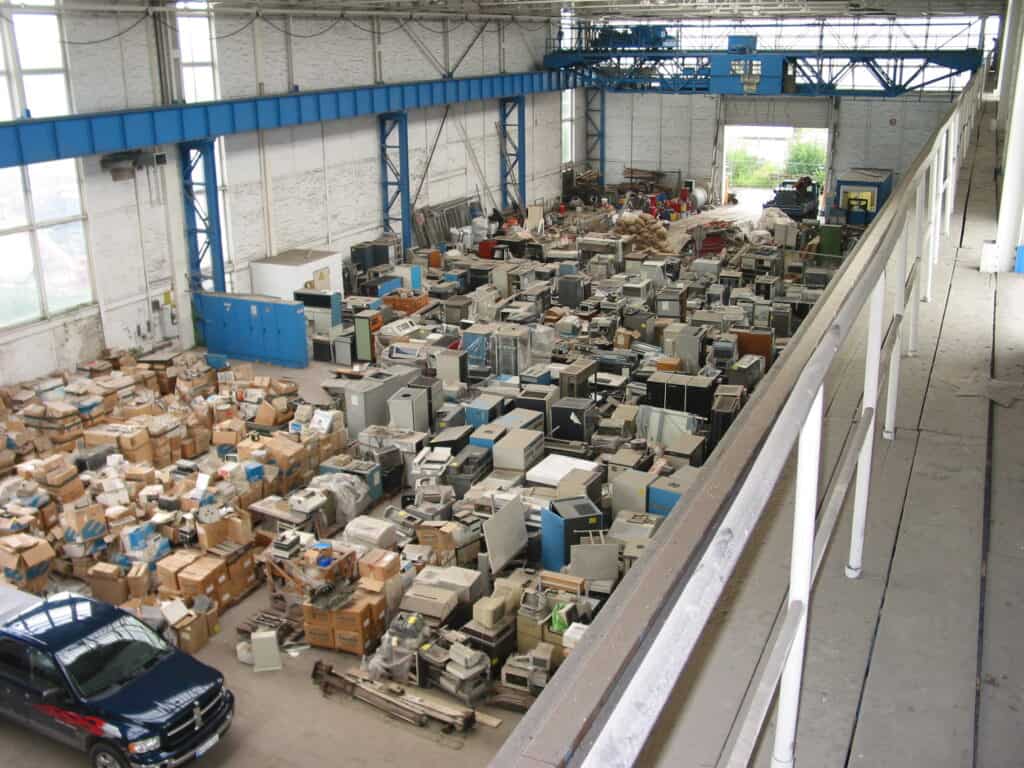
Overview of the collection in storage.
The first rows (A0–C13) mostly contained pallets stacked with documents and media. Despite occupying only 20% of the area, these items consumed nearly 40% of our time. Their condition ranged from water-damaged and moldy to surprisingly well-preserved. We encountered a wide variety of media: large disk packs, Diablo and RK05 types, paper tape, punch cards (both 80- and 96-column), magnetic tape, DECtape, magnetic strips, cartridges, and floppy disks—most of which contained source code or applications, with a few holding data.
The documents were especially rich, often representing complete sets of system documentation. We found engineering manuals, maintenance records, software guides, and marketing materials for systems from IBM, CDC, EAI, Siemens, Telefunken, CII Honeywell-Bull, and ICL. Other non-paper items on the pallets included small mechanical calculators, early business machines, spare parts, cabling, rack-mounted minicomputers, and CRT monitors.
The majority of the collection’s footprint was taken up by large computing hardware—mainframes, minicomputers, disk drives, line printers, and punched card equipment from the 1930s to the 1980s. We even found a cluster of Calcomp plotters with original company tags.
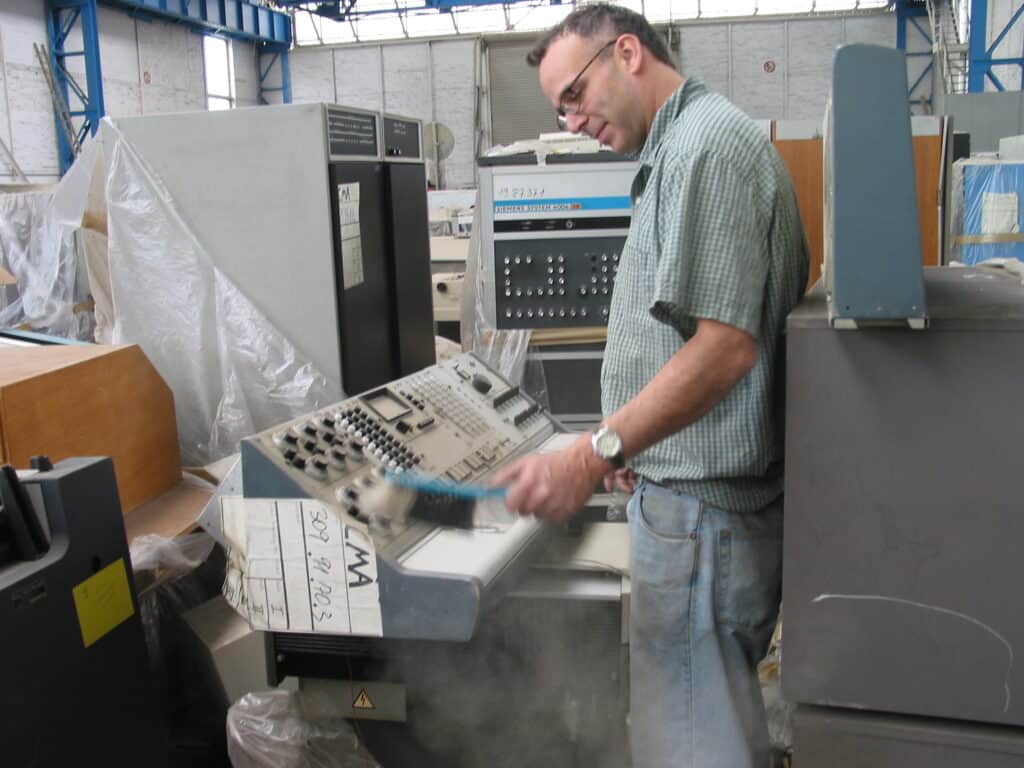
CHM Senior Curator Dag Spicer dusting off the control panel of an analog computer. Dag and fellow CHM curator Alex Bochannek were especially gratified to see several very important analog and analog/hybrid computer systems among the collection.
Assessing the Trove
Over the course of our ten-day visit, Alex and I plowed through the mammoth collection one object at a time, doing real-time history and curation to ensure a good fit with the goals of CHM’s permanent collection. We verified each item against our current holdings to avoid duplication, debated the object’s significance, and—if it passed muster—tagged it for shipment to our headquarters back home in Mountain View, California. We estimated that over 1,000 individual objects needed to be examined, evaluated, and cross-checked against CHM’s holdings.
Check out the slider below to see some of the artifacts we found.
Explore the Treasure
The Warehouse
Exterior photo of the warehouse in Castrop-Rauxell (2006). Off to the right, about 250 yards away, was an unexploded 500 lb. WW II Allied bomb, which a special German military ordnance disposal team removed while we were there.
Rare German Computer
Control panel from a German Librascope LGP-30 computer system (1956).
Popular IBM Computer
CHM Senior Curator Dag Spicer holding the nameplate from an IBM System/370 Model 148 mainframe computer system (1976). The System/370 was IBM’s primary large mainframe offering from the 1970s through the 1980s.
Box of Paper Tape
Mixed lot of paper tape, probably for DEC PDP series minicomputers (the “PDP” is a uniquely DEC term). When their purpose could be determined, many of these paper tapes were rescued by CHM.
Soviet Computer System
Soviet computer system (1982). The black box marked “CM 5400” is a hard disk drive, manufactured—like all Eastern bloc hard drives—in Bulgaria.
German Terminal
Telefunken SIG 50 terminal (ca. 1970), a lower-cost smaller data display unit for the desk of the programmer and for commercial applications. It connected to computers via its built-in RS-232C interface.
IBM Germany Sorter
IBM Germany Model 82 Sorter (1949). This was part of IBM’s line of punched card sorting machines and could process 650 cards per minute. The sorter had an input hopper and 13 output bins, one for each of the 12 possible hole positions in a column, and one for rejects.
Rare TRICE Computer
Close up view of the extremely rare TRICE computer. The TRICE was made by Packard Bell in collaboration with Raytheon Company and was a digital differential analyzer (DDA). TRICE was the pinnacle of big hybrid DDAs. The $89,500 price bought only the starter system. Customers included North American Aviation and NASA.
Telefunken Mainframe Operator Panel
Operator panel from West German Telefunken TR 440 general purpose mainframe computer system, ca. 1971. About 45 were built, most of them going to universities.
Siemens Tape Drive
Tape drive from Siemens System 4004, introduced in January 1965, and based upon the RCA Spectra 70 architecture.
Magnetic Ledger Machine
Exacta Continental 6000 magnetic ledger machine, built by Exacta Büromaschinen GmbH (1958). Such machines were an interesting transitional technology between typewriters and computers. Data entered on the ledger forms was also encoded on a magnetic strip on the back of the form.
East German ROBOTRON Printer
East German entity ROBOTRON made many copies of Western data processing machines, especially DEC-style minicomputers and peripherals. This printer, made ca. 1983, used dot matrix technology and could print at a rate of 360 characters per second.
Kienzle Matrix Line Printer
This Kienzle matrix line printer has three vertically oriented seven-pin print heads for high speed. Kienzle was a West German computer manufacturer spun off from the Kienzle clock factory (Kienzle Uhrenfabriken AG) in 1929. In the 1980s it was merged with Mannesmann as Mannesmann-Kienzle, and in 1991 it was sold to the Digital Equipment Corporation GmbH and renamed Digital-Kienzle Computer Systeme.
Control Data 3100
The 1967 Control Data 3100 was a less powerful computer system than the CDC 6000 supercomputer series, at the time the fastest computers in the world. The 3000 series was a great success and became CDC’s cash cow through the 1960s. The United States Internal Revenue Service used a series of 3000 machines for many years.
Surprises
Conditions inside the warehouse were not ideal. One Control Data optical character recognition system, for example, had several plants growing out of it.
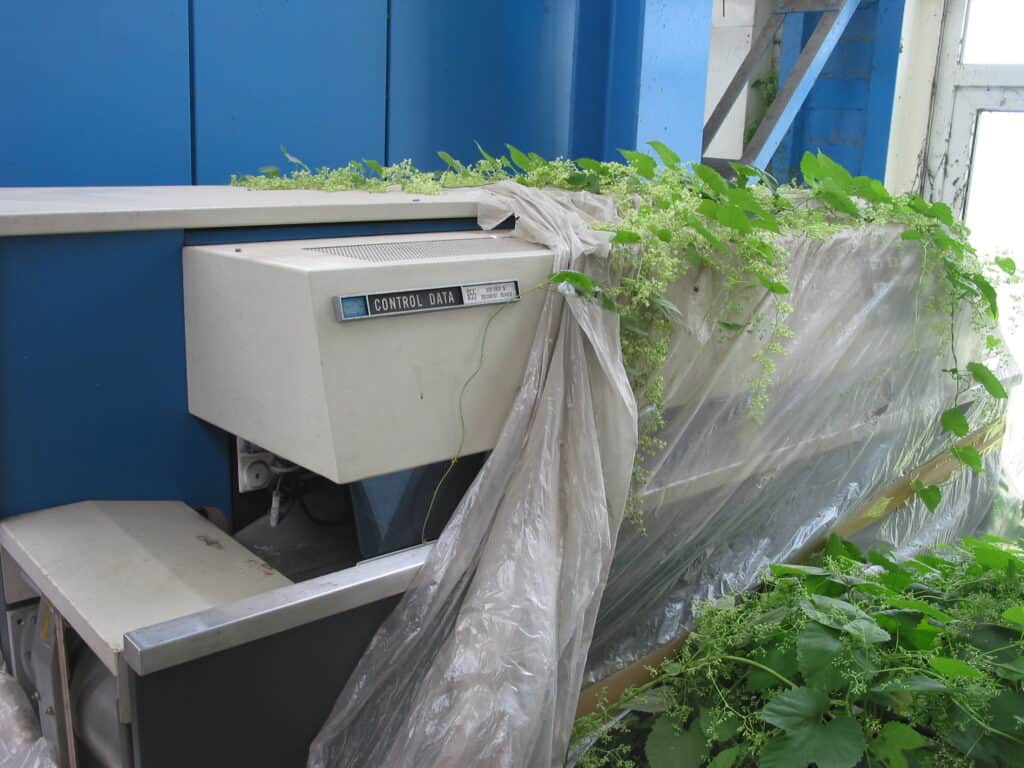
CDC OCR plant-growing peripheral.
We also discovered birds living in the rafters—several of whom left their distinct mark on an otherwise beautiful punched card sorter. We nicknamed it “the guano sorter.”
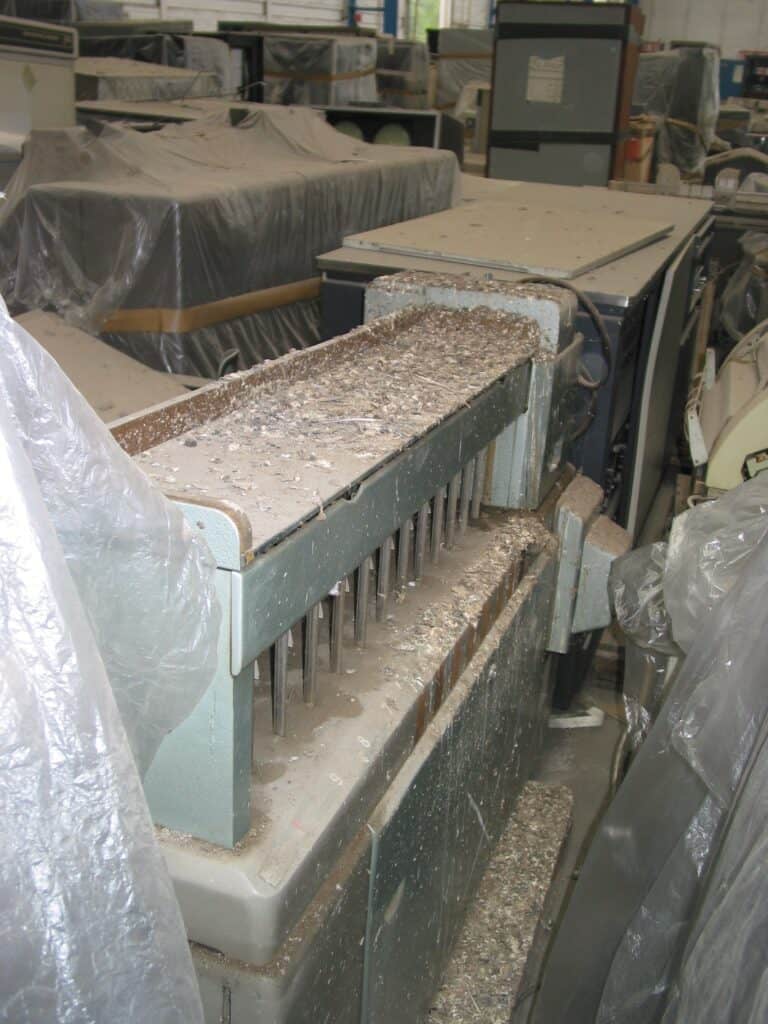
The “guano sorter.”
Bringing It Home
Thanks to CHM Trustee Ike Nassi—then an executive vice president and chief scientist at SAP—the museum was able to cover the considerable shipping costs: in total, we marked seven tractor-trailers’ worth of objects to make the trans-Atlantic voyage, through the Panama Canal, and back up the West Coast to San Francisco, where the trucks drove it to the Museum.
With 2,056 total artifacts—1,127 of them physical objects—the acquisition was so large that it led CHM to expand its storage capacity, resulting in the purchase of a new climate-controlled facility that now houses much of the museum’s physical collection and what we now call “the SAP Collection.”
Just in Time
And about those WWII bombing raids? Midway through our work, we noticed a demolition team carefully dismantling a live 500-pound Allied bomb just 350 feet from our location. According to a local office worker, this wasn’t unusual; numerous unexploded bombs had been found on-site in the years prior, prompting evacuations in 2004. Though we paused briefly, we resumed work once the area was declared safe.
In that moment, I was reminded of the closing line from The Great Gatsby: “And so we beat on, boats against the current, borne back ceaselessly into the past.” In this remote corner of northern Germany, while we worked within the bombing fields of generations ago, we had uncovered one of the world’s great amateur computing collections—one that now lives on at CHM as a vivid reflection of computing’s storied past.