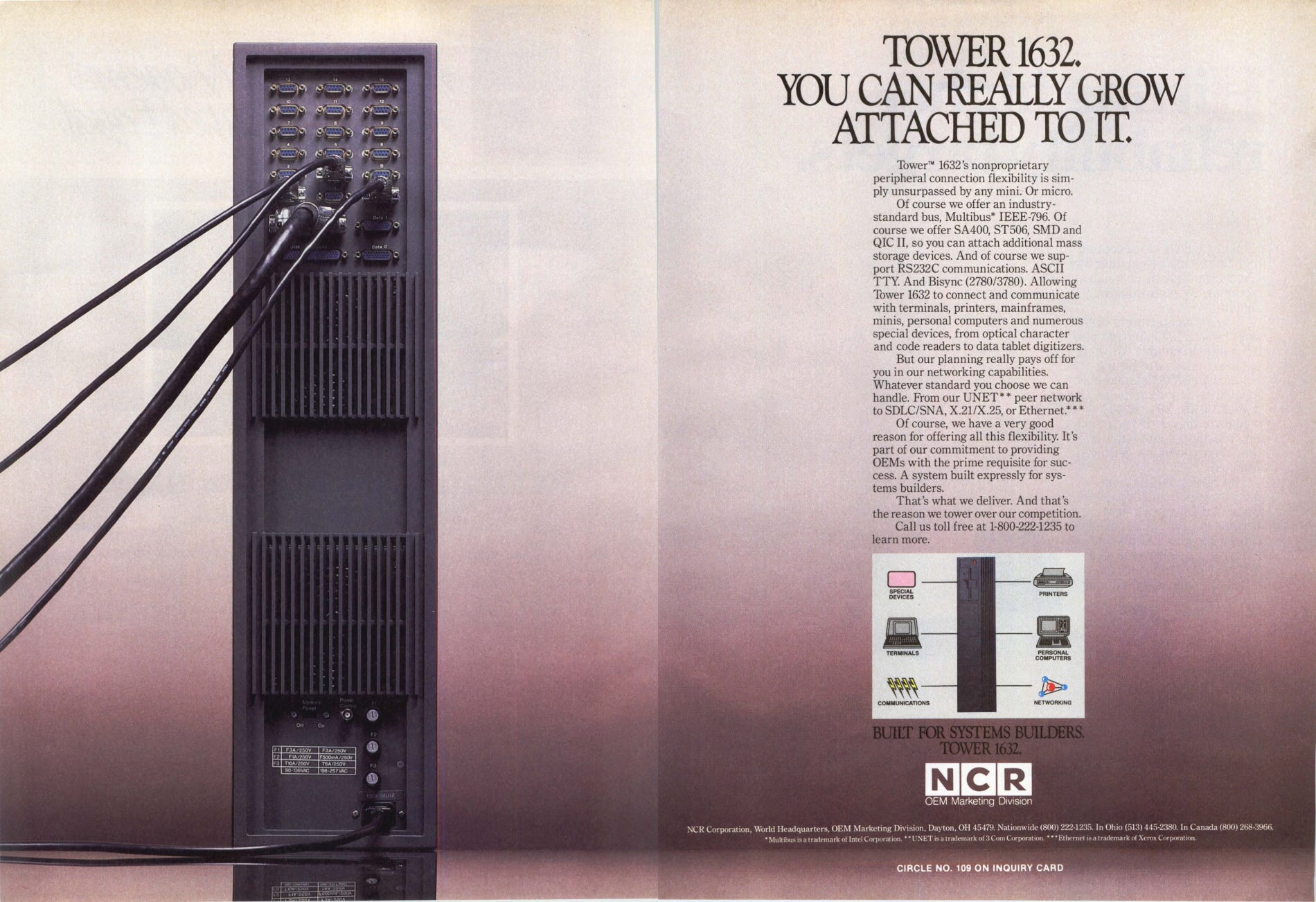
I covered the history of NCR when I wrote about their PC4i system in 2024.
The Tower 1632 system was announced in the December 13, 1982 issue of InfoWorld:
NCR Corporation, in a move to capture an increasing share of the OEM computer market, has announced a new small computer based on the Motorola 68000 microprocessor. The 16-bit multiuser and multitasking computer is called the Tower 1632. It runs an operating system derived from UNIX III and provides data storage with fixed Winchester disk drives.
All the elements have been packaged into a 29-inch-tall cabinet that can fit under an office desk. The basic unit has a list price of less than $12,500. The Tower 1632 can support up to 16 users.
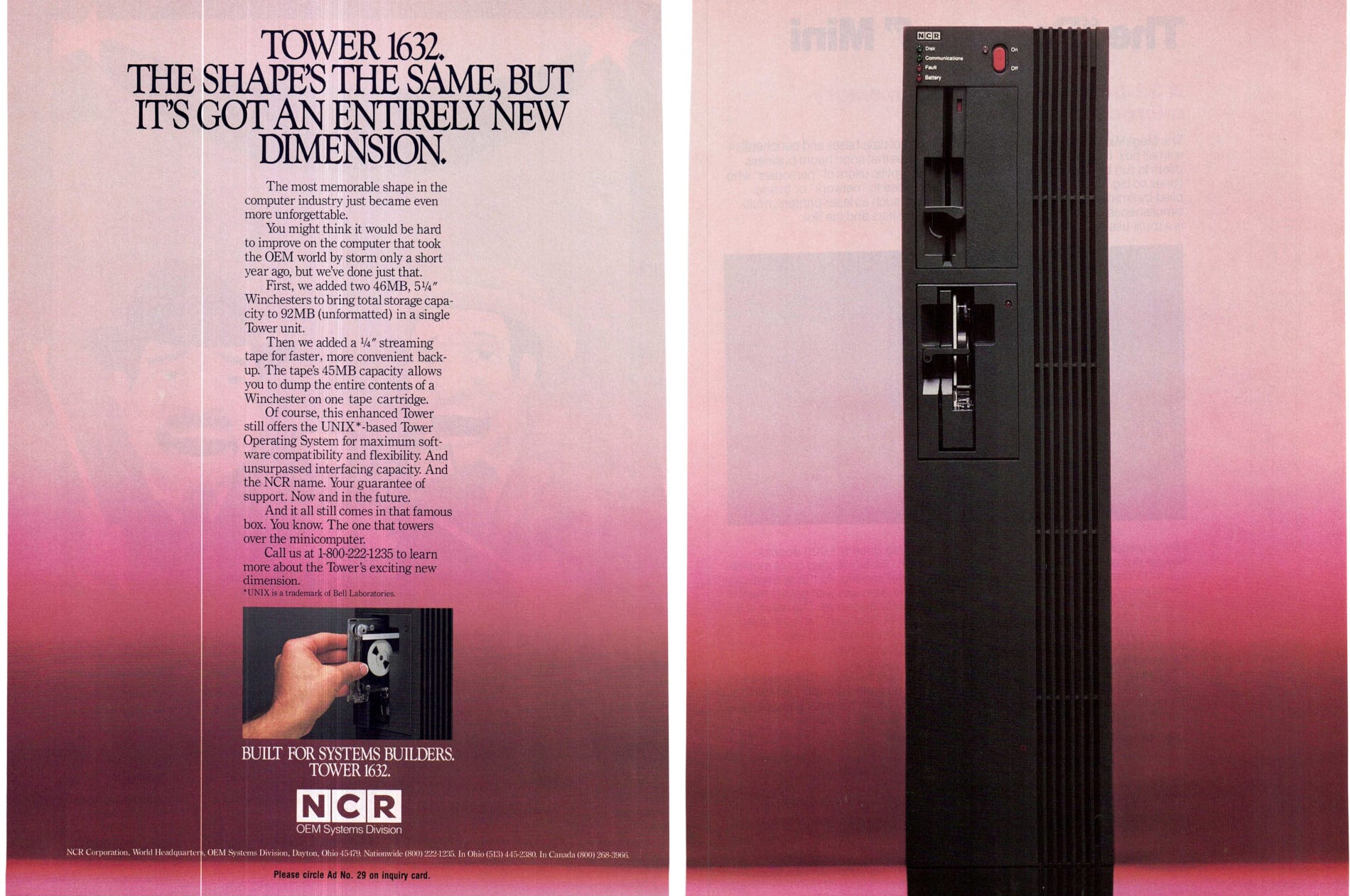
In August of 1983, Datamation carried the second half of an article by Jan Johnson on major changes at NCR.
The Dayton, Ohio-based company has made a fundamental change in corporate strategy. It is attempting to reposition itself, both in terms of product strategy and organization structure, as a company that sells primarily to large organizations rather than to smaller ones.
While that may sound like a minor tune job, the decision led to some major changes in product strategy and corporate organization. To compete successfully for business from large corporations, NCR’s executives determined they needed products with leading-edge technology and a nimble development and production organization that could constantly generate new ideas and get them out the door—fast.
The development and production side of the house was one of the first organizations to get hit by a wave of renovation. The main thrust was to push decision making down to the plant level. Plant managers now operate much like small company presidents, with profit and loss and R&D responsibilities, to name only two.
…
“The previous [management] approach involved a group of staff people who had opinions but no responsibilities; responsibilities were greatly dispersed,” agreed Hugh Lynch, vice president, general purpose systems, who reports to Buster, “What we are trying to do now is give production people a great deal of control without having to have committee decisions.” Lynch’s organization developed and produces the Tower 1632 and the 9300, a breadbox-sized mainframe.
“We are as entrepreneurial as we could become. That was the idea behind the new structure.” That is how Don Coleman summed it up. Coleman, who also reports to Buster, is vice president, CI/MEG systems (commercial, industrial/medical, educational, government). Coleman’s organization developed and produces the Decision Mate V.
Under the wing of each of the 24 general managers is manufacturing, engineering, R&D, purchasing, financial, MIS, and product management. In addition, each GM is responsible for developing a business plan and directing his or her own development projects. There is a great possibility for product development overlap.
So how does a $3.5 billion company manage all that independence? To keep a lid on wild and uncoordinated product development efforts, such as producing a product that does not interconnect to any other ncr product, there is a rigorous review system in place. Each GM reports to a systems vice president, who in turn reports to executive vp Buster, who also serves as a member of the office of the chief executive.
Buster is one of five persons who sit on NCR’s new top-level management team. Other members of the office of the chief executive are William Anderson, chairman; Charles Exley Jr., president and chief executive officer; Manuel Garcia, executive vice president responsible for marketing and sales; and Don Herman, executive vice president (and founder of what is now NCR/Comten Inc.), responsible for integrated systems, basically those business units that are self-contained or don’t fit well anywhere else. Herman’s realm includes NCR/Comten, NCR/Telecom, Applied Digital Data Systems, micrographics, and the office systems division.
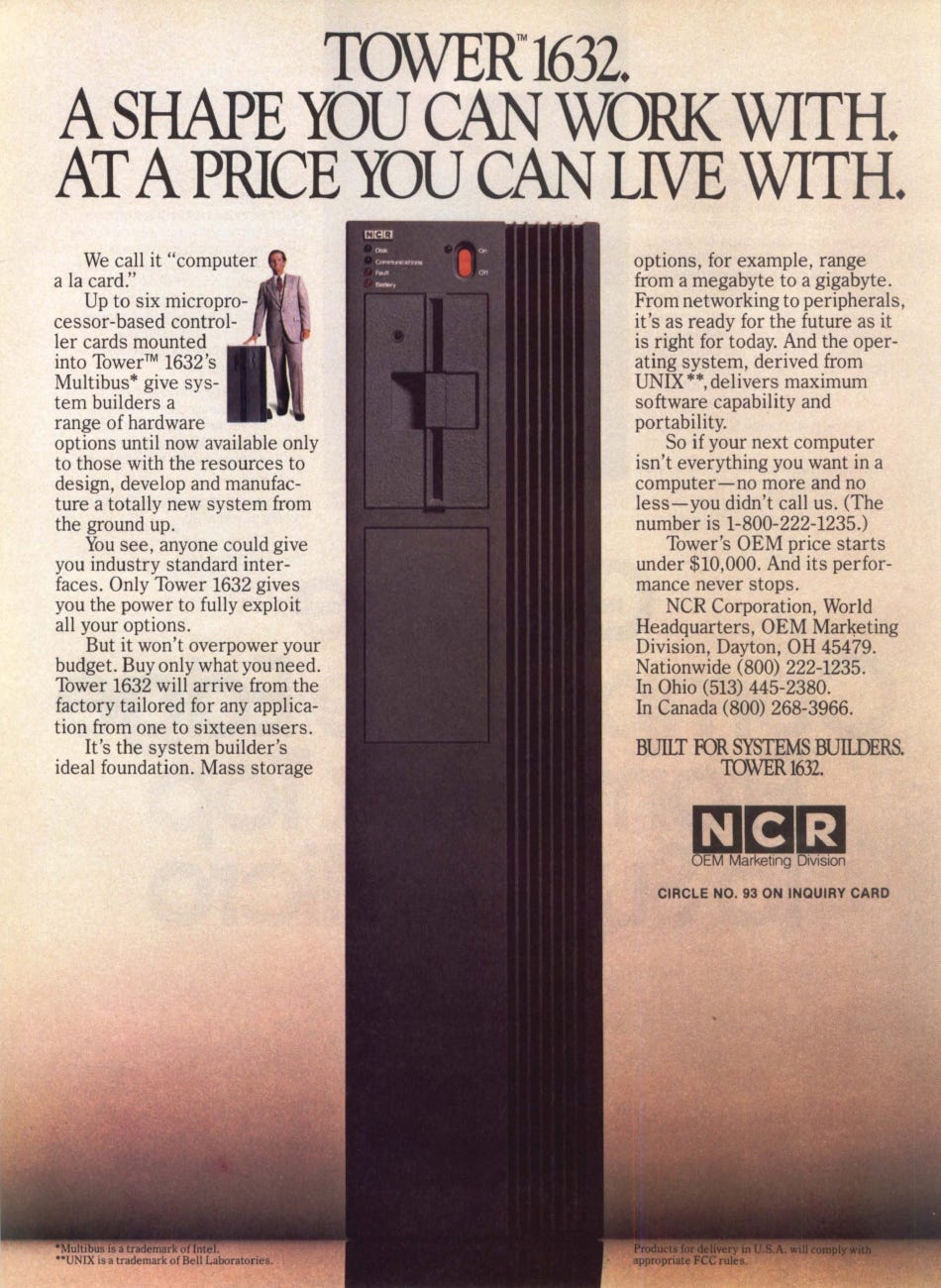
Auerbach Publishers compiled two volumes covering all available hardware and software. Here is the information they had for the Tower 1632:
Overview The NCR Tower 1632 is a multifunction, multitasking microcomputer system intended for the OEM market. The system is contained in a 29-inch-high cabinet, which can fit under an office desk, and supports word processing, data communications, electronic mail, and scientific applications.
The Tower 1632 is supported by NCR field engineering organizations in over 1,200 cities worldwide. Its self-diagnostic capabilities give users the option of maintaining their own systems.
System Design The NCR Tower 1632 features the 16-bit Motorola MC 68000 processor, supporting up to 6 microprocessor-based controllers. Main memory ranges from 256KB to 2MB, in increments of 256KB. The industry-standard IEEE-796 I/O interface and separate dedicated high-speed memory bus operate simultaneously and independently, limiting bus contention and increasing throughput speed. The Tower 1632 can support up to 1GB of disk storage.
The UNIX operating system from AT&T, enhanced by NCR, provides the Tower 1632 with flexibility and compatibility. Applications programs can be created with the N-GEN applications generator. Supported programming languages include Business BASIC, COBOL, C, and FORTRAN.
A typical configuration for the Tower 1632 includes the processor, 512KB of ECC memory, a battery backup unit, 1MB of diskette storage, a 32MB Winchester disk drive, 81/0 ports, and the UNIX operating system.
Available communications capabilities include RS-232C, ASCII-TTY, NCR DLC, IBM 2780/3780 and SDLA/SNA, X.21/X.25, and UNIX networking.
Winchester disks, diskette drives, and streaming magnetic tape provide additional Tower 1632 mass storage options.
Competition & Pricing The NCR Tower 1632 competes with the AT&T 3B2/300, Plexus Computers P/35, and Pertec Computer SYSTEM 3200.


The December 1983 issue of Computer Design carried an announcement of the 1632’s release:
The 29” (74-cm) high Tower 1632 is built around a 16-bit 10-MHz Mce8000 processor, a Unix III based operating system, a Multibus I/O subsystem, and fixed Winchester drives. The MC68000 supports up to 16 simultaneous local or remote users, each performing multiple functions. Up to six microprocessor based DMA controllers that handle the 5 1/4” disks, eight-channel I/O, and multiprotocol communications offload I/O functions from the CPU. Up to 2M eye of main memory in 256Kbyte increments and 60M bytes of Winchester disk mass storage in the main unit are supported. Add-on units can expand mass storage to more than 1G byte. Standard magnetic media interfaces include the sA400 for 1M-byte 5 1/4” floppies, the STS06 for 10M-byte Winchesters, an SMD for 8” Winchesters, and the QIC II streaming tape. The six-slot Multibus I/O system is separate from the dedicated two-slot high speed memory bus. The buses function both simultaneously and independently to minimize contention and maximize throughput. Unix optimized memory management unit with 256K ECC memory uses a full 24-bit addressing field and provides a clear migration path to 32-bit technology.
Five “menu personalities,” one for each of five programming sophistication levels, are part of the enhanced Unix. These personalities allow easy access to the system. To facilitate applications development, NCR’s N-GEN dictionary driven applications generator contains the needed software tools to generate quick computer programs. Cobol, Business Basic, Fortran, and C languages are supported. Two RS-232-C ports provide ASCII teletypewriter and Bisync 2780/3780 communications. Other protocols supported are NCR’s DLC, SDLC/SNA, X.21/X.25, and Unix networking.
Carrying features beyond industry standards, the Tower 1632 includes a power fail recovery system that preserves data in memory (without specialized applications programming) until power is returned after an outage. In addition, the intellectual properties protection system prevents both proprietary operating and applications software from running on unlicensed machines.
The $12,000 Tower 1632 will be sold to computer systems houses, OEMs, distributors, and dealers who can add applications software, specialized peripherals, and other subsystems to suit customized needs. NCR Corp, Dayton, OH 45479.
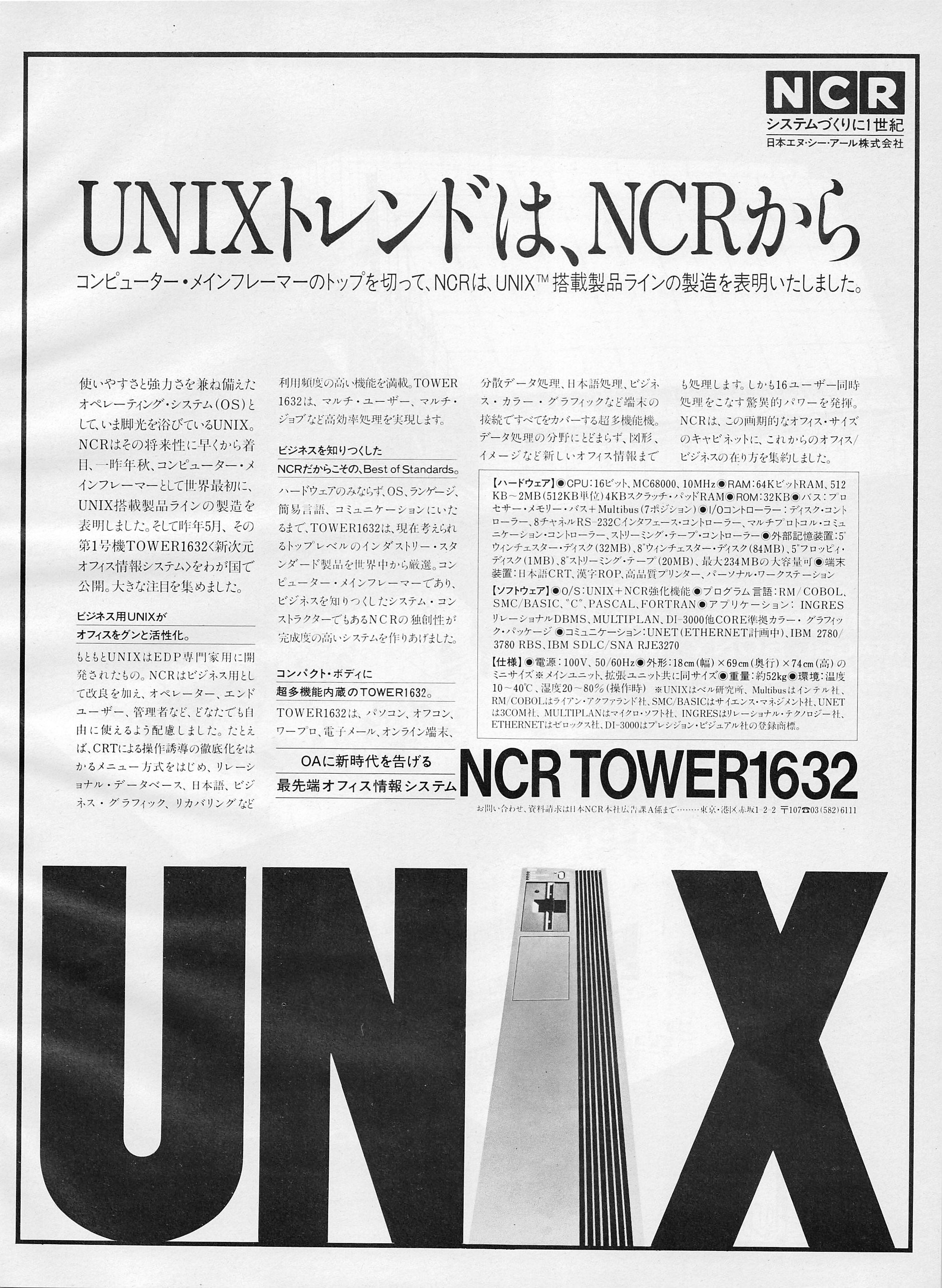
I couldn’t find any reviews of the Tower 1632 in my computer magazine archive. I did find a Usenet post from September 10, 1984 that talked about the system. Interestingly, the poster (MHARRIS) was associated with Bolt, Beranek and Newman (more commonly known as BBN). BBN was instrumental in creating ARPANET, the precursor to the Internet.
A project I’m working on has a Tower, said to be the “first delivered in New England” (about a year ago). It has 3/4 mbyte, 30mbyte disc, 8-port card, and not much else. The supplied opsys was v7, and only by dint of pushiness over craftily obtained NCR internal phone numbers (”Who are YOU? How did you get MY number?”) did I get it up at all. Now they have Sys.V it is said, but I haven’t been blessed with an update. The machine is currently unused, since (1) the opsys is still unreliable as well as old, (2) getting files to/from it is difficult to impossible, (3) the promised “support for writing device drivers” never appeared, and (4) the disc is VERY slow (the second disk, in fact: the original one died a horrible death). We’d sure like to use the machine for something, though; maybe someone from NCR will read this.
--mh
Have you ever used an NCR Tower 1632? Let us know in the comments below.

What computer ads would you like to see in the future? Please comment below. If you enjoyed it, please share it with your friends and relatives. Thank you.