
from the July 1985 issue of MicroTimes magazine
By Laurie and Steve Foster
In ancient times, the well symbolized a place to quench one’s thirst for knowledge as well as being a meeting place for the community. Today, The WELL is a tool to access and share information as well as being a meeting place for an extended (on-line) community.
The WELL (Whole Earth ‘Lectronic Link) is a computer-based information utility run from the offices of The ‘Whole Earth Catalog and The Whole Earth Software Review in Sausalito, California. It was co-developed with NETI (Network Technologies, International) of Ann Arbor, Michigan.
As a regional telecommunications utility, The WELL is poised somewhere between national services like the Source or CompuServe, and the endlessly proliferating special-purpose BBS systems that serve local users and run on PC or Apple-sized micros.
Basic functions available to WELL subscribers include teleconferencing, electronic mail, on-line chat, and file transmission. On-line HELP and optional menus guide the new user through desired functions and features.
Currently active conferences include:
Legal
Jokes
Music
Writers
Science Fiction
Games
IBM PC
Word Processing
Spreadsheets
Macintosh
Programming
Hackers
Currents in The Well
System news
Help
Politics
Garage
Medical
Spirituality
Human Resources
Video
Telecommunicating
Commodore
Databasics
Fido
CP/M
Unix
Programmers
Hosts
Net
Design
Video
LapTop
BMUGSIG
Manual
Each conference holds a series of numerically identified conversations. Any conversation consists of a “topic” (a conversation-initiating message), and a series of “responses” (conversation-continuing messages). Interactive prompts guide the user to BROWSE a list of current topics, SEE a specified topic and associated responses, ENTER a new topic (i.e., start a new conversation), or RESPOND to an existing topic (i.e., join in an on-going conversation). Helpful system features allow you to:
by-pass conversations that are not of interest;
make a Conference List that automatically strolls you past conferences you want to follow;
get an automatic display of all new comments in any specified conference since the last time you checked that conference;
find out what other users are on the system simultaneously with you (which means you can initiate an on-line “chat” with them);
find out what other users are participants in any conference or on The WELL itself;
find out the last time that a specified user logged onto The WELL (handy when you want to know if someone has picked up their mail yet);
find out what remarks another user has made about him/herself by way of introduction to other WELL users.
There are numerous other features as well.
The Electronic Mail function is very straightforward. Messages and responses are routed between WELL users. An exciting feature is the ability to route mail to and from users on certain other telecommunication networks. Links are rapidly being built to various national and international systems.
You can transmit (upload) regular (ASCII) text files and store them on The WELL. Any other WELL user can read or capture (download) such a file if they know the file name and user ID of the file creator. This feature allows conference conversations to direct readers to external files that might — for example — hold a list of local events relevant to that conference. It also allows a group of people to work together on the development of a co-authored document. Additionally, special facilities allow the transfer of binary files — so The WELL can be used to transmit graphic images as well as public domain software.
Using basic features of The WELL is relatively simple. Ample prompts and HELP notes are available to aid the novice. An on-line Manual can be downloaded and printed from your computer. Each conference has a host, who — like a good host at a party — assists newcomers, keeps relevant conversations flowing, and directs irrelevant conversations to more appropriate conferences. New hosts are welcome.
The response time is very fast. Unlike any other BBS we’ve tried, it gives no reason to wish for more speed.
We found The WELL to be a very friendly place — not just an easy to use computer system, but quite literally— a place where one might make some very good friends.
The price of this service is one of its friendliest features. Its hourly access fee is from one fifth to one tenth that of the Source, and for many of us — authors included — that’s a make or break difference!
Using more advanced features of The WELL takes more time, but that’s the price of power, and there are some incredibly powerful features available to the initiated user. (Space limitations prevent even a partial list.) Continued evolution of the system promises to make more and friendlier power available to subscribers.
The cost of using WELL services is an $8 per month member fee and a very low $2 per hour access fee. These charges are billed directly to the user’s credit card account (VISA or MasterCharge). Pacific Bell costs are the normal fees charged for calls between your phone area and Sausalito, and show up on your regular monthly telephone bill. These phone costs can be cut by about 50% by arranging for ORTS service to Sausalito with Pacific Bell. Rates are much cheaper at night, of course. The WELL will soon be accessible via UniNet, TeleNet or TymeNet, which will reduce phone costs significantly. For about $300 you can purchase a lap-top micro with built-in modem that will enable you to communicate on The WELL.
To register with The WELL by computer, call (415) 332-6106 via your modem. As prompted, type “newuser” (lower case, without quotes) as your login ID; then enter your VISA or MASTERCARD number and expiration date. You will then be asked to choose a user identification code and a password. For personal assistance, call (415) 332-4334.
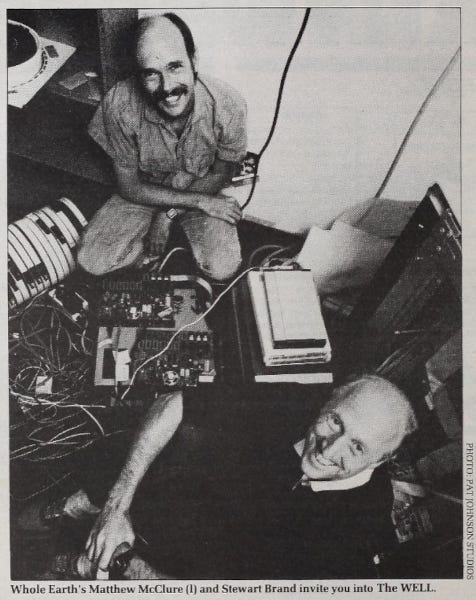
We asked Stewart Brand and Matthew McClure of Whole Earth Access Link about their new venture. The WELL has been up and running since April, 1985, and it seems to be off to a fine start.
Who’s behind The WELL, and how did it get started? How did the Whole Earth people and the NETI people get together?
Matthew McClure: When we were putting together the Whole Earth Software Catalog, we used telecommunications extensively to gather reviews. We used mostly New Jersey Institute of Technology’s EIES network — The Electronic Information Exchange System, a national teleconferencing network. Our catalog authors would send their word-processed documents to EIES. We’d pull them down to our own micro-computers, run them through a couple of electronic transmogrifications, and transmit them to the typesetter. So, that was a lot less work for us. We’d also use the EIES network to hold online conferences, and we met a lot of interesting people. So, we recognized it as a valuable tool. We saw a lot of ways that it could be used that it wasn’t being used. And we looked at things like CompuServe and the Source and saw that they were expensive, monolithic, not too friendly, and often very slow. We wanted a regional information utility and conferencing system. Coincidentally, NETI, in Ann Arbor, had this software called PICO-SPAN that they had developed, and they were looking for places to put it. Their idea is to set up regional networks like The WELL, around the country, and then to hook them up in different ways, so that you can have some kind of communications in the whole area.
Stewart Brand: I’d known of Larry Brilliant (founder of NETI, who also directed SEVA, a service organization) for years, and so had reason to be interested in NETI. I ran into him at Western Behavioral Sciences Institute in La Jolla, where I was a faculty person, teaching classes on-line for senior corporate people. They would get into the EIES network for two years and meet every six months face-to-face in La Jolla. At one of those occasions, Larry Brilliant was there, and we chatted about NETI, and about his idea for regional teleconference systems. I got very interested because I realized that regionally is something new to the process, that there was a middle ground between BBS systems and the national networks, and that that middle ground is very congenial to the kind of thing the Whole Earth has been at all these years.
The stories Larry tells mostly relate to the work of fighting blindness that SEVA’s been doing in Nepal and India the last couple of years. Doing eye operations and logistically horrendous projects, bringing in helicopters to the high mountains. He found that a lot of their coordinations involving technical and political people scattered all over the face of the globe — which would have taken months or years, or been impossible in the past — were able to move quickly thanks to teleconferencing capabilities.
Asynchronous teleconferencing especially pays off when you have a lot of people in different time zones. So he was already sold on teleconferencing as a tool for World Saving, and he thought there was so much commercial potential there that they could fund many of their own service activities by pursuing the commercial opportunities.
MM: So we got together. They were in a position to put up some money so we could get a computer and the software. What we put up, of course, is our expertise, our connections and the people who run the system.
What made you decide to offer a service like The WELL?
MM: In terms of facilitating information gathering, input and participation, teleconferencing is a terrific tool. The Bay Area is an interesting place full of interesting people. Our idea was that if we could facilitate communication among these interesting people, unpredictable synergies would result. And so far they have. Our whole system has gotten several orders of magnitude easier to use, and more powerful and interesting just as a result of our users, who have a wide variety of expertise, and have offered this arid that kind of suggestion and cooperation among one another, with the result that it’s gotten better, more sophisticated, and easier to use. I think that’s wonderful.
SB: The attraction of The WELL to me is that it’s the most rapidly adaptable medium — certainly business medium — that I’ve ever seen or been involved in. That is, once you have the basic apparatus set up, the range of possibilities gets wider every time you think about it. We’re trying to establish The WELL as a really open invitation to business people in particular, and everybody in general, to try stuff, to discover new uses for this medium. And this is consistent with what we’ve done from the beginning with Whole Earth — the idea is access to tools.
So this could be a home for anyone’s experiment?
MM: Yup. That’s what we’re doing it for. To find out what are the possibilities with the teleconferencing. So far they’ve been fairly limited by the corporate environment. Or, they’ve been limited by storage capacity, processing speed, and limited number of phone lines. We are working on getting rid of all the limitations we can find, so we can first find out what’s possible, and then assess its usefulness.
SB: People who get on are participating in the shaping of the system. Because it is such a flexible, interactive, and populist medium, it’s going to be adapted to their realities to the extent that they pitch in.
One of the advantages we have is the software. PICO-SPAN is built to be highly adaptable. It has lots of hooks — places where you can attach it to other software that either exists, or that you develop.
MM: For example, we wrote a routine that would give you a list of all participants on The WELL, in alphabetical order. We wrote another routine that would tell you at the end of each session how much time and money you’d spent during that session. There’s a lot of different enhancements you can do, writing in either Unix or C, that you can just hook into PICO-SPAN.
What happens when and if you get into a space crunch? Though you’ve got excess storage space right now, it has to run out at some point.
MM: No it doesn’t. The economics of the situation, as near as we can tell, are that once we have enough people talking that we run into a space problem, we will have enough money that we can pay for another disk. So, the system is designed to pay for its own expansion.
SB: So, the trick is to keep it growing rapidly enough so that the cash flow makes sense, because it’s an expensive system, but slowly enough so that it doesn’t get ahead of us to where suddenly people are getting too many busy signals or we just lose control.
You’re basically operating from a perspective of plenty, which assumes “there is plenty of room now, we can afford to buy more as we need it, and we can serve all needs. Businesses . . . individuals . . . just no limits . . .”?
MM: That’s right. We haven’t run up against the limits yet, and we have plans for dealing with most of the limitations that we are aware are likely to come up. So, yes. It’s pretty wide open.
Who sets priorities & guidelines for The WELL? How are decisions made, such as what conference subjects are welcome — or internal decisions about The WELL?
MM: Mostly that’s being done by Stewart and myself. Our main guideline is: if it looks at all interesting, let’s try it and see if it works. The whole thing is so amazingly experimental that it’s like having a giant sandbox, a pail, a shovel, and water . . . new forms begin to appear. Some of them are strong, and some of them just go back into the sandbox.
What type of inter-active audience do you see this reaching, as opposed to CompuServe or the Source?
SB: I think there will be more very straightforward business use of this system than with CompuServe, for example, because of the very low cost — especially small businesses, or businesses that have a number of regional nodes. That want a good electronic mail system, or a place where they can get together and hash something out without all having to drive to the same place, work through a contract together, all of these collaborative writings that go on.
So you are encouraging businesses to use The WELL as a utility?
MM: Yes. We will be offering a business service that includes two primary features — “E-FORUM” and “E-MEMO.” The business class WELL provides excellent teleconferencing and electronic mail systems.
Another thing that we’re doing is developing transactional software, so that companies like the Whole Earth Access Store can put their catalog on-line and have people order from them directly through The WELL — home shopping, basically.
SB: . . . and all manner of services that people are performing for one another directly through The WELL. Another business use of The WELL is what they’re calling “virtual” businesses. It’s a phenomenon that we’re starting to see on the various teleconferences, and is based on the idea of virtual memory and virtual reality. These angelic businesses form, a business plan comes out, work gets performed, the various people get paid, and they never have to meet face-to-face.
What other uses do you expect people will find for The WELL?
MM: Some people may wind up creating a private conference to go write a novel collaboratively. That’s happening now, on EIES. They have what they call “The Soap Opera” . . . and we may start a Soap Opera conference towards the end of the summer. Also, we want to provide listings of stuff like local movies . . . tell people what’s playing at the different theatres, concerts, restaurants.
What about using The WELL to start up a barter network?
SB: Yes. One of the most interesting ranges of software to me has been the DIAL-A-MATCH stuff. The sex software that runs on various bulletin boards in the Bay Area. You have to call in at three in the morning in order to get on, they’re so busily finding each other. You can do that with barter or you can do that with people looking for jobs or employers looking for workers — obviously there’s a whole range of matching that can be done. And it’s especially nice in a regional network, because then you can do the face-to-face part, you can take a look at the thing that’s being offered and show them what you’re offering back. Sure, barter would be great.
MM: Also, there are different projects that are springing up. Some involve computer projects. Some involve politics. The idea is that if you can increase the free flow of information, you’ll probably wind up with better decisions being made at the end.
The way that we hope the system is going to grow is sort of like an epidemic, that people will catch it from one another. And it seems to work that way, because once people discover the magic of electronic mail, they want to contact their friends and get them on-line.
SB: The system should not become characterizable as only one thing, or perceived as just a techie hangout, or a new age hangout, or a business hangout, or a telecommunications nerd hangout, but a place where basically anyone will find something, and hopefully lots of things. It’s just another form of connection. □

What computer ads would you like to see in the future? Please comment below. If you enjoyed it, please share it with your friends and relatives. Thank you.