qiudanz technique is a movement practice based on the computational transformation of minimalist movement sequences.
the purpose of the technique is to create, share and enjoy dances based on abstract computational machines.
one could say that it is part of a commitment to preserve computer science beyond electronics and industrial civilization, as developed and practiced by the txiemonks.
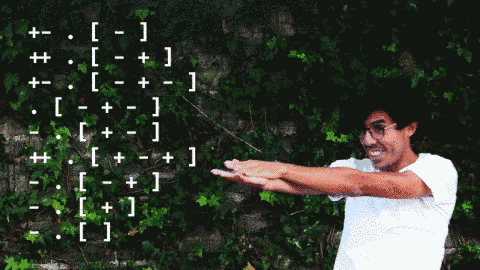
we have been developing qiudanz mode 1:
video: intro to qiudanz technique mode 1
we used the qiudanz technique for a couple of performances: our alive computing dance in algorave 10th anniversary; and for showing qiudanz tag in the Hybrid Live Coding Interfaces Workshop 2022.
see the qiudanz devlog for updates.
movement sequences
in the technique, we work with linear sequences of movements from a given and constrained vocabulary.
the first movement of a sequence is the "head", and the last one is the "tail".
these sequences can be of an arbitrarily large length, depending on the skill and practice of the participants.
in the technique, we learn how to computationally manipulate those sequences.
modes
we have envisioned four potential modes, that correspond to the size of the vocabulary and of the number of transformations:
- mode 1: two movements and transformations
- mode 2: four movements and transformations
- mode 3: eight movements and transformations
- mode 4? sixteen movements and transformations
so far, we have mainly worked with qiudanz mode 1.
we have some additional qiudanz working notes.
performance/play types
- solo: perform a new movement sequence each time by applying a specific transformation to the previous one
- solo card: the same as before, but taking the transformation from a card or other randomizer
- conversation: one person performs a sequence, the other repeats it with an applied transformation, and this continues back and forth. the receiver could perform the original sequence (optionally synchronized with the transmitter) before the transformed one.
- card conversation: the same as before, but taking the transformation from a card or other randomizer
- tape and guide: one person performs and transforms the movement sequence continuously, as indicated by the transformation(s) given by the guide in the form of movements.
- target: starting from a given movement sequence, apply succesive transformations to get to a target sequence. if playing in the tape and guide configuration, try to have the guide memorize the transformation sequence as its own movement sequence :)
a way of complexifying any of these would be to learn to apply more than one transformation when/before performing the new sequence.
another possibility would be to have beforehand a list of transformation to apply, with some or all of them being conditional on the movement currently in the head.
turing completeness
having some way of assigning the transformations to apply given the current movement in the head, would allow to perform arbitrary tag systems and/or turing machines, and m>1 tag systems are turing complete, e.g.:
Universality of Tag Systems with P = 2 (1964) Cocke and Minsky
cyclic tag systems are also turing complete, and they only require the sequential application of rules:
we have explored dancing cyclic tag systems in qiudanz tag.
more about tag systems and cyclic tag systems:
Tag Systems: A New Kind of Science | Online by Stephen Wolfram
Cyclic Tag Systems: A New Kind of Science | Online by Stephen Wolfram
incoming links
- log
- roadmap
- talks and workshops
- danzasistemas-tag
- iclc 2025 workshop proposal
- optimizaciones
- proposals
- txiemonks
- técnica qiudanz
- qiudanz devlog
- alpaca 2025 workshop proposal
- alive computing dance
- qiudanz mode 1
- backlog
- alpaca 2025 workshop notes
- home
- slomoco application
- performances
- qiudanz workshops
- qiudanz working notes
- qiudanz tag