Deciding to kill people and destroy things for some political purpose–which is what a decision to use military force is about–must be a momentous choice.
Richard K. Betts, American Force
“Just tell them we’re Animorphs.”
“Tell them we’re what?” Rachel asked.
“Idiot teenagers with a death wish,” Marco said.
K.A. Applegate, Animorphs #1: The Invasion
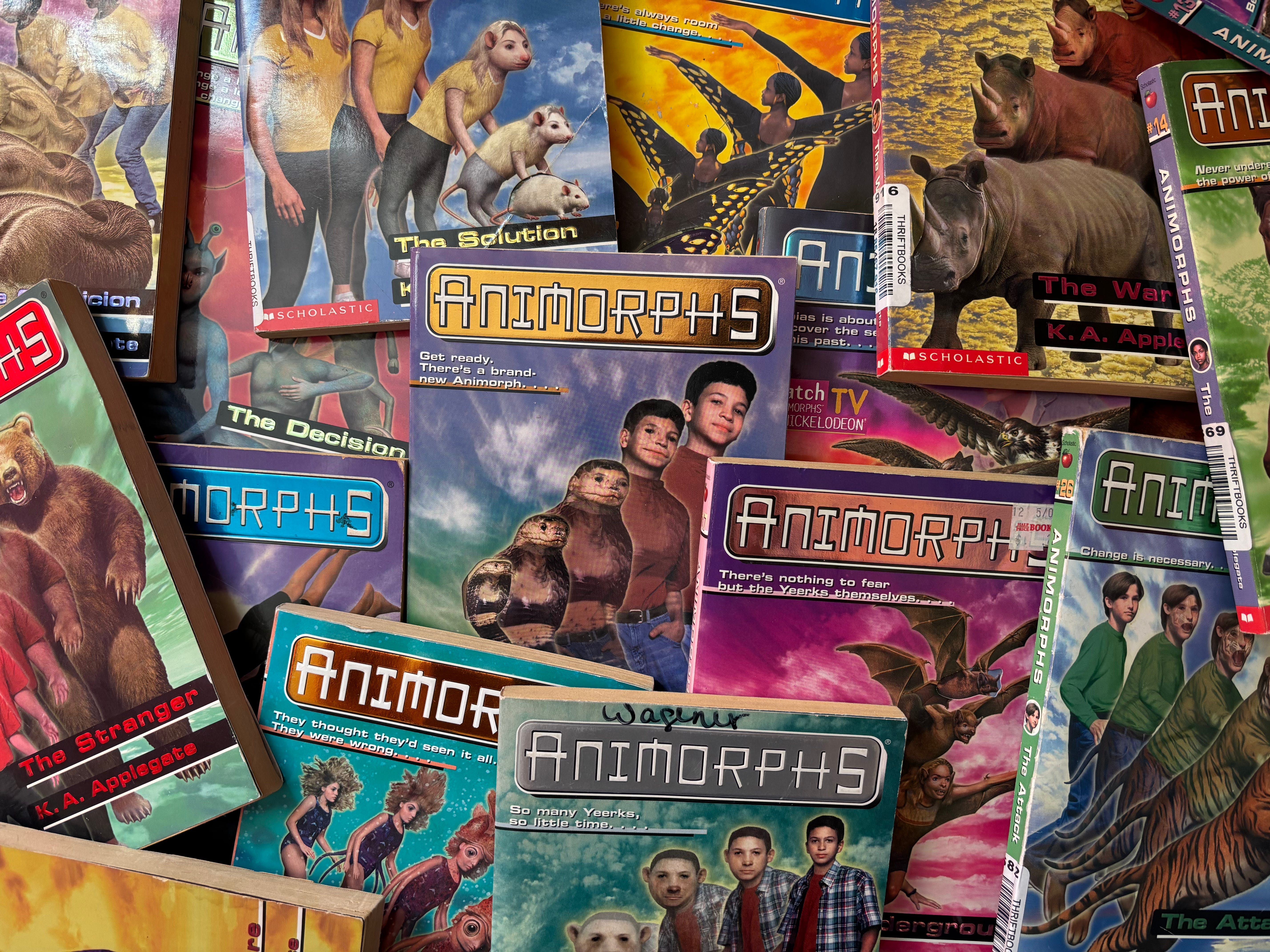
In 1996, I was in the first grade. I remember very little about that year; we were in a new town, very briefly, before leaving Texas for a while, and if I had any friends at that school I’ve long forgotten them. One thing I do recall is the Scholastic Book Fair. Like many kids of my generation, my eyes were immediately drawn to a strange book cover: a boy’s face transforming into a lizard, superimposed over a blue sky. The book was Animorphs 1: The Invasion by K.A. Applegate.1 We bought it, and my dad read it to me as a bedtime story. I was captivated. I had to know what would happen next, so I learned how to read. I spent my allowance on as many Animorphs books as I could and got the rest from the library.
Of course, I grew up and moved on to other things. Put childish things behind me, as they say. But recently, I revisited the series. I have my own kid now, and what better time to return to childish things?
If you read online commentary of Animorphs, one idea that comes up repeatedly is that “it’s not really for kids.” Readers point to the mature themes, the ways Applegate approaches the horrors of war, and claim that it’s really a book for adults, disguised as a kids story. This isn’t exactly true; the Animorphs books are, undoubtedly, for kids. They’re fun adventures, silly at times and serious at others. They’re also surprisingly deep and honest, with a real understanding of war and violence. Applegate tells a grounded and truthful war story, in a way that’s accessible for kids. It is, I believe, one of the greatest achievements in Juvenile Fiction.
Animorphs tells the story of five kids who get conscripted into fighting a guerilla war against alien invaders. One night, Jake is at the mall, playing video games with his best friend Marco. It’s getting late, so they head out. They run into Tobias (a lonesome nerd who has latched onto Jake after he saved him from some bullies), Rachel (Jake’s cousin), and Cassie (Rachel’s best friend). The five of them decide to cut through an abandoned construction site on their way home, as one does, but they’re stopped when an alien spaceship crash lands in front of them. The pilot, named Elfangor, emerges. He’s an Andalite, which is kind of a blue centaur/scorpion looking thing, and he’s wounded, about to die.
Eflangor tells the kids that an invasion of Earth is already underway by the Yeerks, a parasitic slug alien that crawls into other creatures through the ear canal and wraps themselves around the brain. Once in place, the Yeerk can peer into the person’s mind, search their memories, and control their body. A person infested by a Yeerk is called a “controller,” and many humans have already been taken.
But the Andalite has a weapon, a special technology. He sends Jake inside the spaceship to retrieve a glowing blue box, and when they each place their hands on it, they gain the ability to transform into animals. It’s a powerful tool that they, these middle school children, can use to fight the Yeerks.
They’ve barely received instruction when the Yeerk spaceship lands. Out steps a group of human controllers (including their assistant principal, Chapman) along with controllers from two alien species, the Hork-Bajir (snake-dinosaur things with razor blades sticking out of the arms and legs) and the Taxxon (giant cannibalistic centipede things). Worst of all, they’re led by Visser Three (a “visser” is a ranking in the Yeerk army), the only Yeerk to infest an Andalite host body. Visser three morphs into a giant alien monster and eats Elfangor alive. The kids escape.
Our heroes now have two goals: first, stave off the invasion as long as possible until the Andalite army arrives, and second, don’t get killed. They keep their identity secret, letting the Yeerks believe they are “Andalite bandits” hiding out on Earth, because if the Yeerks find out who they really are, they’re dead.
You can see why this setup would hook a young reader. It’s a great premise! And Applegate follows up on that by establishing the necessary ingredients for drama: stakes and constraints.
The big picture stakes are obvious – we don’t want Earth to get taken over by parasitic slug aliens – but Applegate wisely adds in personal stakes for each character. Jake’s older brother, Tom, is a controller and, we soon learn, a somewhat important one. He’s not a visser or anything close, but maybe something like a mid-level manager. Marco’s mom, long presumed dead, is one of the highest ranking controllers, Visser One. Tobias is a social outcast who finds purpose and meaning in the struggle. Cassie is an environmentalist who is aghast at learning the Yeerks’ ultimate plan involves recreating Earth in the image of their home world, which is basically a lifeless wasteland. They’re soon joined by Aximili (“Ax” for short), and Andalite and the younger brother of Elfangor, who wants to avenge his brother’s death. The most interesting of the personal stakes, though, is Rachel: she’s simply drawn to the fight. There’s something deep inside her personality, her soul perhaps, that is a warrior, and in the fight she comes alive.
Drama needs constraints, boundaries around what can happen and what can’t, and Applegate structured her constraints – both the heroes’ and the villains’ – for maximum drama.
The rules around morphing go like this: before morphing an animal the kids must “acquire” it by placing their hands on it for several seconds; after it’s acquired, they can morph it whenever they want; while in morph, they can communicate telepathically2; they cannot morph straight from one animal to another, but must return to human form first; most importantly, they can only stay in morph for two hours at a time, and passing this limit has the huge consequence of being stuck as that animal forever. Morphing has several more inventive constraints as well, beyond hard-and-fast rules. For example, when they’re in a morphed form, the animal’s instincts stay with them. There are a lot of fun implications to this. For example, morphing a dog or a dolphin makes you feel happy, a useful treatment when you’re suffering from PTSD. Morphing a cat increases your confidence. This effect isn’t always good, though – morphing an ant or a termite makes you lose all sense of individuality, and you become part of the hive mind.
The villains have their own constraints. Once every three days, the Yeerks must leave their host bodies and return to the Yeerk Pool, a sort of underground sludgy lake, so that they can absorb “Kandrona rays.” If they don’t, they’ll shrivel up and die.
Applegate then heightens the drama through dynamic characters with often conflicting motivations and desires. Jake is the leader, tasked with making hard calls around life-and-death and which moral lines are worth crossing. He’s in love with Cassie, a bleeding-heart pacifist. She’s best friends with Rachel, who is invigorated by violence and wants to push Jake to take even greater risks. Rachel is in love with Tobias, who is trapped as a bird and constantly negotiating his human and animal instincts. Marco is a jokester, but smart and pragmatic; he butts heads with everyone, for different reasons, but his levity helps keep them sane, and over time it becomes clear that he’s the most level-headed of the group. Tobias and Cassie both have the best understanding of how cruel nature can be, but Tobias accepts it while Cassie fights it. Rachel and Marco argue constantly and don’t work well together, Rachel’s boundary pushing in conflict with Marco playing it safe – except, sometimes they work great together, because they both have a deep understanding that sometimes you just do what has to be done. Then there’s Ax, who is light years away from home and can never really fit in with the humans.
I could go on and on like this, writing about the way each of the main characters relate to the other five. When Applegate starts breaking the team into sub-groups, the dynamics can change in near endless permutations.
On top of this, there’s all the ways these books get weird: the Ellimist, an alien who exists outside of time and operates as a sort of god3; Crayak, the Ellimist’s evil counterpart; the Helmacrons, tiny quarter-inch tall aliens who are also trying to take over Earth, but are very bad at it; the Chee, an interstellar group of androids who worship dogs and have been living secretly among humans for thousands of years.
From here, you can let your imagination run with all the story possibilities. In the first book, Tobias overstays the two hour window and gets trapped as a hawk, leading to internal conflict about his identity. There’s a story where Jake gets infested by a Yeerk during a botched mission, and the others have to keep him captive for three days so the Yeerk can die. In another, the Ellimist whisks them light years away to fight a completely different battle.
And all that is before we get to the ways Applegate complicates the central premise. For example, the Andalites are, over time, revealed to not be the heroes we thought they were. They’re arrogant and distrusting, and Earth is so far down their priority list that they may never come at all. At one point, they’re willing to give up Earth entirely if it gives them an opportunity to defeat the Yeerks. Another ongoing sub-plot concerns the Yeerk peace movement, an underground faction that has friendly relationships with their controllers and wants to end the war. These complications don’t alter the fundamental conflict – at large, the Yeerks are the threat and Andalites the allies – but they add realistic nuance.
It is, simply put, an endlessly inventive and creative series. Applegate has a knack for taking her weird premise seriously and playing out its implications in more and more interesting ways, and this is just plain fun to see.
This all might sound overly complicated, but it never really feels that way, because the individual books are so tightly plotted. These books are smart.
The first entry does not waste a single page. By the end of chapter one, a mere eight pages in, the kids have met Elfangor. From there, it moves along at a brisk pace, and the entire opening sequence at the construction site takes us about a quarter of the way through the book. They learn how to use their morphing powers, debate what to do about all this, figure out where the Yeerk base is, and attempt an attack. This is all in a slim, thirty-thousand-word chapter book.
The Animorphs are not superheroes. Applegate takes seriously the idea that these kids have become, very specifically, guerilla soldiers. After that dramatic first book, the action scales back. Their missions become things like “morph the vice principal’s cat and follow him around his house,” “follow known controllers around town to identify entrances to the Yeerk Pool,” and “cut off their supply lines.” They spy on controllers, figure out what they’re up to, and interfere as much as possible. They play defense. When they do get into open battle, it usually ends quickly and badly, with the kids-in-morph having lost limbs, bleeding out, and barely escaping with their lives4. Often, danger comes more prosaically, such as when they have to morph insects to infiltrate a Yeerk operation and get caught in a spiderweb. There’s a very procedural aspect to these books – it’s fun to watch them game out scenarios, make plans, and improvise when things fall apart.
As the series goes on, the plots become a bit more fanciful and high-octane, but for the most part it really is a very grounded look at how these kids would engage in guerilla warfare, under the circumstances.
Throughout this, Applegate respects the intelligence of her young readers, largely by respecting the intelligence and integrity of her young characters. This is to say: the plot is rarely driven by a character’s momentary stupidity. They make plenty of mistakes, sure, which complicate the situation and raise the stakes, but these mistakes are usually rooted in their inexperience – the kids are still learning how to be guerilla warriors!
For example, the climax of the first book involves the Animorphs attacking the Yeerk pool in an attempt to rescue Jake’s brother Tom and maybe end the whole invasion. Here’s their plan: enter in human form, blending in with the crowd, then somehow find a place to morph into predators, and… well, that’s the whole plan. This is absurd! But again, they’re middle school kids who have no idea what they’re doing. The attack goes poorly, because of course it does, and they barely escape with their lives, having accomplished nothing. Tobias gets trapped in hawk morph. The mission is, in fact, a failure, mitigated only by the fact that they didn’t die.
The kids don’t return to the Yeerk pool until book seven. This time, they have a better plan: sneak in as cockroaches and do recon, searching for something to sabotage. It still falls apart, almost immediately, and they only survive due to a last-minute save by the Ellimist. They finally pull off a moderately successful attack on the pool in book 17, but even that is a mixed bag. Until the very end of the series, the best they can do is “get in for a quick rescue, then escape.”
From each mistake, they learn something. They become more cautious and thoughtful in their planning, bolder when the risk is worthwhile and averse when it isn’t. They smarten. Things still go wrong, constantly, but it’s because the Yeerks are also paying attention to their tactics and adjusting accordingly. The kids are outnumbered and outgunned, and their enemies aren’t dumb either. This progression happens slowly and believably.
Talk to any adult fan of Animorphs, ask them why they like the books, and they probably won’t talk about the tight plotting. Or at least, it’s not the primary talking point. The big draw of these books, the thing that helped it dig its claws into so many of our brains, is how dark Applegate was willing to go.
It isn’t just the mechanics of guerilla warfare that Applegate takes seriously; she doesn’t back down from the psychological reality of what these kids are going through. They’re living secret lives, constantly lying to their parents and teachers and everyone else and existing in fear of what would happen if they slip up. The books are gruesome. The kids come close to death, with most of the books featuring scenes of them bleeding out and fading away. In one book, Tobias is captured and tortured by an insane controller. The torture lasts for about a third of the book’s pages. Then, there’s the time Cassie, in human form, finds Hork-Bajir flesh in her teeth; earlier that night, she had been a wolf and killed one, and some of it stayed with her while she demorphed. In another, they’re in the jungle and Rachel is in bear morph, being eaten alive by ants. She’s unconscious, so she can’t pull the “demorph to safety move.” Jake, thinking fast (and remembering their own previous disastrous experience as ants), yanks off a handful of Rachel’s bloody fur, rushes it over to a different ant colony, lets the ants climb aboard, then brings it back. The two ant colonies start fighting each other to the death over the right to Rachel’s body, distracting them long enough for Rachel to regain consciousness.
Under the weight of this pressure, the kids start to break down. They argue and bicker amongst each other. They start to make rash decisions – or retreat into their own worlds and shut out the others – depending on the character.
This penchant for dark storytelling is most evident in two plots: the “David trilogy” and the series’ endgame.
In the David Trilogy (books 20, 21, and 22, generally considered the series’ high point), the Animorphs meet a new kid at school named David. He’s a bit of a weirdo, but he happens to have Elfangor’s blue cube – the device that can bestow the power to morph5. He has no idea what it is, obviously, so he shows it off and gets a Yeerk target put on his back. The kids save him from the Yeerks, but his parents are taken and infested. His home is destroyed. He’s now a fugitive who has no idea what’s going on.
The kids do the only thing they can: give him the power to morph and induct him into the team. Welcome David, the seventh Animorph.
This does not go well. It turns out, David is at best unsuited for the job, and at worst an actual psychopath. He possesses the worst traits of each Animorph, without their accompanying good traits: the ruthlessness of Rachel without her humanity, the tactics of Jake without his caution, the caustic humor of Marco without his wisdom, the deep insight of Cassie without her gentleness, and the outsider nature of Tobias and Ax without their desire for community. David quickly realizes that he would rather strike out on his own, use the morphing power to benefit himself.
Of course, the best way to do that is to betray them. David knows all their secrets, including their identity, and this makes him a threat. He turns on them, and it’s Animorph versus Animorph. It’s incredibly thrilling! You get “tiger versus lion in the mall,” “owl versus eagle dogfight,” and all sorts of spying and being spied upon. Then, it’s terrifying; at the trilogy’s conclusion, the kids accept that the only way they have any chance of survival is to eliminate the threat. But they can’t bring themselves to kill David, so they set a trap and get him stuck in mouse morph, past the two-hour time limit. Once he’s a mouse, they deposit him on a rocky island, inhabited mostly by other mice. The final words of that book are: “We never heard from David again. Not directly, at least. But months later I heard some kids at school talking about the rock. It was haunted, he said. He and his family had passed close by on a boat. He swears they heard a faint, ragged voice crying, ‘No! No!’”
One of the best decisions Applegate makes, throughout these books, is refusing to give her characters an easy way out. The logic of their situation is clear and unavoidable, even if the solution is deeply disturbing. Most of the kids can’t stand to think about it. They aren’t murderers. They aren’t like the Yeerks, and so they try to find a solution, a way to brush the problem aside, without doing the thing that needs to be done (kill David).
More important than the solution itself, though, is who pulls the trigger. Throughout the series, Rachel is always the most eager character for a fight. This is often played for laughs – a recurring joke has Marco referring to her as “Xena Warrior Princess” – but the truth is, it’s dark. Danger and violence excite her, and the other kids use that to their advantage. When Jake needs someone to get their hands dirty, he sends Rachel. She resents him for it, but what’s she going to do? After all, she’s only doing what she’s told, and she trusts Jake’s judgement. Jake uses Rachel’s violence to absolve himself, and she uses his judgement in the same way. The David Trilogy makes this dynamic clear.
Then, there’s the series’ conclusion. In the final stretch, the status quo shifts. The kids’ identities are discovered and they go into hiding, while the Yeerks conclude their secret infiltration and launch open war on Earth. This is a real test of Applegate’s talents: stop writing an espionage and guerilla combat narrative, and start writing a straight-up war story. Once again, Applegate knows what she’s doing. She gives this final act the same grounded treatment that made the early books so compelling.
Applegate effectively structures this final act around the mechanics of warfare. Our heroes, now hiding out in the woods with the free Hork-Bajir and (most of) their families, realize that their small group doesn’t stand a chance. As secret freedom fighters, they could muck up the Visser’s plans – but in open war?
They need more troops. They break into a children’s hospital to recruit disabled kids, correctly theorizing that the Yeerks are not interested in infesting anyone with a disability, and therefore there’s no need to worry about whether or not the new recruits are controllers. They make contact with the governor of California and several military leaders. It’s a mess – the enemy is everywhere – but eventually they’ve got a decent group of confirmed non-controller allies. They even make tenuous alliances with several Yeerk traitors, including Jake’s brother Tom and a group of Taxxon.
Their basic tactics are straightforward. Step one: destroy the Yeerk pool. Step two: commandeer the Pool Ship (an orbital Yeerk Pool and battle station). Step three: with their Kandrona supply cut off, force a surrender. Easier said than done, and once again, the complications are grounded and based in credible constraints. There are timeline issues: their military allies need to quarantine for three days to eliminate any potential controllers, and in that time the Yeerks start digging a new pool (apparently that’s quite a bit easier when they aren’t doing it underground in secret). So, now they have to stop that too.
Eventually, they pull it off. A ground assault by the US military and the new Animorph recruits provides a distraction, while Tom the traitor smuggles the Animorphs aboard the Pool Ship. There’s a fight, and they gain control of the ship. The Visser is cornered and has to surrender.
Jake’s plan works, but at a cost. The three most important choices he makes haunt him. First, the new recruits get slaughtered. Every one of these disabled kids that Jake drafted into a war gets gunned down. Jake knew they had no chance of survival, but the mission relied on that diversion. Second, while onboard the ship he flushes the pool, along with 17,000 uninfested Yeerks, into the vacuum of space. They’re helpless – they should be prisoners of war at worst or enemy civilians at best – but he needs another quick distraction to pull the Visser away from some crucial action. Third, and worst for Jake, he orders Rachel to secretly take out Tom6, sacrificing herself in the process. When the fighting finally ends, Jake is a hero, but he considers himself a monster.
What doesn’t happen is just as important as what does. Jake never really loses his cool. The story is not that Jake’s humanity is eroded by a life of violence, leading to him breaking down and engaging in unnecessary atrocities like Mr. Kurtz in Heart of Darkness. No, it’s far worse than that; Jake willingly sets his humanity aside, because that’s the only way he can win.
There’s a political scientist and international relations scholar named Richard K. Betts, who argued in American Force: Dangers, Delusions, and Dilemmas in National Security that one of the great tactical – and humanitarian – errors that modern nations make in war is the improper use of force. This includes using excessive force when it’s uncalled for, but it also extends to using insufficient force with poor strategy. Regarding the war on terror, he writes:
The negative part of the record, however, was mostly due to a bad combination
of material power, moral conceit, and middling effort. American leaders–both Democrats and Republicans–tried to do a lot, with excessive confidence in their ability to understand and control developments, but they wanted to do it all on the cheap. All too often they wound up surprised when the price turned out to be expensive. They liked to use force frequently but not intensely, when the reverse combination would have been wiser. Too often they found that force proves ineffective if applied sparingly.
The war dragged on and on, with relatively light force used across too large an area, over too many years, and without a clear plan. The result was a region destabilized and more terror groups created. This is not to say that Betts is a hawk (or, in Animorphs terms, a Rachel), wanting more aggression, stronger violence – he is quite critical of America’s decision to go to war in Iraq. Yet, Betts is a realist. He believes that “force should be used less frequently, with better reason, and with more conscious willingness to pay a high price.” The use of force is, essentially, a tactical choice with a long and complicated list of trade offs and considerations.
The advantage, of course, is that you often can’t win without it.
Force is most effective in direct suppression of opposition when it is massive and overpowering. Force used in small doses or hesitantly may fail to conquer, prolonging indecisive combat and thereby additional carnage . . . Overwhelming force is likely to make conventional war shorter, and sometimes less destructive in the end.
Failing to actually win the battle is a real problem. We fight and fight and drag the violence out indefinitely, never giving people a chance to stop fighting and build a stable society. The land becomes mired in a repeating cycle of war and violence. A quick and powerful show of force, the theory says, is more humane than a prolonged and half-hearted battle, because it gives people a chance to survive and, one day, thrive.
It’s a disturbing line of thought, and many people – myself included – will argue against it from a moral perspective. How could we not? The end point of that thinking is that peace will be found when all our enemies and all our possible enemies are defeated. It’s the Andalite way of thinking, where they’re the universe’s peacekeepers. At many points in these books, Applegate explicitly argues against this way of thinking. And yet, I’m writing this from America, where I benefit from a historic level of comfort. Would I be here, writing a deep analysis of a children’s book series while drinking my coffee, had it not been for my country’s willingness to drop bombs? I don’t know.
The brilliance of Animorphs, the way it weaves together moral clarity with real-world ambiguity and nuance, is that it argues against the Andalite view of war, all while dramatizing the cold and inescapable logic of Betts. The series’ conclusion drives this home, but it’s set up much earlier.
In a prequel novel, The Andalite Chronicles, Elfangor – the Andalite who crash lands in that construction site and gives the kids the morphing power – is a young military recruit, on a mission under Alloran, an Andalite prince. They board a Yeerk spaceship, kill the few Taxxon and Hork-Bajir controllers piloting it, and find themselves alone with thousands of helpless Yeerks, all floating inside vats. It’s a transport ship. Alloran orders Eflangor to flush the helpless Yeerks into the vacuum of space. Elfangor refuses, saying that the Yeerks are their prisoners, and murdering them would amount to a war crime, to which War Prince Alloran responds “war is not about striking brave poses and playing the hero. War is about killing.”
Elfangor manages to talk Alloran of this particular war crime (though only on strategic grounds, as they don’t want to alert any other Yeerk ships of their presence). Young and idealistic, Elfangor is relieved. He gets to maintain his soul, for now. Yet, Alloran’s pragmatism is vindicated. Later in the book, they get a redo: again, Alloran orders Elfangor to murder helpless Yeerks, and again refuses. In the confusion, Alloran is incapacitated and infested with the Yeerk later known as Visser Three, who eats Elfangor in the opening of the first book.
In war, keeping your soul has consequences. There’s a bit of a prisoner’s dilemma at play, where victory will inevitably go to the side that breaks – or at least bends – the rules as much as they can get away with. Alloran understands this, while Elfangor does not. Near the end of the series, Jake is presented with the exact same choice. Aboard a Yeerk ship, surrounded by thousands of helpless slugs, he flushes them into space. The decision haunts him. It breaks his soul. And yet, he is the one who wins the war, not Elfangor.
Scenarios like this play out again and again throughout Animorphs. The heroes have an opportunity to inflict some real damage. They debate and deliberate, then finally they make a decision. Usually they choose to be humane, but that impulse cannot hold through to the conclusion.
This is the real value of Animorphs: not that it’s dark, but that it’s honest. The books never justify the horrors of war as being a necessary evil, but Applegate does argue, quite forcefully, that the horrors are inevitable. You cannot go to war without committing crimes, no matter how important the battle or how judiciously you consider just war principles, because cruelty confers the upper hand, and if you don’t take it, your enemy will. War heroes like Jake are sacrificial lambs, destroying their souls to protect us from harm. It is, after all, good that Jake won the war. To lose would mean giving up all of humanity to enslavement by space slugs.
At this point, you may be thinking ok, this doesn’t sound like a book for children at all, and you wouldn’t be alone. This is a popular idea within the Animorphs fandom, and you don’t have to search far to claims that it is “a war story disguised as a kids book.” While those analyses are picking up on something real, they’re also wrong; Animorphs is definitely a book series for kids, and that’s what makes it so good.
For one thing, the books are obviously about kids. The protagonists are middle schoolers, thirteen years old at the start, and the drama often includes things like homework and crushes. There’s a lot of quippy dialogue, full of pop culture references7, as they tease and snipe at each other. There’s an easy metaphorical reading to the story: our heroes are right at the age when kids start to really separate from their parents and individualize themselves, when they learn, in no uncertain terms, that no adult around them can be trusted. Their assistant principal is a high-ranking controller, for god’s sake! Furthermore, this is a book with protagonists going through puberty, and it includes passages like this:
Jake’s face seemed to open up, to split open into a complex mess of valves. I think I would have thrown up, seeing that. Except that I, also, no longer had a mouth.
At that very moment, I felt antennae explode from my forehead like impossibly long spears.
I was shrinking as I morphed, falling, falling, falling down into the water which had been around my thighs and was now around my neck.
I had the terrifying sensation of knowing that all the bones in my body were dissolving, as a hard, fingernail-like crust covered me all over.
My human body was melting away.
That’s Marco, turning into a lobster, but every single book includes body horror like this. Morphing is gross. Your body does weird things, and each book subjects readers to multiple play-by-play descriptions. As an adult reader, it’s obvious why this would resonate with the series’ young audience!
Thankfully, Applegate doesn’t get too cute with this. This isn’t Buffy the Vampire Slayer, where the story is hyper-tuned to the metaphor. High school is hell, your boyfriend becomes a literal monster after you have sex, and so on. Applegate keeps the metaphorical level at a further distance, employing something more like J.R.R. Tolkien’s description of applicability, which “resides in the freedom of the reader.” It never feels like Applegate is trying to teach you something (even when she clearly is); she lets the story take center stage.
This story is told through simple and straightforward prose. There’s a lot of action, both in the sense of “chases and fight scenes” and in the more prosaic sense that “things are happening.” Actions are described in blow-by-blow fashion, creating a low-barrier-to-entry immersive experience for young readers. Here’s a representative passage from an early book:
I wasn’t worried. We were more than enough to handle a Taxxon.
But then –
Zzzzzzzzaaapppp!
A brilliant red beam of light sliced the air just inches in front of me. It blocked my way.
Zzzzzzzzaaapppp!
Another beam of blinding red light. This crossed behind me. It exploded gravel into steam as it traced a path!
<Dracon beams!> Ax cried.
I spun around, looking for cover.
Zzzzzzzzaaapppp!
This does the job, and generally speaking Applegate does it well. I’ve quoted the most zappy half-page I could find, but it takes skill to balance character reaction and descriptive actions, while keeping things grounded in real stakes. Many action-oriented books, including those written for adults, become jumbled and hard to follow, or worse boring. Scenes like this are not particularly sophisticated. They’re filled with BAMS and BOOMS – there are a lot of onomatopoeias throughout Animorphs, with fine distinctions: tseeeew is a laser gun firing, while tseeeer is a red-tailed hawk screech. A self-respected adult novel would not do this, but Animorphs is written for kids. And it’s good! Writing like this accomplishes the goal of giving young readers something exciting to hold onto.
The books are written in the first person, with rotating narrators. Book one is told by Jake, book two by Rachel, and so on. This structure provides a lot of interiority, but it’s not particularly subtle. The narrators tell you exactly what they’re feeling as they walk you through the finer points of that book’s particular moral dilemma. Again, this works well for young readers who have probably never read anything before that engages with real-world issues quite like this. Their struggles and internal conflicts are compelling, and there’s no need for Applegate to ask her young audience to read between the lines there.
Applegate works in subtlety at the series level, by letting the characters learn slowly, over time. The David Trilogy ends with Rachel recognizing that she has a darkness inside her, and that it’s useful, while also reaffirming her friends’ role in maintaining her humanity. So long as she stays connected to them, she won’t fall down a dark path. It’s a nice conclusion to the book, but it doesn’t hold; as the series wears on, her friends grow more and more scared of her. They stop challenging her as often, instead letting her throw herself recklessly into the violence. When Jake gives Rachel her final order, she doesn’t flinch. She understands what it means – kill her cousin and die in the process – and she doesn’t question the order.
It’s not even entirely unique for Animorphs to be a kids book that takes adult ideas seriously, at least not exactly. This is a long tradition in children’s literature: Charlotte’s Web is honest about death and the loss of friendship, Old Yeller and Where the Red Fern Grows are honest about death and what it means to love a dog, The Giver is honest about the link between joy, sadness, and every other emotion, and so on. Usually the honesty of these stories is related to death (though they all connect to it through different avenues), and this should not be surprising. It’s a constant in life, yet very far from the everyday experience of most kids. Literature provides a safe place to explore that.
The difference – and the thing that makes Animorphs unique – is that it isn’t children’s literature at all: it’s juvenile fiction.
Juvenile fiction is a commercial product. These are book series aimed at young readers (generally elementary school age) who have learned the basics of reading but do not yet have confidence and fluency in a large set of words and sentence structures. They usually have children as protagonists and use a set formula. Juvenile fiction series tend to have dozens of entries, and there’s no need to read them in order or hit every book. Classics of Juvenile Fiction include Nancy Drew, The Boxcar Children, The Babysitter’s Club, and Goosebumps. They’re usually written by a rotating group of ghostwriters, even if they’re attributed to one author.8
The goal of Juvenile Fiction is to move kids’ past one of the most difficult literacy hurdles: the jump from “Words and Patterns” to “Intermediate Reading.”9 Prior to this shift, kids have learned all the common words and they’re able to parse meaning on their own during silent reading. They have finished “learning to read” and now must start “reading to learn,” meaning that they can effectively use written language to acquire new knowledge.
This is incredibly difficult, because there’s no direct instruction method that can push a reader into the intermediate stage. Phonics, the most direct literacy instruction, is very effective at getting students to the alphabetic fluency stage and supporting their entry into Words and Patterns, but it can’t get them to Intermediate Reading because the phonetic rules get too strange and idiosyncratic – at least half of English words have irregular spelling, meaning they can’t be sounded out by phonetic rules alone.10 The task of teaching those rules is too big; even if it could be done, you’d lose your students’ attention before you get there.
These rules – the ones that govern the majority of words – are, like all language, learned implicitly through a process called “comprehensible input.”11 Basically, imagine you could measure the comprehensibility of a text, to you specifically. If you can easily understand the full text (whether a sentence, paragraph, chapter, etc) on the first read through, without consulting any dictionary/reference or rereading, and it does not feel below you, that text has a comprehensibility of 1.0. A text in a foreign language that you have never studied has a comprehensibility of 0.0. An academic journal in a field outside your domain of knowledge probably has a comprehensibility of 0.5.12
If you spend all your time reading texts at 1.0 comprehensibility, you will increase in confidence and fluency. You’ll be able to read faster, and perhaps aloud in front of your peers, but you won’t advance to read more complex texts. On the other hand, if you jump too far, the text will be incomprehensible and meaningless. The reader gets frustrated by their lack of understanding, thinking that they just “aren’t good at reading,” and stops.
What you really need is a comprehensibility rating of something like 0.9 to 0.95. At this point, the text is understandable. The reader can follow the story. But it’s a little out of their comfort zone. Some of the sentences are written in unfamiliar structures, and a good chunk of the vocabulary is unfamiliar (whether because the word itself is unknown or they just haven’t seen it written before). Most importantly, they can understand enough to gain intrinsic interest in the story, so they want to keep reading. When emerging readers engage in texts at this level, the slightly-too-complex content is received as comprehensible input. The new literacy rules they encounter – sentence structures, vocabulary, etc – get absorbed into the brain and incorporated into their reading schema, without the need for direct instruction. Then the reader masters this level of text and can move on to receive comprehensible input at more complex levels. Through this process, they begin to acquire the language of written English.
Say you’re reverse-engineering a project to support this. You would want many books (dozens, at least) featuring recurring characters with consistent personalities, working through plot formulas with similar-but-new conflicts, wrapped up in imaginative kid adventure stories. This formula creates content that is easily comprehensible, even with vocabulary and syntax that at times stretches the reader’s abilities. They would read these stories over and over, because they’ve become interested in the world and its characters, and in the process new vocabulary and syntax sneaks into the brain, in the guise of fun adventure stories.
All this is to say: Animorphs taught me how to read. My dad read the first two or three books aloud to me, when I was in the first grade, then I took it upon myself to read more. I had never read anything at this level before, but I had also never before wanted to read something like this.
Each book begins with about two pages recapping the series’ premise: who are the main characters, what are the Yeerks and the Andalites, how does morphing work, etc. It isn’t a stock description or copy/paste effort, though, each instance is a new description. Any secondary characters or plots that appear in that entry (the Elimist, the Chee, etc) get their own reintroduction. These descriptions are varied quite a bit, due to the rotating narrator conceit.
In these first two-to-three pages, I received comprehensible input. I already knew these details, because my dad had read a couple books to me, and now I was reading them for myself, through the eyes of very different characters and personalities. By the time I’d read a dozen or so of these, my literacy had increased dramatically. These books helped pave the way for reading longer novels like Redwall and Harry Potter and more complex children’s literature like The Hobbit.
Applegate was writing in the established format of juvenile fiction, but she elevated it. Other series, including old classics such as Nancy Drew or The Boxcar Children as well as contemporary series like Desmond Cole Ghost Patrol or Minecraft: Woodsword Chronicles, exist purely in fantasy land. They’re fun adventures, meant to engage young kids and level up their reading so that they can move on to “real literature.” But in Animorphs, Applegate created something with the benefits of both.
In the last two books, the tone changes. Applegate seems to have matured as a writer, or perhaps she made a conscious choice, as the war reaches its conclusion, to shift from a commercial Juvenile Fiction style to one more like serious children’s literature. When Jake is contemplating the tactical decisions before him, he narrates:
At the beginning of the American Civil War both sides thought the war was about taking or holding cities and ports and rivers and mountain passes. They thought it was a chess game.
By the end of the war they’d figured out that they weren’t playing chess. Cities didn’t matter much. Ports and rivers and mountain passes, while useful, were secondary to the real game. The real game was destruction.
Lincoln had figured it out earlier than most and his generals; Ulysses S. Grant, William Tecumseh Sherman, and Philip Sheridan made it happen.
They burned enemy homes and farms. They burned crops in the field and slaughtered farm animals and wrapped railroad tracks around trees. They starved the enemy.
They realized that warfare was no longer about chivalry and honor, but about killing the enemy. Find the enemy, kill the enemy. Kill so many of them that those who are left alive lose their will to fight on. Do whatever it takes.
This is much more sophisticated writing than we saw in the early books. It starts with an extended metaphor (the game of chess), a higher level of literary device than most intermediate readers are probably familiar with. Then, Applegate wraps in complicated historical references and moral nuance. The good guys – the ones fighting to save the Union and end slavery – won by total warfare! Finally, she drives it home with a simple refrain: kill the enemy, kill the enemy.
It continues this way, even in the battles. When Jake is watching the disabled Animorphs being slaughtered – his own orders being carried out – it’s described in sparse, tense prose: “The shot caught the hindquarters of the rhinoceros. For a horrifying moment the front legs kept running. The creature–a girl named Tricia–toppled forward, dug its horn into the dirt, rolled over, and was dead.” It’s direct and to the point. This continues when our narrator engages in battle himself, rather than just watching:
After all the pent-up watching and waiting it was good to have claws and teeth and enemies to face. From time to time as we went, lone Hork-Bajir-or-human Controllers spotted us. Most ran and survived. Others did not run. A small patrol of what had to be some sort of Yeerk military police stood and did battle with us. They slowed for us only a few seconds.
This is very different from the way fights are described throughout most of the series. Instead of blow-by-blow narration that tries to recreate television on the page, there’s an evocative description with sparse detail, just enough to give the reader a feeling for what the battle is like. There’s not an onomatopoeia in sight.
The final book follows the remaining heroes over several years after the war ends, dramatizing the different effects war has on each main character. Jake, unable to forgive himself, falls into a deep depression. Tobias, heartbroken over the death of Rachel and angry at Jake, disappears and retreats farther into isolation than he ever had before. Ax rejoins the Andalite military and commands a small spaceship, traveling the universe in search of the missing Blade Ship.
The only ones who appear to be doing well are Cassie and Marco. Cassie works for the American government, coordinating conservation efforts and protecting land for the now-free Hork Bajir. It’s an important job, and it’s exactly what she was made to do. Marco is a celebrity; he makes the rounds on talk shows and publishes a (ghostwritten) memoir and stars in a TV show about a superhero who can turn into a gorilla. It’s a less important job, and it is definitely what he was made to do.
Throughout the series, it’s easy for a young reader to get frustrated with Cassie and Marco. Their roles are often to push the brakes, saying “no, let’s not fight,” albeit for very different reasons (Cassie is morally conflicted, and Marco just doesn’t want to die). But kids pick up these books for the adventure! The stories are more exciting when they follow Rachel’s momentum and charge into battle, so Marco and Cassie can be a bit of a drag.
Yet, this reluctance to fight is exactly why Cassie and Marco come out the other side more psychologically intact. They kept themselves at a distance, engaging only when absolutely necessary, and through this managed to offer their psyches some amount of protection. The irony, of course, is that this was a better strategy for themselves personally than for the war effort; had the team followed their leads more often, Earth would likely have fallen to the Yeerks.
Marco tries to snap Jake out of his depression. He tells his friend that it wasn’t his fault, that the Yeerks started the fight and Jake was just doing what he had to do. This is all true, but it doesn’t change what he did, and it certainly doesn’t help him feel better. There’s only one thing that could do that: another fight.
It turns out, Ax found the Blade Ship, but no one has seen him since. He may be dead, they don’t really know. Thanks to some intergalactic politics, the Andalites can’t go after him, but if Jake were to “steal” a ship that just happened to be fitted for human piloting and stocked with human food… well, that would be a shame, wouldn’t it! Jake says goodbye to Cassie then recruits Marco and Tobias, and they set off.
In the series’ final few pages, many light years from home, they finally find the Blade Ship. It’s operated by human Controllers who fled at the end of the war, but they’re under the leadership of a new enemy, someone who calls himself “The One Who Is Many,” or “The One” for short. The One is a classic sci fi villain, the kind that assimilates other beings into itself, incorporating them into a cruel hive mind. It’s a half-mechanical hive, part creature and part machine, and it’s got Ax. Applegate gives a truly disturbing image, on the second-to-last page of the entire 60-some-odd book series: “The face that belonged to our friend Ax split wide open across the bottom and revealed a new-formed mouth full of red-rimmed teeth.”13 Then, outgunned, Jake gives an order. They put full power to the engines and ram the Blade Ship.
That’s it. That’s the end of Animorphs.
For a young reader, this is, to put things mildly, disappointing. Earth is saved, yes, but what about our heroes? Rachel is dead. Ax is assimilated into a weird monster and probably, for all purposes, dead. Jake, Marco, and Tobias are launching a hopeless attack, probably dead, and also two of them were irrevocably broken. Cassie is ok, except that, you know, all her friends are dead. To make things worse, it ends on a cliffhanger! This isn’t what six-year-old me expected when he picked up that first book at the Scholastic book fair. By the time it ended, I had been reading the series for years, basically my entire childhood, and nothing had prepared me for this.
And yet, the ending is perfect. From the start, Applegate establishes that this series would take its premise, absurd and sometimes silly as it was, seriously. She will let that premise play out until its inevitable conclusion, and she does.
The series concluded during the early days of internet fandom, and many readers were displeased. In a letter to her fans, K.A. Applegate explains herself:
Animorphs was always a war story. Wars don’t end happily. Not ever. Often relationships that were central during war, dissolve during peace. Some people who were brave and fearless in war are unable to handle peace, feel disconnected and confused. Other times people in war make the move to peace very easily. Always people die in wars. And always people are left shattered by the loss of loved ones.
That’s what happens, so that’s what I wrote. Jake and Cassie were in love during the war, and end up going their seperate ways afterward. Jake, who was so brave and capable during the war is adrift during the peace. Marco and Ax, on the other hand, move easily past the war and even manage to use their experience to good effect. Rachel dies, and Tobias will never get over it. That doesn’t by any means cover everything that happens in a war, but it’s a start.
…
So, you don’t like the way our little fictional war came out? You don’t like Rachel dead and Tobias shattered and Jake guilt-ridden? You don’t like that one war simply led to another? Fine. Pretty soon you’ll all be of voting age, and of draft age. So when someone proposes a war, remember that even the most necessary wars, even the rare wars where the lines of good and evil are clear and clean, end with a lot of people dead, a lot of people crippled, and a lot of orphans, widows and grieving parents.
If you’re mad at me because that’s what you have to take away from Animorphs, too bad. I couldn’t have written it any other way and remained true to the respect I have always felt for Animorphs readers.
It’s a bit unusual for an author to be so forthcoming with what her work means, but that is the strength of these books. They aren’t simple – there’s more than enough moral ambiguity in these pages – but they are always direct. It’s a poignant letter, made even stronger by its timing; it was published just months before September 11th, 2001.
Animorphs is a powerful anti-war book, because Applegate refused to give an easy way out, instead complicating the story at every turn. The Andalites aren’t saviors, but are more likely to sacrifice Earth if that’s how they can beat their enemies. The kids can’t win easily, but have to make hard choices. There’s a secret Yeerk peace movement, but it’s not enough to mitigate the existential threat posed by the invasion. For all these complexities, at the end of the day, they have to stop the Yeerks to avoid becoming enslaved. The series starts in a very simple, black-and-white place (evil aliens are here, we need to stop them), then it adds in shades of gray, before ending again in simplicity (kill the enemy) without forgetting the complexities. Applegate took a very commercial genre of Juvenile Fiction, remained true to that genre, and told an honest story that treated her readers honestly.
It’s easy to imagine this going poorly, from a literary perspective. The Harry Potter series, for example, purportedly transitions into a war story, but that conclusion doesn’t really ring true. We never see war and violence have any real effect on J.K. Rowling’s characters. Sure, several second- and third-tier characters die in the final set piece, but it’s played more as a dramatic cue, tugging at the audience’s heartstrings, than a reality. It’s all heightened stakes and heroics, then the enemy is defeated and everything goes back to the way it was. Far from carrying the pain of war throughout his life, as Animorphs’ Jake and real soldiers tend to, Harry’s scars are literally healed as a result of the battle. The book’s final line is “The scar had not pained Harry for nineteen years. All was well.” This is not what war does to people!14
Part of the problem here is that Rowling has not actually told a war story at all. The narrative in Harry Potter and the Deathly Hallows is structured as a video-game-esque fantasy plot: travel across the land, fight these monsters and destroy these magic items, then face off against the big bad guy in an epic fight. Had Applegate structured her book this way – if Jake and the team were, say, hunting down magic space items that were the key to defeating the Visser – it would have failed to achieve its anti-war aims. Maybe some bad things would happen and Jake would get sad, but it would be weightless. It works because Applegate got the mechanics right. Jake was forced, by grounded (if not exactly “realistic”) circumstances, to make strategic decisions that won the war and damned his soul.
What’s really impressive is that Applegate accomplishes this while keeping the books firmly for kids, rather than becoming a weird hybrid in-between juvenile and adult literature. Yes, the writing becomes more sophisticated at the end, but it’s still a kids book. The word count never gets inflated. She keeps the recaps – even the last book in the series, opening on Rachel’s suicide mission, still has about two pages at the beginning that explains the Yeerks and everything. The final arc, from when they head out into space to the final page, is only 12 pages long. Applegate has an impressive economy of words.
Most children’s books take a path similar to Rowling. They work on a metaphorical level, where young readers can take inspiration from the books’ heightened scenarios to apply to their regular lives. Just like Harry Potter faced his fears and defeated Voldemort, you too can overcome your nerves and do that violin recital or ask that girl to the dance, and things like that. It’s the old Chesterton quote about dragons. This is fine, but it falls apart when you start to take the story seriously on its own terms. Is the truth about war and violence really “be brave, beat the bad guy, and everything’s good”?
This challenge isn’t unique to children’s fiction, either – a lot of science fiction and fantasy struggles with the gap between metaphorical applicability and the honest implications of a story’s face value. J.R.R. Tolkien famously abandoned a sequel to The Lord of the Rings when he realized that the only way for the story to continue was for his heroes’ victory to, on some level, be erased. It wasn’t just the only option narratively (because a novel needs a conflict), it would have been the only way to be honest. No king, however good and noble, can create endless peace – not even Aragorn. The rottenness of man – a recurring theme throughout Tolkien’s mythology – will always rear its ugly head. Ultimately, the myth-making aspect of The Lord of the Rings was more important to Tolkien, and that works on the metaphorical level. Preserving this was prioritized over the potential sequel.15
In a way, Applegate flips Tolkien’s sequel problem around. If The Lord of the Rings’ mythic meaning would be ruined by undoing the finality of its conclusion, Animorphs’ anti-war honesty would be undone by any sequel that gets its heroes a permanent victory, out of harm’s way. The point is that war goes on, that many who go don’t ever fully come back. There’s no better way to tell that story than to end it in a fight.
At this point, you may be asking: do I recommend that you, an adult, read Animorphs? If you’re an author of children’s literature yourself, then I would say: yes, go learn from the master. Otherwise, that’s a surprisingly hard question for me to answer. Typically, I can easily give a firm “read” or “don’t read” recommendation about any book I write about, and it’s true that I greatly enjoyed re-reading these books over the past few months, not to mention my belief that they’re a great literary accomplishment.
Yet, it’s a lot to ask.
There are 54 Animorphs books and eight spinoffs, making 62 books for the dedicated reader. That’s a lot of books, and though Applegate maintained an impressive quality level across the series, there are a few clunkers in there. Some fans have put together their own guides to an abbreviated Animorphs, telling hurried readers which of the books are necessary and which are skippable, but even that is tricky. The number of truly bad books is very small, so if you only cut those out you aren’t reducing the word count by much. To get around this, most abridging guides also cut out the “mission of the week” books that don’t move along the main plot lines. This will noticeably cut the length, but at a cost.
These “skippable” books are often where the character development happens, where the series’ key themes play out and complicate themselves. Take book nine, The Secret. This is usually included as a “skip,” with some lists putting it as the first book you can pass over, because it does not move forward any long-term plot elements. It’s just another mission for the kids.
Yet, the book does move the characters forward. The mission in The Secret is to shut down a Yeerk logging operation in the national park that butts up to Cassie’s farm. The Yeerks hoped that, by clear-cutting the redwoods, they could root out any Andalite bandits hiding out in the woods (and of course, that is where Ax lives). The kids need to infiltrate the logging base, by morphing termites.
This is just a few books after their disastrous experience as ants (they briefly lost their sense of individuality and were almost murdered by a rival colony), after which they swore off ants forever. Now, they’re giving termites a try. At face value, this seems to violate the “characters don’t lose their intelligence to advance the plot” rule, except that Applegate really sells it. The kids are making a dumb mistake in the most realistic, human way possible: they’ve learned just enough to avoid learning the real lesson. See, they’re more careful this time. They do research. Termites aren’t ants – more closely related to cockroaches, in fact, which they morphed just fine! – and the hive mentality may not be as strong. Also, they made sure to acquire a termite from that exact colony, so there won’t be an attack. It will be totally different this time!
It is, of course, not totally different. The moment they enter the colony as termites, their sense of self vanishes entirely. Their human voice grows distant, and the termite mind takes over with one goal: serve the queen. The small bit of human mind left in them begins to freak out, realizing that if they don’t take control, and fast, they’ll spend the rest of their lives as part of a termite hive. Cassie, the narrator of this book, convinces her termite mind that the queen is an invading ant, and she commits brutal regicide. The colony collapses in a frenzy, all the now-leaderless termites attacking one another, and the kids demorph just before they’re killed, bursting out of the walls as their human bodies regrow.
Murdering the queen wrecks her. Until now, Cassie has been the team’s calm pillar, and now suddenly she has a full panic attack, cradled in the arms of “warrior princess” Rachel. She’s so distraught that she abandons the mission to try and save some baby skunks, whose mother was injured as collateral damage during a skirmish with some Yeerks. Cassie gets angry at Tobias (who, turns out, ate one of the skunk babies). Jake gets mad at Cassie and chews her out (it’s the first, but not the last, time the fearless leader falls prey to stress and loses his temper). But then, something happens: the others decide to help Cassie help the skunks. They have no reason to, but still they take shifts watching these baby skunks while Cassie tends to the mother in her barn. Tobias rules them off-limits for hunting. They don’t care about these skunks, not really, but they do care about Cassie. She’s their friend.
This story dramatizes a primary question that drives the series: do we owe more to our own group than we do to others? At the book’s conclusion, Cassie asks Jake: “Am I a part of nature, so I should just live by the laws of nature, kill to eat, kill or be killed? Or am I something different because I’m human?” She notes that they regularly kill Hork-Bajir controllers in combat, while only injuring human controllers. Are these aliens or termites any less deserving of life, merely because they aren’t human? And who are these five kids to determine who gets to live? Does it all really come down to who is the strongest?
The best answer they can give is that they have a responsibility to humanity first. It’s not the most comfortable answer, but it’s an honest one.
Here’s another “skippable” book: number eleven, The Forgotten. This story involves time travel, and by the end almost all of its events are wiped from the timeline. You almost can’t imagine a less necessary entry in a serialized story. And yet, I cannot, in good conscience, recommend skipping this book, because it so effectively dramatizes the series’ other main theme: the weight and responsibility of war.
The Forgotten is the third Jake-perspective book, and the first that really dramatizes what it’s like to be the team leader. The kids steal a Yeerk spaceship, with the goal of flying to Washington DC and exposing them to the world, but they get attacked by Visser Three. They accidentally create a rip in spacetime (long story) and crash-land in the Amazon Rainforest. They have only hours to find a way to fix the spacetime rip – all while avoiding death by Yeerks or wild animals – before it fixes itself by erasing them from existence.
It’s the perfect setup to explore what it’s like to lead the Animorphs. For the most part, they are a democratic group; before embarking on any mission, they deliberate until they have reached consensus. Jake’s leadership, meanwhile, is tactical: in moments of crisis, they look to him. When they hit bumps in the road, or when battles get tense, Jake gives orders and the team obeys. There’s no time in these moments for debate or deliberation.
This story is all tactics. The entire thing is unplanned, spur-of-the-moment actions, and they face one danger after the next, so the team is constantly looking to Jake. They’re also constantly questioning him. He sends Ax to get something from the spaceship, putting him in the path of a horde of Hork-Bajir. He sends Tobias to the sky to check for danger, even as he is an easy target, a hawk out of place in this habitat. Every decision Jake makes puts someone in danger.
In the end, they close the time rip by dying, at which point they immediately wake up before the whole thing began. When I first read this, as a kid, I was disappointed. What a cheap end to such a thrilling tale! Deus Ex Machina I would have cried, if I hadn’t been in the second grade. What I missed then seems terribly obvious to me now: The Forgotten dramatizes the fact that Jake’s job is to decide who lives and who dies. It does this first in small moments, as he sends team members into danger without backup, then in larger set pieces, as he works frantically to save an unconscious team member from an ant swarm, then finally through an exaggerated literalism: the only way out is to die, and it’s all Jake’s fault.
Let me reiterate: The Secret and The Forgotten are, supposedly, “skippable” books. But when you read the entire series, you see these themes and questions play out again and again, and it makes the conclusion so much more powerful. Also, with few exceptions, they’re just good. If you’re going to read Animorphs, you really ought to just read the whole thing.
Animorphs is, I believe, one of the greatest accomplishments in Juvenile Literature. But will it be remembered that way?
Critical opinion of the series is not strong. It’s not that it’s criticized – mostly it’s just overlooked entirely. I did a quick JSTOR search for various touchtones in children’s literature, and Animorphs came up very, very short. Charlotte’s Web came back with nearly 35 thousand hits. The Wind in the Willows had 13 thousand, and Where the Red Fern Grows had 10 thousand. Harry Potter boasted more than 44 thousand articles. Animorphs, meanwhile, had 39 hits, most of which were just passing references. Even Old Yeller, more often the butt of a joke than anything else, had 1,098.
The books don’t command much respect in popular culture, either. The characters and alien types are not regularly referenced in other media. They have not entered our shared lexicon – you can reference Harry Potter, maybe call someone a Slytherin or a Hufflepuff, and people not only accept it, but understand what you’re saying. Refer to someone as a “human controller” and they have no idea what you’re talking about. Utter the word “Animorph” in polite society, and people look at you with second-hand embarrassment, like you’re a huge nerd, and that includes the ones who will casually throw out a “five points to Gryffindor” joke.
Part of the problem is that the books are hard to find. Books are remembered and canonized when they’re accessible in print, and these really are not. The first three books recently went back into print, with new covers, but after that you’ll have to search the used market. Books 1-8 also got a re-release back in 2011, so those are plentiful and cheap (the timing of these new print runs is suspicious to me; I suspect Scholastic is just meeting their contractual minimum, to hold onto publishing rights). The first half-or-so of the series in general had large print runs, but in the back half, orders decreased. Also, the books were printed somewhat cheaply; the existing stock is nearing thirty years old and falling apart. For certain later-series books, a good quality copy can run you thirty, even forty, dollars.
Official ebook editions have been released, which certainly helps with access. Animorphs was late to the ebook game, because at some point over the years, somewhat comically, the folks at Scholastic had deleted the original files. Presumably, they had to retype the full series (it’s unclear if they had hard copies on hand, or if they sent interns to scour the local Goodwills). These are priced affordably, at $4/book. Except, again, there are 60 of them. The full series will run you $240, and that’s just for digital files.
For my re-read, I got as many ebooks from my local library (via the Libby app) as I could, but their collection was missing more than half the tiles, especially in the back half. Some of these were available on audiobook, and others not at all. For the completely missing titles, I purchased the ebooks. I also spent $150 ordering used copies of books 1-30, to get my kid started whenever he’s ready to read on his own. This was both expensive and complicated. I had to project manage my reading, strategically timing my library holds. If reading Animorphs requires this sort of personal investment, it will not have a resurgence any time soon. These books need to not only be available, they need to be available to kids – adults can only support, but not lead, a revival – and this is just too much work.
It’s sad, as someone who cares about literature, to think that these books could be forgotten. They are a truly unique accomplishment and deserve better.
In my more cynical moments, I think that this is the inevitable end for any media that isn’t backed by massive capital. Kids love properties like Harry Potter and Star Wars, not because these are the best stories we can offer them, but because they’re given stuffed Yodas and Hedwigs from birth. Enormous sums of money are spent on market research, strategy consultants, product design, and manufacturing, buying future market share in the form of kids’ interests. How can a scrappy, out-of-print book series compete with that?
Truthfully, part of me doesn’t want it to. I love the books as literature, not intellectual property, and I don’t particularly want a world where every ounce of life is wrung from it through an “Animorphs Cinematic Universe.” The impulse towards endless IP is already present in the series; Applegate wrote spinoffs about the Ellimist and the Hork-Bajir, along with several choose-your-own-adventure books and some ill-advised time travel side-stories. Moreover, the Animorphs fandom, to whatever extent it still exists, wants the ever-expanding IP. Any time Applegate or Grant take questions on Reddit, they’re asked “why can’t you write a Taxxon Chronicles or Crayak Chronicles?”
The logic of IP and market economics would be: say yes to all of this and more. Fill out every last detail of the world. Forget the thematic significance of the never-ending cycle of violence and the deeply unsatisfying nature of war – what fans really want is a sequel movie where they save Ax from The One! And you know what? Let’s bring Rachel back from the dead, too, she’s a fan favorite. Nothing some time travel or the Ellimist can’t fix. She and Tobias really deserve a happy ending. While we’re at it, let’s kill off Cassie’s new boyfriend and get Jake over his trauma. Maybe he’ll fully reform the Howlers and lead them in battle to rescue Cassie from something. Then they can kiss again. It’ll come full circle and have all the impression of being meaningful. Fans will love it! Juvenile Fiction, after all, is a commercial genre. Why not milk it?
Applegate resisted these base impulses, when it really counted, and ended her story with honesty and integrity.
Of course, the corporate owners are going to try anyway. In April 2026, it was announced that Ryan Coogler, director of Sinners and Black Panther, is creating a TV adaptation of Animorphs for Disney+. Despite myself, I want it to succeed. I want it to be good, and I want it to justify Scholastic bringing the full series back to print. And it might work: Coogler is particularly talented at telling exciting commercial stories that incorporate hard truths in a real and honest way.16
In the long run, though, it doesn’t really matter whether or not Coogler’s adaptation is successful. Someday, the copyright on Animorphs will expire. It will enter the public domain, and then any publisher will be able to print and sell their own edition of the series. They could compile the series into a giant Library of America type edition, all 1.5 million words in tiny print across four volumes. They could abridge it, cutting the weaker entries and presenting a streamlined version. Or, of course, they could just re-release the books exactly as they are, corner flipbooks and all. At this point, Animorphs will be on even footing with its competitors, and I believe its genius will be recognized.
Why do I believe this? For one thing, I think I know quality when I see it. But more importantly, I know the effects of quality. I’ve seen my own kid get into Animorphs, thirty years after I did, and excitedly tell me about his favorite character and what animal he would turn into if he could. The books work, you just have to get them into the kids’ hands.