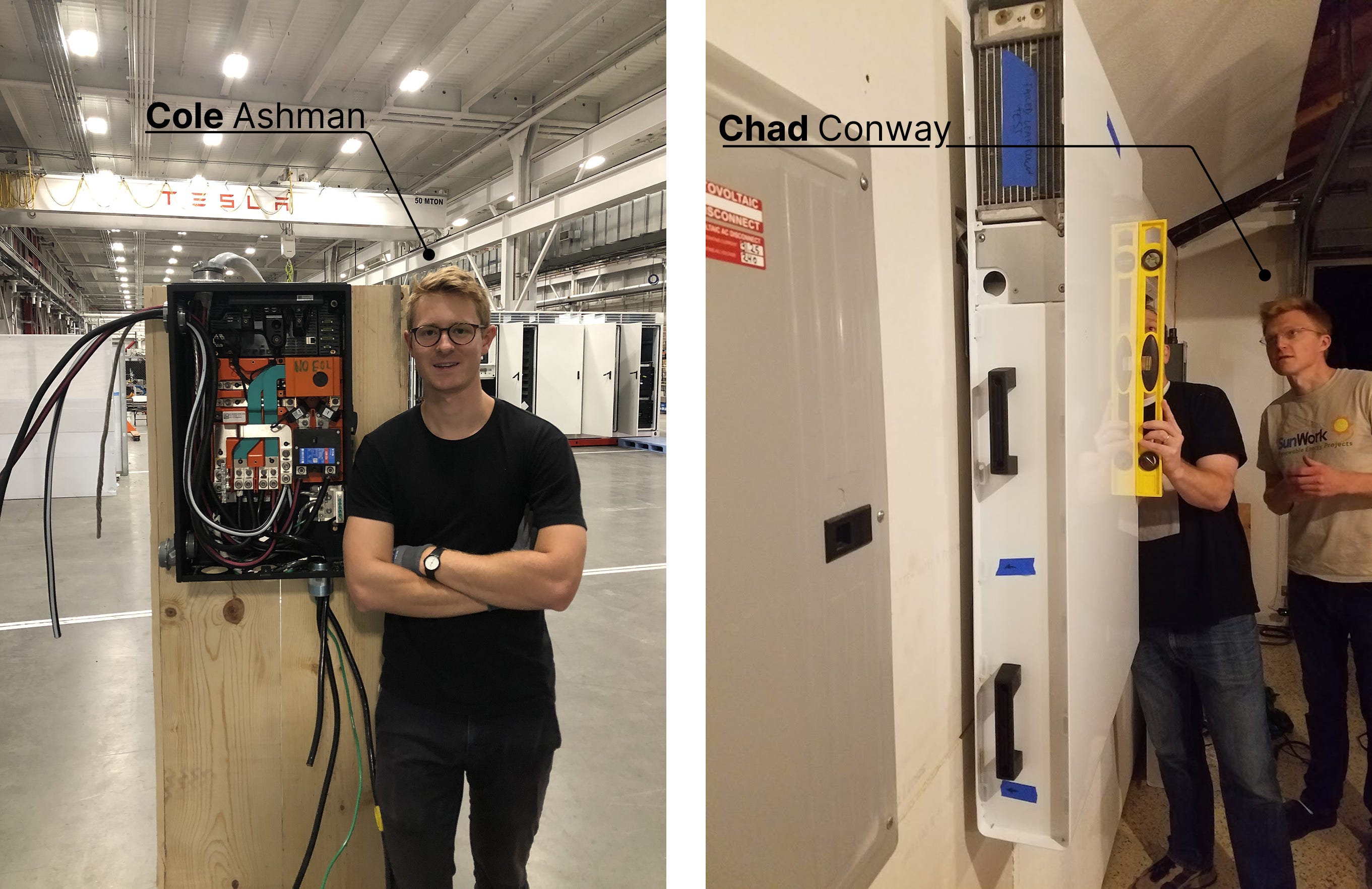
Co-Authored by Cole Ashman (Founder/CEO, Pila) & Chad Conway (Founding Partner, 981.vc)
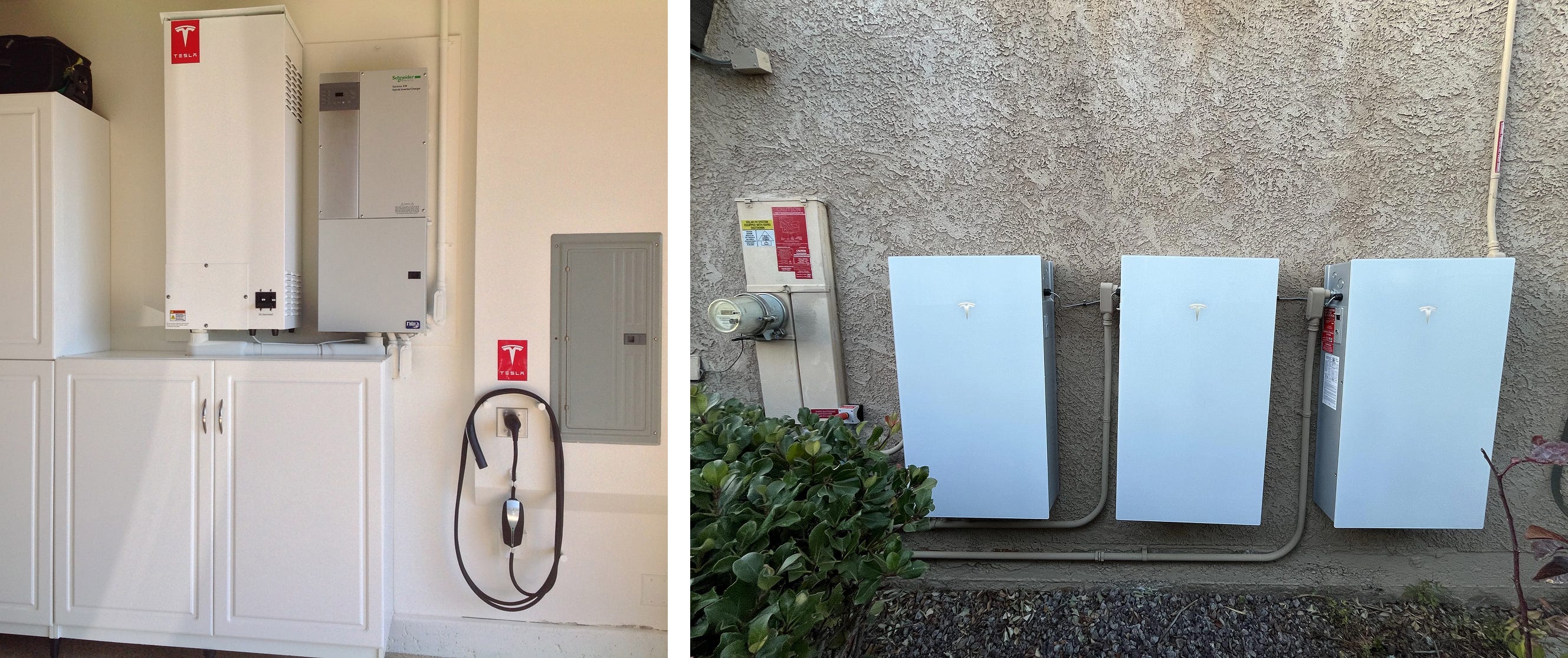
Two-and-a-half repurposed Model S battery modules… a Schneider inverter designed for 48V lead acid racks… a white sheet metal box with no branding, no app. This is the product that kickstarted Tesla’s residential energy business – it’s an epic and little-known hero origin story.
Powerwall 2 and 3 are the products most call to mind when they think of Tesla’s mastery of vertical integration in home energy products. The high-capacity battery design, the impressive hybrid inverter, the super-smart site controller, solar optimization, islanding devices – all in one box, one platform, all Tesla. It’s become an oft-cited template: control everything, own everything, and you win.
The thing is, that was the destination, but it wasn’t the path. I’ve often wondered if confusing the two has led early-stage hardware companies in the wrong direction.
First, where we’re coming from: I (Cole) joined Tesla in 2017, working on new product development globally for Powerwall. Chad joined Tesla even earlier in 2013 and became the 5th employee on the brand-new Energy team, and went on to lead Applications Engineering across the Powerwall ecosystem. We both later helped build the Product team at SPAN. In 2024 I founded another battery company, Pila, to expand access to smart home batteries.
I hope telling this Tesla story from the inside perspective proves helpful for those looking to build ambitious hardware platforms.
Why not build the whole damn thing integrated from day one – pack, power electronics, and compute under one roof, on a fully automated line – and win on the entire cost stack?
It’s a question I’ve often encountered in talking about system costs, with investors and with other founders. The honest answer is: those usually aren’t the right problems to be focused on at the earliest stages. They may be in a few years in – But trying to solve them in year 1 or 2 will slow you down exactly when you need to move fastest.
Chad has a refrain he uses with every hardware founder he backs at 981: “As soon as you take venture capital, you have a 10-year window and you need as many shots on goal as possible. The founders who move fastest are the ones who resist the temptation to build everything and stay ruthlessly focused on what creates the next unlock.”
The Tesla vertical integration story is compelling because it’s true… eventually. But it often gets told backwards. Held up as a masterplan rather than the result of fast, serial, focused bets.
It all started with grant funding from California.
In 2012, Tesla’s fledgling residential energy group secured a CEC grant with a specific goal: prove that a high-capacity lithium-ion battery pack could be safely and effectively connected to a home for backup power. Nobody had done this at residential scale. The team was tiny – a handful of mechanical and firmware engineers working inside an EV company still fighting to survive.
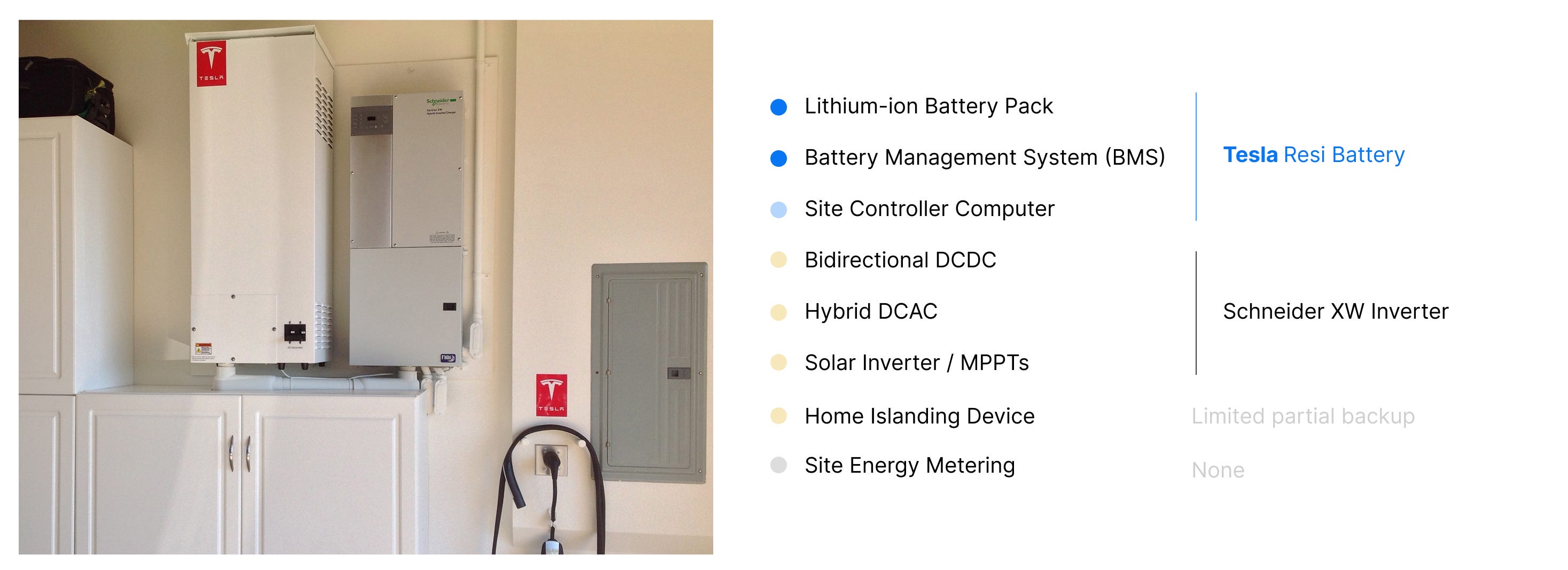
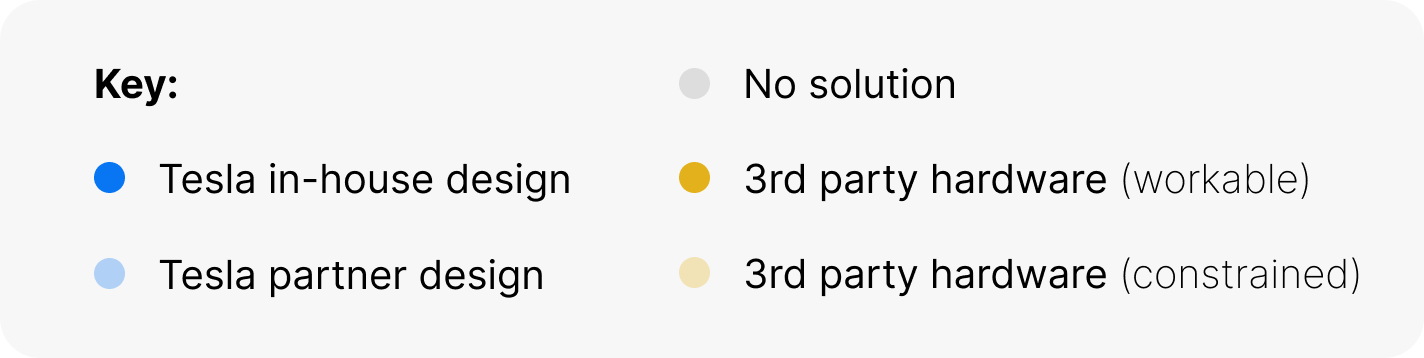
The product they built was as minimal as it could be: two-and-a-half modified Model S battery modules with a basic BMS, packaged in a simple white enclosure and wired to an off-the-shelf Schneider XW 4048 (an inverter designed for 48V lead-acid battery arrays). One piece of real ingenuity was a small site controller: a basic edge computer that pulled in battery telemetry and could adjust the Schneider’s voltage setpoints – effectively coaxing a lead-acid inverter into following a Li-ion charge curve. The battery was supposed to just react to the inverter, but in this case it was steering it. Otherwise, Tesla built around the inverter’s spec, since that meant moving faster.
“We picked the inverter and made the battery work with it,” Chad recalls. “No new tooling, as few custom parts as possible. Just get something out there.”
Tesla deployed ~400 Resi units in California. It proved the concept, and seeded what would become one of Tesla’s most important product lines.
The home battery market was picking up. Germany had been the first mover on residential solar, and its storage market had started to take off around 2015. Competitors were emerging across Europe. The Tesla team knew the next product had to be meaningfully better – cheaper, denser, and differentiated enough to launch a brand.
Hello, Powerwall 1. Two stock Model S modules – same form factor, same production line, different cells – and a custom DC-to-DC converter (DCDC) wrapped inside a statement-piece of an enclosure.
This new in-house DCDC module was key: Tesla could now boost the pack voltage to 300-400V, making Powerwall 1 a compatible DC input for the leading solar inverters of the day – SolarEdge and SMA. But there were still limitations. Those string inverters only supported a 25A backup disconnect – enough to back up a handful of 120V circuits (fridge, lights, maybe a router). But no big 240V loads like HVAC or EV charging, and no whole-home islanding.
This was okay – because that wasn’t the prime question Powerwall 1 had to answer. The question was whether Tesla could build something beautiful enough, affordable enough (the launch pitch targeted $500/kWh installed), and compatible enough to create a brand moment and get to market at scale. In the end, Tesla produced around 10,000 Powerwall 1’s.
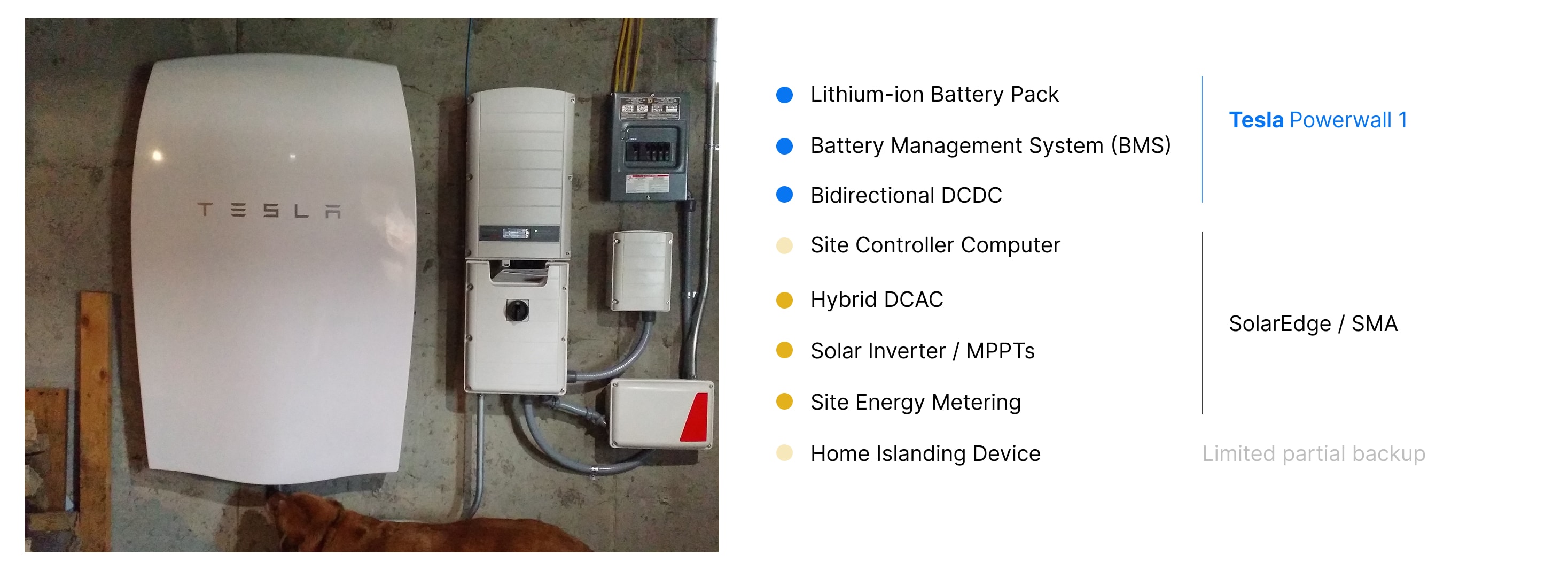
The dependency on SolarEdge was becoming a liability before anyone openly admitted it.
Firmware updates on Powerwall 1 had to travel through SolarEdge’s servers, and they moved slowly. “Maybe 60% of their inverters at the time were even connected to the internet,” Chad remembers. “Updates that needed to roll out across the fleet could take a year. And if something went wrong, it was a pointing contest – whose fault is it?” Customer data lived in SolarEdge’s cloud. Warranty issues became coordination nightmares.
With the market proven, Powerwall 2 was the decision to own the full AC power stack. Enter: a custom bidirectional DCAC, whole-home islanding, and a dedicated grid interface device – the Backup Gateway 1 – that handled microgrid interconnection and load transfer. For the first time, Tesla could island an entire 200A home through a single device, independently of whoever made the solar inverter.
But here’s a key point: even while taking all of that on, the team deliberately chose not to build a solar inverter.
The IP war at that time between SolarEdge, Huawei, and others was a bloodbath. Rapid shutdown requirements were making string inverters more complicated, not less. The decision was to hold on picking a side, and stay compatible with all solar systems. “If we’d aligned with SolarEdge, every SMA installer wouldn’t touch us,” Chad says. “We would have contracted our market the moment we launched. Working with all solar offerings meant every installer, every existing solar system, could add a Powerwall 2.” It this sounds like a concession, it wasn’t. It was a sharp calculation of market access: build trust with the full installer base first, own the inverter layer when the time is right.
In truth, that choice wasn’t free. When Powerwall 2 islanded from the grid, some grid-tied inverter’s DC bus capacitance could force the local microgrid AC voltage to spike near 400V – blowing out customers’ sensitive electronics. Difficult edge cases like this came with depending on inverters Tesla didn’t control… which is exactly the kind of thing that pushes you to own the next layer.
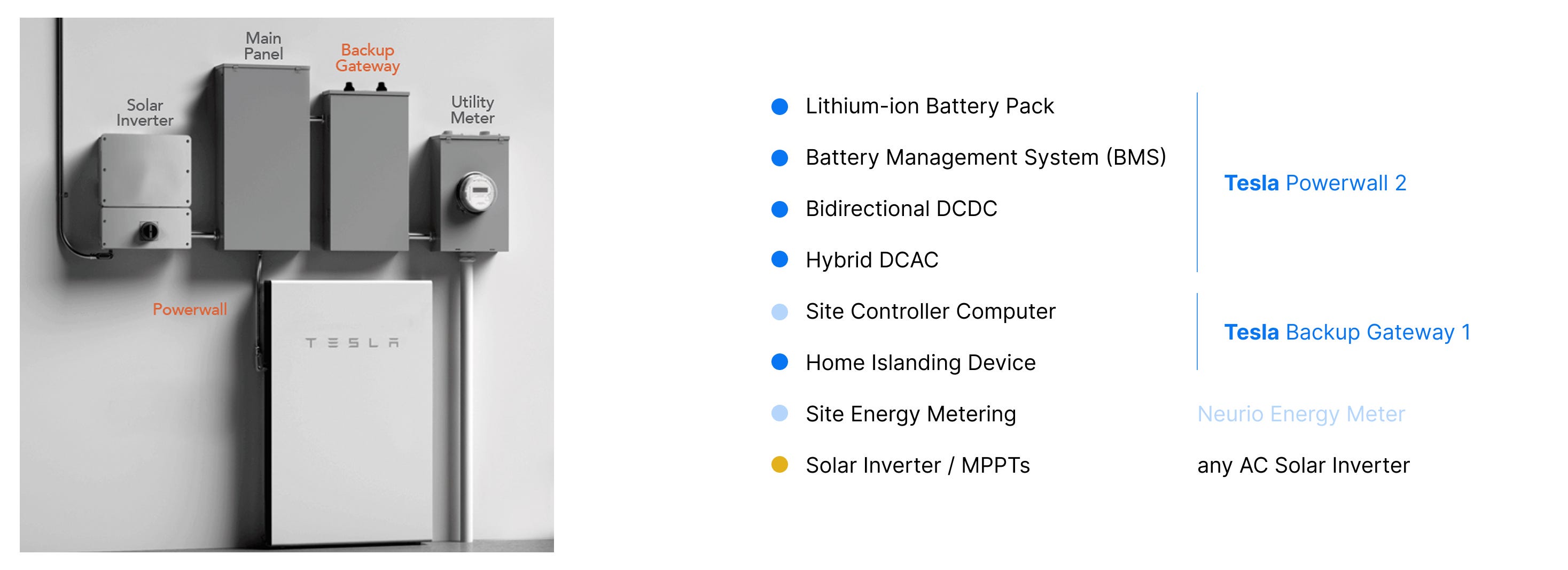
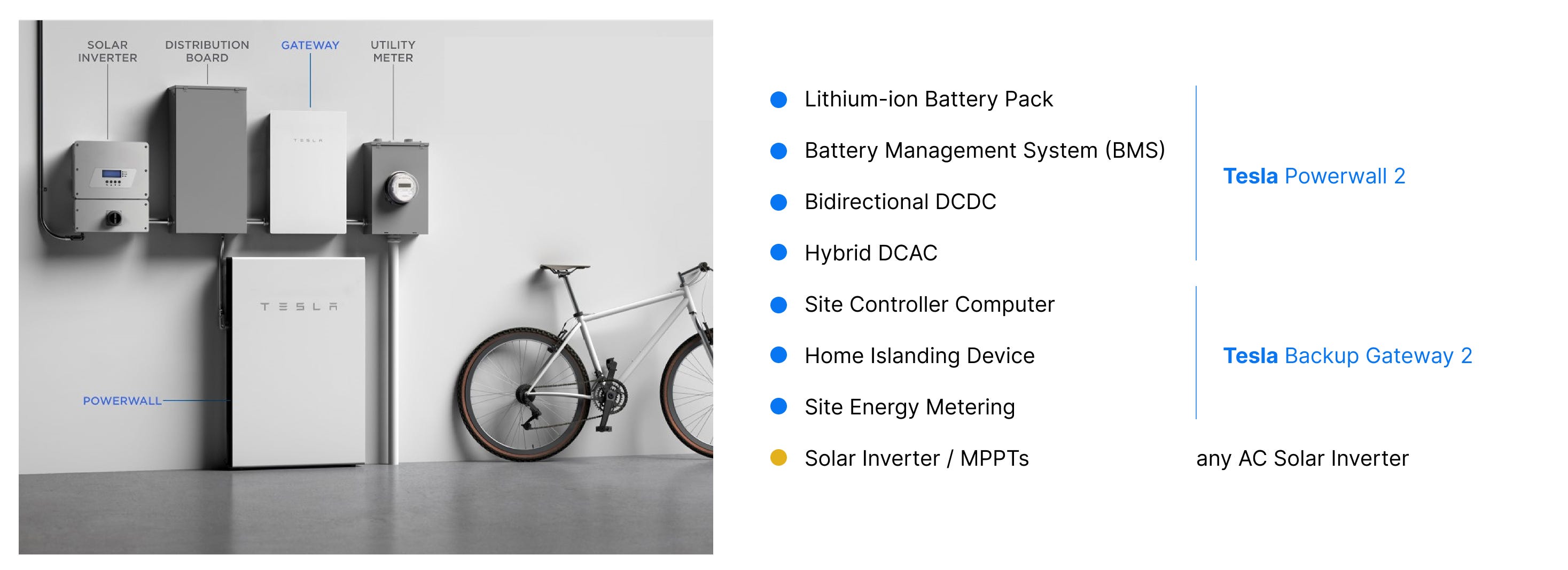
The platform continued to evolve. Each step brought an intentional unlock:
With Backup Gateway 2 we replaced the off-the-shelf energy meter (developed by startup, Neurio) with in-house metering. Better telemetry and accuracy meant Tesla could participate more effectively in VPP and demand response programs, while the simplified installation architecture improved deployment margin and speed. It also expanded the backup offering to three-phase homes in Europe and split-phase homes in Japan – new markets, without an entirely new battery product.
By this point Tesla had serious solar experience. The SolarCity acquisition in 2016 brought deployment and solar algorithm development in-house. But the subtler advantage came from that works-with-everyone decision: because Powerwall 2 was AC-coupled and ran alongside any solar inverter on the market, Tesla had spent years getting intimately familiar with how all of those inverters actually (mis)behaved in the field. You better believe that Tesla used these insights to build a better solar inverter.
The Tesla Solar Inverter – built on the same liquid-cooled Powerwall inverter architecture – made sophisticated energy harvesting and better arc fault detection possible for Solar Roof. Because it’s a simple string inverter, it carried a lower system BOM than running module-level power electronics on every PV panel (At the time this decision was a bold challenge to the status quo set by the solar leaders of the day, SolarEdge and Enphase). Most importantly, it gave Tesla actual software-level telemetry and control from the solar side. Better data means better product decisions. And better control meant a problem like that 400V spike could be handled directly, instead of through the cruder frequency-curtailment workarounds.
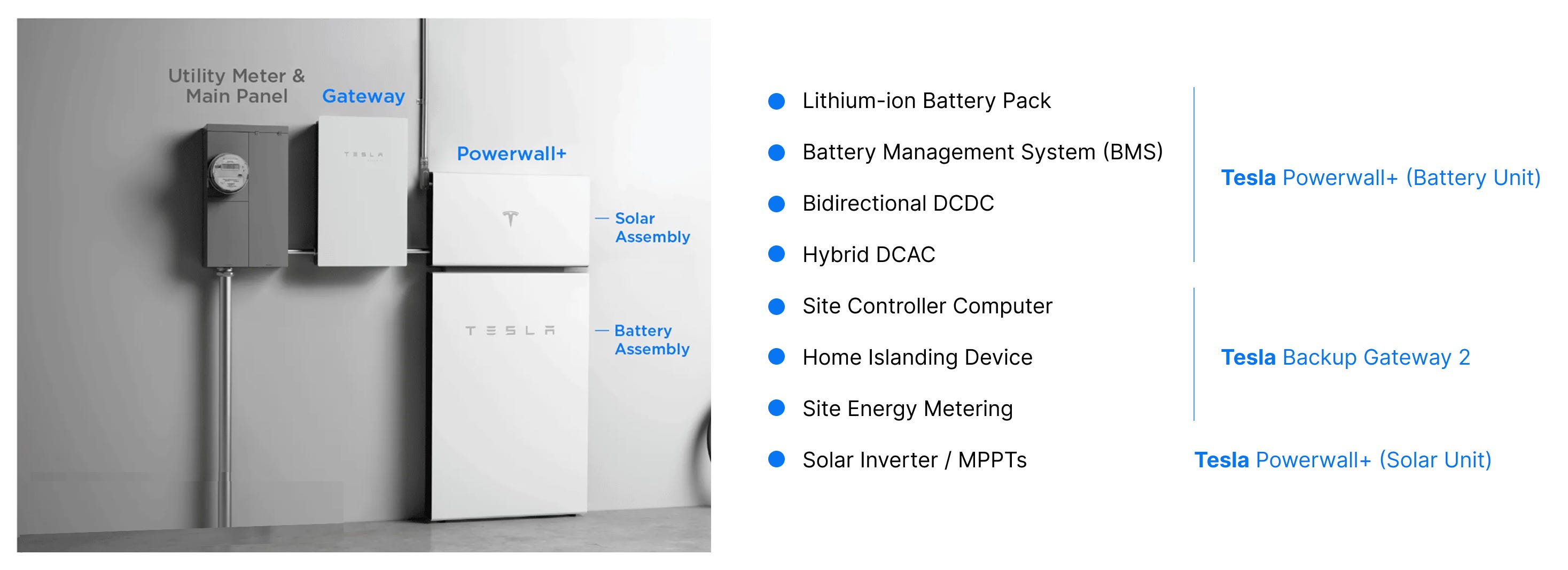
Powerwall+ and the Backup Switch (Tesla’s meter socket adapter) are best understood as one evolution: another smart half-step toward a single box on the wall. Soft costs like installation, design, permitting still account for roughly half of total installed cost for whole-home storage. Simplifying the install architecture was never only about cosmetics. Simplifying this was pure deployment economics.
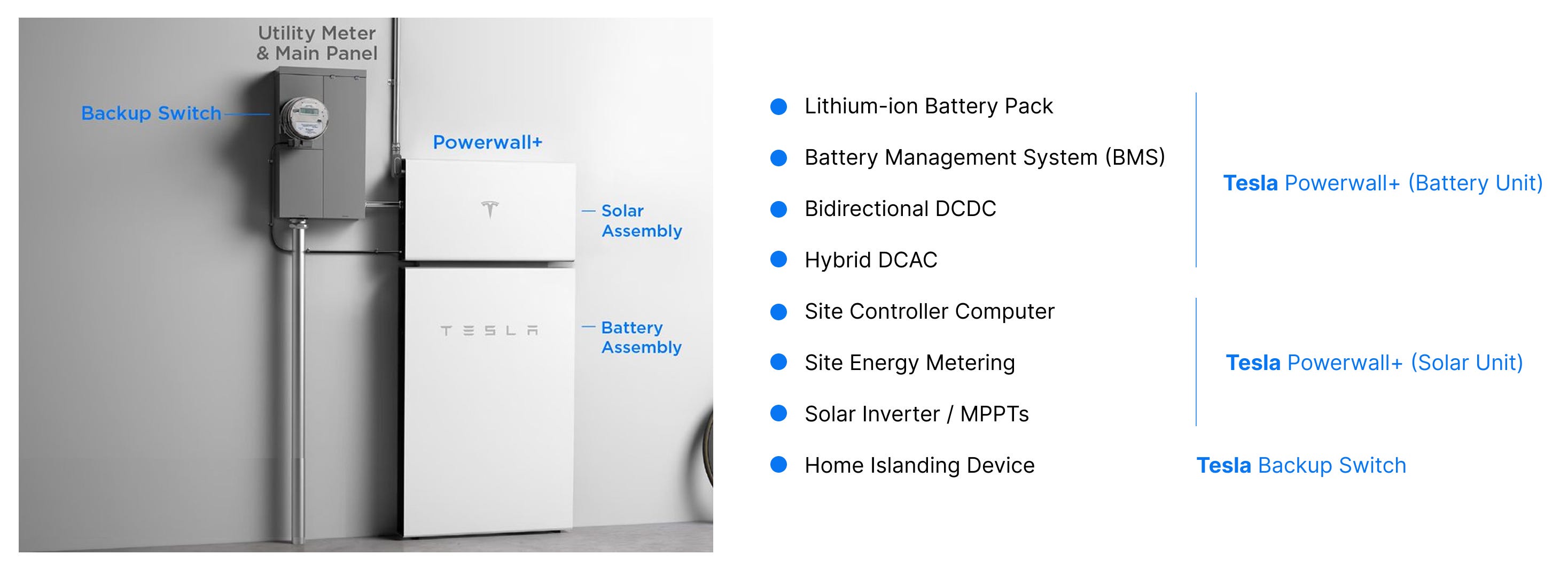
Powerwall 3 completed the arc, launching in 2023. An integrated platform for the battery, BMS, DCDC, 3-phase DCAC, wide-range solar MPPTs, site controller compute, islanding contactor controller, and MID relay. Device software, app, manufacturing, and supply chain… all of it under one roof and (nearly) all in one integrated package.
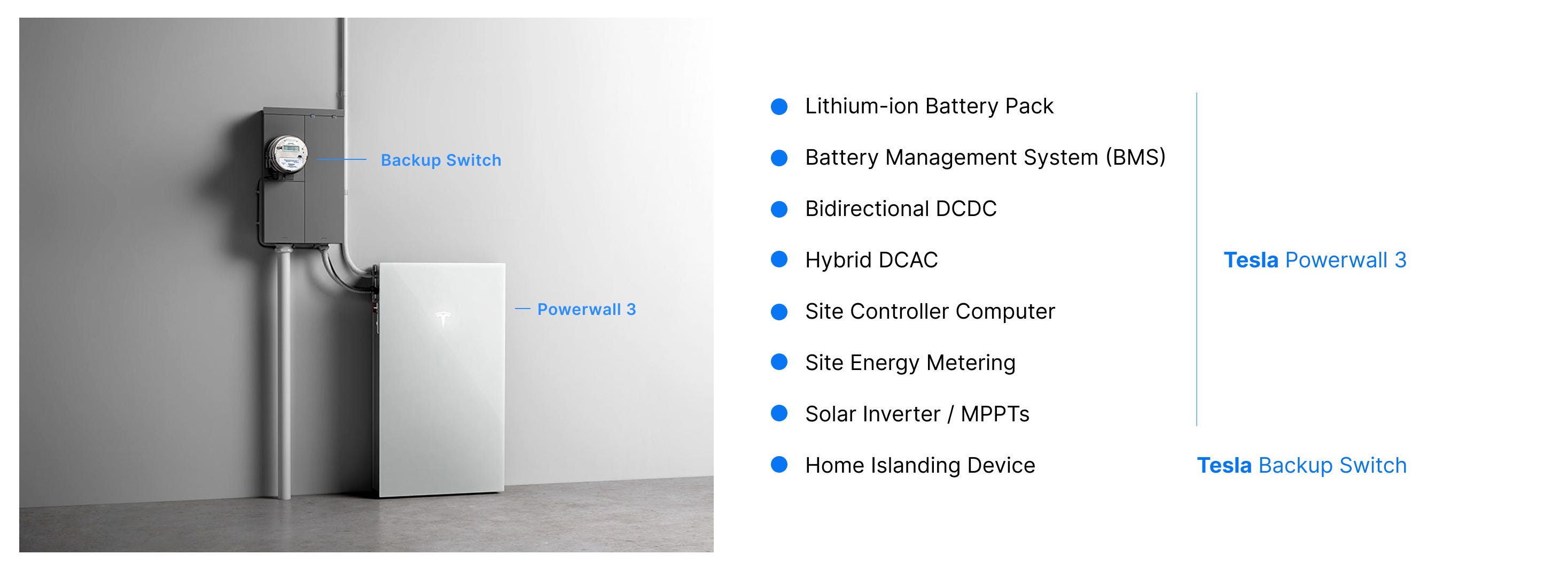
Every step along this path was a chance to improve the components themselves – making the DCAC more capable and easier to mass-manufacture, for example. That’s another reason rapid cycles make all the difference in hardware: every little loop improves not only what the product does but how well you can build it. This thing that started with two-and-a-half borrowed battery modules and a lead-acid inverter has now become about as vertically integrated as a consumer energy product gets.
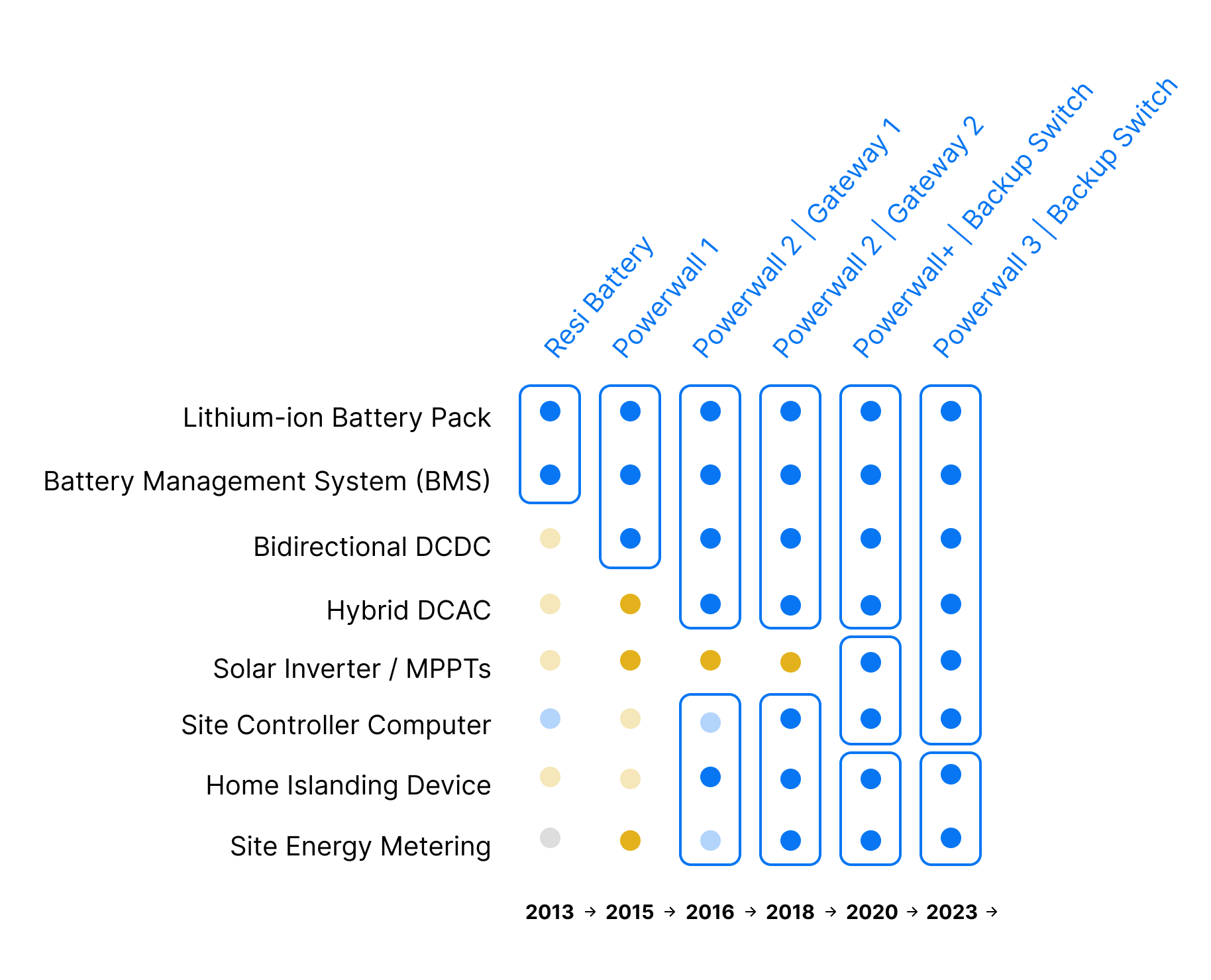
Look at the product arc: Resi → Powerwall 1 → Powerwall 2 → Gateway 2 → Solar Inverter → Powerwall+ → Powerwall 3. Each generation solved one primary problem really well. Everything else was either borrowed, partnered, or deferred. Not for a lack of ambition or engineering skill, but because being focused on what to own when meant learning and deploying faster.
No surprise: This wasn’t unique to Powerwall. It was core to the Tesla strategy. The original Roadster used a Lotus Elise chassis and an AC Propulsion powertrain – Tesla focused on the battery and the integration, the parts that actually redefined what an electric car could do, and partnered for the rest. Same playbook, but different product.
A few things make this playbook work:
Strategic tech partnerships weren’t though of as a fallback – more often, they were the deliberate choice that got Tesla to market fast enough to deploy a fleet that created an unfair advantage in pace of learning.
When the next product launched, the team moved on. Once Powerwall 1 was in the field, development stopped anchoring to it – service got the documentation, and the engineers focused forward. Done poorly, this becomes a brutal support burden, and it always comes with tradeoffs. Done right, it’s what keeps a small team moving fast.
Third (and this one is the hardest to replicate) by acquiring SolarCity as a direct deployment channel Tesla was uniquely both the equipment manufacturer and the installer. This dramatically shortened the feedback loop. Most manufacturers don’t find out what’s broken until support tickets trickle in months after launch; most installers are stuck with whatever products the market hands them. Tesla deleted this problem. Field issues, install headaches, what actually held up in real homes all flowed quickly back to engineering HQ before the product design was locked.
You can’t know what to bet on owning in Gen 3 until you’ve learned what matters most from actually getting Gen 1 out there.
The takeaway isn’t necessarily “start small”. The most successful hardware companies can hold a long-term platform vision and short-term execution discipline at the same time. Each development phase is a focused, strategic step that levels up the offering. In-housing more of the stack is a natural result of those leaps, not a prerequisite to them.
At Pila, we designed the full system architecture first – with a long-term vision to become the operating system for power in 100% of buildings: a software-defined virtual battery platform, aggregated locally. Then we made deliberate choices about what to build in-house and where to partner for our Gen 1 battery node. Again: not because we couldn’t envision owning more, but because those weren’t the right problems to derisk in Pila’s chapter one. The unlock right now is proving that plug-in, mesh-networked batteries work reliably in real homes – across any geography and home style – and produce a whole greater than the sum of parts. Proving this is what makes the next decisions possible. Cell manufacturing and in-house PCBA fabs are real conversations. Just not yet.
Powerwall 3 is an extraordinary product. It didn’t come from a masterplan. It came from 400 unsexy battery boxes in California, an off-the-shelf inverter, and a team disciplined enough to question this at every stage: What’s the one most important unlock and how do we learn quickly, nail that part, and repeat?
Thanks for reading! This post is public so feel free to share it.