maak.el — Maak integration for Emacs


maak.el brings seamless integration for Maak: The infinitely extensible command runner, control plane and project automator à la Make (Guile Scheme - Lisp) into your Emacs workflow. Maak replaces archaic Makefiles with the elegance and power of GNU Guile Scheme. With maak.el, you can discover, inspect, and execute your Maak tasks directly from the comfort of Emacs, complete with rich minibuffer completions.
Most build tools invent their own limited domain-specific language. Maak embraces the powerful λ Lisp and the amazing Guile Scheme programming language.
This also means your code is flexible, robust and reliable (+declarative) for at least the next 50 years.
- Automatic Project Discovery: Automatically locates your root
maak.scmfile using dominating-file heuristics. - Smart Visibility Parsing: Respects your Maak configuration's
#:exportlists—only showing public tasks (or all, if no exports). - Polished Completion UI: Implements aligned columns in your preferred completion framework (Vertico, Ivy, Helm, or native
completing-read) showcasing task signatures and docstrings. - Interactive Argument Gathering: If a task expects parameters,
maak.elwill sequentially prompt you for them in the minibuffer before executing. - Native Compilation Buffers: Executes tasks asynchronously via Emacs's native
compilesystem, keeping shell-escaping watertight and allowing you to jump straight to errors.
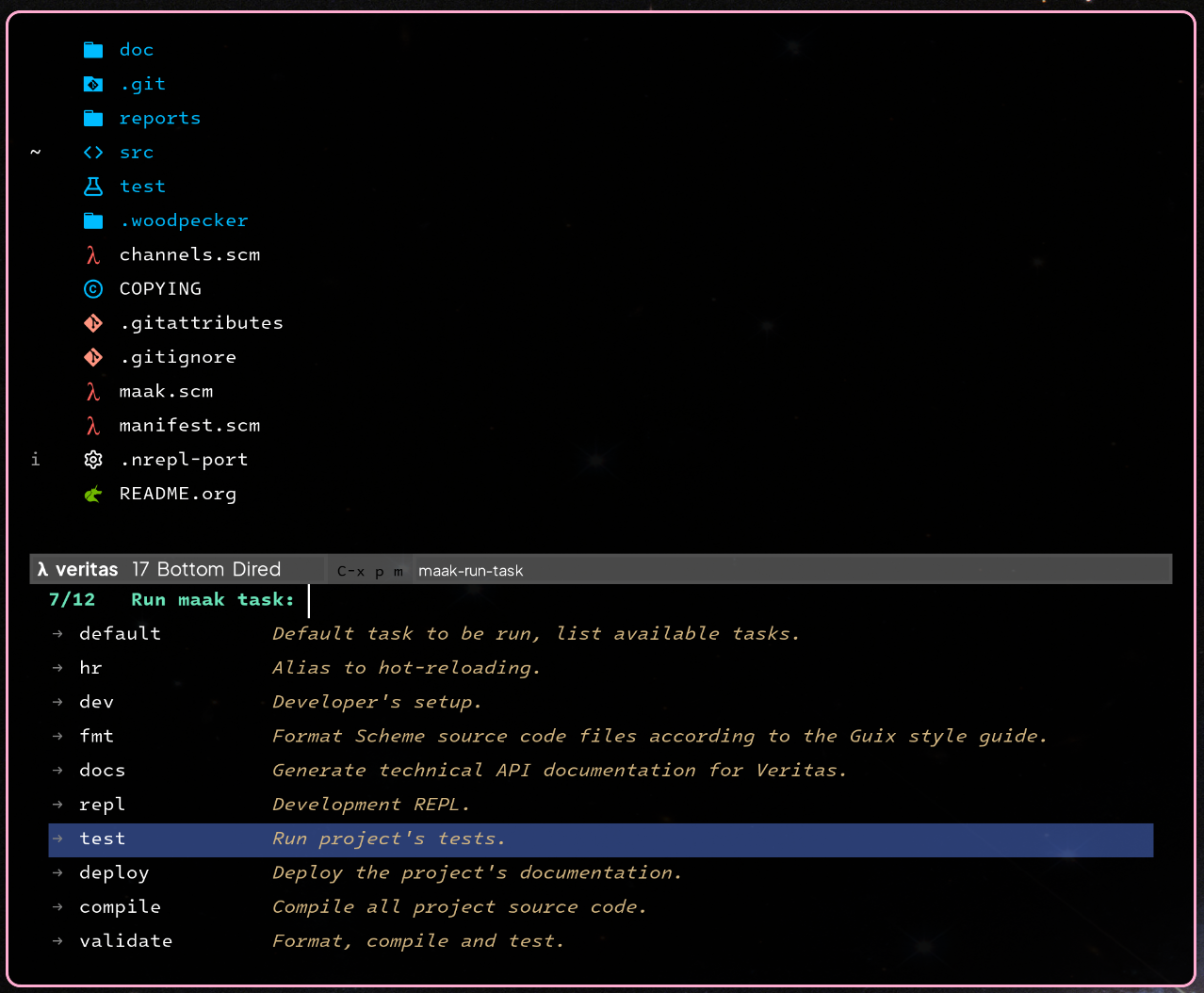
Using standard Emacs properties, your tasks are dynamically formatted in completion list. It will render beautifully aligned columns matching your theme's default font lock faces.
Thanks to Lisp being universal, and Scheme and Emacs Lisp being mutually parseable, maak.el parses maak.scm locally and cleanly, while being aware of S-exps, comments, etc.
- It spins up a temporary buffer inside standard Emacs Lisp mode to parse Scheme forms safely.
- It locates the module's
#:exportform (handling comments and strings seamlessly) to build a whitelist. - It maps defined procedures matching public exports (or all, if no exports), extracting Scheme docstrings and formal parameter lists.
 ,---.       ,---.
(     \     /     )
 )  (  \____/  )  (
(    \ @  @ /    )      [ Maak ]
 )    ( oo )    (       The infinitely extensible
(      \__/      )      command runner, control plane,
  `------------'        and project automator.
If you like my work, please support me by buying me a cup of coffee ☕ so I can continue with a lot of motivation.
Community & Support
Join the maak community to ask questions, discuss development, share configurations, screenshots, report issues, or just hang out:
Issues & development: Codeberg repository
Chat, support, discussion, announcements (Zulip): Join the maak Zulip community
If you're unsure where to start, Zulip is recommended. Codeberg issues is also a good place to add ideas, report bugs or improvements.
Installing
This package is not (yet) available in popular Emacs repositories such as MELPA or ELPA. An example installation with Elpaca:
  (use-package maak.el
    :ensure (:host codeberg :repo "jjba23/maak.el" :branch "trunk")
    :demand t
    :bind ("C-c m r" . maak-run-task))
Usage
Running Tasks
Invoke the primary command:
M-x maak-run-task
- Emacs will search upwards from your current buffer to find a
maak.scm. - A completion menu will pop up listing all exported tasks from your Scheme configuration.
- If the task you select defines parameters (e.g.,
(define (deploy server env) ...)), the minibuffer will prompt you sequentially. - A standard
*compilation*buffer will spawn executing your task viamaak <args...>.
Using standard Emacs properties, your tasks are dynamically formatted in completion list. It will render beautifully aligned columns matching your theme's default font lock faces.
Customization
You can customize maak.el behavior and looks with Emacs Lisp config (or via M-x customize-group RET maak RET ). Some worthy mentions:
| Variable / Face | Default Value | Description |
|---|---|---|
maak-annotation-padding |
4 |
Number of spaces to maintain between the arguments and the docstring in completion columns. |
maak-task-arguments-face |
Inherits font-lock-variable-name-face (italic) |
Face used to render the task arguments list in completion. |
maak-task-documentation-face |
Inherits font-lock-doc-face |
Face used to render the task docstring in completion. |
Thanks to Lisp being universal, and Scheme and Emacs Lisp being mutually parseable, maak.el parses maak.scm locally and cleanly, while being aware of S-exps, comments, etc.
- It spins up a temporary buffer inside standard Emacs Lisp mode to parse Scheme forms safely.
- It locates the module's
#:exportform (handling comments and strings seamlessly) to build a whitelist. - It maps defined procedures matching public exports (or all, if no exports), extracting Scheme docstrings and formal parameter lists.
Licensing
Maak and all of its source code are free software, licensed under the GNU General Public License v3 (or newer at your convenience).
https://www.gnu.org/licenses/gpl-3.0.html
The documentation and examples, including this document, which are provided with Maak, are all licensed under the GNU Free Documentation License v1.3 (or newer at your convenience).
https://www.gnu.org/licenses/fdl-1.3.html
AI Policy
This project adheres to the jointhefreeworld AI (Artificial Intelligence) policy.
Our core principle is simple: AI should assist human creativity and problem-solving, never replace human reasoning.
While tools like Large Language Models (LLMs) and interactive chatbots can be beneficial for reviewing, refactoring small functions, or acting as a sounding board, they should be used with moderation.
We require a human in the loop for all contributions. The use of autonomous AI agents to automatically generate and submit pull requests to this project is strictly prohibited.
Code of conduct
This project adheres to the jointhefreeworld code of conduct. Find it here:
https://jointhefreeworld.org/blog/articles/personal/jointhefreeworld-code-of-conduct/index.html
In summary, we foster an inclusive, respectful, and cooperative environment for all contributors and users of this free software project. Inspired by the ideals of the GNU Project, we strive to uphold freedom, equality, and community as guiding principles. We believe that collaboration in a community of mutual respect is essential to creating excellent free software.