State of Clojure 2025 Results
18 February 2026
Christoph Neumann
Demographics
80 countries represented
80 different countries were represented by respondents to the State of Clojure Survey!
Responses by Country
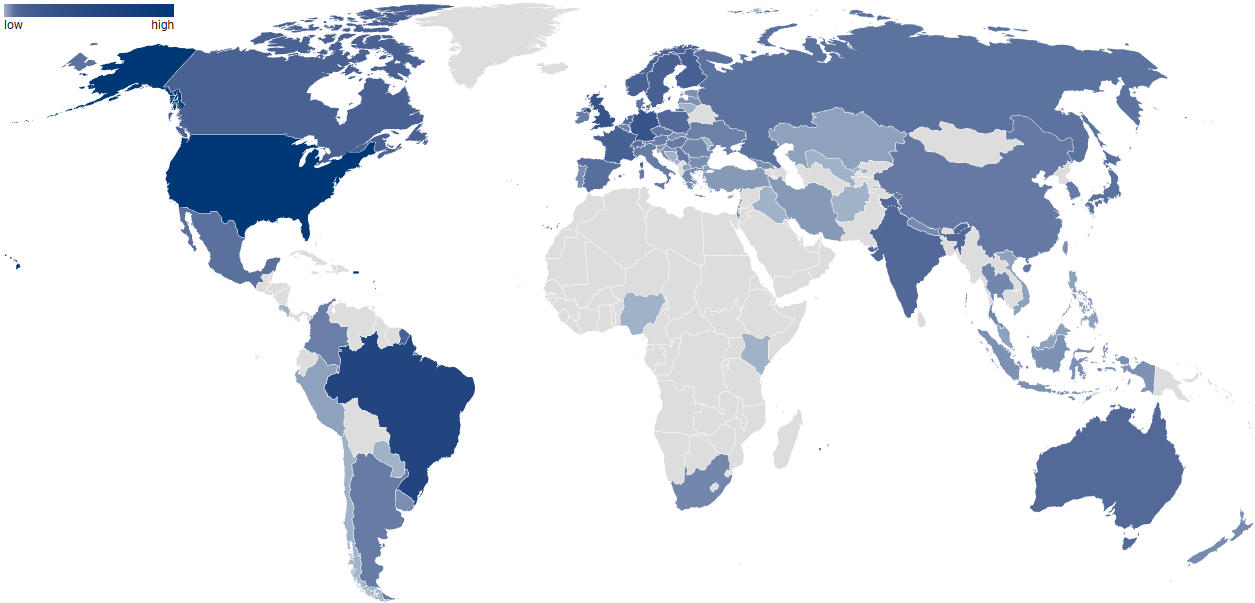
The Top 10 countries, by count:
1. United States |
6. Sweden |
In fact, the top 4 countries constituted 50.1% of the respondents, so by the numbers, the United States, Brazil, Germany, and the United Kingdom have the same number of Clojure users as the rest of the world.
What if we adjust for population? We can see where Clojure is most concentrated per capita.
1. Finland |
6. Serbia |
Northern Europe has an especially high concentration of Clojurists.
Responses by Per Capita
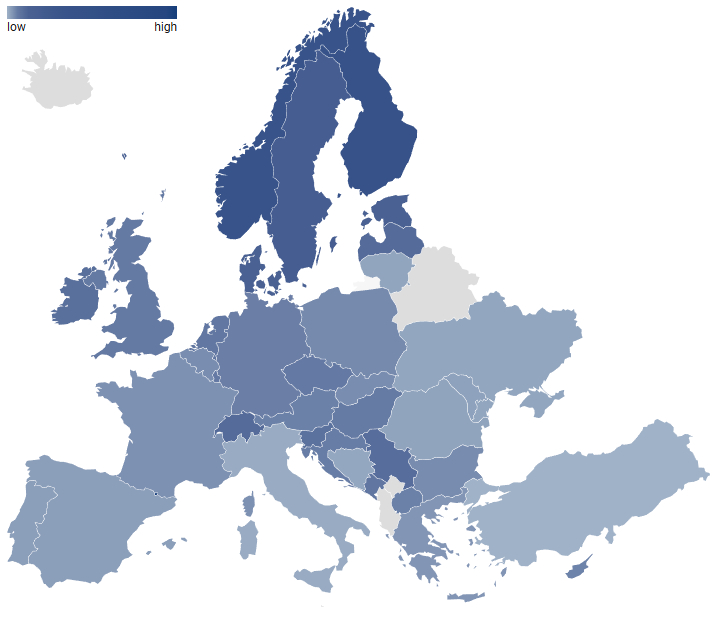
Also, despite the population differences, Austria, Australia, United States, Brazil, and Canada all have a similar concentration of Clojurists.
82% of Clojure developers have 6 or more years of professional programming experience
Experienced developers continue to be well represented in the Clojure community.
Question: How many years have you been programming professionally?
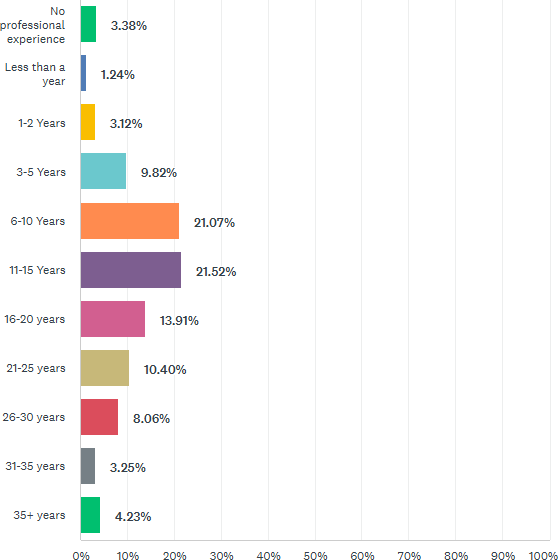
Clojure attracts developers across a wide range of professional experience
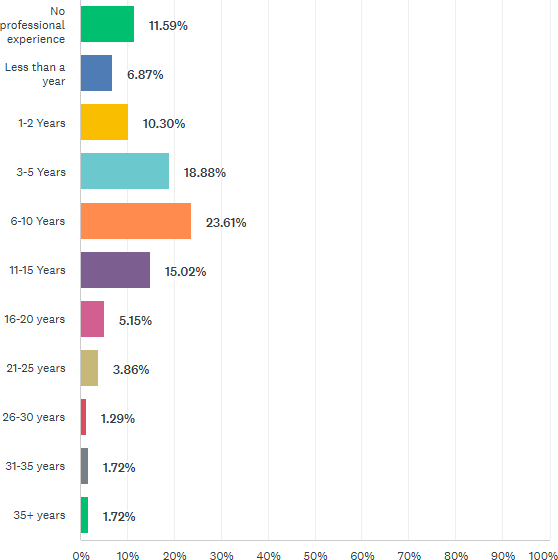
Clojure isn’t just appealing to highly experienced professional developers. Clojure also attracts developers with little to no professional experience. New Clojure developers are from a wide range of professional programming experience.
Professional experience for those with ≤ 1 year of Clojure experience
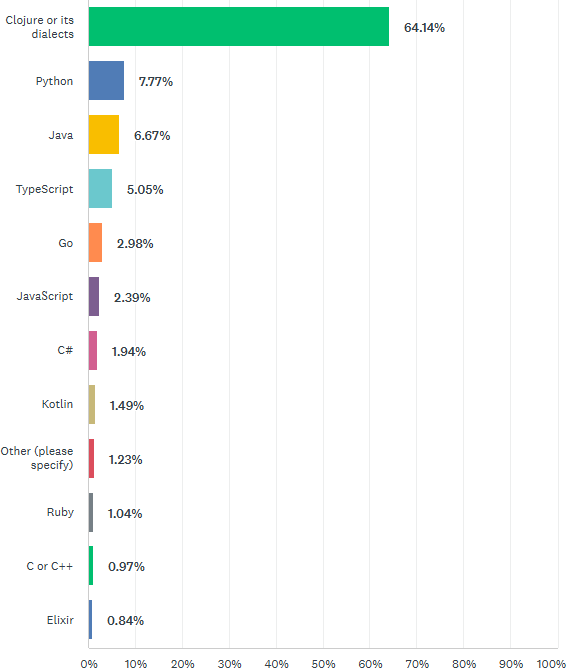
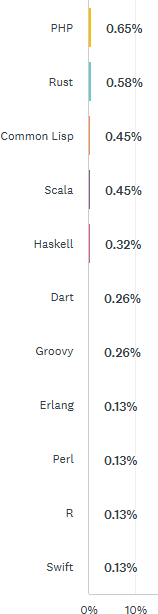
Most Clojure developers use Clojure as their primary language
About 2/3 of the respondents use Clojure as their primary language. When Clojure isn’t primary, popularity seems to influence language choice more than a specific language attribute (such as a functional style).
Question: What was your PRIMARY language in the last year?
|
|
Developer Satisfaction
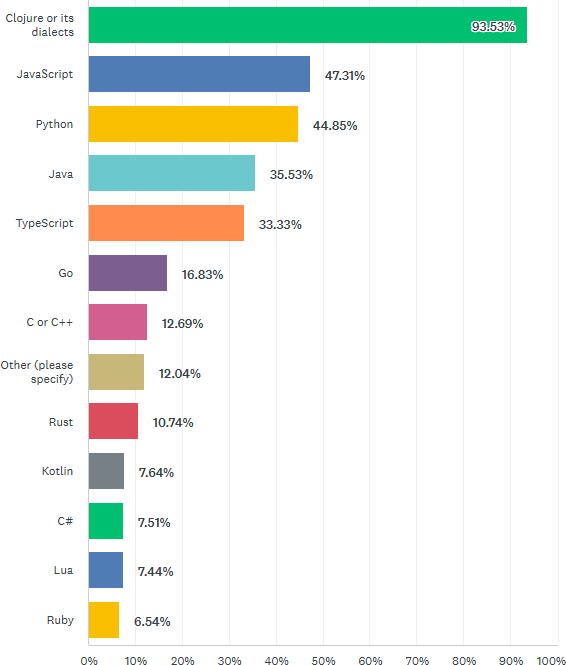
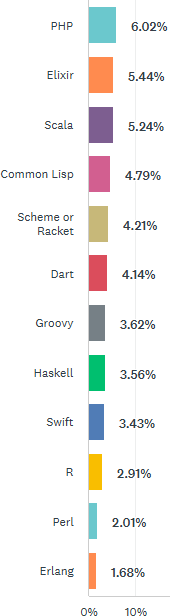
Clojure is used in a mix of popular languages.
10% of Clojure developers indicated that they only used Clojure. All others indicated at least one other language they used. This choice, like the primary language, appears to be influenced by popularity, although functional languages (eg. Elixir, Lisp, Scheme/Racket, etc.) appear to be overrepresented versus their general popularity.
Question: What programming languages have you used in the last year? (select all)
|
|
1 in 10 Clojure developers would quit programming without Clojure
The results below are for developers that selected Clojure and its dialects as their primary language.
Question: If you couldn’t use Clojure, what language would you use instead?
|
|
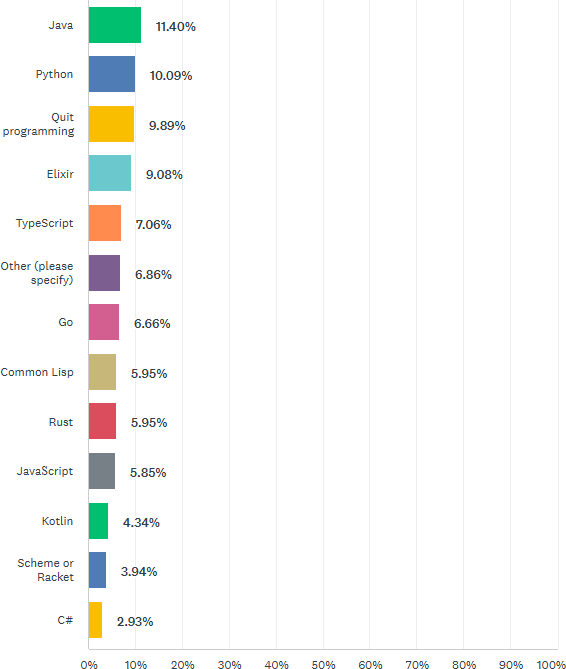
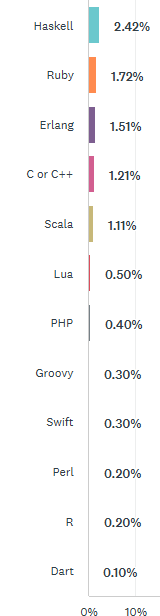
Unsurprisingly, the most popular languages are well represented in the top choices: Java, Python, TypeScript, Go, etc., but notice the functional languages are overrepresented versus their general popularity: Elixir, Common Lisp, Scheme/Racket, Haskell, and Erlang.
The design of the Elixir language was influenced by Clojure, so it makes sense that it would stand out as a Clojure alternative versus other functional languages.
Industries and Applications
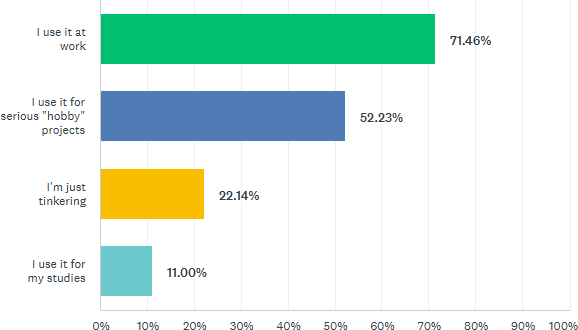
Work use continues to lead, but hobby programming is popular too.
Survey respondents have nearly as much fun with Clojure (52% for hobbies) as more serious uses (71% for work).
Question: How would you characterize your use of Clojure today? (select all)
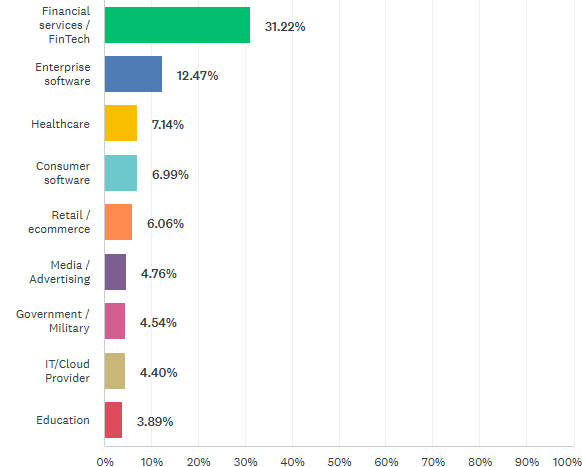
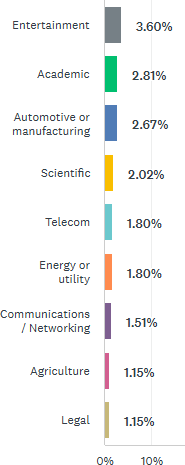
Fintech, Enterprise Software, and Healthcare are the top industries for Clojure at over 51% combined.
Clojure is used across a range of industries, but Financial Services, Enterprise Software and Healthcare stand out as the top ones. Fintech is 2.5x more popular for Clojure than Enterprise Software and over 4x more popular than Healthcare.
Question: What primary industry do you develop for?
|
|
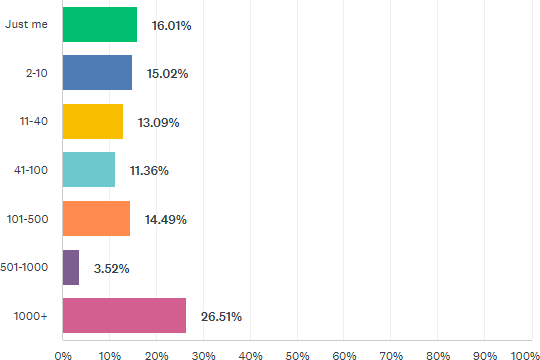
Clojure is used at large companies and small companies alike.
16% of Clojurists are solo developers. 55% are in an organization of 100 people or less. 26% are in an organization larger than 1000 people—many are likely part of Nubank, the world’s largest digital-only financial services platform, which employs thousands of Clojure developers.
Question: What is your organization size?
New Users
Clojure continues to attract and retain developers.
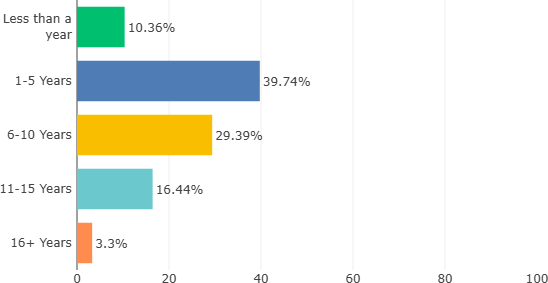
15% of respondents have used Clojure for one year or less. That’s roughly equivalent to the 16% that have used Clojure 11-15 years. With 16+ years of experience, 3% of the Clojure community is made up of Clojure’s earliest adopters.
Question: How long have you been using Clojure?
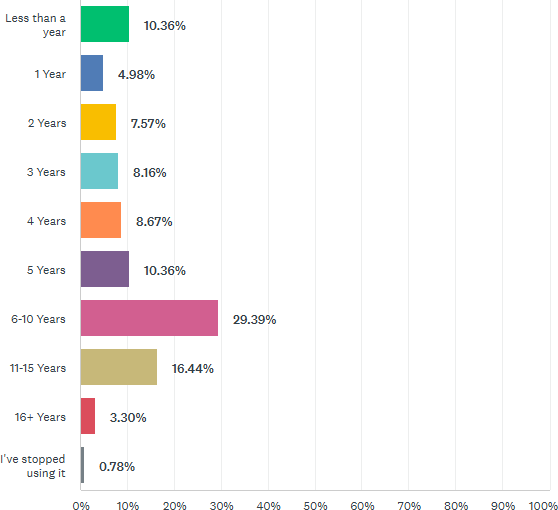
Using equally sized buckets, it becomes clear that about half the community has 5 or less years of Clojure experience and the other half has 6 or more years.
Years of Clojure experience
Functional programming, work, Lisp heritage, and Rich Hickey’s talks are the top reasons for investigating Clojure.
The survey asked developers with ≤ 1 year of Clojure experience to select all the factors that first prompted them to investigate Clojure.
Question: Why did you first start looking at Clojure? (select all)
Seeking a functional programming language |
40.20% |
Use at work |
39.70% |
Seeking a modern LISP |
39.20% |
Inspired by conference talk or video by Rich Hickey or others |
32.16% |
Seeking a more concise/expressive language on the JVM |
14.57% |
Seeking a better language for web / full stack programming |
13.07% |
Inspired by programming writings by prominent authors |
12.56% |
Enjoyed the community |
9.55% |
Seeking a language for safe concurrent programming |
8.54% |
Introduced by a friend or colleague |
8.54% |
Inspired by using a tool or framework written in Clojure |
7.04% |
Other (please specify) |
6.53% |
Business advantages like leverage, hiring, pay |
3.52% |
Interested in doing music / art programming |
2.51% |
Use in a university class |
1.01% |
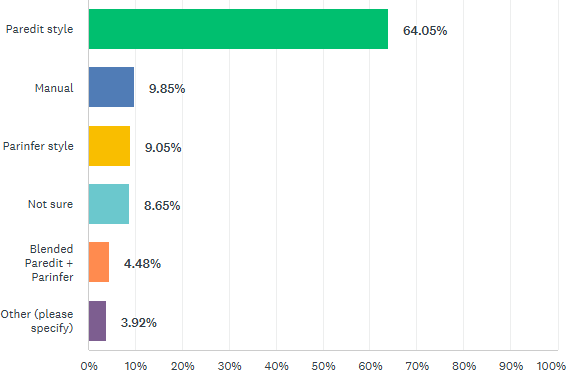
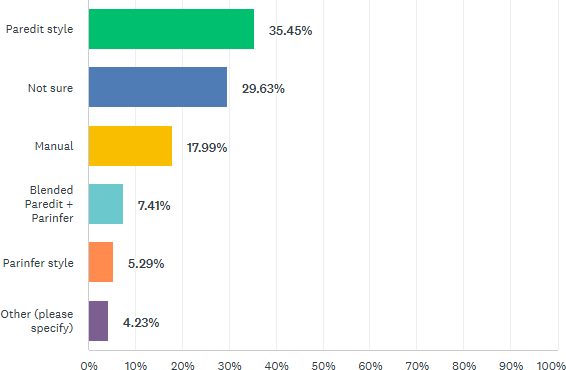
Nearly half of new Clojure developers are unfamiliar with structured editing.
Structured editing allows a developer to efficiently edit Clojure code while keeping parenthesis and other delimiters balanced. It is especially useful for Lisp-style syntax where the distance between those delimiters ("on the outside") can span many lines of code.
As you can see below, only 19% of experienced Clojurists don’t use it ("manual") or are "not sure" about structured editing. For the inexperienced group, a full 48% don’t use it or are not sure.
Question: Which method do you use to edit Clojure code while balancing parentheses, brackets, etc? (Structured editing)
Respondents with 2 or more years of Clojure experience
Respondents with 1 year or less of Clojure experience
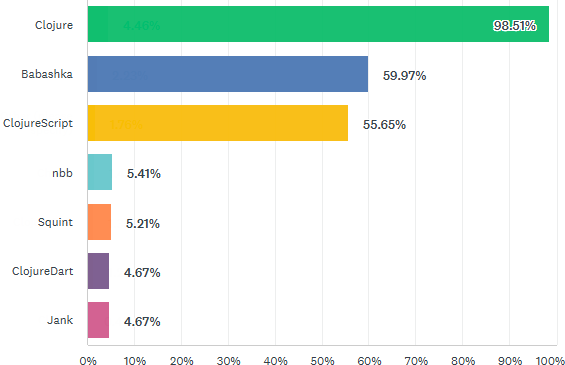
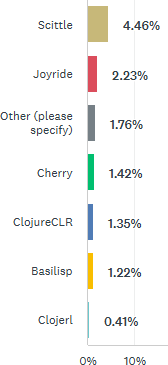
Clojure remains more popular than any dialect, but Babashka and ClojureScript are quite popular too.
3 out of 5 respondents indicated they use Babashka, which edged out ClojureScript for the #2 spot for the second year in a row.
Question: Which dialects of Clojure have you used in the last year? (select all)
|
|
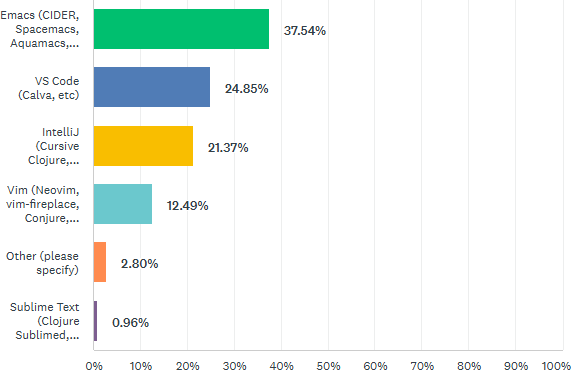
Emacs still holds the top spot overall, but new Clojurists are much more likely to use VS Code with Calva.
Across all respondents, Emacs is the most popular, although there is a near perfect 50-50 split between Emacs + Vim and all the others.
Question: What is your primary Clojure development environment?
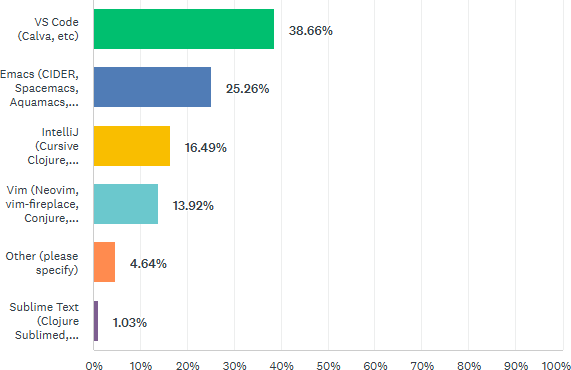
For Clojure developers with one year or less of Clojure experience, Emacs and VS Code essentially trade places.
Respondents with 1 year or less of Clojure experience
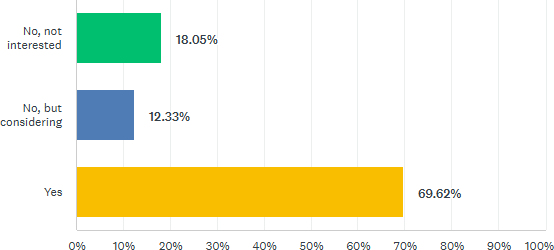
70% of Clojure developers have used AI tools for software development, and 12% are considering it.
The industry-wide surge of AI tooling can be seen in the Clojure community. Although a huge majority of Clojure developers have used AI tooling, a disinterested 18% are quite content without it.
Question: Have you used AI tools for software development?
Final Comments
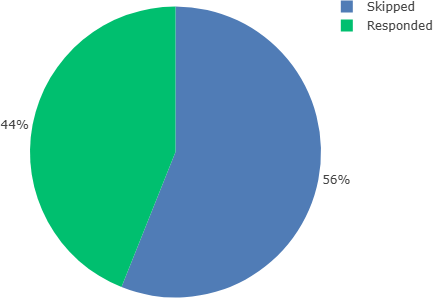
44% of respondents took the time to express appreciation.
After a very long survey, nearly half of the respondents took even more time to express appreciation for others in the Clojure community. You can read their many, many words of appreciation in the full results of the 2025 survey.
Question: Who do you appreciate in the Clojure community and why?
In the spirit of thanks, we would like to thank you again for using Clojure and participating in the survey!