A first-person shooter that ships no art assets at all.
Every texture, every mesh, every animation and every sound is generated
from code the moment you open the page.
Needs a WebGL2 browser and a few seconds to build the world on your GPU.
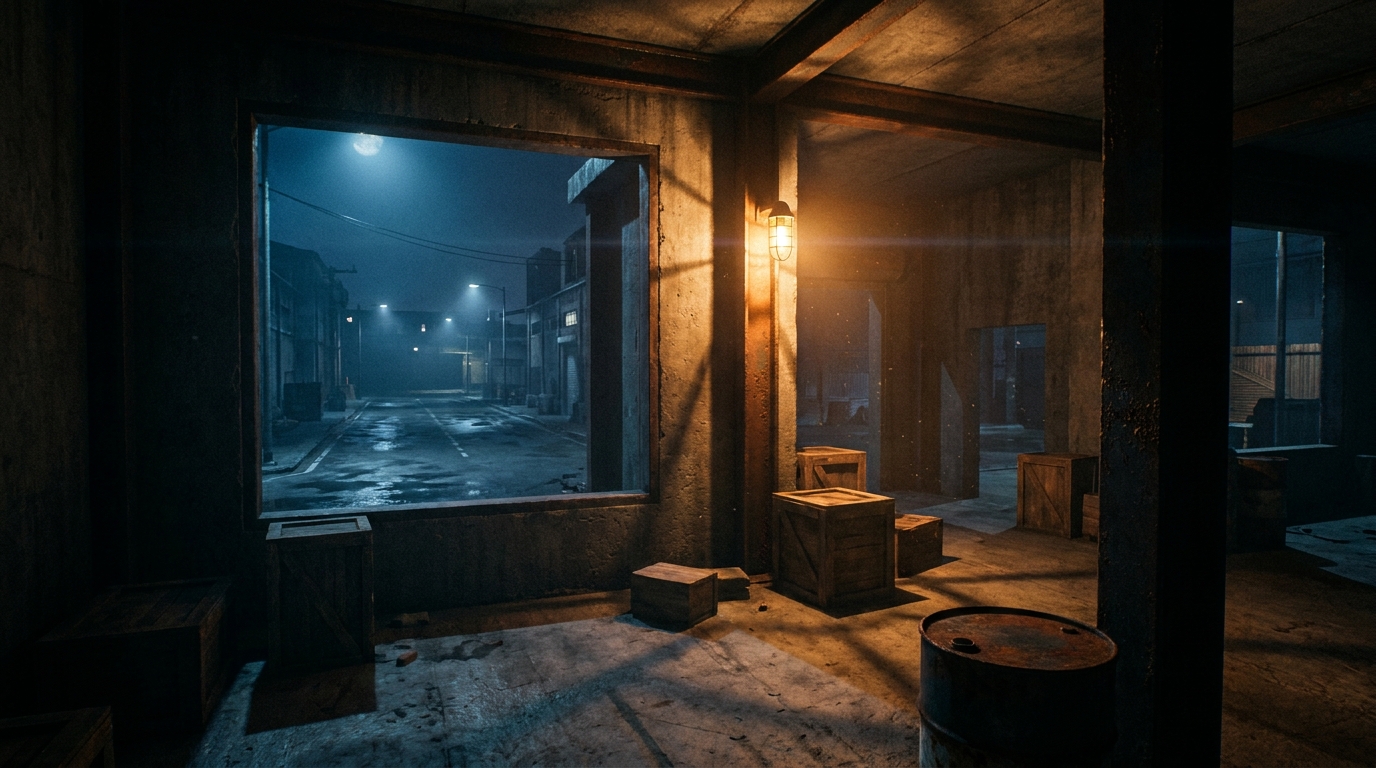
Backdrop: concept art — not actual gameplay
01 — THE WHOLE POINT
There is no assets folder.
Most games ship gigabytes of authored content. This one ships a single
JavaScript bundle. The concrete, the brick, the rusted steel, the
soldiers, the weapons, the reverb on a gunshot in a stairwell — none of
it exists until your GPU computes it at load time. That is why the first
load takes a moment, and why the download is smaller than one photograph
from most games.
0image, model or audio files in the repository
19procedural surface materials, generated on the GPU
1runtime dependency — three
~500 KBgzipped, the entire game
02 — CAPTURED IN ENGINE
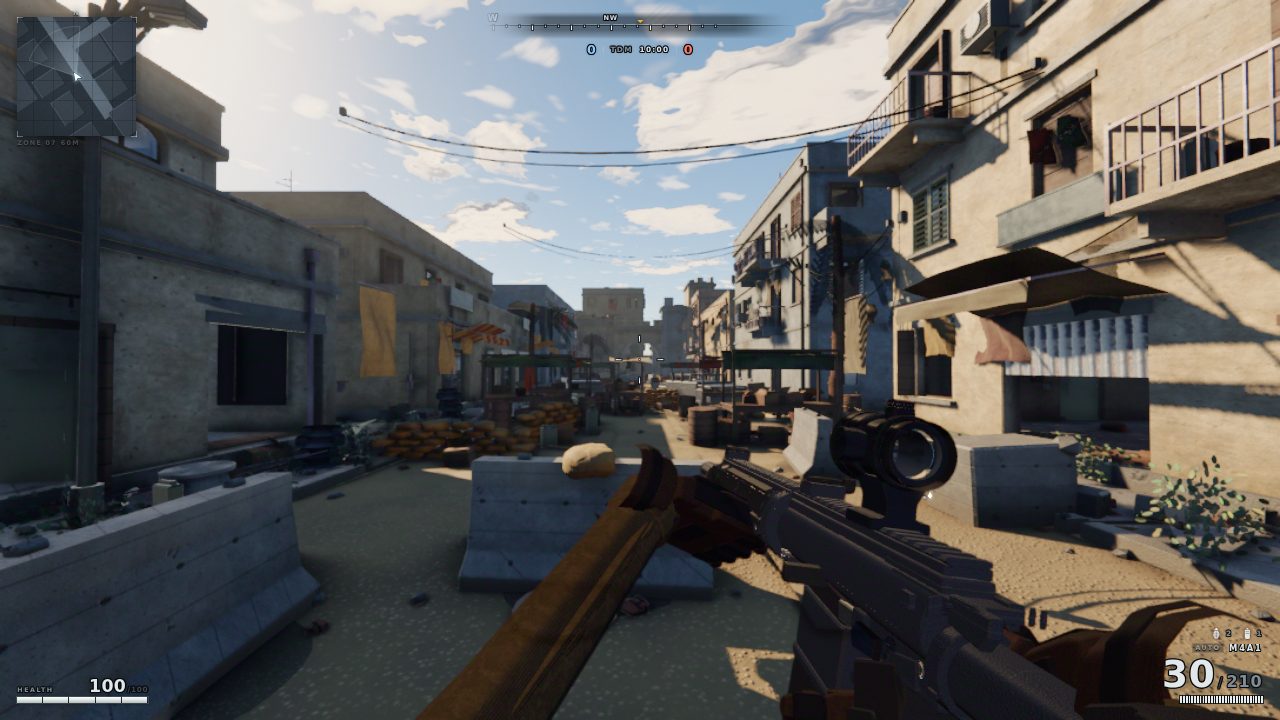
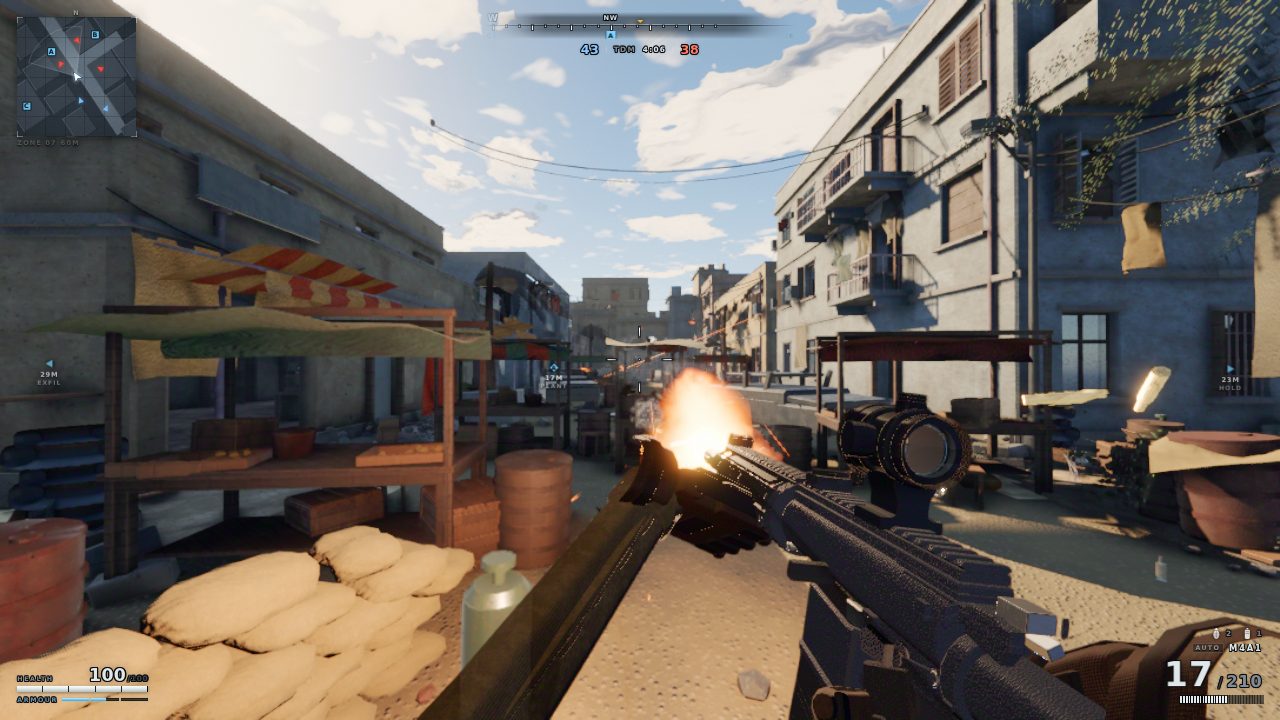
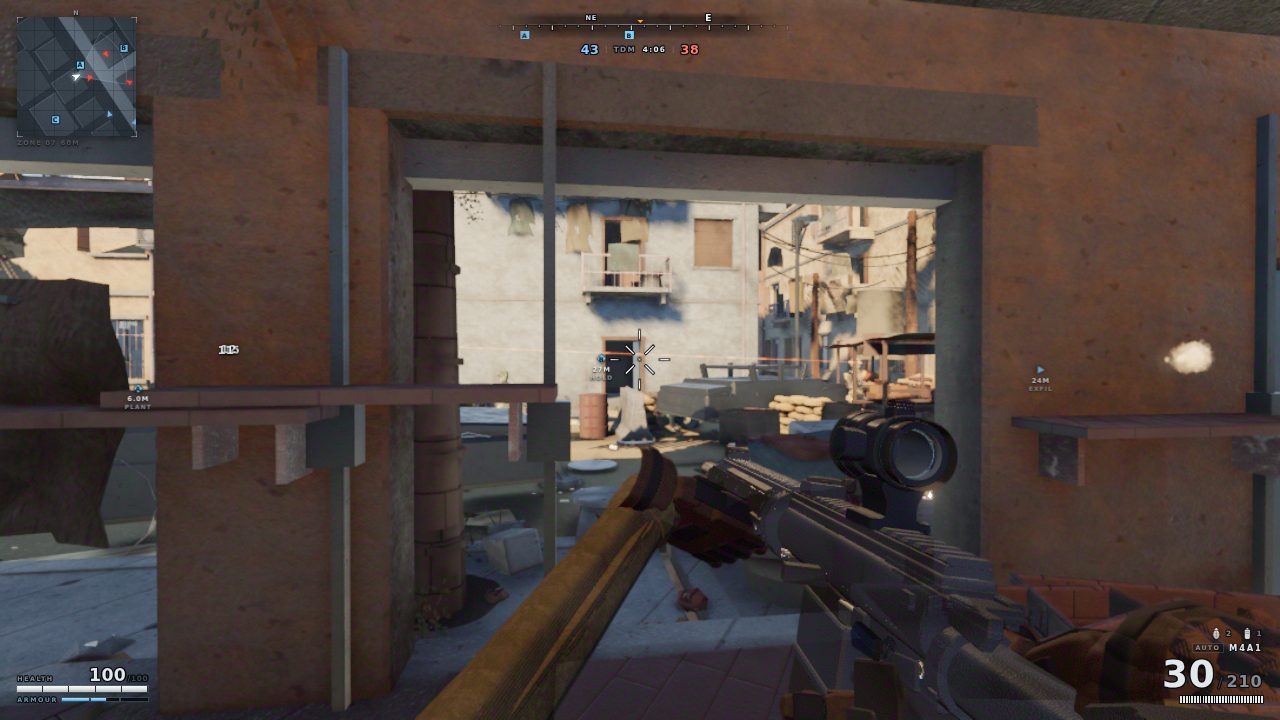
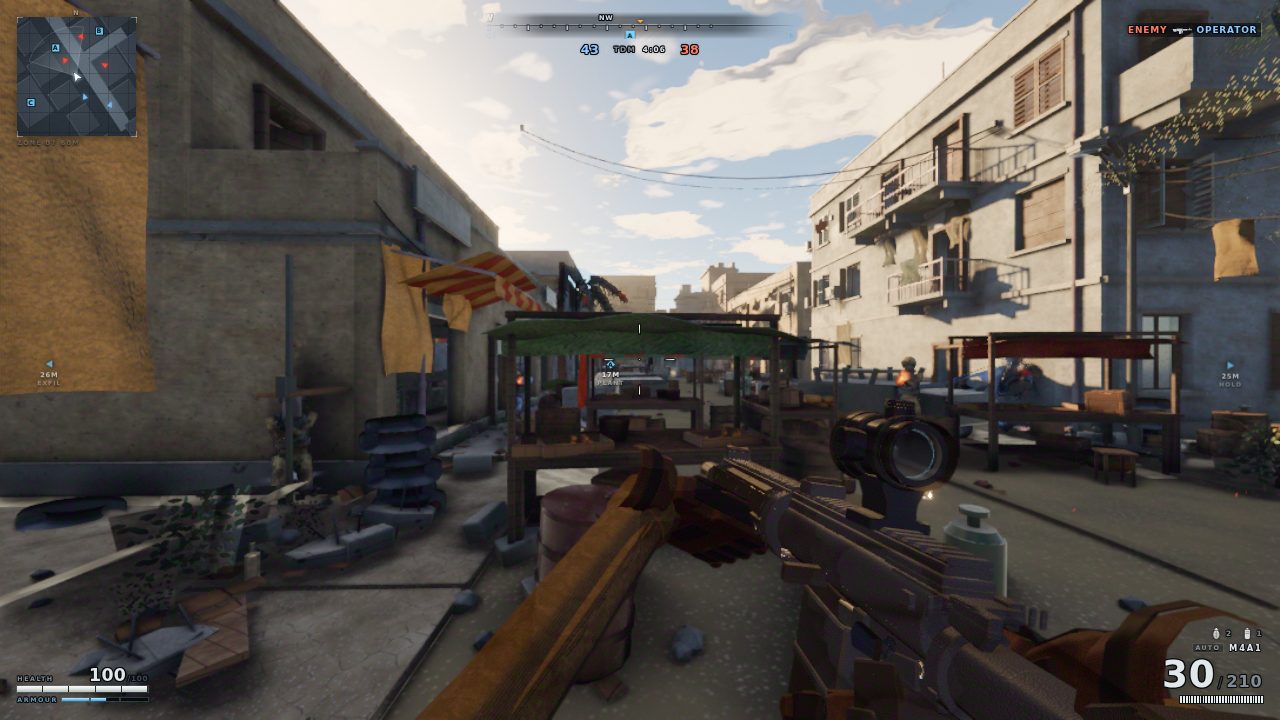
Every pixel here was computed, not drawn.
Unedited screenshots from the running game, taken through the project's
own capture harness. None of these are concept art.
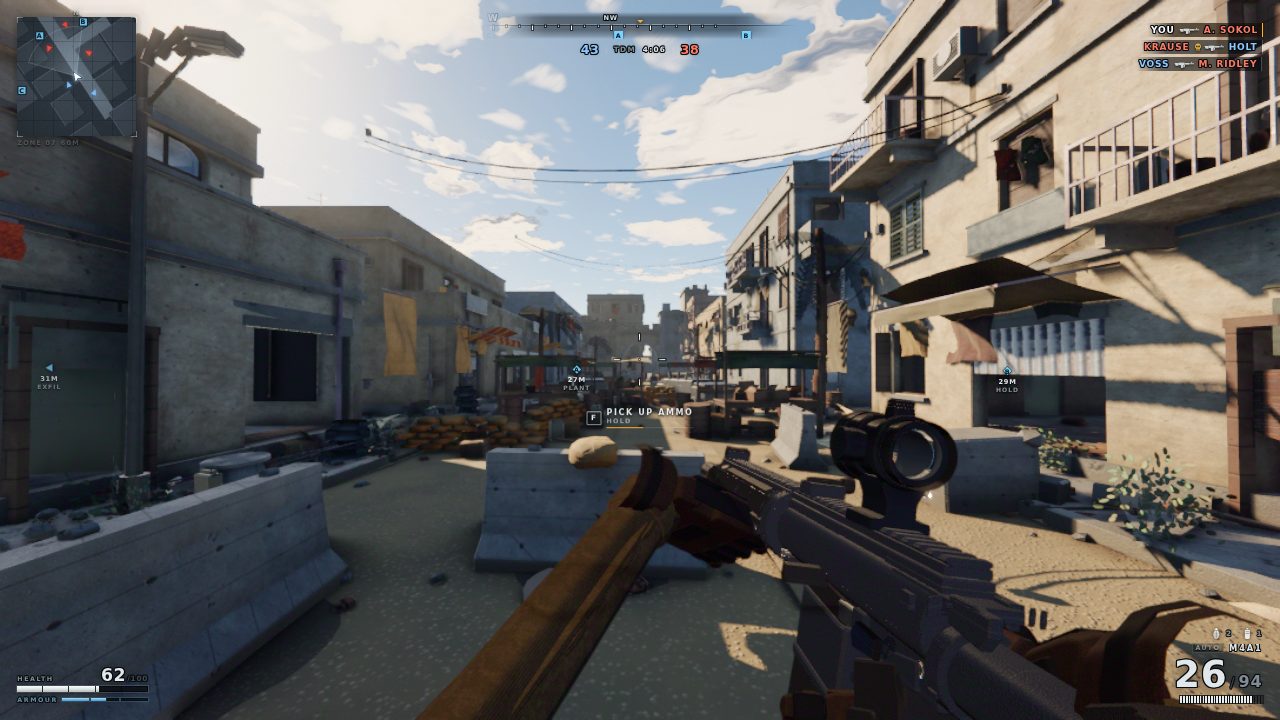
The market street — a modular building kit with real wall thickness and
several hundred instanced props.
Muzzle flash, light spill and case ejection.
Enterable interiors, lit through their own openings.
Skinned soldiers with navmesh pathing and cover behaviour.
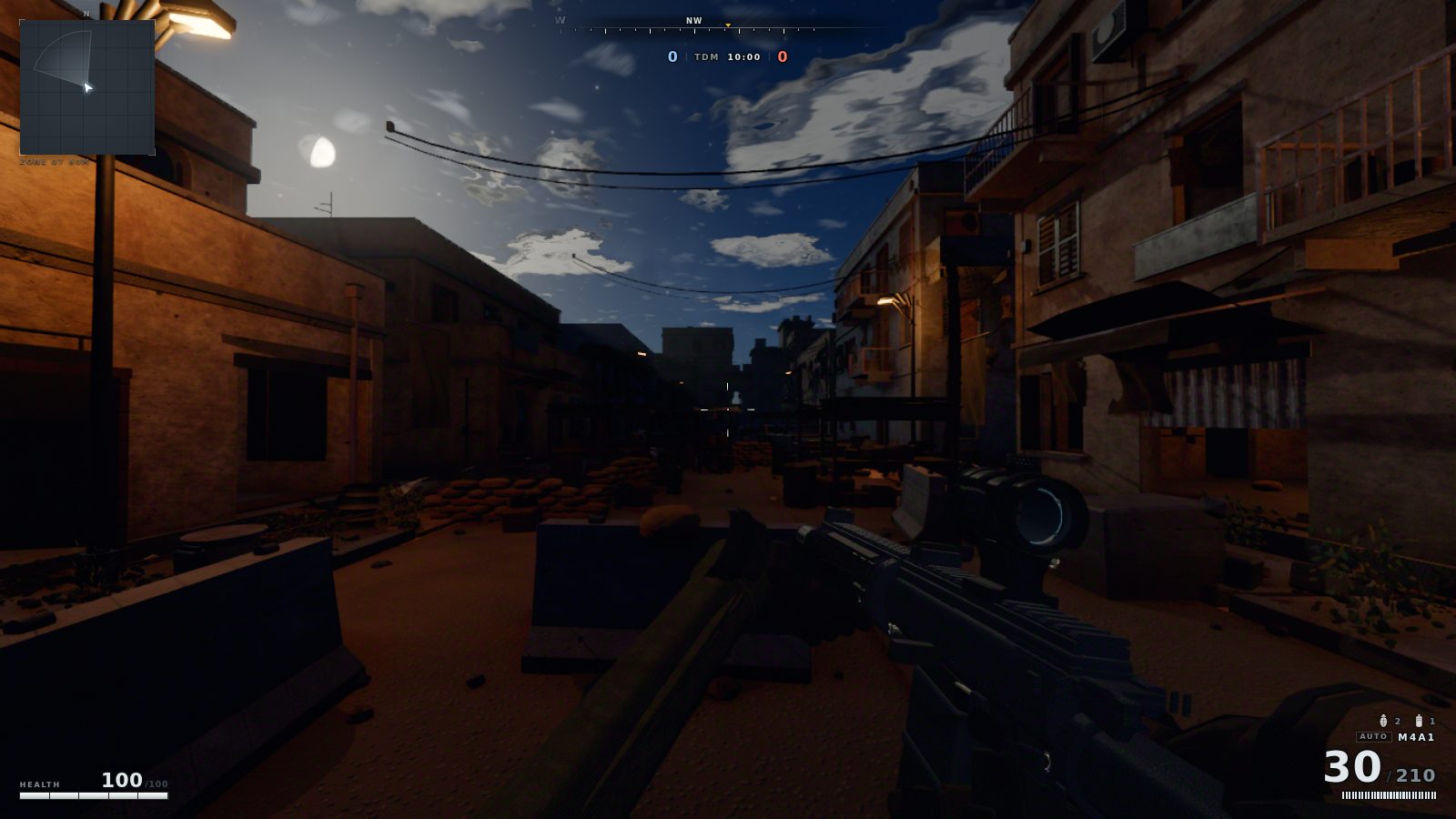
The same street at night — one time-of-day parameter, and the
atmosphere, the lamps and the exposure all follow.
The HUD is DOM and CSS — crosshair, minimap, compass, killfeed,
objective markers.
Concept art — not actual gameplay
03 — ELEVEN SUBSYSTEMS
Written from scratch, including the parts nobody writes from scratch.
01
Renderer
An HDR pipeline built by hand, not assembled from examples. Cascaded
shadow maps with texel snapping and contact hardening, a depth and
velocity prepass, ground-truth ambient occlusion, temporal
anti-aliasing with variance clipping, motion blur, a Karis bloom
pyramid, GPU metering and an AgX composite.
02
Materials
A texture forge that runs on the GPU. Nineteen surfaces — concrete,
brick, plaster, asphalt, sand, rusted and painted and brushed metal,
wood, fabric, glass — with periodic noise so everything tiles,
height-derived normals, parallax occlusion and curvature-driven edge
wear.
03
Physics
No library. A binned-SAH bounding volume hierarchy, a swept-capsule
character controller with a five-plane crease stack, impulse rigid
bodies with continuous collision, position-based ragdolls and
multi-layer bullet penetration.
04
Audio
Synthesised through the Web Audio API with no sound files at all.
Layered weapon fire, convolution reverb, HRTF spatialisation and
occlusion.
05
Sky
Atmospheric scattering with a time of day, environment maps generated
at runtime, volumetric fog and light shafts.
06
Agents
Skinned soldiers with navmesh pathing, perception, cover behaviour and
ragdoll deaths — the meshes and their textures generated like
everything else.
04 — WHERE IT CAME FROM
One prompt produced this repository.
“I want you to build a first-person shooter at the level of the most
recent Call of Duty games. It should be utterly perfect, visually
beautiful, with every single thing done at AAA quality — from textures
to physics to anything you could think of.”
Roughly 55,000 lines across eleven subsystems followed, written by a fleet
of AI agents working against a shared engine contract, with a harsh visual
critic looping on each subsystem until it passed. The full prompt and the
harness that reviewed the output are both in the repository.
It is a single-player technical demo, and it is honest about that: no
multiplayer, no matchmaking, no server. What there is, is a renderer you
can read.