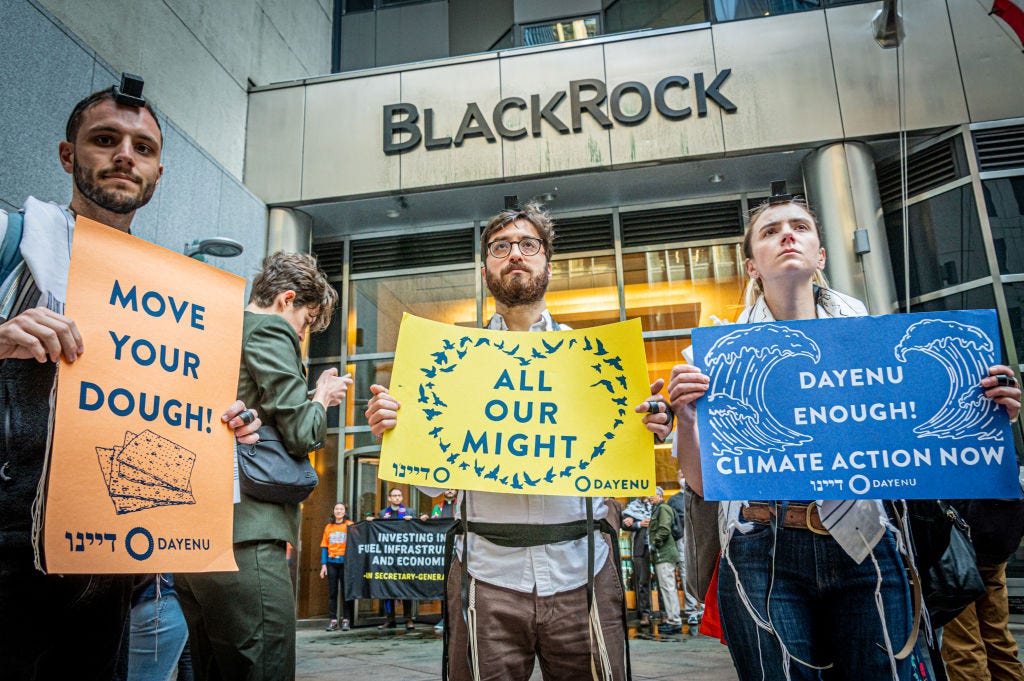
Major corporations were long seen as natural allies of the tax-cutting American Right. But that changed with the rise of “woke capital,” especially in 2020, when big companies fell over each other in a rush to proclaim their support for Black Lives Matter, affirmative action, and the rest of the Left-wing identity-politics agenda.
Yet corporate posture changed again with the “vibe shift” of Trump’s reelection. Corporate America is being a lot quieter these days.
Of course, it’s one thing to see such trends play out, and another to measure them empirically. A new working paper tracks the rise and fall of corporate wokeness, testing a few key hypotheses against the data in the process.
The authors’ major contribution is to tally up the “DEI commitments” that more than 15,000 companies have made in their securities disclosures over roughly the past two decades. They’re able to do so by identifying buzzwords in the text and having AI evaluate whether each mention is a voluntary commitment to DEI or just boilerplate. The resulting trendline, which I recreated from their chart with some help from ChatGPT, is quite striking:
Through the W. and Obama years, these public commitments were rare, if becoming ever-so-slightly more popular. They rose more noticeably under Trump I, then exploded in late 2020 and through the Biden years. At the height of DEI mania, the average firm was making multiple DEI commitments per quarter. But as the wave crested—and especially as Trump was re-elected and moved back into the White House—corporations changed their tune back, and quickly at that.
Pro-DEI comments in these documents are not the same thing as actual DEI policies, which is an important limitation of this method. However, the authors do find a modest connection between these commitments and the firms’ non-white employee share. And as they note, these disclosures “are not entirely cheap talk insofar as misstatements may carry liability under the antifraud provisions of the federal securities laws, and various stakeholders (including political ones) parse them.”
The authors use their data to test three hypotheses, finding at least partial support for all of them, although they admit they cannot always distinguish correlation from causation.
First, firms whose leadership leans more to the left—measured with campaign-finance data—were more enthusiastic about DEI in general. That gap widened when the national environment changed. Perhaps the craze of 2020 gave liberal leaders permission to do more of what they already wanted to do, or perhaps they were just more susceptible to pressure from the left, though the authors find that local protests in the county of a company’s headquarters don’t seem to be a big driver here.
Second, before and during the Peak Woke period, institutional investors like BlackRock put considerable pressure on companies to advance DEI and other left-wing priorities under the banner of ESG (“environmental, social, and governance”)—which was the focus of a different study I wrote about for City Journal a while back. The new paper finds that more “Big 3” ownership (BlackRock plus Vanguard and State Street) corresponded to more DEI commitments during the times when wokeness was on the rise or cresting.
And third, there’s legal and political pressure. The Supreme Court turned against affirmative action in higher ed with 2023’s Students for Fair Admissions v. Harvard, while the second Trump administration has declared war on racial preferences in hiring, especially at federal contractors.
Contractors were especially quick to beat a retreat from DEI during Trump II. However, the authors find little impact from developments in the SFFA case (the legal issues in which didn’t bear directly on private hiring), or from broader measures of exposure to government policy.
Woke capital’s rise showed that corporations are not natural, permanent allies of the political Right. Its fall is revealing the true determinants of their behavior—including the pull of their leaders’ ideology and the pressures they face from actors with power over them, such as investors and political authorities.
From the Manhattan Institute
An education agenda for New York, from heavy-hitters Jennifer Weber, Danyela Souza Egorov, and Ray Domanico.
Other Work of Note
Confidence in U.S. institutions: Not great, Bob.
A good skeptical dive into a study claiming that inequality erodes democracy.
“People in more individualist cultures are more motivated to make others feel better.”
Lots of survey data on Hispanic identity in the U.S.
From the United Kingdom, a clever way to measure the effect of being closer to a fast-food restaurant: Look at the transition from primary to secondary school, when kids start spending a lot more time in a new place that may, or may not, have fast food close by.
Being near coworkers seems to make software engineers better coders.
A lot of research on cash transfers has been underwhelming, but this paper finds they reduce criminal offending for fathers and kids. And does unemployment insurance mitigate the effect of mass layoffs on suicide?
A new book chapter from Paul Cassell on the “Minneapolis effect,” i.e. the idea that the George Floyd riots and attendant de-policing contributed to the recent homicide spike. He’s also coauthored a paper on whether juries should hear “propensity” evidence in sexual-assault cases.
The connections among intimate-partner violence, two forms of “non-monogamy,” and relationship dissolution.
How societies respond to reports of sexual misconduct.
“A handful of highly prolific offenders drive the vast majority of unadjudicated and hidden murders.”
Algorithms: How good are they at predicting violent behavior? What about child maltreatment?
New mortality data from the CDC.
The “Flynn Effect” refers to a long-running increase in IQ scores from one generation to the next. But the increase has reversed in some societies of late—a countertrend that began among the higher-income, at least in Norway.
A new theory on hand dominance. Plus thoughts on cannibalism!
Auto-enrolling people in IRAs seems to work.
Some cross-country evidence on discrimination in rental markets.
Tracing the effects of racially restrictive housing covenants.
A new way to measure judges’ ideological leanings.
Some tricks for improving payment integrity in federal programs.
Which cities mix residential and commercial areas the most?
“Republicans report worse mental health as the share of Democrats in their neighborhood increases. Democrats show no such sensitivity.” I have no idea what to make of that!