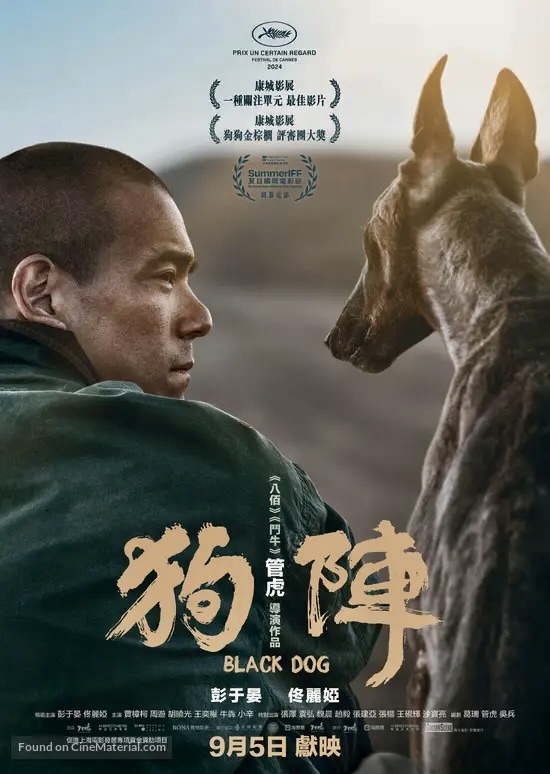
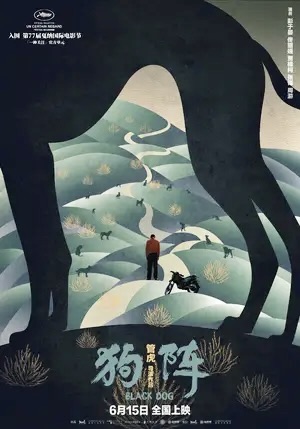
Movies about dog owners and their canine companions have always been a popular cinema subgenre, especially in recent years as witnessed by such feel good entertainments as Arthur the King (2024), Dog (2022), Togo (2019), Megan Leavey (2017) and A Dog’s Purpose (2017). Taking an entirely different approach to family dramas like these is the 2024 Chinese film, Gouzhen (English title: Black Dog), an unsentimental, tough love tale about two pariahs in an economically depressed wasteland; one is a former prisoner returning to his village, the other is a stray dog suspected of carrying rabies. With their feisty distrust of other people, the two prove to be kindred spirits and form an unlikely bond in Guan Hu’s sparse drama of survival and redemption. In some way, the man and the dog are mirror images of each other in that they both function as lone wolves.
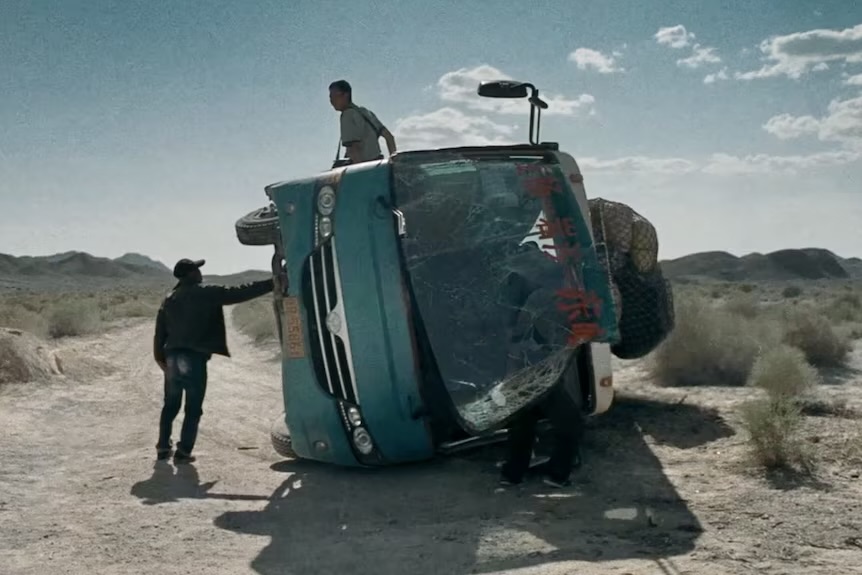
The film has one of the more unusual openings in recent memory. As the camera pans across a vast expanse of the Gobi Desert, we see a bus traveling along a dusty road in the distance. Suddenly a pack of feral dogs, possibly a hundred or more, race down a hillside and into the path of the bus. The driver, in turning to avoid them, swerves out of control and the bus is overturned. The passengers crawl out unharmed and the local police are called for assistance. At this point, we are introduced to Lang (Eddie Peng), who is returning home after serving a ten-year sentence for manslaughter. Once a popular rock musician and motorcycle stunt driver, Lang is now required to perform community service as part of his parole.
Much has changed in the northwestern Chinese town of Chixia since Lang was incarcerated and it is now almost a ghost town. Many residents were forced to move elsewhere when the economy collapsed but left their dogs behind. The result is a huge population of stray dogs running wild among the deserted buildings and surrounding plains. To combat this problem and to make the town more attractive for prospective businesses, the local authorities have tasked a dog patrol to round up and remove all of the strays. The man in charge of this is Lang’s Uncle Yao (Jia Zhang-Ke) and he assigns his nephew the job of driving the animal transport vehicle.
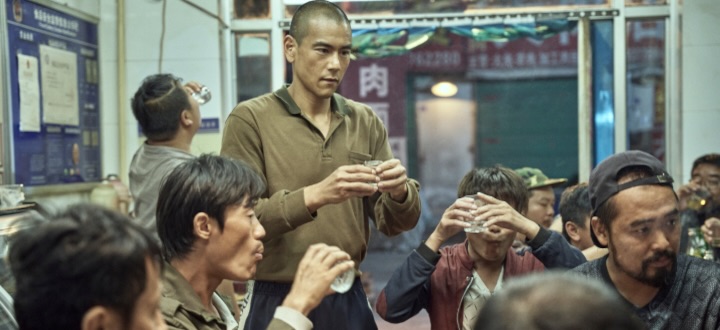
It is during Lang’s exploration of the city’s mostly abandoned neighborhoods that he encounters a black stray (a possible mix of greyhound and whippet) that bites anyone who tries to capture him. Lang becomes a bite victim as well but ends up imprisoning the dog in his father’s deserted apartment to make sure neither he nor the canine have rabies during their quarantine. Eventually the two learn to trust each other but their relationship is continually threatened by the town’s dog catchers and Butcher Hu (Xiaoguang Hu). The latter is a snake farm owner and the father of the man who was killed in an accident caused by Lang. Hu is bent on revenge and his cronies relentlessly stalk and harass Lang after his return.
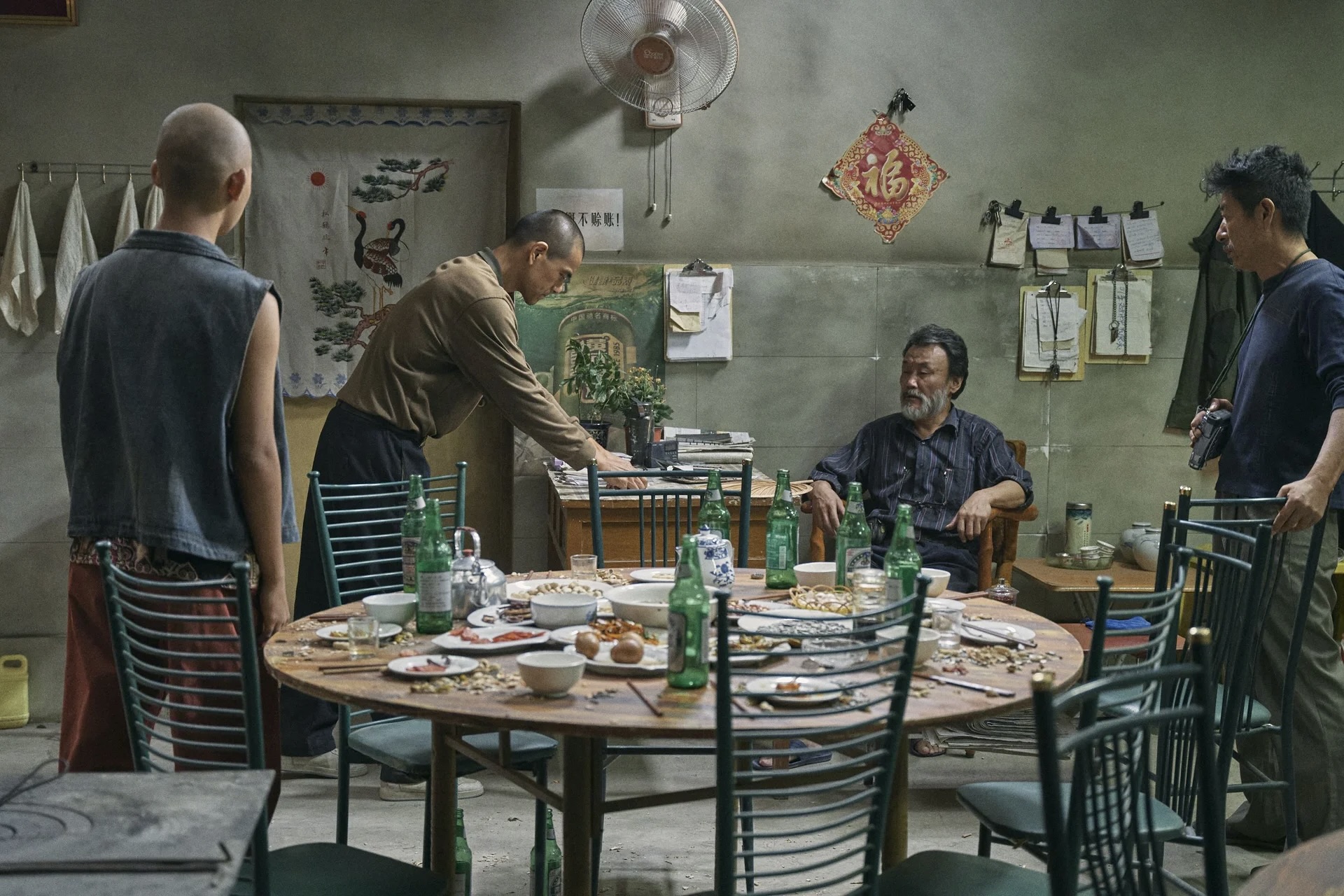
This is the basic setup of Black Dog but there is a lot more going on beneath the surface than just a story of a man and his dog. The film, which is set in early 2008 as China was preparing for the Beijing Summer Olympics that year, often functions as a sociological drama that shows how the global financial crisis of that era played out in rural areas of China, especially a frontier town on the edge of the Gobi Desert. Director Guan Hu also introduces characters and situations without any backstory or exposition so that the viewer is left to sort out Lang’s connection to it all.
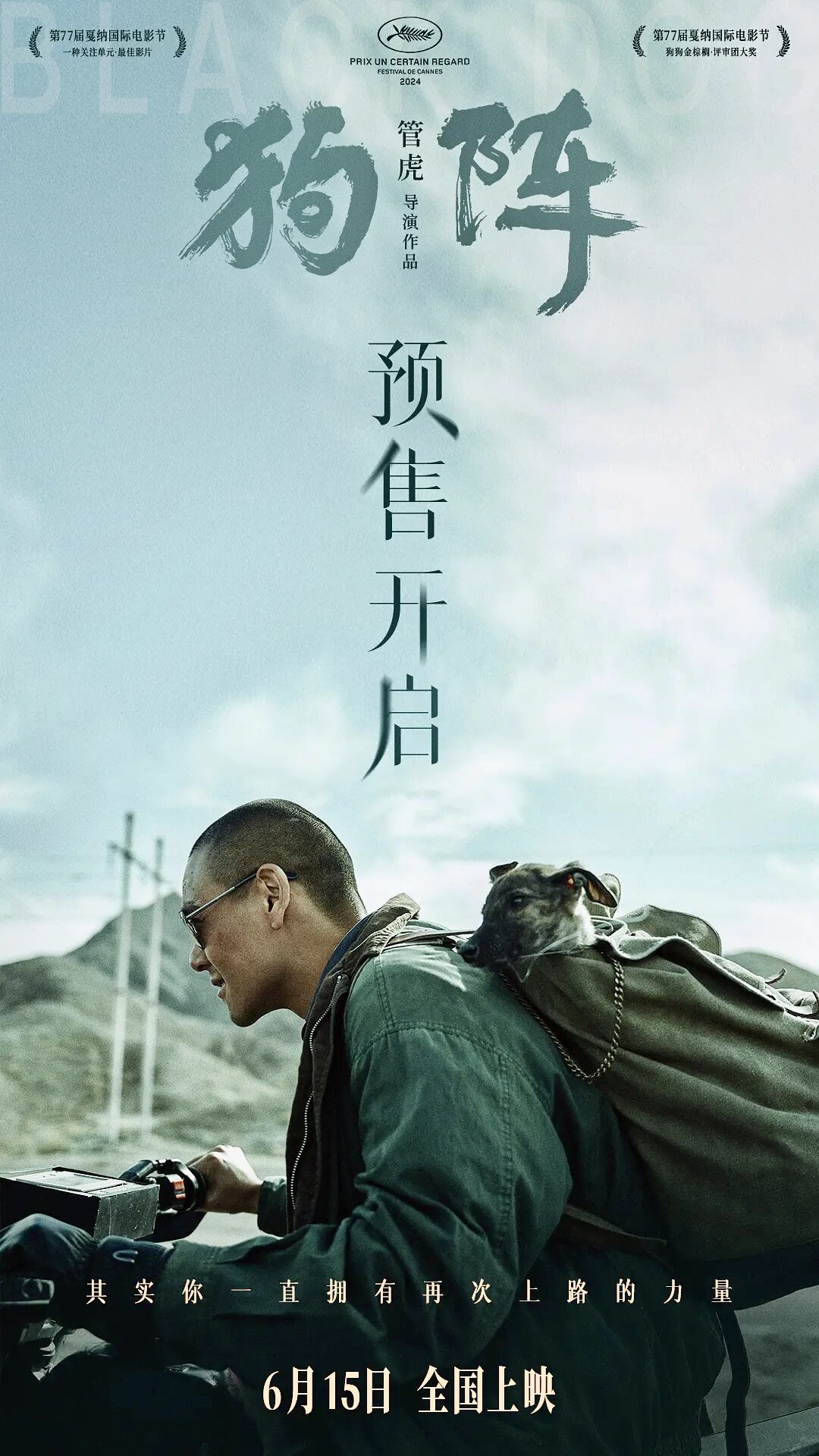
The protagonist’s relationship with his father, for example, remains unexplored although their obvious estrangement may be due to the elderly man’s alcoholism (the few scenes of them together take place in a hospital where the father has come to die). We also never learn the exact details of the death that resulted in Lang’s manslaughter conviction. Even the title canine has a mysterious past and we only learn in the final moments of the film that he has a mate and she is pregnant with their puppies.
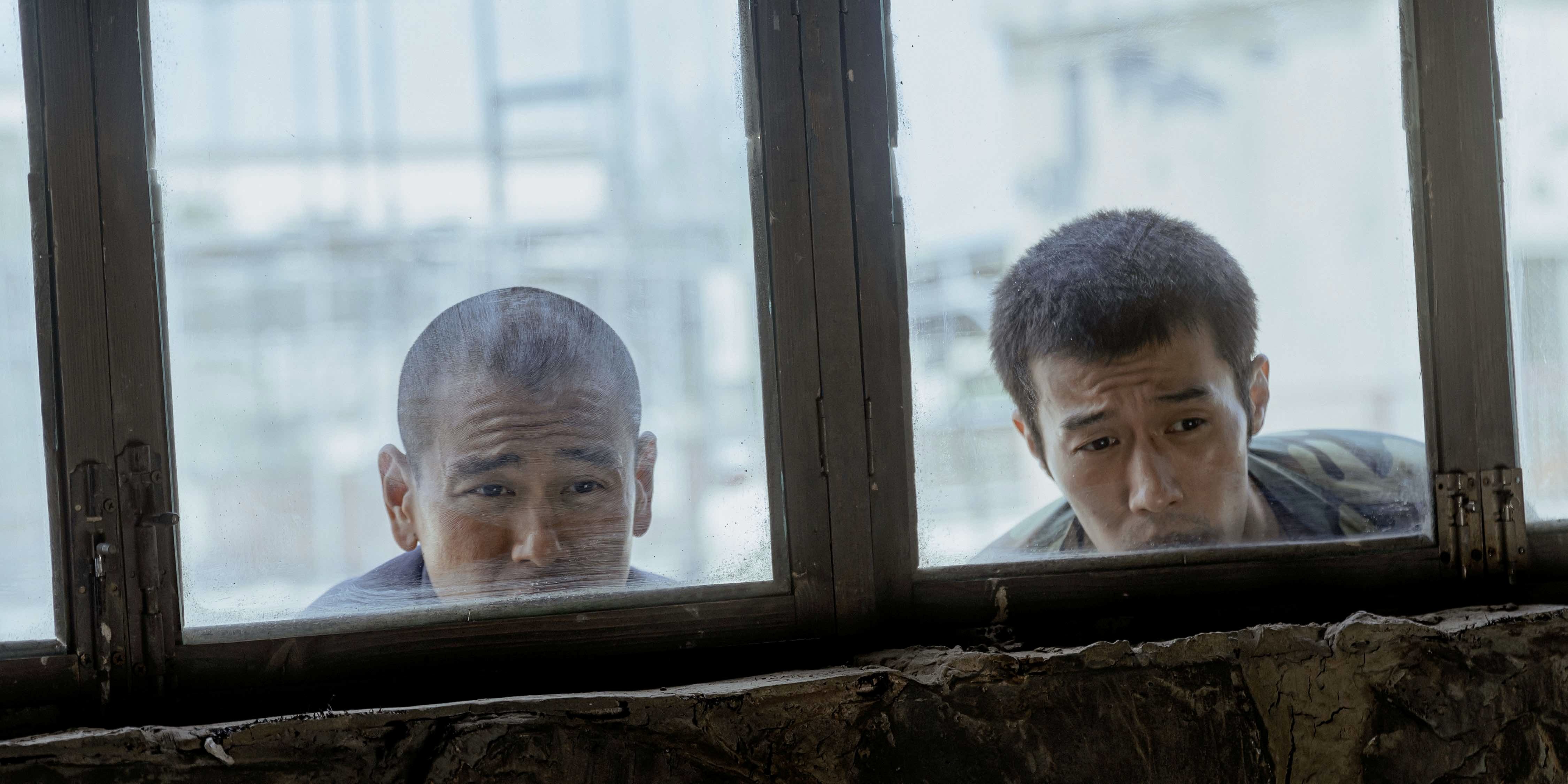
Black Dog has the look of a sparse, stripped down western combined with an end-of-the-world apocalyptic thriller. The abandoned factories, trashed apartment buildings and empty streets are not studio sets, however, but the documentary reality of a collapsed economy. Particularly haunting and adding a surrealistic touch to the film’s visual design and atmosphere is the depiction of the town’s former tourist attractions – a bungee-jumping platform and a zoo where a handful of animals remain, including a Mandarin tiger, a monkey, a camel and some peacocks.
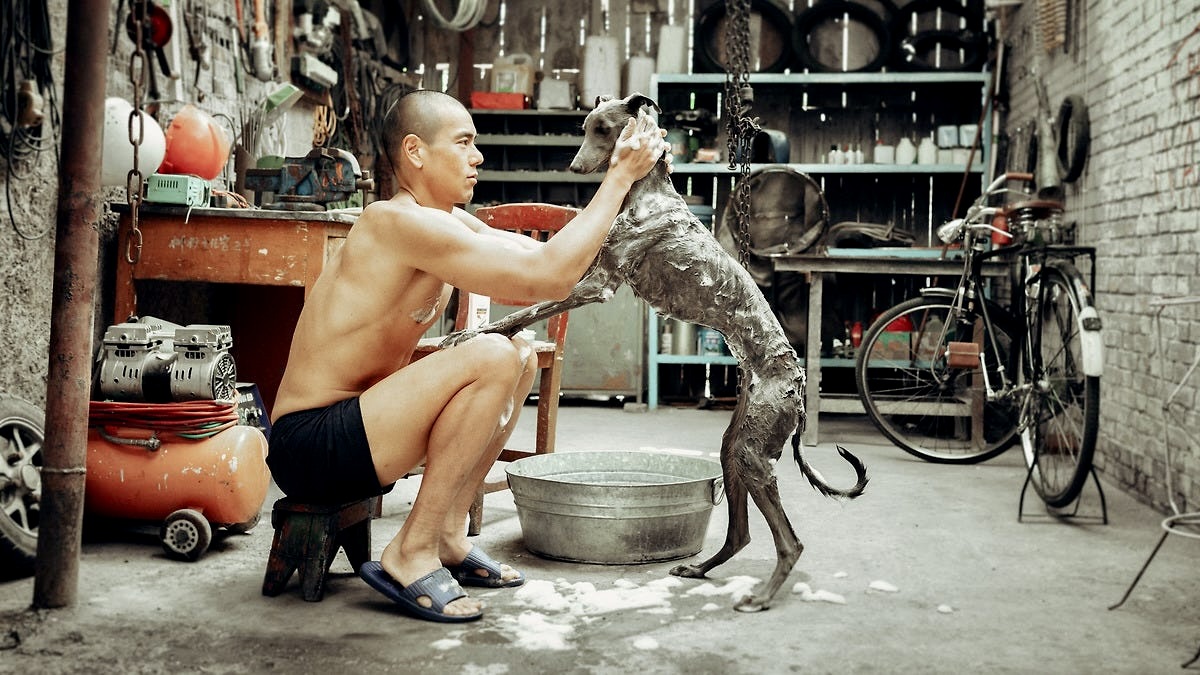
Hu’s film is striking in other regards as well. The stunning cinematography of Weizhe Gao integrates moments of awe and transcendence among the poverty and desperation on display such as a scene where tourists arrive to witness a total eclipse of the sun or Lang being caught in a sandstorm at night with his dog. Dialogue is minimal throughout most of Black Dog and, except for the brief use of two songs by Pink Floyd (“Mother” and “Hey You”), there is no persistent music score to cue our emotions. Also, the black dog is never given a name and Lang remains almost mute for most of the film but his physical actions and facial expressions provide the necessary drama to carry the story forward.
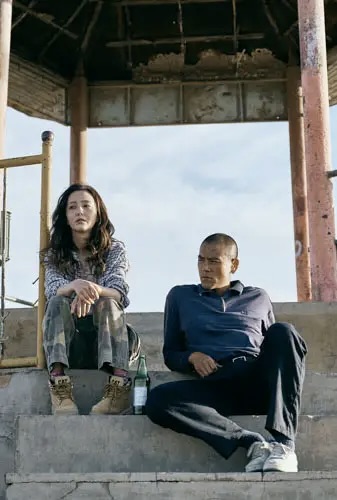
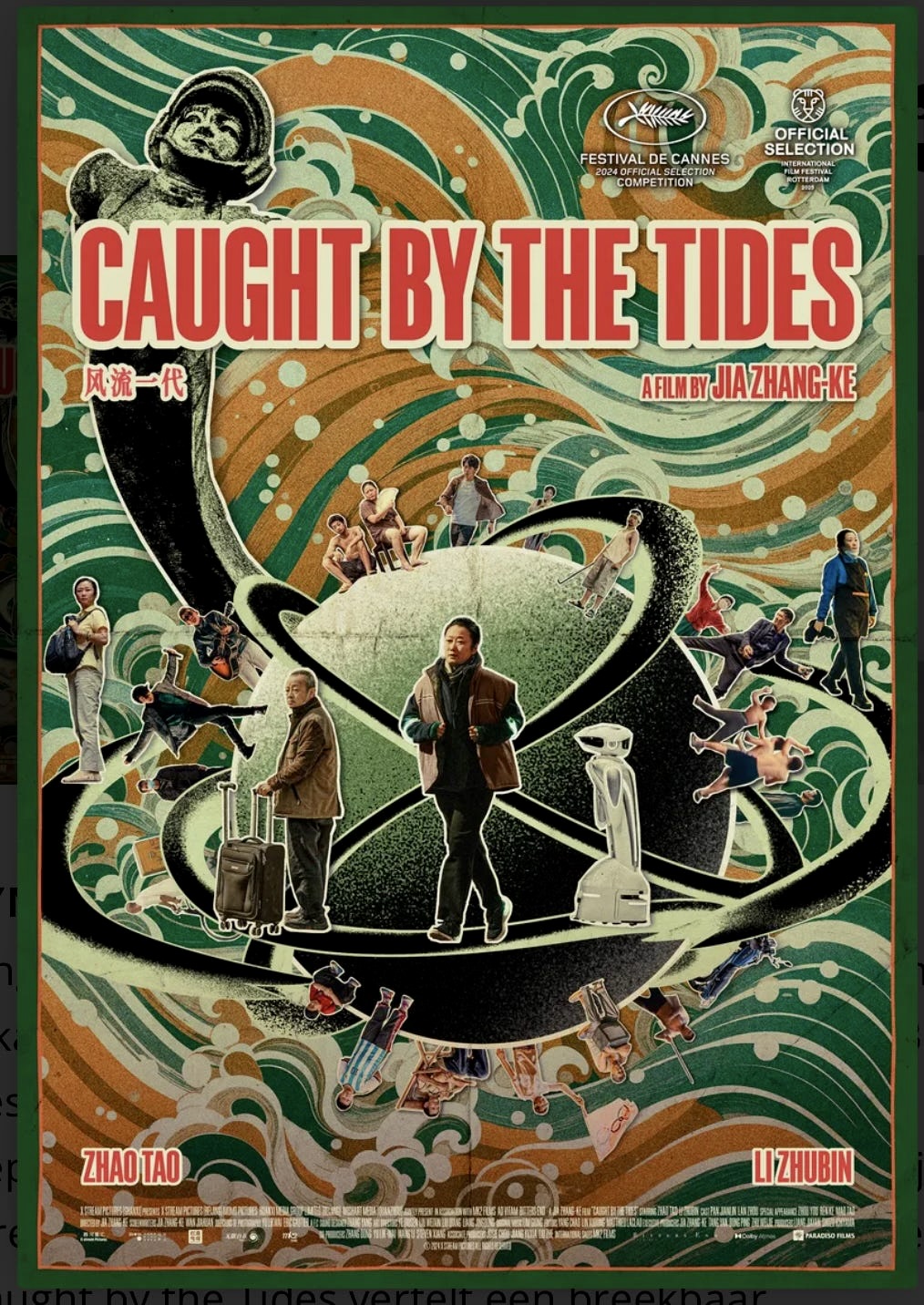
Black Dog was a departure for Guan Hu whose previous films have included big budget Chinese blockbusters like The Sacrifice (2020) and The Eight Hundred (2020) but its low-key, austere approach is closer to an art house indie than a man and dog buddy movie. The film was also a change of pace for leading man Eddie Peng, who is better known for action-adventure films like I Did It My Way (2023), The Rescue (2020) and Immortal Demon Slayer (2017). A major celebrity in China, Peng is quietly charismatic and empathic as Lang and even displays some sly humor in some Buster Keaton like comedy sequences with the black dog. There is also a brief romantic flirtation with Grape (Liya Tong), a dancer in a traveling carnival, that never really develops. It should also be noted that Jia Zhang-ke in the role of Uncle Yao is better known as a director and his most recent film is the highly acclaimed drama Caught by the Tides (2024), which was nominated for the Palm d’Or at Cannes.
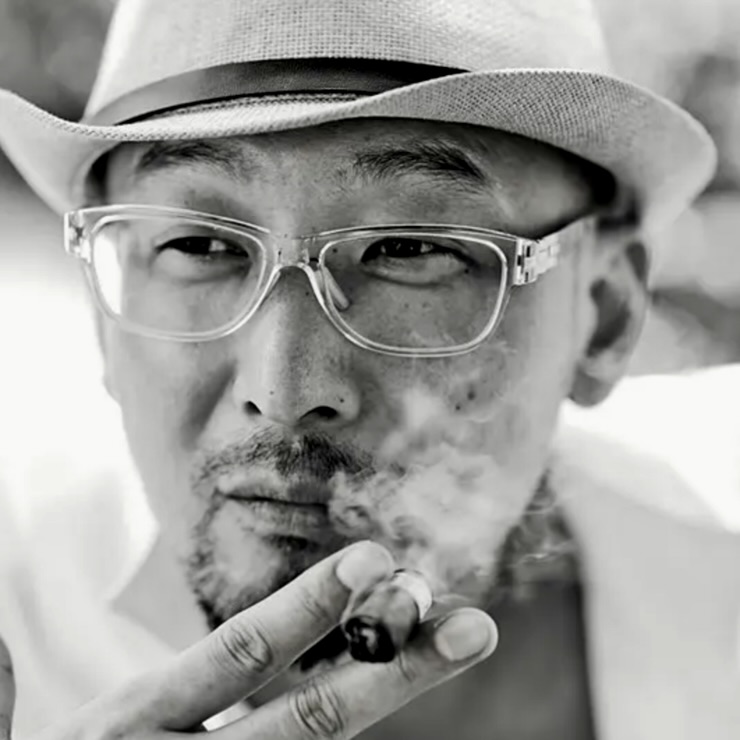
Although Hu is said to be a big fan of German shepherds, his main motivation in making Black Dog was to focus on something more than just a man and his dog drama. In an interview with The Guardian, he said, “Individual human life seems incredibly small and insignificant in the face of nature. But when you focus on that individual life itself, the life of an ordinary person is immensely significant. So, it’s a story of two extremes. We wanted to explore the animalistic nature of humans.”
Among the critics who have championed Black Dog are Ian Wang of Sight and Sound, Jordan Mintzer of The Hollywood Reporter, and Amber Wilkinson of Eye for Film. Wang wrote, “Guan mixes apparently contradictory visual styles, moving between the vast landscapes of a western and the shadowy claustrophobia of a noir, to tell a story that is both sternly satirical and deftly playful. With its drifter protagonist and 2008 period setting, the film Black Dog most closely resembles is perhaps Kelly Reichardt’s Wendy and Lucy (2008), another austere portrait of abandoned small town life at a time of financial crisis and gaping inequality.” Mintzer’s review stated that “Guan’s highly original, deadpan thriller begins with a jarring sequence of dogs causing a bus to flip over on a desert road, only to get weirder and wilder from there. But at its heart, the film is really a classic story of redemption, taking lots of unexpected turns as it follows a down-and-out hero toward recovery.” And Wilkinson commented that, “Visually, Guan never puts a frame wrong, whether he’s setting up a physical comedy set-piece, idly incorporating a solar eclipse or letting the dogs steal a scene. The result is a quirkily defiant portrait of an unlikely friendship blossoming in the unlikeliest of places.”
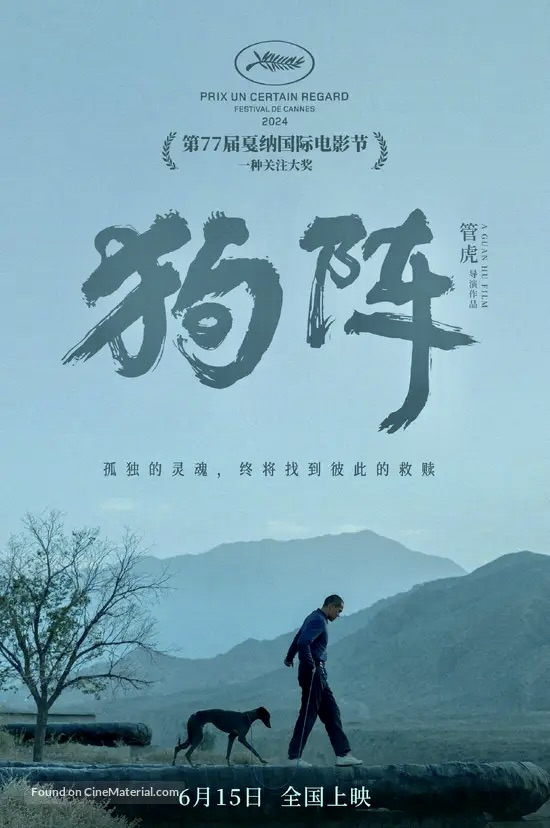
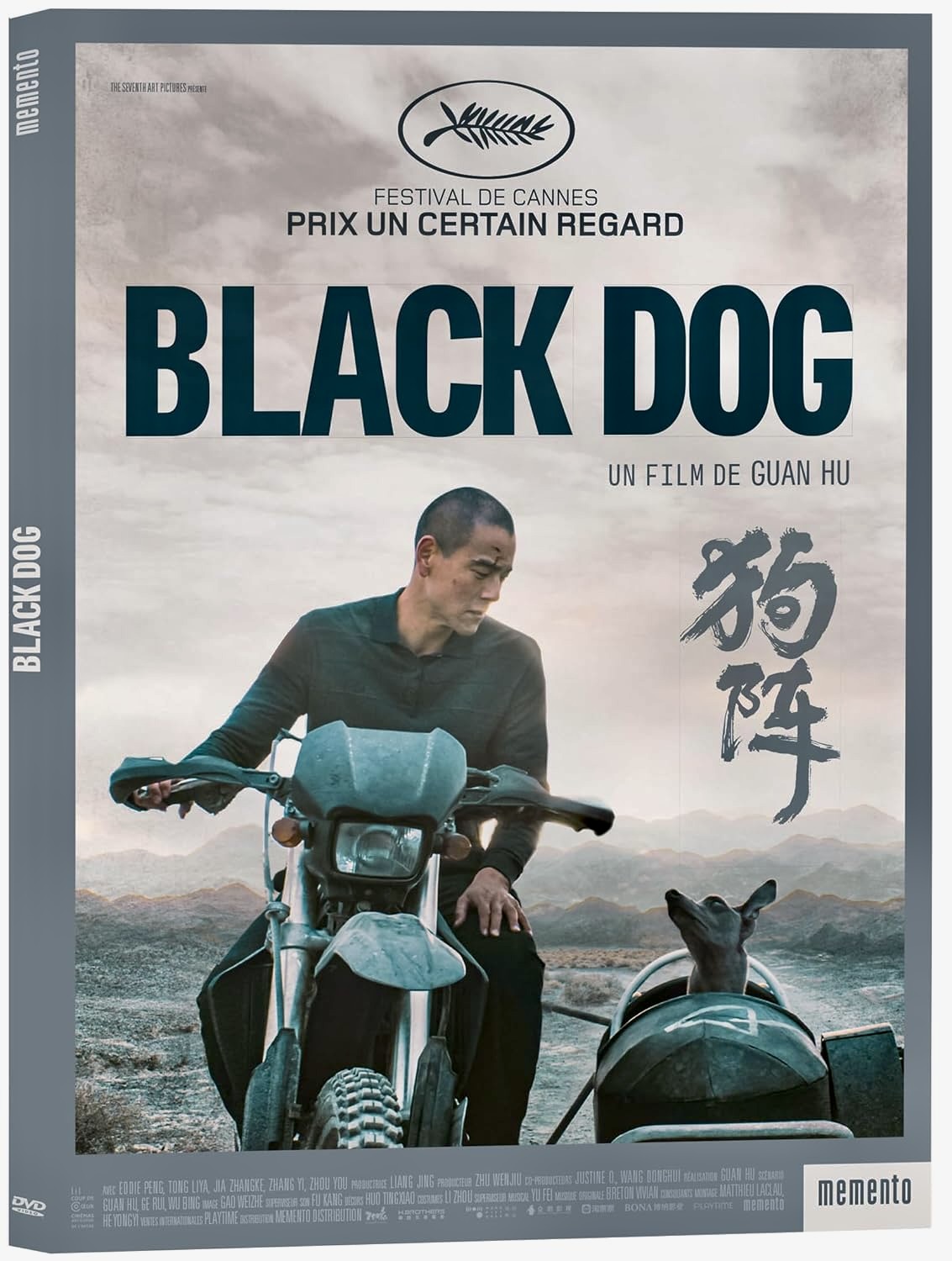
Black Dog has also won critical acclaim at numerous film festivals around the world and grabbed the award for Un Certain Regard at the Cannes film festival. Unfortunately, it had a very limited theatrical release in the U.S. but Memento Films released the movie on DVD in November 2025 so it is available to those who have any interest. It is also available to stream on Kanopy.
Other links of interest:
http://newschinamag.com/newschina/articleDetail.do?article_id=2347§ion_id=4&magazine_id=21
https://www.theguardian.com/film/article/2024/aug/27/black-dog-director-guan-hu-chinese-film-maker
https://china-underground.com/wp/collection/guan-hu/