I have asthma. And lately, my feeds will not leave me alone.
ParaPurge. ParaGuard. Worm cleanse protocols. Claims that parasites are the hidden cause of autoimmune disease, breathing problems, even cancer — and that the medical establishment doesn’t want you to know. Buy this $40 herbal supplement and “expel the toxins.”
Here’s the thing: I’m a skeptic by disposition. Not in the “I believe everything I see on TikTok” sense — more in the “I’ve watched enough institutional narratives unravel that I try not to take any claim at face value” sense. COVID-19 policy reversals, the Epstein files, the general pattern of information control in the last decade — these things don’t make me trust random supplement companies more. They make me want to verify everything.
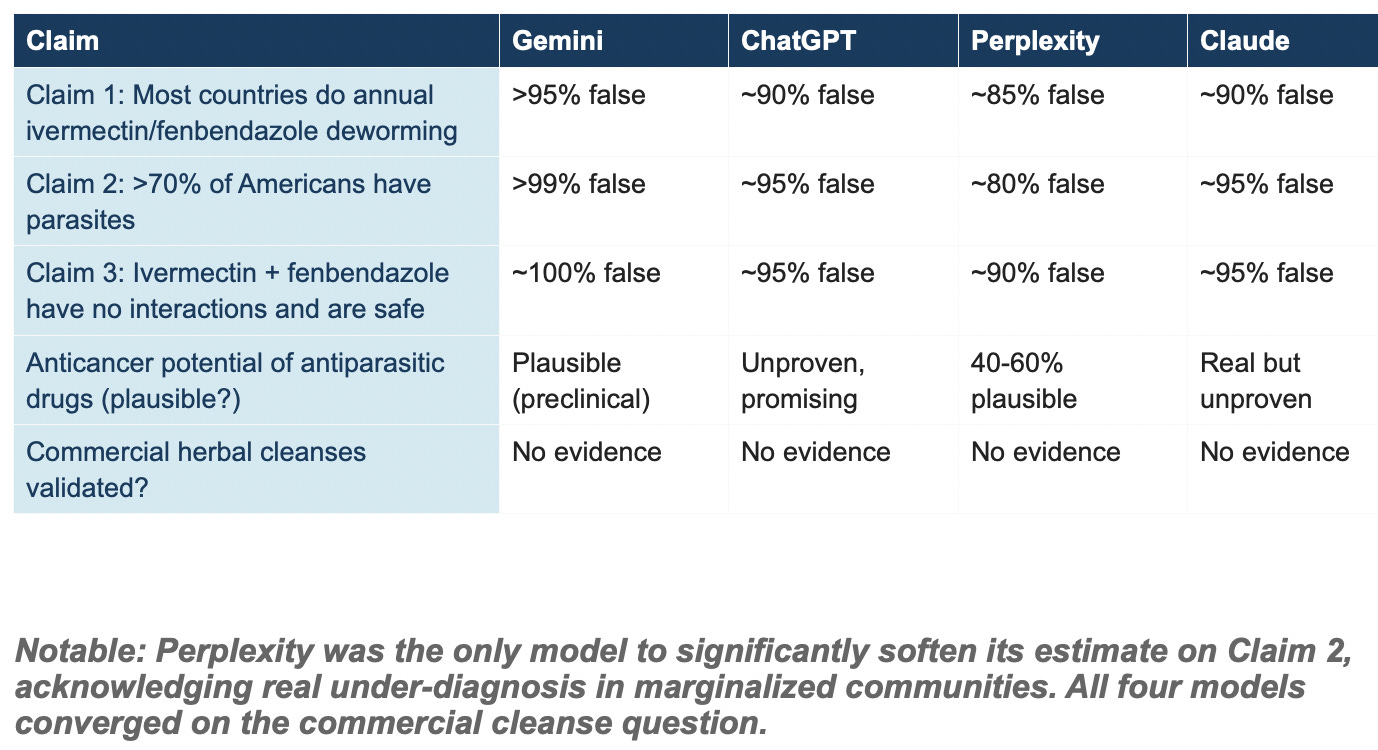
So I did what I do. I fed the same set of claims into four different AI models — Claude, ChatGPT, Gemini, and Perplexity — and asked them to evaluate the evidence. I wanted to see not just what they found, but where they agreed, where they diverged, and whether the consistency (or lack of it) told me anything.
In the future, once I get ‘unhinged’ qwen2.5 fully operational, I’m going to use it to give me the unvarnished truth. Like are these 4 AI’s just lying to us? By unhinged, I mean jail broken. I’m almost there, I now can prompt to tell me I’m the President of the US- so we’re totally like 90% there to the truth. :P
Note: This is not a definitive medical truth claim. It is an honest inquiry using publicly available AI tools. Nothing here constitutes medical advice.
The viral narrative circulating on social media — amplified by products like ParaPurge — rests on roughly three pillars:
Most countries around the world prescribe Ivermectin and Fenbendazole once a year to deworm their populations. Americans are the only ones who don’t.
More than 70% of Americans have parasites.
Fenbendazole and Ivermectin have no known drug interactions and are safe to use.
I ran these through all four models. Here’s what came back.
Gemini was the most direct, calling the claim “False / Highly Misleading” with less than 5% probability of accuracy. It specifically flagged that Fenbendazole is a veterinary drug with no human approval and that WHO guidelines only recommend MDA (Mass Drug Administration) where prevalence exceeds 20%.
ChatGPT rated confidence the claim is false at ~90%, noting large programs use albendazole or ivermectin — not fenbendazole — and only in targeted disease elimination campaigns.
Perplexity gave the most nuanced answer, holding at ~85% confidence the claim is false even under a CDC/WHO-skeptical framework. It cited the 2025 EMA approval of a fixed-dose ivermectin/albendazole combination, but noted even that is strictly indicated for poor-sanitation endemic areas — not general populations.
Claude (prior session) aligned with the group consensus: no clinical evidence supports routine deworming of healthy adults in high-income countries, and the premise is not supported by independent parasitologists like Peter Hotez either.
Gemini was again the most categorical: False, less than 1% probability. It noted the 70% figure appears to originate from refugee population seroprevalence data being misapplied to the general population, or conflation with the human microbiome.
ChatGPT rated this false at ~95% confidence, citing CDC estimates of 1.3–2.8 million Americans with specific parasites — a far cry from 70% of 330 million.
Perplexity introduced the most interesting nuance: under skeptical CDC/WHO priors, it acknowledged that poor and marginalized Americans (rural South, inner city) may have parasite exposure rates of 20–40% in specific communities, citing a 2024 peer-reviewed study showing 35% prevalence in underserved settings with poor sanitation. It still rated ‘>70% of all Americans’ as ~80% likely false, not the 95–99% of the other models.
Claude noted the ‘70% claim is not supported by parasitology data in the US’ with parasitic burden primarily associated with poverty, travel, or immunocompromise.
Gemini gave this 0% probability of accuracy — the only claim to receive that rating. It specifically flagged the ivermectin-Warfarin interaction (increased bleeding risk) and the benzimidazole-Metronidazole interaction that can cause Stevens-Johnson Syndrome, a potentially life-threatening skin reaction.
ChatGPT rated this false at ~95%, noting fenbendazole lacks FDA approval for humans, meaning its interaction profile with human P450 enzymes is not clinically established.
Perplexity gave ~90% confidence the claim is false even under skeptical priors, noting India’s ICMR ultimately removed ivermectin from COVID guidelines after reviewing the evidence — which cuts against the ‘suppressed miracle drug’ narrative.
Claude concurred: prescription antiparasitics have documented interactions and the herbal cleanse versions are entirely unvalidated.
Perplexity was the only model to seriously engage with the CDC/WHO-skeptic framing as a legitimate epistemic position, re-running its analysis under those assumptions and still arriving at similar (though slightly softer) conclusions. The other models addressed skepticism but didn’t explicitly reweight sources.
Gemini was the most clinically precise, using pharmacology terminology (P450 enzymes, Stevens-Johnson Syndrome) and probability estimates. It felt like a senior researcher’s peer review.
ChatGPT was the most structured and citation-heavy, providing confidence percentages per claim and linking to specific sources.
Perplexity uniquely introduced the ‘legitimate hidden burden’ angle — that parasites ARE under-diagnosed in poor Americans, and this is a real public health gap — while still not validating the broader 70% claim.
All four models agreed on the anticancer drug angle: ivermectin and fenbendazole show interesting preclinical activity, but the leap to ‘cures cancer in humans’ is not supported by any current human trial data.
Figures represent model confidence that each claim is FALSE (higher = more confident the claim is wrong).
The consistent finding across all four models was that the supplement-industry narrative strips out the actual science and monetizes what remains. But there are threads in legitimate research that are real and worth watching:
Helminth-derived molecules (not live worm infections) are in early development as pharmaceutical leads for IBD, MS, and allergic disease.
The gut-lung axis — the connection between gut microbiome diversity and asthma susceptibility — is increasingly well-documented. This doesn’t validate cleanses but does validate microbiome research.
Antiparasitic drugs (fenbendazole, mebendazole, ivermectin) are entering formal oncology trial phases. This is worth watching through the lens of trial results, not testimonials.
Under-diagnosis of parasites in poor, rural, and marginalized American communities is a legitimate public health gap flagged by independent researchers like Dr. Peter Hotez — even if the ‘70% of all Americans’ number is fiction.
The social media version of the parasite-health narrative is largely inflated, misleading, and commercially motivated. Four different AI models, using different underlying training data and search approaches, converged on this independently.
…. Or are they? Hmm….
The commercial cleanses are unvalidated. The asthma claim is a distortion of real but inconclusive helminth immunology. The cancer claim inverts established science — some parasites cause specific cancers; the antiparasitic drug research is preliminary and not ready for self-prescription.
What the models agreed on most clearly: the science is genuinely complicated, and supplement companies are strip-mining that complexity for profit.
I’ve attached the full research PDF below — including prompts, AI responses, and source list from the initial Claude session. Draw your own conclusions. That’s kind of the whole point.