The knowledge-understanding problem is perennially debated. Many sense a difference and argue that we should ensure students learn knowledge and understand it. But others claim that understanding doesn’t exist beyond what you know.
The issue begins with an assumption: knowledge is something stored, something we have.
This appears generally acceptable. But then, if this is the case, where would understanding be stored? It doesn’t seem right that we’d have memory for knowledge and separate memory for understanding. Some claim, therefore, that understanding is nothing but something mystical and without substance beyond knowledge.
This problem is easily solved, however, when we approach the distinction from a different direction. And it’s easily seen through an example most teachers have experienced: exam questions.
We don’t judge the knowledge students have
Gregory Bateson (1972) said that examinations were like measuring pieces of paper by throwing stones at them. The more stones that hit, the larger the paper. When testing our students, we prompt them with questions and see how well they respond.
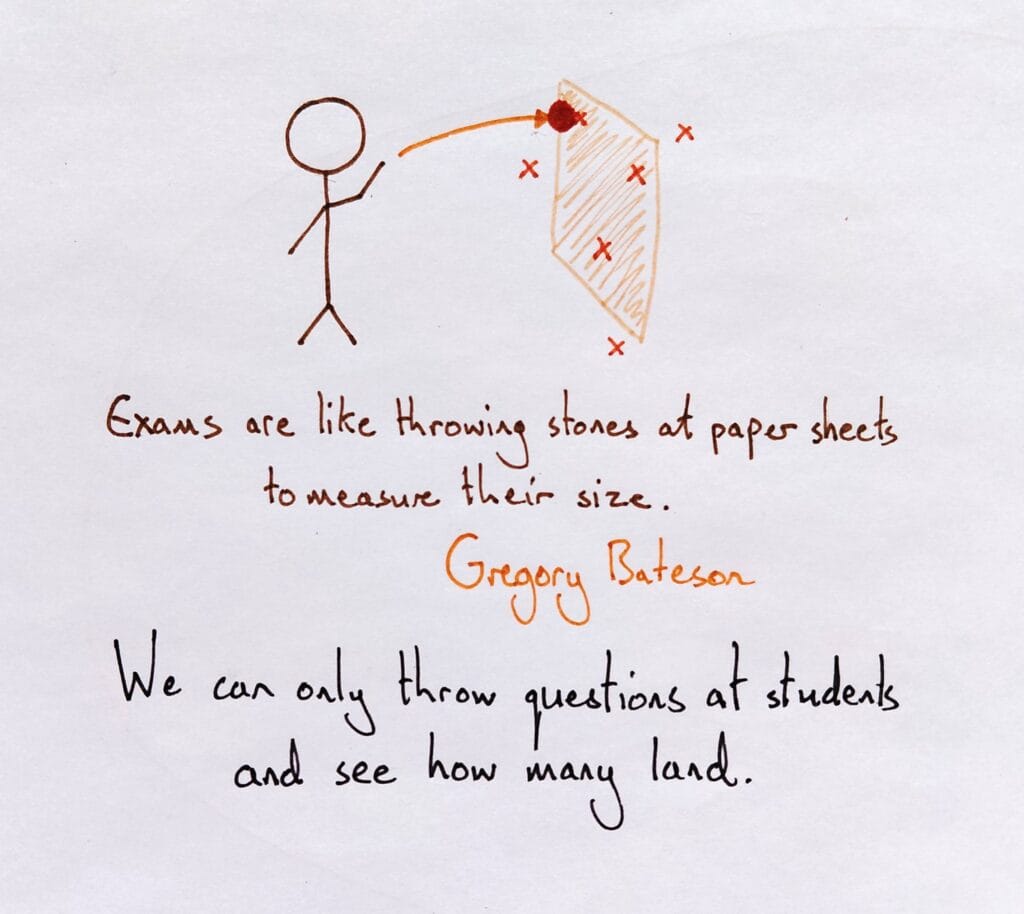
We could measure a piece of paper directly using a precision tool like a ruler. But we can’t do that with knowledge; no one has direct access to the knowledge in the mind. Hence, we end up throwing questions and tasks at students.
The problem lies here. People assume knowledge and understanding must be stored somewhere, that people have them. But they can’t actually measure them directly, and we end up measuring something else.
Instead of objectively measuring knowledge or understanding, we only ever measure how students respond to the challenges we give them. We measure how they act.
When we design an assessment, we begin by thinking, “If students have learnt XYZ, I’d expect them to be able to do these tasks and do these questions.” We also decide what form of response represents good enough learning for the level of the course. We observe our students’ actions, in writing, speaking, or other forms of performance, and judge whether they are knowledgeable.
Pragmatically, knowledge is whether or not a teacher thinks your actions are adequate for the task. If a student’s exam answers are good enough, they’ll consider them knowledgeable.
Knowledge is adequate action according to someone’s judgment.
This is the definition given by the founders of enactive cognitive science, Humberto Maturana and Francisco Varela, and which I use in Teaching Meaning. I want to add to this to give teachers a way of distinguishing between knowledge and understanding.
Bringing objective measures of knowledge into being
When I discuss this with people, they worry about poor judgments of knowledge. What if a teacher is wrong, and a student really does know what they’re talking about? One person’s judgment can’t deny that some people are knowledgeable. This is true, but how would we ever know?
We’d need a second opinion, of course, a more expert teacher who can make finer distinctions and better inferences. And if this judgment were to satisfy us, we’d still be relying on someone’s assessment of a student’s actions. This second teacher just had a different criterion for what they considered adequate action.
As schools, we often defer our ability to judge knowledge to an exam board, a community of experts. This community then deliberates what adequate action is in an exam and classifies those actions into grades according to the knowledge they represent. Objectivity here is really a community’s way of regulating and aligning its conversations through shared standards and protocols for judging action (Di Paolo 2023).
Distinguishing knowledge from understanding
On standardised exams in my subject, science, we could make a practical distinction between two types: those that test their knowledge and those that test their understanding. The form of these questions makes the distinction obvious.
Observing knowledge
Think of exam questions that ask students to do things they’re expected to have done before: identifying features, naming facts, carrying out procedures, giving the typical explanations, and solving the usual problems. These are the things that appear in the textbooks, the exam syllabus, and the curriculum documents. Teachers are expected to have taught them, and students are expected to adequately reproduce them.
If they can handle these questions, we consider the students to have learnt; they are knowledgeable. These are the questions that test knowledge.
Observing understanding
Think of exam questions that present students with previously unseen contexts, ones they haven’t been taught. These questions, in biology, can lead to comical upset from students who protest that they’d “never been taught it”. While they had studied the human digestive system, they hadn’t been taught anything about a rabbit’s digestive system.
These are the questions exam designers make in the hope of testing understanding. The questions are based on the knowledge of the course, but include a variation of some type that they expect the vast majority of students won’t have seen before. The variations come, implicitly, in the form of “What if?”, what if this were in a different context, would it mean the same? What if I changed this part? What if they were in a race, or on a beach? What if it were a rabbit?
If students understand, they’ll act adequately in responding.
Here’s how knowledge and understanding differ:
- Knowledge is adequate action when faced with foreseen tasks (as judged by someone).
- Understanding is maintaining adequate action when faced with unforeseen variations (as judged by someone).
A game of cat and mouse ensues. As soon as the exam is over, the exam board’s collection of questions that test understanding no longer test understanding. They know that these new variations will rapidly be incorporated into the teacher’s question bank that students must practise. Therefore, they become questions that test knowledge, and the exam board must design questions with new variations every time.
This is why many people think that a one-to-one conversation is a good measure of understanding; students must continually adapt to the unforeseeable deviations and surprising questions. We have to understand what people are saying, because we haven’t heard them say it before and aren’t entirely sure what meaning they had in mind. And when we speak, we try to make ourselves understood as we wish to prompt a listener to adequately act (according to our expectations) upon hearing our communication.
The difficulty of conversation-style assessments is in different assessors agreeing on what constitutes a good enough understanding in a conversation.
Knowing (and understanding) are interactions with the world
The knowing and understanding are in the doing. But still, when someone has worked in a field for 50 years, do they not have understanding? Probably, but in saying so, we make an assumption. We assume that, given unforeseen circumstances, this person’s peers would judge them as acting adequately.
Think about those students who come triumphantly to an exam, they’ve studied hard and they “understand it”. Only for them to be distraught at a poor grade. People may think they have knowledge and have understanding, but whether they do so is only revealed in acting (and judgment).
Likewise, we can only reveal our knowledge by testing ourselves. This is sound revision advice that many teachers give to their students. I ask students to begin revision, not with rereading, but with practising their knowledge. Either answering quiz questions from memory, reproducing key diagrams from memory, and self-explaining them as if explaining to someone else.
When doing these, the students’ actions reveal to themselves what they do and don’t know, helping them prioritise their study time. They also reinforce the idea that knowing is doing. They will be judged on their actions, and so we tell students to practise doing.
When we know something, many people like to think of it as having knowledge. This can be useful. But we should recognise that knowing is fundamentally about doing, as this fits how we actually observe and assess knowing.
If we have knowledge, then understanding is a kind of potential knowledge. Teachers, for example, predict what unforeseen contexts their students could handle. They don’t yet have that knowledge, as they’ve never done it before. That knowledge comes into being upon adequately handling the unforeseen task. And, of course, memory is key; we can also forget how to handle tasks.
Should we focus on knowledge or understanding?
The pragmatic question is what we can do with this distinction to help students develop understanding. According to my distinction, understanding isn’t something students will have. Instead, it’s a potential to act: a potential knowledge. As a sort of “adjacent possible”, we should expect a greater potential to handle unforeseen tasks in people who know more.
In the “have” model, sometimes teachers aim to teach for understanding at the expense of knowledge. In such situations, having understanding is considered more desirable than having knowledge, and students are questionably fast-tracked to problem-solving activities.
However, there’s also the danger of focusing too much on developing a bank of knowledge. You can see it take form in courses that prioritise the recall of isolated facts and procedures. I’m sure we’ve all experienced students who excel at reproducing the facts on a test but who can’t maintain a conversation on the topic.
In his book on transfer, Haskell (2000, 107) makes the same distinction:
To use an analogy, someone who implements a recipe quickly and accurately can be called a routine expert, whereas an adaptive expert would be able to substitute ingredients in the recipe if necessary and modify it for different requirements. In general, training leads to routine expertise, whereas knowledge-based deep learning leads to adaptive expertise and to creativity.
Distinguishing teaching knowledge from teaching understanding
The simple way I distinguish between just teaching knowledge and teaching understanding is by a ratio:
The variety of potential actions : The variety of content taught
This is a pragmatic distinction that would be difficult to identify in a classroom where students may be learning more or less for various reasons. Nevertheless, here’s how I see them differing:
When just teaching knowledge:
The variety of potential actions = The variety of content taught
Students can just do what they’ve been taught to do, whether recalling descriptions or reproducing procedures. I saw this once in a lesson on natural selection taught in a “I do, we do, you do” format. The students were just taught the procedure for answering an exam question on natural selection. This form of teaching does have a place for the right content and context.
When teaching understanding:
The variety of potential actions > The variety of content taught
When I teach natural selection, I focus my lesson not on procedures but on distinguishing the key aspects of the concept. Students must perceive the difference that “genetic variation” and “selection” make (see Difference Maker).
With this, students should be able to answer exam questions. And, as they have distinguished them (have a place for them in their mind), they can think with “genetic variation” and “selection” to understand natural selection in many unforeseen examples.
In both cases, having more knowledge is beneficial. What makes the difference is the resulting potential variety of actions (the potential knowledge). Following the law of requisite variety, the more variety of potential actions, the more scenarios a student can adequately handle.
How do we develop understanding?
Many people might recognise this view of understanding as related to the problem of transfer. Transfer occurs when learning in one situation helps you handle tasks in a different situation. When students can do this, they must do more than just act; they must also perceive the new situation as calling for the actions learnt in another.
Understanding, then, is as much about perception as action; it involves discerning what a situation calls for to maintain adequate action. In enactive cognitive science, the two are brought together as a single process: “perceptually guided action”.
At first glance, transfer makes us think about the importance of perceiving and generalising similarities. Students are shown examples of an idea, and then we expect them to be able to spot that idea later on. Nevertheless, this will only work if the students can already perceive what matters; if they can’t see it in the first example, why would they see it in the rest?
For transfer to work, therefore, we first need students to distinguish what matters; and for that, differences are key (Marton 2006).
Imagine an isolated settlement a thousand years ago in the middle of Siberia, where the people had never encountered (heard, or heard of) any other language. They’ve been told that their language is Russian, but what is their idea of language? Language, to them, is equal to the word Russian. No matter how many times they hear people speaking Russian (many examples of similarity), they can’t distinguish language from Russian.
Yet one day, some nomads happen to explore new areas and meet the Russian-speaking people. They immediately perceive that they speak a different language, and the idea of language takes a new form and gains meaning: “Russian is a language”. To be able to perceive language, they had to distinguish it from Russian. And that required they perceive a different language, another variety of language. As variation theory explains, language itself had to vary (Marton 2015).
Now that they perceive language as an aspect of their world, not only has their knowledge increased, but also their understanding. This is because it creates a part-whole relationship: Russian is a part of the idea of language. And this gives the person the potential to distinguish previously unforeseen parts of this idea.
When they come across other previously unforeseen examples of language, they can now distinguish them and consider them languages: spoken, signed, whistled, or written. They can think with the idea of language.
And, therefore, distinguishing language increased their variety of potential actions; their understanding. They could see that there were a variety of ways of achieving the same thing.1
Teaching for knowledge and understanding in lessons
In teaching, then, we must teach content to increase our students’ knowledge. But among that content are aspects that students must distinguish if they are to understand and build their potential knowledge. Those aspects aren’t just content; they are key distinctions among the content that, if perceived, allow students to understand it.
I’ve adapted the following graphic from my book, Teaching Meaning, to help show how to think about this difference:
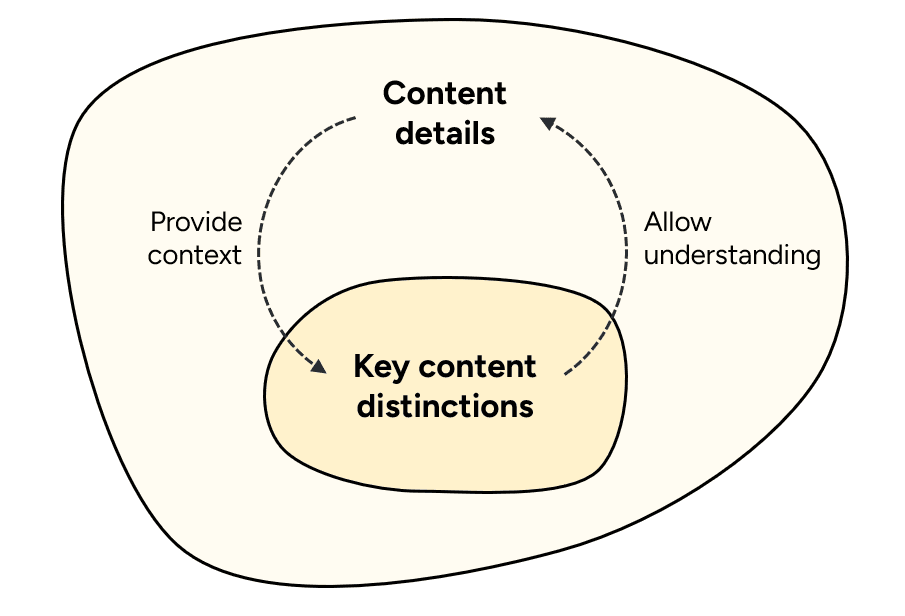
If just teaching content, all students can do is memorise it in order to adequately reproduce it. If, however, we also have students perceive and distinguish key aspects, they’ll be able to think with these to understand.
The most basic of all moves, then, for developing understanding is variation. The “What if?” question is the best example. As teachers, we identify which aspects we think matter most, and then we vary them. We can ask, “What if this were in this other context, or if this part were different in this way?”.
Discover more about varying as a basic move and how to enact it in everyday lessons in Teaching Meaning: What Works When Telling Isn’t Enough.
References
Ashby, W.R. 1956. An Introduction to Cybernetics. New York: Wiley.
Bateson, G. 1972. Steps to an Ecology of Mind: Collected Essays in Anthropology, Psychiatry,
Evolution, and Epistemology. USA: Jason Aronson Inc.
Di Paolo, E. 2023. “F/acts: Ways of Enactive Worldmaking.” Journal of Consciousness
Studies 30 (11–12): 159–89.
Di Paolo, E., Cuffari, E., and De Jaegher. 2018. Linguistic Bodies: The Continuity
Between Life and Language. USA: MIT Press.
Engel, A., et al. 2013. “Where’s the Action? The Pragmatic Turn in Cognitive
Science.” Trends in Cognitive Science 17 (5): 202–9.
Foerster, H.von. 2003. Understanding Understanding: Essays on Cybernetics and
Cognition. USA: Springer-Verlag.
Foerster, H.von, Müller, A., and Müller K. 2014. The Beginning of Heaven and Earth
Has No Name: Seven Days with Second-Order Cybernetics. Translated by: E Rooks
and M Kasenbacher. Ebook Edition: Fordham University Press.
Foerster, H.von, and Poerksen, B. 2002. Understanding Systems: Conversations on
Epistemology and Ethics. New York: Kluwer Academic/Plenum Publishers.
Haskell, R. 2000. Transfer of Learning: Cognition, Instruction, and Reasoning. USA: Academic Press.
Marton, F. 2006. “Sameness and difference in transfer.” Journal of the Learning Sciences 15(4): 499–535.
Marton, F. 2015. Necessary Conditions of Learning. London: Routledge.
Marton, F., & Booth, S. 1997. Learning and Awareness. New York: Routledge.
Marton, F., Fensham, P., & Chaiklin, S. 1994. A Nobel’s eye view of scientific intution: Discussions with the Nobel prize-winners in Physics, Chemistry, and Medicine (1970–1986). International Journal of Science Education, 16, 457–473.
Maturana, H. 1987. “Everything Is Said By An Observer.” In Gaia, A Way of Knowing: Political Implications of the New Biology, edited by William I. Thompson, 67–84. USA: Lindisfarne Press.
Maturana, H., and Varela, F. 1992. The Tree of Knowledge: The Biological Roots of
Human Understanding, revised edition. USA: Shambhala Publications.
Pickering, A. 2010. The Cybernetic Brain: Sketches of Another Future. London: University of Chicago Press.
Spencer-Brown, G. 1979. Laws of Form. 2nd ed. USA: E.R Dutton.
Varela, F. 1987. “Laying Down a Path.” In Gaia, A Way of Knowing: Political Implications
of the New Biology, edited by William I. Thompson, 50–66. USA: Lindisfarne
Press.
Varela, F. 1992. “Whence Perceptual Meaning? A Cartography of Current Ideas.”
In Understanding Origins: Contemporary Views on the Origin of Life, Mind, and
Society, edited by Francisco J. Varela and Jean-Pierre Dupuy, 235–263.Dordrecht: Kluwer Academic Publishers.
Varela, F., Thompson, E., and Rosch, E. 2016. The Embodied Mind: Cognitive Science
and Human Experience. Revised Edition. Ebook edition: MIT Press.
- I’m very fond of George Spencer-Brown’s distinction (he was a mathematician) in his book, Laws of Form:
This might be a helpful moment to introduce a distinction between following a course of argument and understanding it. I take understanding to be the experience of what is understood in a wider context. In this sense, we do not fully understand a theorem until we are able to contain it in a more general theorem. We can nevertheless follow its proof, in the sense of coming to see its evidence, without understanding it in the wider sense in which it may rest.Following and understanding, like demonstrating and proving, are sometimes wrongly taken as synonymous. Very often a person is regarded as not understanding an argument, a process, a doctrine, when all that is certain is that he has not followed it. But his failure to follow may be quite deliberate, and may arise from the fact that he has understood what was presented to him, and does not follow it because he sees a shorter, or otherwise more acceptable, path, although he might not, yet, know how to communicate it.
Following may thus be associated particularly with doctrine, and doctrine demands an adherence to a particular way of saying or doing something. Understanding has to do with the fact that what ever is said or done can always be said or done a different way, and yet all ways remain the same. ↩︎