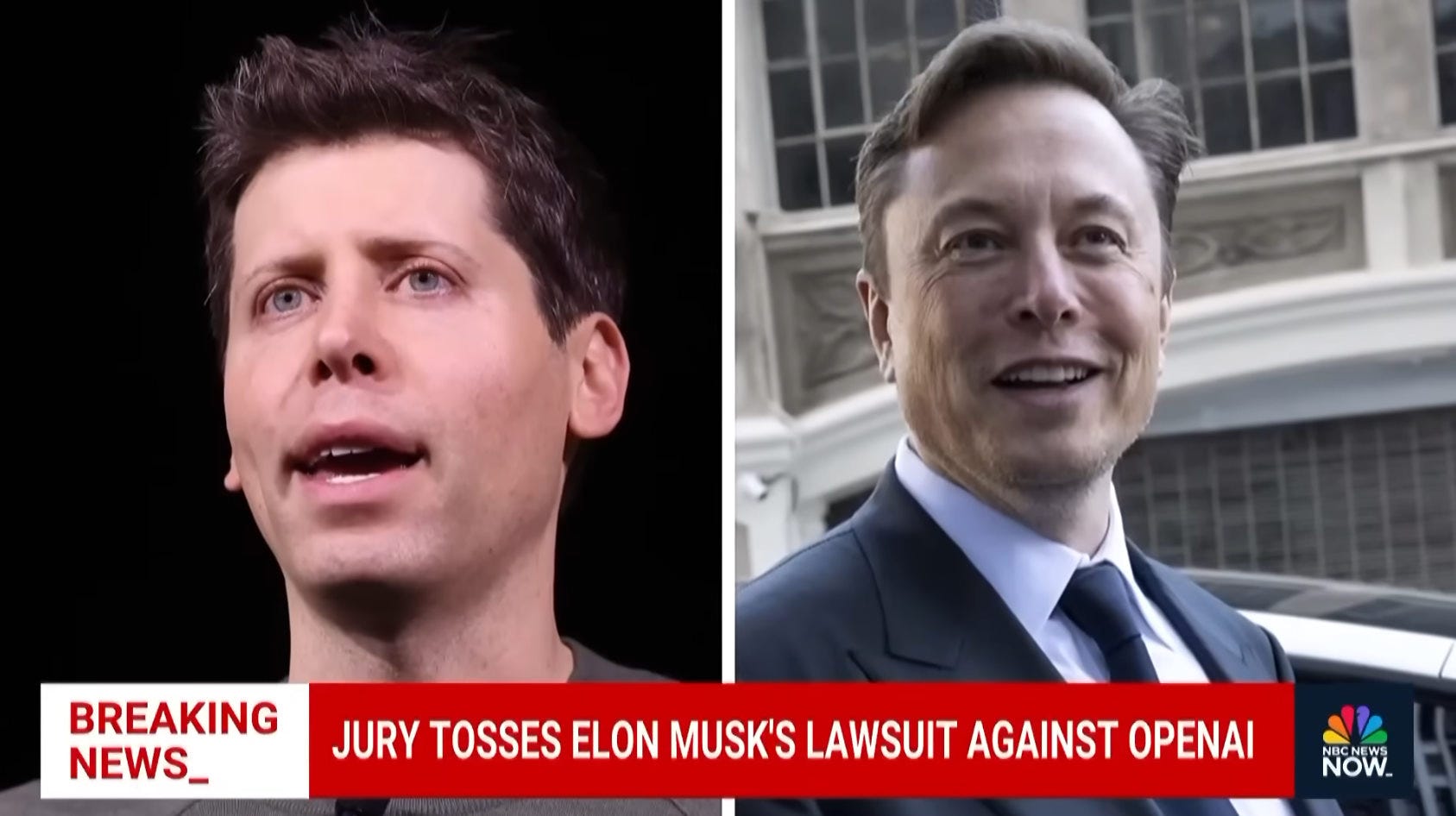
Yesterday, at the conclusion of the federal civil trial at a California district court, Elon Musk lost his suit against Sam Altman et al. Here’s an official statement:
“The jury reached a unanimous verdict that plaintiff’s claims for Breach of Charitable Trust and Restitution based on Unjust Enrichment are barred by the Statute of Limitations.”1
Musk plans to appeal.2
The jury returned the verdict quickly, on their first day of deliberation. But just how obvious is it that Musk’s claims were barred by the statute of limitations? We used Colit’s AI-hybrid process to draft a motion that supported the jury’s decision. It read strong. Then, we used the same process to generate an opposition motion. And, well, that read strong too. So let’s compare the arguments, and preview what Musk’s appeal may rely on.
To apply the statute of limitations defense, OpenAI had to prove that the alleged harm occurred before August 5, 2021.3 If they managed that, they will next have to survive Musk’s attempts to delay the start of the statute of limitations clock via the discovery rule. Musk might persuade the jury that prior to August 5, 2021, “he did not discover, and did not know of facts that would have caused a reasonable person to suspect, that he had suffered the claimed harm and could not have discovered those facts with reasonable diligence”.4
Now let’s look at the harm at issue, the fraud Musk alleges. Briefly, it is that the defendants transformed the non-profit OpenAI he funded into a closed source for-profit entity. From Michelle Kim’s reporting from the courthouse on April 29:5
“Either go do something on your own or continue with OpenAI as a nonprofit” Elon emailed to Sam Altman and Greg Brockman in 2017. He says they reassured him that they were committed to keeping the company a nonprofit, while planning to pivot to a for-profit.
“I was a fool who provided free funding” for Altman and Brockman to start a startup, Elon says.
“If they wanna get rich, they should go do so as a for-profit, Elon Musk says, referring to Sam Altman and Greg Brockman. “They should not get rich off a nonprofit.”
“I gave them 38 million dollars of essentially free funding,” which Altman and Brockman used to create a $800 billion dollar company, he says.
So OpenAI had to show that Musk knew, or reasonably should have known, about OpenAI’s for-profit trajectory prior to August 5, 2021. OpenAI’s lawyer confronted Musk with an OpenAI term sheet proposing a for-profit arm in 2019. Musk admitted to have received it. But he claimed those terms, that capped the returns for investors, did not rise to violating OpenAI’s non-profit mission (“No, because if you’ve got a capped profit situation, it hasn’t violated the nonprofit’s goal.”)6
Later, Musk conceded knowing that Microsoft put in $1 billion into the for-profit arm in 2019, and saying in a September 2020 tweet, “This does seem like the opposite of open. OpenAI is essentially captured by Microsoft.” OpenAI’s lawyer also got Musk to testify that he stopped his quarterly $5 million donations to OpenAI in 2017, and stopped picking up OpenAI’s office rent in 2020.7 The defense brought out these Musk admissions to show that Musk had his misgivings about OpenAI’s corporate trajectory well before August 5, 2021.
While OpenAI’s arguments that the statute of limitations applies might appear solid, there was an early indicator that this issue wasn’t that straightforward. Because if it were, it would have been decided as a matter of law by Judge Rogers before trial. In a pre-trial order, Judge Rogers wrote “[g]enuine material disputes of material fact exist”. She was referring to whether Musk can assert justifiable reliance on OpenAI’s (alleged) misrepresentations to him.8 Justifiable reliance is a legal principle Musk could use to countenance his delayed discovery of the (alleged) fraud. Musk could persuade the court at trial that he was reasonably misled by OpenAI’s reassurances that “the fundamental mission of being a nonprofit open-source company continued.”9
You could see Musk making the justifiable reliance argument repeatedly at the trial. Musk testified that after his September 2020 tweet decrying the Microsoft investment, Sam Altman texted him with the reassuring message “OpenAI was staying on the mission as a non-profit”.10 And when Musk received the for-profit term sheet in 2019, he was informed by Sam Altman that the investment was done “in a way where all investors are clear that they should never expect a profit”,11 suggesting that the non-profit mission continued untainted. Finally, there were Brockman’s 2017 diary entries, arguably the most powerful evidence heard in court.12 They were highly suggestive that Brockman and Altman were working to conceal from Musk their true aims for OpenAI. From Colit’s opposition motion:
Altman and Brockman themselves viewed the shift to a for‑profit or b‑corp as something that could not be candidly described to Musk without provoking a “very nasty fight.” Their 2017 notes—“we cannot say that we are committed to the non‑profit . . . if three months later we’re doing b‑corp then it was a lie”; “can’t see us turning this into a for‑profit without a very nasty fight”—illustrate contemporaneous intent to conceal and to proceed by degrees. The jury can reasonably infer that the subsequent communications to Musk were crafted to obscure, not reveal, the facts constituting the fraud.
Separately, Colit’s opposition motion flagged another useful rebuttal against the statute of limitations, one that did not figure much at trial. OpenAI had a fiduciary relationship with Musk. This relaxes the standards requiring Musk’s diligence to act on his suspicions. Again from Colit’s opposition motion:13
California’s discovery rule is clear that suspicion triggers a duty to investigate, but where a fiduciary relationship exists and the fiduciary is giving specific assurances, the law affords a “relaxed” duty of inquiry, and courts postpone accrual until the beneficiary has knowledge or notice of an actual breach. See WA Southwest 2, LLC v. First American Title Ins. Co.
The court did not instruct the jury on this relaxed duty of inquiry, “that plaintiff’s burden of discovery is reduced and he is entitled to rely on the statements and advice provided by the fiduciary.”14
So Colit’s opposition motion lays some groundwork for a Musk appeal. When Musk’s appellate brief is eventually filed, we will eagerly compare notes.
This article benefited greatly from discussions with my co-founder Lawrence P Oh. I would also like to thank Michelle Kim (@michelletomkim on X) for her invaluable day-by-day reporting from the courthouse.