In 2025, the two of us went on trips across India and China with friends. We wanted to understand how the world’s two most populous countries view each other geopolitically, and how their technology industries compare – questions that have remained top of mind amidst recent ruptures to the world order and our growing conviction in India’s and China’s economic centrality to the 21st century. This year, almost half of global economic growth will come from these two countries.
During our travels, we were lucky to meet many Indians and Chinese working in business, tech and policy. A few questions guided our conversations. What do India and China really think about each other? Will India develop tech giants that rival China’s and America’s? To what extent has Silicon Valley tech culture diffused to each country’s tech scene? And finally, how will the cultures and demographics of the two countries shape their long-term trajectory? We have written about China and India individually elsewhere, so our focus here is on how the countries compare and interact.
Our trip in India began with a few tumultuous days in Delhi. Trump had announced a 25% increase in tariffs on India in retaliation for purchasing Russian oil. Many of the Delhi elite asked whether India needed to pivot closer to China, or at the very least hedge its bets. As we would learn, this “China” question struck a chord in the Indian national psyche.
We began to notice an obsession with China among India’s elite that, to our surprise, often ran deeper than what we’ve observed in Washington. For some, there was a deep sense of envy: “Why couldn’t India industrialize like China?” For others, defensiveness: “Indian democracy prevented rapid capital buildup but was needed because of our diversity.” And, intellectualized cope: “We have produced more GDP per dollar of debt than China.”1 It was clear India’s relationship with China had a memetic quality.
There was China envy even when we spoke with Rahul Gandhi, the current opposition leader in Parliament. The meeting took place at 10 Janpath, home to the Gandhi-Nehru family for nearly four decades. We were escorted to a visiting room with walls lined with model sailboats and books. Several were part of the personal collection of Nehru, India’s first prime minister, with notes addressed to his daughter Indira, whose metallic bust stared at us from the wall.
Typically, audiences with politicians are tightly curated and controlled. Yet the conversation felt candid and unscripted. Gandhi spoke of his relationship with his family and criticized Thomas Piketty’s recent book, which discussed inequality in India, for not considering caste, which he noted would be a blind spot for us foreigners. At one point, when discussing the importance of social skills for young graduates in India, he quipped that too many engineers couldn’t talk to girls.
But unprompted by us, it was China that took up the bulk of the conversation. China had a “culture of production” that India needed to obtain, Gandhi told us. Other critics of the Modi government have argued that India needs to focus on consumption and services-led growth, given the difficulty of competing in manufacturing in the 21st century. So it was interesting to hear Gandhi preach something more like the China model.
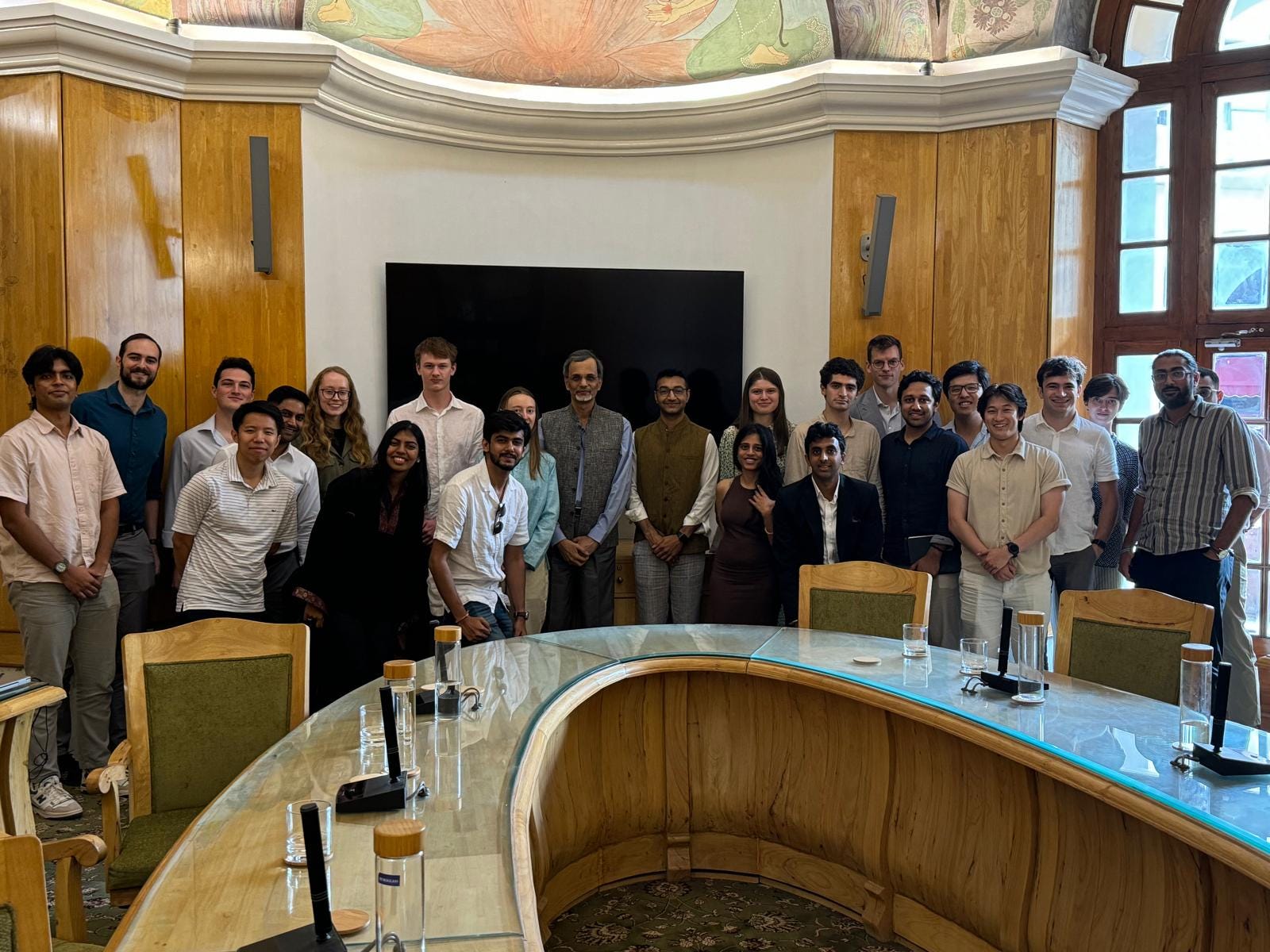
At times India has shown a desire to learn from China.2 Indian Prime Minister Narendra Modi met one-on-one with Xi Jinping a remarkable 18 times from 2014-19. But geopolitical tensions have gotten in the way of further ties. We had whiskey one night with an officer from the Indian army at his leafy home in Bangalore. He recounted the 2020 conflict between the Indian and Chinese armies in the Himalayas, which led to 20 Indian and four Chinese casualties. The military had sore memories of the 1962 war where the Chinese army steamrolled through India’s northern border. The helplessness of the Indian army scarred Nehru, India’s first prime minister, and has never truly left the collective Indian public memory. So while India’s leadership sees clear economic benefits to getting closer, it is also guarded in its approach.
We expected that India would be on the minds of at least some Chinese elites as well. But it soon became clear the relationship was one-sided. “We don’t think about India very much,” a macro analyst said bluntly. “They have no important tech companies,” said an AI researcher, adding, “I haven’t heard of any Indian AI companies, have you?” The only Chinese person we had a serious India-China conversation with was a professor of international relations who had a particular interest in the countries’ border dispute. Partway through our conversation, we learned that this very professor had briefed Indian officials — including some we had met — on China just the previous week.
While Chinese society dismisses India’s rise, the Chinese state has longer memories and thinks further into the future. India is hoping to be the +1 in “China+1.” More than 20% of iPhones are now made in India. But Beijing has also ordered 300 Foxconn employees back and restricted the export of several key technologies, including solar cell manufacturing equipment. In late January 2026, India’s biggest conglomerate, Reliance, halted plans to manufacture lithium-ion battery cells in India because a Chinese supplier pulled out of a partnership to comply with Chinese export restrictions. Just as America has tried to keep China one step behind the technological frontier on AI and chips, China’s top leadership appears to be doing the same to Indian manufacturing.
What of the Indo-American relationship? One of our group asked an official about the Indian purchases of Russian oil. “The EU is the number-one purchaser of Russian oil”, they replied. You can see why India was annoyed that American tariffs on India were raised to 50% while tariffs on China stood at 37%.3 Yet though Modi is proud he is also pragmatic. The official told us that “in six months we expect to have resolved the situation.” That was six months ago. In early February, the US and India announced a trade deal that will slash tariffs for both parties (the Supreme Court’s ruling may make this redundant). Along with the recent India-EU deal, India could quickly become a remarkably more open economy than it was a few months ago.
India’s tumultuous ties with China and America look confusing in isolation but make more sense when viewed altogether. An editor at an Indian newspaper gave a rendition of Napoleon’s famous quip to us: “Give me a nation’s geography and I can give you its foreign policy.” India is surrounded by Russia, Pakistan, and China. It cannot be an enemy of all of them and expect to thrive economically. On the other hand, its services exports are dependent on ties to the West. That is why India must be ruthlessly pragmatic in its relations with the West, China, and Russia, pursuing shared interests when aligned without committing to a true alliance. When Indian elites say the country is “non-aligned” or “multi-aligned” people should believe them.
Western elites may now sympathize more with India’s historical non-alignment. In his viral Davos speech, Mark Carney said Canada would pursue “variable geometry — different coalitions for different issues”. It was a line that would have fit just as well in a speech from India’s foreign minister S. Jaishankar. Right after Carney’s speech, European commissioner Ursula von der Leyen announced “the mother of all trade deals with India.” As Canada and Europe stop pursuing a unified trade policy with America, they have opened up to Chinese exports. Just after Davos, British PM Keir Starmer made a state visit to China. Variable geometry is a Chinese characteristic too.
The world consists of two major poles of technology – America’s and China’s. We were curious to investigate whether the world’s largest country, India, would become a natural third.
The story of China’s tech industry is, whether intentional or not, one of history’s greatest successes in infant-industry import substitution. The Great Firewall, initially built for censorship, created a digital protectionist wall that enabled China to build a parallel set of tech giants to the West.4 China’s late development also allowed it to leapfrog internet 1.0 straight to mobile-first. China’s tech giants are not the same as their American counterparts, however.
In Shenzhen, the first company we visited was Tencent. We were taken on a tour of the conglomerate’s in-house museum, a futuristic showhouse intended to showcase both the firm’s technological prowess and commitment to doing good for society. Our favorite part was retro – an old arcade and kitchen filled with old computers and video games that was almost reminiscent of 1970s America.
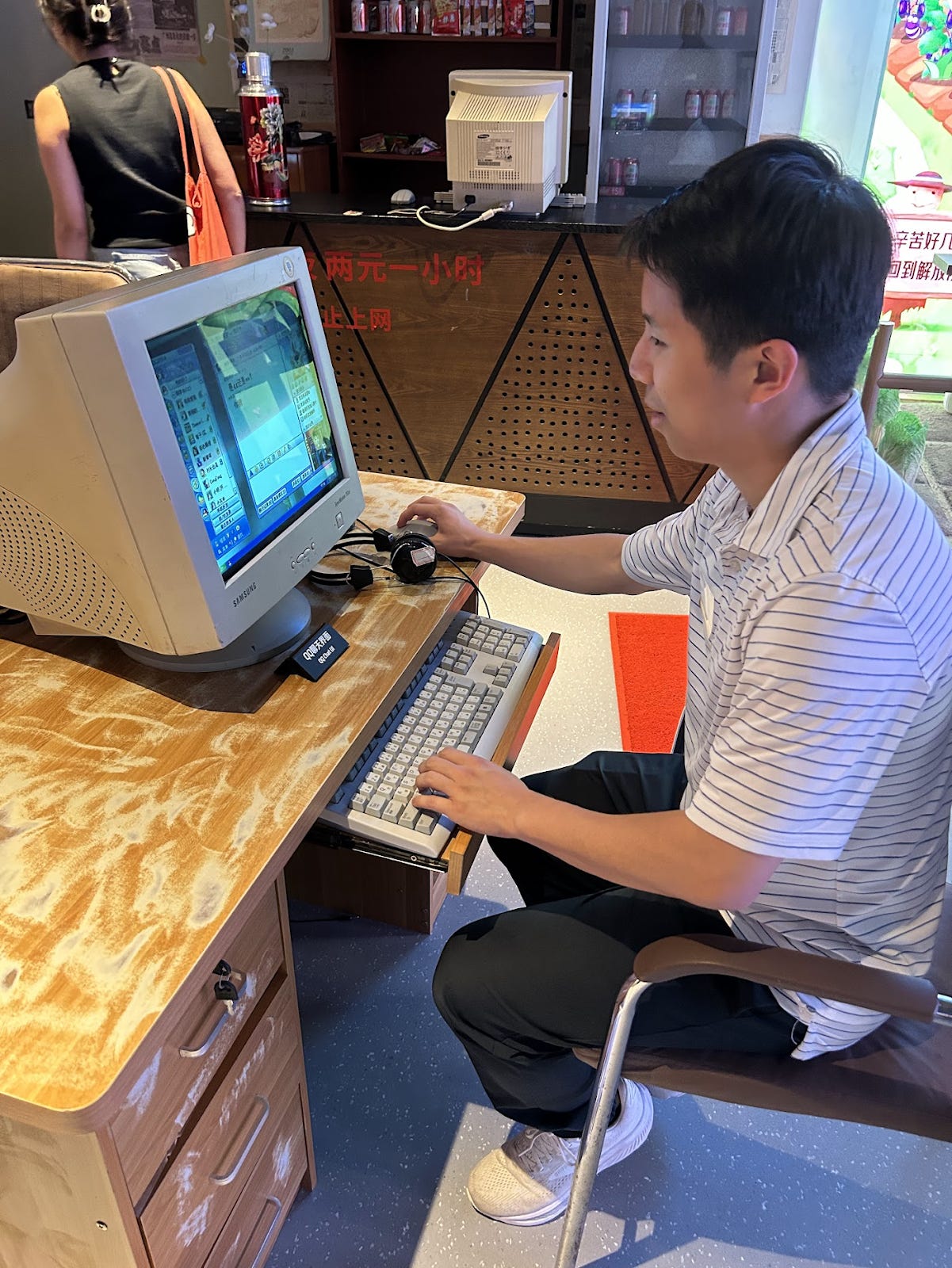
As we toured the Tencent museum, the distinctiveness of Chinese tech came into focus. First, Chinese big tech integrates numerous businesses that are split up in the West. Tencent combines video games with a superapp (WeChat) that includes mini-apps for everything from messaging, social networking and payments to much more.5 A lack of tech infrastructure and legal services in the 2000s and 2010s caused Chinese tech giants to be more horizontally and vertically integrated than their more modularized US counterparts. It’s a good case study in how the shape of technology is historically contingent. Second, while Chinese internet companies have stated ambitions to go global, we got the sense their heart wasn’t really into it. A good example is WeChat itself. The app has clearly saturated its domestic market with over 1bn monthly active users but is more focused on increasing value per user rather than expanding globally.
Indian tech may end up even more unusual. Back in the late 2000s investors thought India would follow in China’s footsteps. We met one venture capitalist who said he moved back to India in 2010 because he thought Indian big tech was inevitable. A few years ago, he changed his mind and moved from venture to private equity. Why? To a first approximation, India is part of the American internet. Without a Great Firewall to stop them, American tech companies can easily scale into the Indian market–Indians represent the largest user base for many American apps from ChatGPT to Facebook.
An English-fluent upper-middle class doesn’t hurt. To be clear, India has plenty of unicorns in categories where localization matters from ride-hailing to delivery. Its talent ecosystem also benefits from Western tech investment. But any category with economies of scale like social, enterprise SaaS, and now AI, is dominated by Western platforms.6 As investors have reset their expectations on the market cap available to Indian tech, several have pulled out, including Sequoia Capital and the Omidyar Network. Last week’s AI summit in Delhi, with all the major U.S. AI company CEO’s attending, is the perfect encapsulation of the close engagement between U.S. tech and Indian markets. And the eviction of an Indian university for passing off a Chinese-manufactured robot dog as a domestic innovation at the expo summit underlines the pressure and fragile state of Indian domestic tech.
Yet it would be wrong to say Indian tech will be nothing more than an extension of Western tech. There is much to lament about a lack of Indian state capacity but one remarkable success story is India’s digital public infrastructure (DPI). The foundation of Indian DPI is Aadhaar, a universal digital ID system that is the world’s largest biometric database. Aadhaar is the authentication layer for the unified payment interface (UPI), an open payments network which processes 50% of the world’s real-time payments. UPI sits between fintechs and banks for P2P and P2B payments, enabling transactions as small as 1 rupee with no fee. It thus dissipates the rents that accrue to credit card companies in the West and fintech giants in China.7
In Silicon Valley, memes from American Dynamism and DOGE to the Engineering State indicate a recognition that the tech sector should be building more publicly valuable infrastructure. Yet in practice, this happens rarely. Indian DPI by contrast is an extraordinary story of tech elites getting their hands dirty to build public infrastructure at scale. Pramod Varma, the chief architect of “the India stack” explained to us how India is now extending the framework of open networks to e-commerce (ONDC) and ride-hailing (Namma Yatri).
The unique industrial organization of Indian tech has implications for AI. India’s corporate sector invests pitifully in R&D. This partly reflects a lack of private sector profit pools in the tech economy. No single actor in India has the resources or technical competence to train a frontier foundation model. In China, there was a clear sense of what the evolving AI market structure would look like: open-source for the model layer (even Meta now uses Alibaba’s Qwen). And then make money on the application layer – follow the TikTok playbook of scale and low margins.
If there is an Indian AI thesis it has to do with the value of local knowledge to produce contextual data in Indic languages. In Bangalore, our friend Manu Chopra of Karya AI, a non-profit AI organization, noted that models struggle with many everyday questions that require contextual knowledge, such as the health consequences of niche dishes in rural India. Karya’s evals, which span many regional dialects, help fill these gaps. Low purchasing power in developing countries means AI labs are unlikely to pay for such data at scale, but this is at least one way developing countries can contribute to AI diffusion.8
Taking stock, India seems set to represent a third pole for tech governance and political economy. Not the incredibly liquid and hyperscaling venture ecosystem of the US which can lead to political imbalances, nor the statist pseudo-party controlled corporations of China. But rather a system that blends a relative openness to US software with a system of open networks that makes digital commerce viable even for small businesses at small volumes. So far that system has not generated the type of Schumpeterian R&D that has powered the tech sectors of America and China. But with the world's largest reserve of talented software engineers, India has the human capital to build something genuinely new — a model for the global internet that neither America nor China has offered.
While the Chinese and Indian tech sectors have drastically different market structures, neither can fully escape Silicon Valley’s cultural gravity. But how deep does that influence run? In our travels, we found the answer differs starkly between the two countries.
For China, this cultural transfusion is clearest in AI. In Shenzhen, we found ourselves in a sleek cafe beside the city’s public museum. Some members of our group struggled to navigate the WeChat ordering menus, but we eventually managed to assemble a colorful spread of matcha lattes and fruit teas. We were there to meet Hal (name changed for privacy), an engineer at one of China’s AI labs. Throughout our conversation, what struck us was how familiar he felt—he could have been an engineer at any Bay Area lab. ‘What does your day-to-day look like?’ we asked. ‘Wake up and scroll Twitter,’ he said, half-joking. But in our conversations with Hal and others, we found China’s AI researchers far less neurotic than those living in SF’s AI culture. There was no talk of ‘x-risk,’ and ‘AGI’ was mentioned with a knowing smile, as if it were an inside joke rather than an existential question.
Similarly, at an AI roundtable in Shanghai, we met several AI founders—many of whom had spent time in the US—who pitched us familiar wrapper models: AI for investment advice, AI for hiring, AI for customer service. Flush with VC funding and generous state subsidies, many of these companies felt aesthetically similar to generic AI startups in San Francisco. We did not feel any more bullish on them than any random AI founder in SF, but success does sometimes come down to shots on goal and China is certainly taking many shots.
But step outside the AI world and American cultural signposts are scarce. During our visits to Chinese factories, American references were hardly to be found. (Though one executive did love Elon: “Elon managed to sell to the Chinese government. That is truly impressive9”). Instead, companies were often a confusing bundle of business lines: semiconductor wafer supplier and smart window manufacturing; combined CHP and modular apartment construction. It is one thing to read about Chinese industrial policy. It is another to walk in the midst of the massive conglomerates building in the physical world in alien ways, and to breathe the rarefied air where the art of the possible is shaped and molded by invisible forces that are difficult to fully grasp.
The executives we met with were by and large open and pragmatic, perhaps the result of intense competition and dealmaking over baijiu-filled banquets. Trump and Xi, to the extent they came up, were viewed as constraints to optimize under rather than something to protest. Yes, tariffs were hurting the economy, but they also presented new opportunities like expanding into semicap manufacturing. Chinese businessmen were most interested in making money and had a strong curiosity about how to tap into foreign markets. American executives in old industries felt remarkably conservative in contrast.
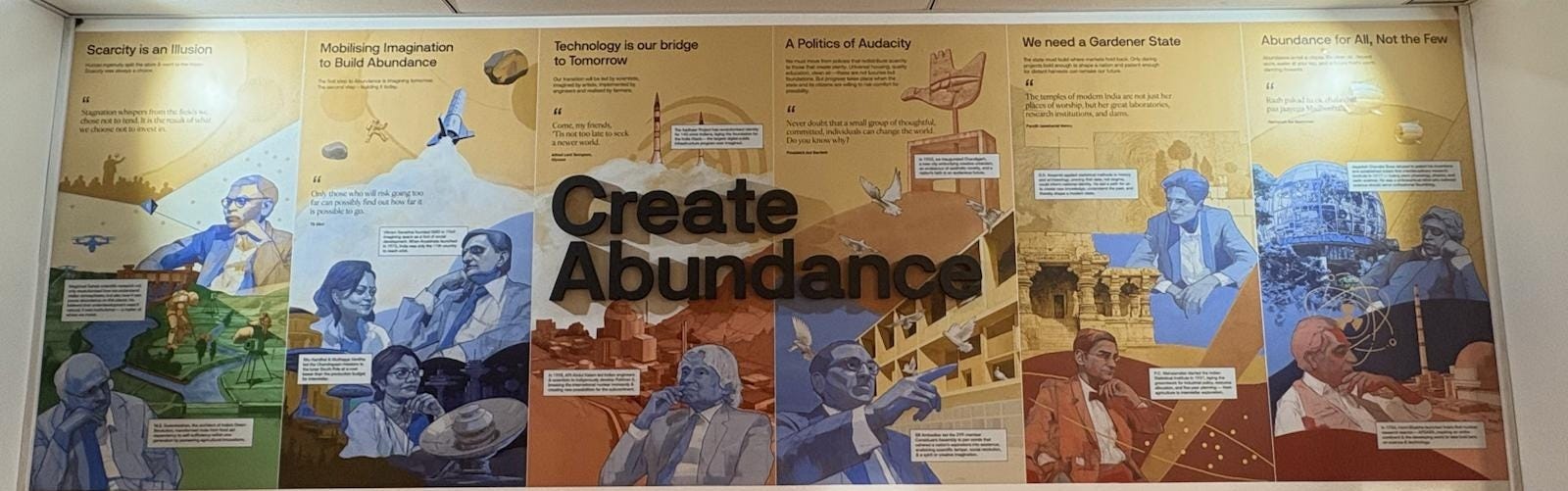
But while Western culture was limited to the AI scene of China’s economy, it permeated the entirety of Indian tech. An English-speaking elite meant conversations often felt indistinguishable from San Francisco—the same frameworks, the same youthful optimism, the same Paul Graham essays. From ‘Occupy Mars’ SpaceX t-shirts to Abundance-themed poster walls, American mindshare dominated. The young founders we met were sharp and well-read, building ‘X-for-India’ companies adapted to the local context but legible to any Silicon Valley investor.
The positive side of US big tech’s dominance in India is that Indians can leverage all the English tokens on the internet to bootstrap their way to economic growth. The investors and founders we met in Bangalore would be at home in an investor pitch at any SF coffee shop. As one founder from Bihar, who has successfully built what is essentially an intercity Uber, liked to say, “If the product is a hero, then CAC is zero”.
Here’s one anecdote of just how much mindshare Western frames had in Indian tech culture: Charles found himself in an Ann Arbor-themed microbrewery in Bangalore (the owner studied at University of Michigan and loved Ann Arbor), with Kesha music playing in the background, talking with an Indian engineer about a niche DC substack on NEPA reform.

The supply of definite optimism—the belief that the future can be shaped, that problems are solvable with indefatigable hard work, the willingness to take risks to do something new—is perhaps a nation’s most essential intangible asset. It is embodied in people before it is empowered by capital. Silicon Valley remains the most potent fountain of such optimism today, but we were struck by how teeming it was in Bangalore.10 And while much optimism has been drained from Chinese society writ large, we saw plenty in the most innovative corners, like AI. Ultimately, how each nation cultivates this cultural resource may matter more for both country’s trajectories than any single policy reform.
Finally, it is worth appreciating what India and China represent: two billion-person experiments in governance and nation-states with almost diametrically opposed philosophies and approaches. India’s diversity and China’s homogeneity, perhaps the deepest structural difference between the two countries, showed up everywhere; in how we navigated cities, in who we could meet with, and in the texture of daily life.
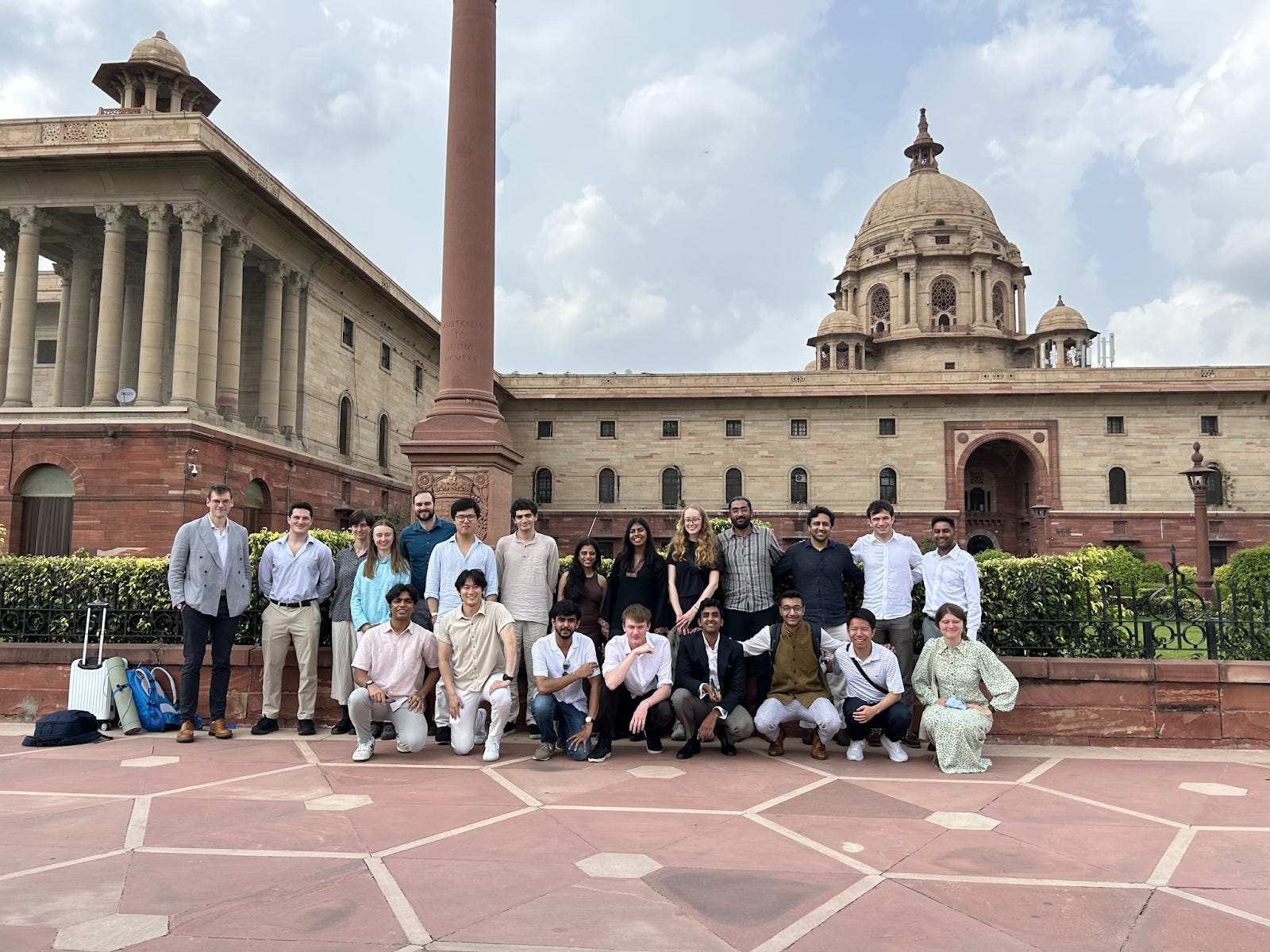
In Hindi, there is a term called “jugaad” for how one muddles their way through society with creativity, just figuring things out, sometimes bending the rules. During a visit to the Finance Ministry in Delhi, we had quite some difficulty finding the right security gate to enter. The guards didn’t trust we were there on official business, so we called our point of contact to help explain to the guards over the phone. We were asked to go to a second gate, a half-mile away, on the long lawn between India Gate and our destination. We were a bit skeptical that it was the right entrance, but we tried nonetheless. This time the guards got a bit annoyed. Who did we think we were, trying to enter through the main gate – Parliament was in session. We were asked to go to a third gate. Again, to no avail. Finally, we went back to the original gate. This time, a different guard was there and we put him on the phone with our point of contact. We were through!
The jugaad of successfully navigating the chaos of Delhi is worth contrasting with Shanghai. In one memorable interaction, after emerging from the metro in the city center, Arjun mistakenly crossed the street without looking at the pedestrian signal. Rather than honk, the surrounding cars smoothly and quietly (they were all electric) stopped, waiting for him to pass by, before gliding onward as if nothing had happened. Such orderly calm is relatively new to Chinese cities. General obedience to traffic laws comes with growth. But in China it was accelerated by state surveillance and policing of anti-social behavior, including noise cameras for excessive honking, and drones that flew around Chinese cities and blared in response to rule-breaking during the Covid lockdowns. The result of this panoptic discipline is an incredibly safe, peaceful, and orderly urban environment.
This contrast between the messy, dynamic mass of India, with the state-controlled calm of China was also reflected in our political encounters. On our final night in Delhi, our party descended upon the Piano Man jazz club, a Delhi mainstay and invited many of our local friends and contacts to join us. Our guests included a few Members of Parliament in their 20’s, who each represented a few million people. One was a self-professed communist and the other an ally of the current more capitalist-leaning government. They were there to banter and we were happy to partake.
Many of us questioned the sincerity of the communist’s beliefs. “Do you really believe in Marx?” “Yes, I want to lead a revolution.” “Then why are you an MP?” “Well in India, you have to go through the system.” A modern take on communism if there ever was one.11 We were glad to see that the communist and BJP-alliance members were friends. Despite having vastly different socioeconomic backgrounds, home states, and mother tongues, their similar age in a geriatric legislature had created a sense of kinship. One of our party members continues to occasionally send the MPs internet memes over WhatsApp.
Our experience was remarkable in how normal it was. There were no formalities or pretensions – just Tocquevillian democracy where the social distance between representatives and the public collapses at a bar.12 Such an interaction between foreigners and National Party Congress members would be unthinkable in China.
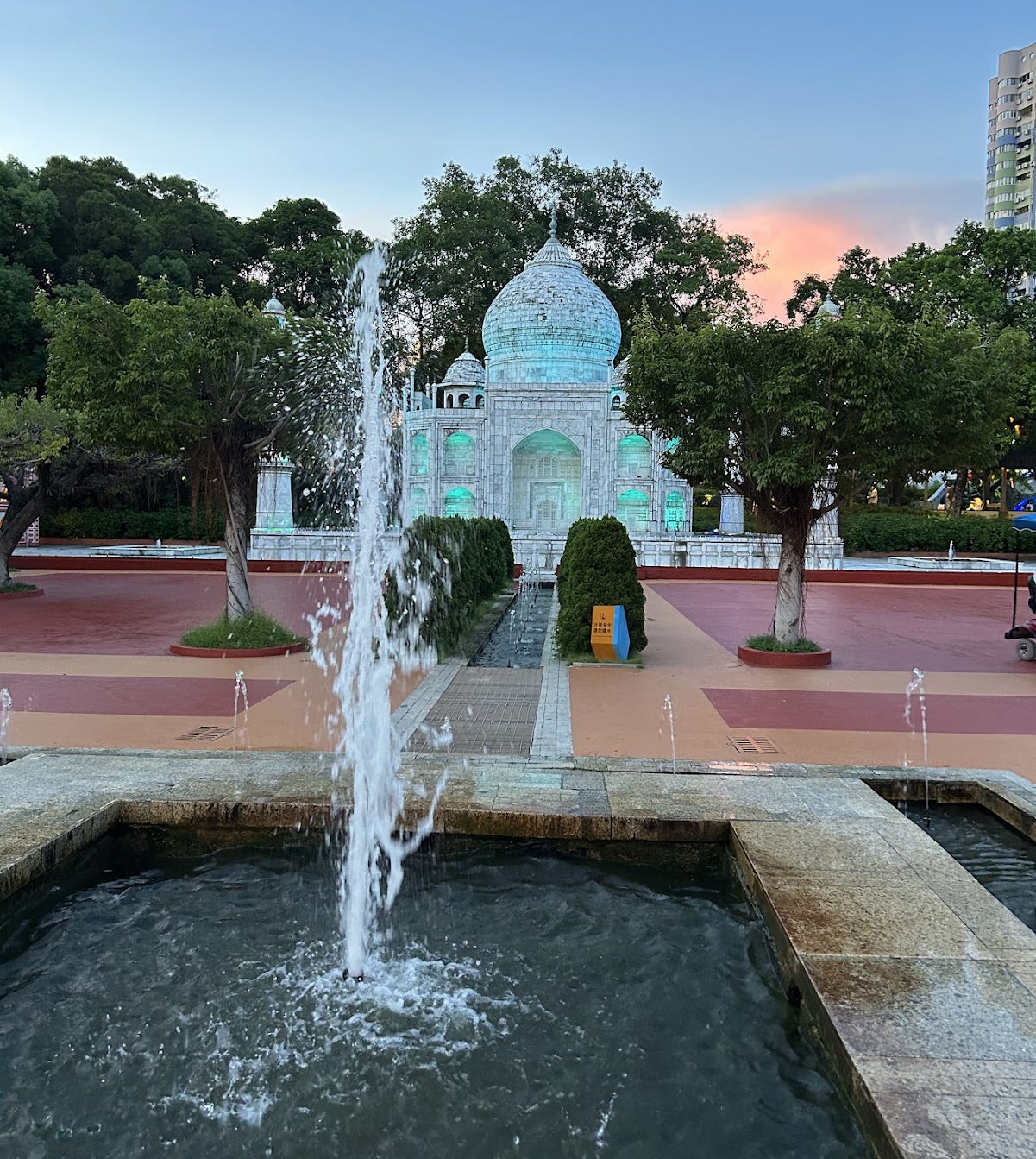
But one should not reduce China to a hopeless, inscrutable black hole. In Shenzhen, we visited Window of the World, a theme park featuring miniatures (to be fair, they were pretty big) of every major architectural monument across the world, including the Taj Mahal, Palace of Versailles, Mount Rushmore, and a giant Eiffel Tower in the center of the park. Built in 1993, it represented a growing China increasingly interested in the rest of the world, a curiosity that we do not believe has disappeared.
The dynamism and chaos of India is also borne from its sheer diversity. This led to a faux pas while in Delhi. I (Charles) had noticed throughout our trip that many of the restaurant staff looked ethnically Southeast Asian. I asked our host if these Delhi establishments used immigrant labor from other Southeast Asian countries. He helpfully explained that no, they were also Indian, but from the northeast provinces like Assam and Nagaland. And in a more serious tone, conveyed it would be perceived as quite offensive to ever question if they were truly Indians.
That diversity extends well beyond ethnicity. Only half the country speaks Hindi fluently; India has 22 official languages, and for the elite, English is the glue. This linguistic fragmentation is mirrored by similar political fragmentation. Indian states are true laboratories of democracy—communist-governed Kerala and pro-business Gujarat each run their own experiments. In every city we visited, the primary language and ruling party were different. Even in economic outcomes, India holds stark differences—Delhi and Goa are worlds apart from Bihar and Uttar Pradesh, which have average incomes comparable to Sub-Saharan Africa. Such decentralization is not an accident but an inheritance: India was never a true unified nation-state pre-partition. Over 550 princely states had autonomy under British rule, and regional power centers, especially in the South, retain considerable independence from Delhi today. In a different post-1947 world, India could easily have become a loose confederation.
Recently, Modi has attempted to make India more Chinese.13 Unlike past Congress prime ministers who have largely been educated at Oxbridge, he eschews Western orientation. The BJP and its ideological wing, the RSS, promote a single national Hindu culture that they argue encompasses caste and creed, roughly akin to how the Han Chinese define China. He has tried to centralize power in the Union government, deregulate the internal economy, and promote manufacturing, using Trump’s tariffs as a window for much-needed structural reforms. That said, India’s underlying diversity and decentralized origins mean any centralization project can only go so far.
In contrast, China’s pursuit of national homogenization has largely succeeded. Since the Putonghua education modernization at the beginning of the 21st century, an entire generation in China has grown up educated in one dialect. China has been under single-party rule since its founding and has either suppressed or assimilated minorities throughout its outer western regions. Similarly, religion is domesticated and contained. All this enables the Chinese state to exercise far more control. As Dan Wang notes in his book Breakneck, Chinese leadership is akin to hydraulic engineers who view “the economy and society as liquid flows, as if all human activity…can be directed, restricted, increased, or blocked with the same ease as turning a series of valves”.14
There are of course advantages to this approach. Regulatory uniformity and a common language for commerce have clear economic benefits. China also boasts much distinct architecture, like the iconic gongyu style high-rise apartments. We enjoyed our time in China’s Tier 1 cities, but Tier 2 and Tier 3 cities are increasingly pleasant places to live. The central government has begun easing hukou restrictions accordingly, reducing the pressure to migrate to Tier 1 cities. And at least so far the Chinese state has produced more economic success. Until the 1970s, India and China were, roughly, economic equals. Today, China is 3-4x as rich in terms of GDP per capita.
But we don’t see Asia’s balance of power in the 21st century as set in stone. India today is growing twice as fast as China. It has more favorable demographics and increasingly better market access to the West. Perhaps surprisingly, India’s richest states (in the south) have been on par with China’s growth since the 90s.15 Much has been made of the “China Challenge” to the US and the West, that is, China’s economic success challenges liberal democracy’s claim as the only path to development. India vs China is perhaps a more apt test for whether pluralistic democracy or one-party homogeneity will be the superior model for the rest of the world.
For the first time since the 1600s, Asia may matter more to the global economy than the West. That is what drew us to travel to the two economic powerhouses of the continent—to understand how Asia’s most consequential civilizations view each other, and how the technological industries driving them forward compare in structure and culture. As analysts by nature, the two of us are drawn to macroeconomic statistics and the stocks and flows of critical supply chains. Yet that is also why we find travels like these so valuable. The people we met and the stories we heard are what give texture to abstract political and economic ideas. An unfortunate consequence of growing geopolitical tension is the urge to retreat inward, to rest on caricatures and secondhand narratives. We hope likeminded travellers from the US, India, and China continue to engage with their counterparts.
V.S. Naipaul, A Million Mutinies Now (more balanced and up-to-date than the slightly better known An Area of Darkness, Naipaul’s first India travelogue)
Arvind Subramanian and Devesh Kapur, A Sixth of Humanity: Independent India’s Development Odyssey
Ramachandra Guha, India after Gandhi
Shruti Rajagopalan and Alex Tabarrok, Premature Imitation and India’s Flailing State
Yuen Yuen Ang, How China escaped the poverty trap
Dan Wang, 2023 Annual Letter
Ezra Vogel, Deng Xiaoping and the Transformation of China
Wang Huning, America against America
Rush Doshi, The Long Game
Thank you to Sparsh Agarwal, Kate Selig, Pieter Garicano, Sandy Koenig, Bala Swaminathan and Neha Ramani for their suggestions on this post; to Sparsh Agarwal, Arjun Soin, Jasmine Sun , and afra for helping make these trips happen with us; for our friends for traveling with us; and to all the people we met in India and China for their time and wisdom.