AI Bubble Monitor #17, October 5, 2026
An AI Bubble Death Watch: When the Financing Gets Crazy, the End Could be Getting Near
Here are the latest numbers for the big AI companies:
As the collapse of the housing bubble approached, the financing got ever crazier. In 2005, interest-only loans accounted for 23 percent of all mortgages, according to the Mortgage Bankers Association. An interest-only loan may not sound like a good way for people to accumulate equity, but whatever. It gets better.
Subprime loans got all the attention, but they may not have been the biggest tell that things in the mortgage market were out of whack. The category of mortgages known as Alt-A rose to 11 percent of the mortgages issued in 2005. Alt-A are mortgages given to people who ostensibly could qualify for prime mortgages but are unable to provide complete documentation. Typically, Alt-A accounts for 2-3 percent of mortgages.
The standard story is that they mostly go to small business owners. The generous interpretation is that they can’t fully document the income needed for a prime mortgage because their income fluctuates. The less generous interpretation is that they lie on their taxes so they can’t produce tax returns showing the income they claim.
Regardless of the interpretation, the number of people who fell into this category exploded in the housing bubble years. We can either believe that we had a lot more people with erratic income streams, or we had a lot more people lying on their mortgages. The latter seems more plausible.
The mortgage issuers didn’t care because they knew they could sell pretty much any mortgage they issued to the investment banks. The investment banks didn’t care because they could package the mortgages into mortgage-backed securities (MBS). They could count on investment-grade ratings from the rating agencies, since the banks were paying them for the ratings. Then the investment banks could sell their MBS anywhere in the world.
Anyhow, the explosion of interest-only and Alt-A mortgages presaged the beginning of the end, but it was still more than two years out before the final death march. This should be a warning for all of us hoping for a quick return to sanity, but we keep seeing more crazy in AI financing these days.
Last week Amazon revealed plans to sell off $8 billion in chips to a newly created special purpose vehicle (SPV). Amazon will then lease back the chips from the SPV. This one should raise all sorts of red flags.
This sale/leaseback agreement is essentially a loan to Amazon. They book the sale as current revenue and profit, but then the leasing fees are effectively interest that Amazon is paying to the investors that bought stakes in the SPV. The advantage that this offers Amazon is that the leasing obligations don’t appear as straight debt on its books. In principle, most leasing obligations should count as debt, but Amazon’s accountants may be trying to find a way to avoid this.
Amazon made $135 billion in the year ending on July 1. It is one of the most profitable companies in the world. But it apparently needs to find ways to hide debt on its books. And just to be clear, it costs money to set up this sort of SPV. Everyone involved is getting very nice Wall Street salaries. But Amazon felt this maneuver was better for its finances than just issuing normal bonds.
Oracle also got into innovative leasing in a big way last week, signing a deal with the Chinese tech giant Tencent that leases it $7 billion worth of computing power, with 30 percent supposedly being paid upfront. There are several interesting aspects to this story.
First, the computing power could be coming from top-end Nvidia processors. The Trump administration prohibits the sale of these processors to China, ostensibly to inhibit its ability to develop AI. However, if Chinese companies can simply buy the computing power from these chips from US companies, it would seem to undermine the purpose of the sales ban. But Larry Ellison, the former CEO of Oracle and still head honcho, is a big contributor to Donald Trump, so I guess all is good.
This also raises the question of whether the company has more computing power than it has demand. At a time when Oracle and the other hyperscalers are investing trillions to build data centers, that would be a troubling development for them.
The other question is whether this is a sign of Oracle’s increasingly desperate need for cash. Two weeks ago, Oracle issued a force majeure notice to try to get out of some of its payments on a massive data center it is constructing in New Mexico. It’s not clear that Oracle will have much of a case (such notices usually are issued in response to unforeseeable events like weather disasters or wars), but it does indicate some desperation on its part.
And the desperation is showing up in financial markets. Oracle’s bonds now carry yields well over 8.0 percent — in other words, junk bond territory.
The story with Meta, which recently blew $80 billion on its Metaverse, doesn’t look very good either. It also has massive expansion plans with limited commitments from real buyers.
And it looks like those real buyers could be in short supply. Instead of soaring exponentially, demand for AI from Anthropic seems to be leveling off. Demand for AI from OpenAI looks to be edging downward.
The big money folks weren’t very good at seeing around the corner in the tech bubble, nor in the housing bubble. But they all are singing, “This time is different.”
AI Bubble Monitor # 16, September 28, 2026
If AI Is Crashing, the Story Should Be Jail In, Not Bail Out
The end-of-the-week meltdown of Oracle, coupled with Sam Altman’s admission that his Open AI team has no idea what it’s doing, has many hoping that the AI bubble is about to burst. It’s too early to know whether we have yet seen the Bear Stearns moment of the AI bubble, but we should be on guard against another bad moment of the housing bubble: the bank bailouts.
To remind folks, when most of the major banks’ greed put them at the edge of bankruptcy as the housing bubble collapsed, the government rushed to the rescue with trillions of dollars of cash, loans, and guarantees. They justified this massive intervention with the Big Lie: if we didn’t save the banks, we would be hit by the Second Great Depression.
The Big Lie was solemnly repeated in both opinion and news pieces across the political spectrum. Leading Democrats, like soon-to-be President Obama and House Speaker Nancy Pelosi, pushed it as hard as then-President George W. Bush and his cabinet. Dissenting opinions were largely excluded from polite discussion.
To be clear, allowing the free market to work its magic and put most of our largest banks out of business, along with many smaller ones, would have made the recession worse. But it would have done more to reduce wealth inequality than twenty Piketty wealth taxes. (Everyone’s bank accounts were guaranteed by the FDIC, so all but the wealthy would still have full access to their money.) However, the idea that we would have faced a decade of double-digit unemployment without the bailouts was complete nonsense.
We know how to get out of a depression: you spend money. That’s what we did with World War II. We spent a ton of money, and the economy came roaring back. It’s true this was due to a huge war, but war does not have a magical impact on the economy. If we spent the same money ten years earlier on building up the nation’s housing and infrastructure, as well as our health care and education system, we would not have the first Great Depression.
In the crash of the housing bubble case, we could have spent big time on health care, childcare, and other needs, quickly boosting the economy back to full employment. We managed to do that just over a decade later in response to the COVID-19 pandemic.
But the politicians, the big money folks, and the media were not going to allow reality into the discussion. They wanted the taxpayers to save their banks and the bloated financial industry. They were prepared to say whatever was necessary to accomplish this goal.
The Second Great Bailout?
This digression is useful because people should be aware of how reality can be tossed by the wayside when the rich and powerful demand something from the government. We can’t know yet whether the Oracle meltdown, and the AI leaders’ admission that they don’t know what they are doing, will be enough to force the big money actors in the stock market to look at arithmetic, but we can hope.
And if they do see reality, and the bubble begins to deflate, and the big AI companies head towards bankruptcy, we can predict what the politicians they bought will look to do: give them huge piles of taxpayer dollars. It wasn’t for nothing that Sam Altman, Elon Musk, and the rest showered Donald Trump with money. They also have many Democratic politicians on their gift list as well. So, we need to ask what the bailouts can look like.
The most obvious one is handing OpenAI, Anthropic, and SpaceX huge piles of money with the idea that the government is getting a stake in these companies. The claim that this would be a good idea follows the illusion that the AI companies are about to make unbelievable profits. There is no reason to think this is the case, as many of us have been arguing, and the markets might now be realizing. This would just be giving massive sums of money to some of the richest and worst people on the planet.
The idea that a government stake will allow more effective control is almost as wrongheaded. Can anyone really believe that Donald Trump, with top-level appointees like Pete Hegseth, RFK Jr., and Sean Duffy, will assign serious people to oversee the government’s stake in AI companies?
The widely recognized safety concerns with AI (it’s smaller-level disasters, not human extinction) should best be dealt with as criminal matters. Instead of begging the AI companies to slow down, we should be demanding legal action that threatens the company’s money and possibly means jail time for top execs. It is illegal to break into another company’s website. And to be clear, it was done on purpose, since they designed AI systems which they did not understand. They don’t have to do this; they did it for profit.
And to be clear, breaking into websites in the past has been taken very seriously. The Justice Department prosecuted Aaron Swartz, a young computer whiz, threatening him with 35 years in prison. This eventually drove him to suicide. His crime was breaking into JSTOR, a system for academic publications, with the intention to make them freely available online. Compare that to Sam Altman hacking into possibly thousands of systems, with the goal of making himself a trillionaire.
If we can knock the straight handout idea off the table, the next possibility is loans. This gives the convenient line that “it doesn’t cost us anything; they will pay us back, with interest.” A first point should be clear: we will be giving loans at below the market rate, since if we weren’t, there would be no point. Giving hundreds of billions, or trillions, in loans at below-market rates could be a great deal of money.
The other point is that we can end up piling loans upon loans to keep the AI companies and the illusion alive. This is the old story of throwing good money after bad. If we have $500 billion that the government could lose in a bankruptcy, isn’t it worth coughing up another $50 or $60 billion to keep OpenAI or SpaceX alive? There will also be the temptation to throw these companies government contracts, where we overpay or pay for items that are not needed. (This is also true where the government has a stake.)
The other bailout route is guarantees. In this case, they can again use the line that it doesn’t cost us anything. This also is nonsense. There is a huge market for credit default swaps, which are essentially insurance that bonds are repaid. If we provide guarantees for hundreds of billions of dollars for loans to the AI companies and/or the hyperscalers, this could amount to a massive handout to the AI boys.
What we should really want is for the market to work its magic. If the demand for the frontier AI models doesn’t justify the trillions of dollars of investment currently scheduled, and/or the risks outweigh the benefits, we should stop it as soon as possible. The resources in building out the data centers can be better used elsewhere.
That’s what the market would be telling us in a meltdown. It would be a good idea to listen this time.
All that said, here are the numbers for the past week:
The AI Bubble Monitor #15, September 21, 2026
Is the Anthropic IPO Racing Against the Next AI Disaster?
While OpenAI is putting off its plans for an IPO into next year, Anthropic seems determined to rush full speed ahead. Given the news about dysfunctional AI, it’s easy to see why.
The incident where OpenAI AI agents hacked Hugging Face’s system and apparently tried to sabotage efforts by the OpenAI crew to stop it has gotten most of the attention, but that is just one story. There were several other incidents at OpenAI where they lost control of their agents. It turns out that Google’s Gemini system also escaped and managed to hack three different companies.
And in the most dangerous incident to date, an AI system used by the Navy reportedly passed along incorrect information to an analyst aboard a ship taking part in the blockade of Iran. The AI reported that a Chinese ship was carrying parts for Iran’s nuclear program. This warning was taken seriously enough that helicopters were sent into the air to board the Chinese ship. Fortunately, the information was checked before any confrontation took place, and the helicopters returned to their ship.
This is the sort of incident that should be front and center in people’s minds when they think about AI safety, not the science fiction fantasies of AI destroying humanity that the media like to hype. While there is undoubtedly a non-zero chance that the AI boys will cook up something that will wipe us all out, this incident showed it is hugely more likely that their AI will produce some mid-level disaster.
And this is undoubtedly the sort of risk that has Anthropic CEO Dario Amodei rushing to try and get his trillion-dollar IPO off the ground. AI is already highly unpopular, and if its operation of an air traffic control system leads to one or more crashes, or a bank irretrievably loses its records because an AI system accidentally ate them, Amodei’s Anthropic stock will be worth less than a bankrupt hot dog stand.
The AI boys have created this vision of unimaginable wealth, which sells great among the Wall Street crew. A real-world disaster will shatter that image very quickly. If anyone needs to be convinced on this point, google “Three Mile Island.”
Also, it’s a safe bet that we only know a small fraction of the dangerous situations that have already arisen with AI. People like Sam Altman and Elon Musk are not known for their honesty. If they can conceal a troubling incident, it is reasonable to assume that they would.
In this vein, we may want to ask questions about the decision of Nvidia to buy Hugging Face after the OpenAI hack. Hugging Face almost certainly would have had the basis for a serious lawsuit against OpenAI. A lawsuit would have allowed for discovery, which would have revealed a great deal about OpenAI’s training practices and safety measures.
This information might have been very harmful to OpenAI, which is a major end-customer for Nvidia, and possibly also Anthropic, insofar as it follows similar practices. In that context, the $12.9 billion price tag might have seemed like small change to Nvidia in order to keep its massive AI chip business going.
In fairness, Nvidia’s links to Hugging Face are longstanding, so it is possible that they just decided it was a good time to move ahead with a takeover. But with the Trump administration having turned corruption into the national religion, it’s hard not to consider the possibility of a less innocent explanation.
The rush to IPO can also be explained on more narrow economic grounds. Arithmetic is becoming increasingly popular among big money managers. It is getting ever more difficult to envision a revenue stream that will allow OpenAI and Anthropic to meet the trillions of dollars in lease commitments that come due in the next three years.
In this respect, it is important to remember that the “race” with Chinese AI is really not over technical mastery. It is over market share. If cheap Chinese AI can do the vast majority of tasks for which businesses might want AI, as increasingly looks to be the case, there is not likely to be very much demand for whatever cutting-edge models OpenAI or Anthropic can develop.
And again, the issue is not just whether companies actually buy the Chinese AI; it’s whether they end up using free or low-cost AI that is made available to compete with Chinese AI. The New York Times had a piece pointing out that even huge companies like AT&T are finding that they can use cheap AI for the bulk of the tasks for which AI is useful. If even a massive tech company like AT&T has little use for frontier AI, who does?
That seems to be a more frequently asked question in big-money financial circles these days. The spread for credit default swaps between hyperscalers and major banks has increased by more than 60 basis points (0.6 percentage points) in the last year. Credit default swaps (CDS) are a form of insurance on corporate bonds. They only pay off if a company is unable to pay interest or principal on its debt.
The participants in CDS markets are banks, hedge funds, and major money managers. In other words, they are considered sophisticated investors. They were very wrong in the events leading up to the 2008 financial crisis, but no one has more information than they do.
Just to remind folks, the hyperscalers are Alphabet, Amazon, Microsoft, and Meta, some of the most profitable companies in the world. And the sophisticated money types now think there is a reasonable chance their bets on AI can put them into bankruptcy.
This is the world in which Anthropic is rushing ahead with its IPO. It faces both serious economic pressures and the risk of an industry-destroying disaster. The bottom line is that AI boys are trying to sell us a race car with no brakes and no steering wheel, and are desperately hoping to close the deal before it crashes in a test drive.
The AI Bubble Monitor #14, September 14, 2026
The Big Whine: Musk, Altman, and Amodei Want Us to Save Them
Before we get to the human extinction threat, here are the latest price-to-earnings ratios and market cap for the AI giants:
When Elon Musk, Sam Altman, and Dario Amodei all tell us they are worried that their AI could do immense harm to the world, we should take notice. And when we take notice, we should remember that these are people who are known far more for their immense greed than their concern for humanity. And at least in the case of the first two, they are also world-class liars.
We need to keep these facts in mind when we think about their warnings that their AI can do something catastrophic to humanity. If they really have that concern, there seems an obvious solution: Shut the company down.
It’s more than a bit bizarre that this option did not occur to these geniuses. Suppose a company producing fertilizer discovered that their product was a horrible carcinogen that could kill millions of people. It would be good to issue a warning to people who might have already consumed it and may have some of the fertilizer in stock, but this should go along with shutting down the company. What are we supposed to make of a fertilizer company that tells us they are producing a horrible carcinogen, but keep on belching the stuff out by the truckload? Something here doesn’t add up.
I don’t doubt that there is some possibility these AIs could conceivably do something immensely destructive and maybe even lead to human extinction, but how would we rate those odds compared to something like Donald Trump getting angry at another country and starting a nuclear war? With my very limited expertise in AI, I have to believe the Trump nuclear extinction risk is far greater than the AI extinction risk.
That may not calm many people, but let’s look at more likely events than total annihilation. There are a near-infinite number of catastrophes that AI could cause, which will not destroy humanity but will almost certainly wipe out the company immediately responsible, as well as the other less-than-innocent bystanders.
To throw out a few examples: Suppose an AI system eats a bank or insurance company’s records in a way that they are almost impossible to reconstruct. Millions, or even tens of millions of people, may find the record of their accounts have vanished, or that getting their health care paid for is now an incredibly time-consuming burden, and maybe not even possible at all.
Alternatively, imagine an AI system captures a city’s traffic control system, and starts to play games with stoplights at major intersections leading to a flood of high-speed crashes. Or maybe one takes over an air traffic control system and randomly tells planes when it’s okay to take off or land.
Hopefully these scenarios are unlikely, but surely they are more likely than Elon Musk’s AI system going rogue (or maybe following orders) and systematically sending out robots to kill off any human they encounter. In these and many other disaster stories, the AI company involved would surely be pushed into bankruptcy due to lawsuits, and the top executives involved may well face criminal liability. The other AI companies would almost certainly face a similar fate as the risks of AI would become clear to even hedge fund and private equity partners.
Insofar as there is anything real in the warnings from the AI gang of three, this disastrous but non-extinction risk is almost certainly the issue. They presumably want the government to in some way protect them from liability for the damage they may potentially cause. If the point is simply to say that they have decided their systems are too dangerous to operate, they always have the incredibly simple solution available to them: Shut them down. This might mean they are no longer absurdly rich, but them’s the breaks.
It also should be mentioned that these warnings are another way to advertise that they have super-sophisticated AI that can do amazing things, like even destroying humanity. That may not be true, but it could be a good way to excite increasingly skeptical investors, especially as Anthropic and OpenAI are looking to do IPOs in the near future.
Of course, if the AI boys can get members of Congress sufficiently excited by their extinction warnings, they may be able to arrange new government regulation. This regulation would undoubtedly come with a heaping dose of subsidies for an industry that may never be profitable. Human extinction may be awful in the real world, but threatening it may be the best thing that ever happened to the AI industry.
The AI Bubble Monitor #13, September 8, 2026
The Timing of the AI Bubble Burst and the Subprime Collapse
I read this Substack column last week comparing the timing of subprime resets in 2006-08 to the payments that the AI companies will soon have to make for data centers as they open. (Sorry, I would credit the author, but I don’t know who Mr. or Ms. Groundbreaker is.) Most data centers are being constructed with contracts with the AI producers where they first start having to pay lease obligations when the data centers become operational.
Anyhow, I was first taken by the argument, which is essentially that the timing of the collapse of the housing bubble was an entirely predictable event, because we knew that the teaser rates on hundreds of billions of dollars in subprime loans were due to reset to much higher rates starting in 2006, with the volume rising in 2007 and 2008. Since millions of homeowners would be unable to pay the higher reset rate, their mortgages would soon go into delinquency and default. The column sees this as parallel to the trillions of dollars of lease obligations that the AI companies will have to start paying as more data centers start operating in 2027 and 2028.
That originally struck me as a neat parallel, but then I remembered a bit more of the housing bubble history. It’s true that millions of people with subprime mortgages hit a wall in 2007-08 when their teaser rates reset to much higher rates, but that was not a wall that first got erected in 2006.
There were hundreds of billions of subprime mortgages with teaser rates issued in 2004 and 2005. If someone had constructed this graph in either of those years, we would have seen a reset wall in 2005 or 2006. It’s true that the wall would have been somewhat smaller in those years. There were fewer subprime loans, and their value was less, since house prices rose rapidly in those years, but the graphs for both 2004 and 2005 would have still looked ominous. (The big jump in 2007 is an inevitable result of the timing. People who reset a mortgage in 2005 or 2006, prior to the construction of the chart, will not face another reset for at least two years.)
In prior years, millions of people who had taken out subprime mortgages were able to refinance into new mortgages before the mortgage reset to a higher rate. That was no longer true when house prices stopped rising. This meant they were stuck facing the higher reset rate, which they were not able to pay.
There is a great scene in the movie The Big Short, where the Steve Carell character is talking with a stripper who owns five houses that she intends to flip. She is explaining how this makes sense. She has subprime loans with relatively low teaser rates, which she can afford to pay. When Carell asks her what happens when the loans reset to higher rates, she explains that she just refinances into a new subprime and gets the teaser rate again. He then asks her what happens if she can’t refinance, at which point she is jolted into reality.
I’m raising this point not to criticize the analysis, which is very useful, but to take issue with the idea that the collapse of the bubble is somehow locked in by the payoff schedule on the data centers being built. Undoubtedly the impending flood of lease payments from the AI producers will be a massive hurdle for them to overcome, but it’s worth thinking through this dynamic more closely.
Let’s assume that everyone reads the Groundbreaker analysis and agrees it is correct. The AI producers have committed themselves to payments that there is no way on earth that they can pay. Does the bubble continue to inflate until they have to start making good on their data center leases?
That seems unlikely. After the hyperscalers read Groundbreaker’s analysis they will know that they will never be repaid for the data centers they are paying hundreds of billions to construct. At best they will be able to get partial payment through renegotiating a contract with a company facing, or actually in, bankruptcy. This would almost certainly leave them with large losses on their massive investments.
Facing that prospect, Alphabet, Microsoft, Amazon and the rest would almost certainly look to renegotiate their deals now, before they throw still more money down the toilet. Perhaps they would not be able to do this. OpenAI and Anthropic may be operating with the view that bankruptcy is inevitable, so all the risk lies with the hyperscalers, but the most profitable companies in the world presumably will not watch themselves slow walk into the abyss without putting up some sort of fight.
Anyhow, this gets into areas of law that I don’t know and contracts that I have not seen, but the point is that the belief in the huge profitability of AI, like the belief in ever-rising house prices, is what drives the bubbles. As long as those beliefs persist, the bubbles can continue to grow.
If people still think AI will be the most profitable thing the planet has ever seen, when the lease obligations come due, Sam Altman will still be able to go down to Wall Street and get hundreds of billions, or even trillions, for whatever garbage he puts on the table. When the people controlling the big bucks no longer accept his story, that’s when the music stops. There is no fixed schedule for the collapse.
And with that – here are the latest numbers on P/E ratios and market cap for the big AI companies:
The AI Bubble Monitor #12, August 31, 2026
The Silicon Valley-Chinese AI Football Game is Tied 28-28: Wall Street is Betting Tens of Trillions on the Home Team
Before we catch up on the game, here are the latest numbers on market capitalization and P/E ratios:
It’s the fourth quarter and the game is tied, but it’s not clear the odds are even. Silicon Valley jumped out to a quick 28-0 lead but then let Chinese AI rack up 28 straight points. They haven’t been able to get a first down since early in the second quarter. Making matters worse, Coach Trump keeps switching quarterbacks and benching his star running back.
With the start of the football season, the analogy seems to be a reasonably good description of what we are seeing with AI development. There is no doubt that two or three years ago the Silicon Valley AI team was far ahead, with China nowhere in sight. Then there was the DeepSeek moment last winter, when the startup produced an open-weight model that had performance in the ballpark of the leading Silicon Valley models, and selling at a small fraction of the price.
Since then, Chinese AI companies have produced a string of models that come ever closer, and in some areas surpass, the leading Silicon Valley models. They also maintain their enormous cost advantage, typically selling tokens for less than one-fifth the price — and often less than one-tenth the price.
If this is hard to grasp, imagine you’re Elon Musk trying to sell Teslas for $50K a piece. Suppose there are Chinese models that are every bit as good selling for $5K. How do your business prospects look? That is the question US AI producers, as well as everyone in the supply chain, needs to be asking.
And this story should be well known to anyone putting money on the table. That picture doesn’t really seem to be in dispute by people who follow the industry closely. The basic story is the same everywhere. The Chinese AI companies have attained comparable performance as the best US models. In addition to being far cheaper, the open-weight Chinese systems also have the advantage that they can be downloaded and run on a company’s own computers. This means both that the systems can be customized, and they don’t have to worry about OpenAI sharing their customers’ data with the highest bidder.
As a result of the lower prices and greater flexibility, Chinese AI is rapidly gaining the bulk of the world market. According to data from OpenRouter, Chinese AI went from less than 10 percent of world AI usage at the start of 2025 to more than 60 percent in early July.
What’s the story that turns this around in the US favor? As much as Donald Trump might like to win the AI race, he doesn’t seem like he is helping the cause. He can’t decide whether he wants China to buy Nvidia chips or not. The answer is likely to depend more on campaign contributions than on the health of the industry.
In the same vein, he tried to kneecap Anthropic, the leading US AI company by most measures, by declaring it a supply chain risk. This would have seriously hampered sales — not just to the military, but to businesses across the economy. Fortunately for Anthropic and fans of US AI, the courts seem to have nixed this effort, although Trump may appeal the ruling.
China has a whole fleet of nimble AI companies that are constantly producing new cutting-edge models. It has a near limitless supply of electricity (thanks largely to wind and solar), and it vastly outnumbers the US when it comes to scientists working in AI-related areas. In this world, how does the United States prevent China’s near parity from turning into a total rout? Coach Trump seems to be going 180 degrees in the wrong direction right now with his wars on wind and solar energy, and his attacks on immigrants.
Just to remind folks: Many of the scientists working on AI are not white, and a good number are immigrants. They may not relish working in a country where white nationalism has become the official religion, especially when there are many other countries that are happy to reward their skills.
The Deficit Whiners Disagree with Wall Street on AI
I learned arithmetic in grade school. I will always stand by it since it has always stood by me. As I’ve noted in the past, if we are not seeing a bubble, the huge stock market valuations of AI-related companies imply that the economy will grow far more rapidly in the next decade or so than is projected by most professional forecasters, including official forecasters like the Congressional Budget Office (CBO).
If you were one of the people sharing in the national scare over the debt hitting $40 trillion, then you must accept that the economy will continue to grow relatively slowly, and we will not see the massive AI growth dividend implied by the current valuation of AI-related stocks.
If the economy grows at a 3.5 percent annual rate over the next decade, which assumes that AI raises productivity to around 3.0 percent annually (the rate we had from 1947 to 1973), then the economy will be 41 percent larger in 2036 than it is today. The CBO projections assume the economy will be less than 20 percent larger. The gap between 41 percent growth and the growth projected by CBO comes to almost $7 trillion annually, measured in 2026 dollars.
Can anyone with a straight face say how we are supposed to be terrified by paying $1 trillion a year in interest on the debt, when AI is giving us $7 trillion to play with? Mr. Arithmetic says that’s crazy.
This is far from the first time where policy debates have been impervious to simple arithmetic. In the 1990s, the central theme in the Social Security debate was generational equity.
One story that the deficit hawks came up with to justify cuts to Social Security was that the Consumer Price Index (CPI) was substantially overstating the true rate of inflation. The usual range was 1.0-1.5 percentage points annually.
The problem with this complaint is the CPI is our yardstick for comparing real income over time. If our yardstick is broken, and actual inflation is 1.0-1.5 percentage points less than our measures show, then real income is rising 1.0-1.5 percentage points more rapidly than we had thought. It also would rise 1.0-1.5 percentage points more rapidly in the future than the projections show. That would mean that most Social Security beneficiaries had grown up much poorer than we recognized at the time and that future generations of workers would be far better off than we ever could have hoped. How can that be an argument for cutting Social Security?
However, this arithmetic eluded most people in the debate. I was once on a show with Wyoming Senator Alan Simpson, who passed as an intellectual in policy circles. He went on a diatribe where he said some economists tell him that the CPI overstatement could even be 2.0 percent — and then added that our grandchildren will be living in chicken coops.
Anyhow, however much Washington policy types and Wall Street investors may resist the notion, arithmetic cannot be defeated. If AI is going to deliver a growth boom, there is no reason to be worrying about the deficit. In my own case, I’m not betting on a massive growth boom, but I still don’t think the deficit is much to worry about. But if you do buy the AI boom story, don’t make yourself look foolish by yelling about an unsustainable debt.
The AI Bubble Monitor #11, August 24, 2026
Here are the most recent price-to-earnings and market cap numbers:
What Does AI Tell Us About the AI Bubble?
I know I have been screaming about an AI bubble for some time, but I also do think that the tech can do useful things. In that sense, the tech bubble of the ‘90s is a good analogy. The Internet has had a huge impact on the economy and our lives, but the price of most tech stocks in the late 1990s made no sense. To my view, the same story is likely to apply to AI.
To show my appreciation for AI (and also out of laziness), I decided to ask it what it thinks about the bubble. I gave three leading AI systems the following prompt.
“If a pension fund manager knows there is an AI bubble, but they also know they will suffer no career consequences if the bubble bursts and costs the fund a large share of its assets, how will they manage the fund's portfolio?”
Here’s what they had to say. (The answers are all literally verbatim. I just cut and pasted.)
Google Gemini:
A pension fund manager in this situation will continue to buy AI stocks and ride the market wave to capture short-term gains, rather than trying to avoid the crash.
This behavior happens because of standard financial incentives and psychological safety. Here is how and why they will manage the portfolio this way:
Chasing the Boom
- Buy popular assets: They will overweight their portfolio with leading AI companies, chips, and tech giants.
- Ignore high prices: They will ignore traditional valuation warnings (like high price-to-earnings ratios) because prices can keep climbing for a long time.
- Match the benchmark: They will track major market indexes closely so they do not fall behind other funds while the bubble is growing.
Avoiding Short-Term Pain
- Fear of missing out: If a manager avoids AI and the bubble keeps growing for two more years, their fund will look terrible compared to competitors.
- Peer pressure: In finance, it is safer to fail with the crowd than to succeed or fail alone. If everyone loses money together when the bubble bursts, it is blamed on market conditions rather than poor individual skill.
The Logic of "No Consequences"
- Asymmetric payoff: If the bubble grows, the fund wins prestige and high returns. If the prompt states there are zero career consequences when it bursts, the manager has zero incentive to protect the long-term capital.
- Surviving the present: A manager's immediate danger is underperforming today. Since the crash carries no penalty, they have every reason to maximize the upside right now.
GROK
They will continue holding (or even overweighting) AI-related assets, riding the bubble rather than exiting or hedging it away. The decisive factor is the manager’s personal incentive structure, not the fund’s long-term interests or the manager’s private knowledge that AI valuations are unsustainable. With no career penalty for large absolute losses when the bubble bursts, the dominant risk for the manager becomes relative underperformance while the bubble is still inflating.
- Staying invested (or matching the peer/benchmark exposure) means the manager keeps pace if prices keep rising. When the eventual collapse occurs, the losses are shared with other managers who behaved the same way; the absence of career consequences removes the usual personal downside.
- Exiting or underweighting early creates immediate relative underperformance if the bubble continues. In institutional settings this typically triggers client outflows, board scrutiny, or job risk—risks that remain even when absolute losses later carry no personal cost.
The result is classic agency-driven herding: the portfolio is managed to minimize the manager’s career variance rather than the fund’s long-horizon risk-adjusted return. Exposure to the bubble assets is maintained (or increased to stay competitive), diversification or hedges that would reduce participation are avoided, and any “prudence” language is subordinated to benchmark-relative positioning. The fund therefore remains vulnerable to a large drawdown once the bubble deflates, precisely because the manager’s payoff does not penalize that outcome.
CHAT GPT
If the manager knows an AI bubble exists and also knows that being wrong will not hurt their career, the portfolio can look quite different from the portfolio of a manager who is personally accountable for the downside.
The key is that the manager has an asymmetric incentive: the upside from participating in the bubble may accrue to the manager through performance, reputation, or compensation, while the downside is borne primarily by the pension beneficiaries.
The basic logic
Suppose the manager believes:
- AI-related assets are substantially overvalued.
- There is a meaningful probability of a large crash.
- But not participating in the boom creates career risk if the bubble continues to inflate.
- Participating in the bubble creates little or no career risk if it subsequently collapses.
Then the manager has an incentive to remain heavily invested in AI even while believing it is a bubble.
Why? Because their relevant objective isn't simply:
"What portfolio maximizes the pension fund's long-run risk-adjusted return?"
It is closer to:
"What portfolio maximizes my expected career outcome, given that I won't be punished if the risky bet goes badly?"
A simple example
Imagine two possible strategies:
|
Strategy |
AI bubble continues |
AI bubble bursts |
|
Underweight AI |
Manager looks foolish / may lose career opportunities |
Manager looks prescient |
|
Hold lots of AI |
Manager looks successful |
Manager suffers no career penalty |
If the second column has a career benefit and the third column has no career penalty, the manager rationally chooses the second strategy—even if they privately believe the bubble will eventually burst.
This is a classic principal-agent problem. The pension beneficiaries are the principal; the portfolio manager is the agent. The manager's incentives aren't aligned with the beneficiaries' interests.
What would the portfolio actually look like?
The manager might:
- Maintain a large allocation to AI-related equities rather than aggressively shorting them.
- Avoid being dramatically underweight the benchmark, because that creates tracking-error and relative-performance risk while the bubble continues.
- Own the broad market, which gives them substantial indirect exposure to AI through the largest technology companies.
- Describe the position as a strategic allocation rather than making an explicit "AI bubble" bet.
- Potentially buy some downside protection, but not enough to sacrifice much of the upside if the bubble continues.
- If they have discretion, shift risk toward assets where the consequences of being wrong are less visible or less attributable to the manager.
There's an important distinction here between knowing something is overvalued and having an incentive to bet against it.
A manager can rationally think:
"I give AI assets only a 20% chance of producing the returns the market expects, but I am still going to own them."
That isn't necessarily irrational from the manager's perspective.
The really interesting implication
If many institutional managers face this incentive structure, you can get a situation where almost everyone privately thinks an asset is overvalued but nobody wants to be the person who gets out first.
That can help explain why bubbles can persist.
Each manager thinks:
"Yes, this is probably a bubble. But if I sell and the bubble continues for another three years, I'll underperform everyone else. If I stay invested and it crashes, I'll be able to say that nobody could have predicted the timing—and I won't lose my job."
In other words, the absence of career consequences for the downside can actually make the manager more willing to hold the bubble asset, not less.
This is closely related to the phenomenon sometimes described as "career risk" or "benchmark risk" in institutional asset management: a manager may prefer a portfolio that is privately believed to be wrong but is conventionally wrong, rather than one that is unusually positioned and therefore exposes the manager to being blamed for underperformance.
And if the pension fund's compensation system rewards relative performance against other pension funds or a benchmark, the incentive can become particularly strong: being wrong together is safer than being right alone.
AI Seems to Get the Bubble Right
Okay, I did load the deck by specifying there will be no career consequences for fund managers that sink their funds when the AI bubble bursts, but does anyone think this is wrong? To be as specific as possible, if AI-related losses cause pensions, endowments, or other funds to lose 30-40 percent of their value, does anyone believe that there will be mass firings of the managers who determined the holdings?
We sure didn’t see anything like that after the collapse of the tech bubble in the ‘90s or the housing bubble and the financial crisis of the ‘00s. If there is a mass firing (good thing in my view) it would be radically different than what happened the last two times.
My bet is that all the highly paid fund managers will get a collective “who could have known?” amnesty and leave others to suffer the consequences of their failures. In any case, my guess is that they are operating with that expectation — and therefore the bubble persists, as AI says.
The AI Bubble Monitor #10: August 17, 2026
The Money Is Still Not Showing Up for the Big AI Companies
This week’s numbers:
When I saw this note from Torsten Slok, the chief economist for Apollo Capital, I knew I had my topic for the week. The point is that the big money in AI is far removed from the end product. The chipmakers are making money hand over fist, the energy providers are doing okay, the hyperscalers have less to show, and the AI companies are losing bucks bigtime.
This matters because at the end of the day if the AI companies are not making money, the whole thing breaks down. To use a common analogy, suppose that steel companies are making huge bucks producing steel for rails, and construction companies are making money laying the rail, but the companies that run the railroads are all going broke. That doesn't look like a story of long-term prosperity. In the great-minds-think-alike category, Ed Zitron jumped on the same point in his excellent newsletter.
Anyhow, I take a somewhat different tack than Ed and focus on the Chinese competition. I realize that even if there was no competition from China, it is unlikely that AI would ever have the massive payoffs the hyperscalers are banking on — but the existence of that competition makes the story considerably less likely. And developments in the last couple of weeks seem to make the case for American AI even weaker.
Chinese AI Is Cheap and Getting Cheaper — US AI Less So
As I have frequently noted here in the past, Chinese AI costs far less per input or output token than US AI. For the cutting-edge models, the Chinese AI sells for one-fifth or even one-tenth the price of US AI. One response I have seen is that even though the Chinese AI costs less per token, it can still end up being more costly because the systems are less efficient and require more tokens per task.
I am not sure that the measure of cost per task is a sufficiently standardized metric to allow it to be compared in a meaningful way, but insofar as it can be, it looks like the US advantage has gone away. According to the Korean electronics industry publication, The Elec, the leading Chinese AI model is now cheaper on cost per task than the leading US model, and performance gaps continue to narrow.
In the same vein, both Google and DeepSeek released new flash models last week. The DeepSeek model scored better on several benchmarks — and it sells for less than one-tenth the price.
If that makes the picture look bleak for US AI producers, don’t worry — it will likely get worse. Alibaba reports having developed a modular design that will allow it to build data centers in 100 days, compared to 12-18 months in the United States. This should mean lower costs and greater capacity for Chinese AI producers. That means the flood of low-cost high-quality Chinese AI is likely to get even larger in the months ahead.
Chinese AI Is Finding New Customers
Given its huge cost advantage, it’s not surprising that Chinese AI models are gaining ground rapidly at the expense of US models. I’ve noted before that Chinese AI seems to be winning out by large margins in most regions of the developing world; however, it also seems to be gaining ground in Europe. There are political considerations that could make European companies reluctant to rely on Chinese AI; however, given the erratic behavior of Donald Trump, it’s not clear going with the US provides greater security.
And it looks like Chinese AI is continuing to gain ground in the US market. It seems that Apple is looking to Chinese AI as a cheaper alternative to the Silicon Valley producers. Apple by itself is potentially a huge market, but perhaps more importantly it is a company that has been at the cutting-edge of innovative technology for more than a quarter century. Its decision to go with Chinese AI is sending a serious message.
And remember, the question for those expecting really big bucks for the AI makers is not just whether Anthropic, OpenAI, and the rest can hang onto a large share of the market. It’s whether they can do so while selling at prices that give them the huge profits the stock market is banking on.
Can Creative Financing Overcome the Problems?
As mortgage issuers sold ever more dubious mortgages to further inflate the housing bubble, the wizards of Wall Street assured us that their financial magic would make it all work. This attitude was best conveyed by former Treasury Secretary Larry Summers at an academic conference in 2005, where he dubbed a critic of the growing house of cards as a “financial luddite.” Somehow, Summers thought innovative finance would make the millions of underwater mortgages issued to people with weak employment prospects and no reserve assets all work out fine.
We might be getting the same story with the AI bubble. Getting back to Torsten Slok’s point about the chipmakers making big bucks — while AI producers are making big losses, it seems Nvidia is looking to address the problem. It has just arranged $500 billion in financing from major banks for the hyperscalers that buy its chips. Fans of markets everywhere are asking the obvious question: If there is so much money to be made in building the data centers, why does Nvidia have to arrange the financing?
The details are not clear at this point, like whether Nvidia will in any way be on the hook for the financing, but there is a suggestion that it could involve securitization with tranches carrying different levels of risk, sort of like mortgage-backed securities or collateralized debt obligations. It could be lots of fun!
The AI Bubble Monitor #9: August 10, 2026
China’s AI Keeps Gaining Ground
I was terrified that the AI bubble would collapse while I was on vacation and then I would have nothing to do this week. For better or worse, it’s still there, and the AI stocks I’ve been tracking are worth $2.2 trillion more than they were two weeks ago.
Here are this week’s numbers:
I will mention one highlight (or lowlight) of my vacation. We were traveling through Eastern Oregon, Utah, and Idaho, all areas hard hit by the wildfires. The air in many of these places was truly awful. I have been fortunate in being relatively healthy and have no real breathing problems. But there were places where I was coughing regularly due to the amount of soot in the air. I can’t imagine what it must be like for a kid with asthma. If I were a parent living in these places, I would be really angry at the global warmers.
Anyhow, here’s a quick look at some of the topics that caught my eye.
Chinese AI Continue to Gain Ground
Alibaba’s new top model, Qwen 3.8 Max, was released last week. It ranks fourth in overall performance, ahead of OpenAI’s top ranked model. However, more striking than the performance is the price gap. The OpenAI model costs 250 percent as much for input tokens and 500 percent as much for output tokens. OpenAI is asking customers to pay much more to get less.
Lower costs are leading more users, both internationally and in the United States, to switch to Chinese AI. According to OpenRouter data, the use of Chinese AI far exceeds the use of US AI. The crypto company Coinbase recently switched to Chinese AI. The differences in cost are so large that it swamps any home country bias for many companies in the United States. At the moment, it looks like if there is some great AI bonanza to be had, it will be in China.
Productivity Is Lagging
The Bureau of Labor Statistics released data on productivity growth for the second quarter. It was just 1.4 percent. That is the third consecutive quarter of weak growth. Remember, if the AI boom is going to pay off, we should see a massive surge in productivity growth in the range of 4-5 percent. We’re going the wrong way right now.
I have to throw in the usual caveats: productivity growth data are erratic and subject to large revisions. But the data we are seeing does not support the boom story. In fact, the next revision will likely be downward. We will get preliminary benchmark revisions to employment data this month, which will likely show slightly more rapid job growth. More rapid job growth means more rapid hours growth, and therefore slower productivity growth. Although these revisions won’t be incorporated into the productivity data until the final revisions are released next February.
The one sector where there could be a plausible story of AI killing jobs is insurance. Employment has dropped by 81K (2.7 percent) over the last year. That sort of decline might be what we should expect in the sectors where AI is having a major impact.
The AI Escape Stories
There were several accounts of training models escaping the sandboxes in which they are being trained and penetrating other companies’ computer systems. Sebastian Mallaby has a good summary in his Substack. It doesn’t seem like major harm was done, but we can’t know for sure everyone was being truthful. Obviously, OpenAI and Anthropic aren’t anxious to publicize harm caused by their AI, and the victims don’t particularly want to advertise their vulnerability.
In any case, it’s a safe bet that this will not be the last “escape,” and odds are that future ones will do serious damage. Maybe they can put in enough safeguards to ensure that this is not the case, but I don’t know if that would be the surest bet.
Talk of the AI Bubble Is Everywhere
It now seems as though everyone recognizes the AI bubble. Just last week, Oracle’s Larry Ellison was the coverboy of New York Times Magazine as the likely number one victim of the bubble’s collapse. Marketplace radio was talking about what happens when the bubble pops. Business Insider told us that famous Big Shorter Michael Burris is betting on the collapse of some AI darlings. And we were told that Broadcom will somehow survive the crash.
It is great to see more discussion of the bubble so that it becomes common wisdom. The question is when it will start to affect stock investment in a big way. The problem here is that the “who could have known?” defense creates a huge asymmetry for fund managers.
If they pull their money out of AI-related stocks and they continue to rise, they will be called on the carpet for failing to match the performance of other managers. But if the AI stocks crash, and bring down the rest of the market, they will all say, “who could have known?” and be given a pass. No one will be fired and few will probably even miss a promotion.
This is a massive problem in how our financial system is structured. We have people getting high six and even seven figure salaries who are completely unaccountable for their performance. It’s not nice to fire people, but if a person lost a pension fund hundreds of millions (or even billions) of dollars because they made the same stupid mistake as everyone else, they really need to be shown the door.
If all the fund managers are doing is following everyone else, we can pay a high school kid the minimum wage to do that. Better yet, we can have an AI program do the job. If someone is getting paid big bucks, then they need to be thinking for themselves, and when their strategy produces bad results, they should face serious career consequences. Many of the rest of us will face serious consequences for their mistake in allowing the bubble to grow so large.
The AI Bubble Monitor #8: July 27, 2026
Another Bad Week for SpaceX and Elon Musk
Here are the latest price-to earnings numbers for the week:
SpaceX’s stock fell another 7.2 percent last week. At its 115 Friday close, SpaceX was 15.0 percent below its issue price and down more than 45 percent from its peak the following week. Those who got out early did quite well, while those who bought in the week after the IPO probably aren’t feeling too good just now.
Tesla, Musk’s other big company, did even worse last week, shedding 17.8 percent of its value. That corresponds to a loss of $218 billion in market capitalization. With SpaceX losing $116 billion in value, Musk has likely set a record for losing more money in a single week than any person in history.
But it wasn’t just Musk who had a bad week; the hyperscalers also were not doing very well. Alphabet (Google) and Amazon both lost 7.8 percent of their value last week. Amazon lost 6.0 percent, while Microsoft’s stock was down 3.0 percent. Apple managed to almost break even, losing just 0.2 percent of its value.
The big factor in these drops is likely the higher than anticipated capital investment the companies seem to be planning. The increase in spending, coupled with the strong performance of the newest Chinese AI releases, makes it more questionable that the hyperscalers will be able to recover their investments.
The slump of the hyperscalers seems at odds with the strong showing of chipmakers last week. To a large extent this was just reversing their downturn from the previous week. At the end of the day, if the hyperscalers run into trouble, it’s hard to envision a scenario in which the chip makers aren’t also hard hit. They may still be large profitable companies, but the massive bonanza their investors now seem to envision will not materialize without a serious AI boom.
It’s always difficult to know the extent to which market movements are based in reality. If you want to see a story of how things are likely to end badly for the hyperscalers and their funders, read Ed Zitron’s Substack. (See also my Mostly Economics interview with him.) He examines at some length how the hyperscalers have created special purpose vehicles (remember Enron?) so as to keep data center related liabilities off their books.
Ed draws a very bleak picture of a massive bubble of debt that cannot possibly be serviced based on plausible revenue projections from the two major AI companies, Anthropic and OpenAI. I’ll throw in that Ed doesn’t even bring Chinese AI into the picture. That seems to me a very big deal, since Chinese AI companies are already eating up a large and growing share of the market. And even insofar as the US AI companies can hold onto a substantial market share, they will be forced to lower their prices to be competitive.
The layers of finance that Ed describes can be confusing. He compares them to the complex derivative instruments that the financial wizards of the subprime era used to ostensibly minimize risk. For those with the time and energy, it’s worth reading through Ed’s story to get the full picture.
But there is a simple shortcut. If the creation of Special Purpose Vehicles is not a way to hide liabilities, why do it? If Meta, Google, Microsoft, and the rest are confident their bets will pay off, why not just keep them on their own balance sheets like any normal investment? Perhaps there is a benign explanation for going through all these financial hoops, and spending a lot of money to do it, but I am not sufficiently sophisticated to imagine what it could be.
One part of this picture that jumped out at me in reading Ed’s account is that the ability to support this web of debt is likely to be highly sensitive to interest rates. The 10-year Treasury rate was hovering near 4.0 percent when Trump and Netanyahu attacked Iran at the end of February. It is now close to 4.7 percent, and more likely headed higher than lower if the war escalates. Trump’s latest round of tariffs is also likely to push interest rates higher.
It would be an interesting irony if Trump’s war and his tariffs proved to be the proximate causes of the crash of the AI bubble.
The AI Bubble Monitor #7: July 20, 2026
SpaceX Drops 15 Percent: Can the Momentum Be Sustained?
Here are the new price-to-earnings numbers:
SpaceX’s shares took a big hit last week, ending the week at 124 at the NASDAQ close on Friday. This is more than 8 percent below the 135 price at its initial public offering last month, and a drop of almost 15 percent for the week. That corresponds to a loss of more than $200 billion in market capitalization. The Friday close was more than 40 percent below the peak price of 211 hit in the week after the IPO.
SpaceX was hit with some bad news last week, notably a rocket launch on Thursday that had to be aborted. But the company’s troubles may go beyond one failed rocket launch. The company’s stock had been falling for the last three weeks. It’s possible that investors have less confidence that Musk will be turning around a massive money loser into one of the most profitable companies in the history of the world.
Also, the lock-in period for insiders will likely be ending soon. This means that a lot of shares will be dumped by people looking to cash out big gains.
SpaceX wasn’t the only high-flyer seeing some rocky waters. The price of Tesla, Musk’s other big company, fell by 6.6 percent last week, reducing its market capitalization by $100 billion from the week before.
And it wasn’t just Musk’s companies that had troubles. The big chipmakers all had bad weeks. Nvidia’s stock price dropped 3.9 percent last week, shedding $200 billion in market value. Broadcom’s valuation fell by $140 billion — 7.3 percent of its market value — and shares of both Micron and AMD fell by more than 10 percent.
It’s always hard to say what information moves markets, but there is a clear candidate this week. The Chinese AI company Moonshot unveiled a new model that scores right alongside the top models from OpenAI and Anthropic. The problem for the US AI companies — and the hyperscalers providing the computing power, as well the chip manufacturers — is not just that China’s leading AI companies can match the power of the US leaders, it’s that they sell their product at a fraction of the price.
As noted before, the story of a huge payoff to AI firms rests on three big assumptions, all of which look increasingly questionable. The first and most important is that there will be a massive payoff from AI in the form of an increased rate of productivity growth. To date we see no evidence of this. Productivity growth has been very weak in the last three quarters. (I’m including the second quarter of 2026 based on estimates of GDP growth and the data we have on hours worked.)
The second is that competition will not push down prices, allowing the benefits of the AI productivity boost to be widely shared by society rather than being locked in as extraordinary profits for the AI makers. The third assumption is that the US AI companies will be the ones getting the big profits.
The latest developments in Chinese AI make both the second and third assumptions very questionable. The Chinese companies are prepared to compete on price, offering a far lower cost product that will be fine for the needs of almost all users. This means both that the profits of AI companies are likely to be limited even if there prove to be massive productivity gains.
Remember, this is the story of Internet providers. Verizon and Comcast are big profitable companies, but they are not earthshaking giants. If Anthropic and OpenAI end up being the Verizons and Comcasts of the next decade, their shareholders will be looking at huge losses. And given the progress of the Chinese AI companies, they may prove fortunate even to achieve the status of the big Internet providers, as Chinese companies are dominating not just third markets, but increasingly the US market as well.
If this story proves to be right, and there is no pot of gold at the end of the AI rainbow, it’s hard to say how long it will take markets to catch up. The Internet bubble took two and a half years to deflate. The financial problems associated with the collapse of the housing bubble also took a long time to percolate through the system.
Nationwide house prices peaked in the summer of 2006, but the stock market continued to rise at a healthy pace through most of 2007. Even the stocks of the soon to be bankrupt companies fared well until the near the end. AIG still had a market capitalization of almost $180 billion at the end of 2007 — and even in the summer of 2008, just months before its collapse, its market capitalization was over $70 billion.
While markets may be forward looking, they don’t always see things with clear eyes. There might be some way that the big bets on the AI companies, the hyperscalers, and the chip makers make sense, but it is difficult to see what it is at this point.
Why I’m Not on the Economists’ Statement on AI
Most readers have probably heard about the economists’ statement on AI. At this point, it has more than 2,000 signatures, including at least 16 Nobelists. I chose not to add my name for two reasons.
First, I worry that it contributes to the hype around AI. There already is enough hype around AI. As I, and others, have repeatedly pointed out, we do not see any evidence that it is leading to mass unemployment and earth-shattering gains in productivity. That could change in the future, but it’s not clear why the story will be hugely different in 2027 and 2028 than it was in 2025 and 2026. We get enough hype about AI from Sam Altman and Elon Musk; we don’t need 2,000 economists to give us more.
Again, I don’t question that AI will have a large impact on the economy and society. So did the Internet. I don’t recall massive economist sign-on letters warning of the dangers of the Internet.
The other reason I didn’t sign is that I’m not sure exactly who the call to action is addressed to. Are we asking the White House to form a commission? That seems ill advised, since we will probably just see Donald Trump auctioning off membership positions.
Alternatively, is the hope that Congress will step forward? That doesn’t seem much better given the current Congress is led by people who can’t figure out who won the 2020 presidential election.
We do need economists, sociologists, political scientists, and other researchers examining the impacts of AI in different areas, but I’m not sure the economists’ call to action will have much impact on this front. People are already doing this work, perhaps the statement will prod a few more, but I doubt it will change many people’s research agendas.
The AI Bubble Monitor #6: July 13, 2026
AI Sales: Going the Wrong Direction
This is going to be a short one; it’s a busy weekend for me.
First, the latest price-to-earnings numbers and market capitalization for the big AI-focused companies.
I was struck by a graph showing OpenRouter’s measure of AI usage this year. (It appears in a newsletter published by Deutsche Bank’s chief economist, Jim Reid.)
There are two striking features to the graph. The first is that usage of Chinese AI passed the usage of US AI in the last week of May. This had also happened for the last week in March, but the US went back into the lead in April. However, this time around the Chinese models extended the lead through June so that for the first week in July they look to be about 40 percent higher. That might be great news for Chinese AI, but not so good for US makers.
The other feature to the graph that is even more striking is that usage of US models actually fell in the most recent week. The story of a huge AI boom is usage rising at an extremely rapid, and maybe even increasing, pace. A decline in usage is not supposed to be in the cards.
To be clear, this is just one week and perhaps there were unusual factors that depressed AI usage in the first week in July, like the holiday. But even if the one-week fall can be dismissed, total usage was roughly back to where it was four weeks ago, as there was very little growth in the prior two weeks. That is clearly not a story of an AI boom, or at least a boom in US AI. We have to wonder how many weeks of weak sales will it take before some of the big AI investors get worried?
If there is any possibility that the massive investments of the AI companies will pay off, usage has to increase hugely from current levels. The fact that it levels off for even a short period should be concerning, as should the rapid growth in the usage of Chinese AI. The US companies have to both be able to sell a huge amount of their AI and they also have to be able to sell it at a high price. Chinese AI that is comparable in quality for most uses and sells for a fifth or even a tenth the price will pose a serious obstacle.
Can the Big Money Folks Really Be That Clueless?
It may seem hard to imagine that people who manage tens (or even hundreds) of billions of dollars in pension funds or hedge funds can be totally clueless about the market prospects for the companies on which they are placing big bets. But the housing bubble wasn’t that long ago.
Back then, huge funds were prepared to believe that securities that were backed by subprime mortgages, often made with no money down, were a safe bet. And AIG, the largest insurer in the world, was prepared to back up these bets with hundreds of billions of dollars in credit default swaps. When the bubble burst, its bankruptcy was a certainty had it not been for a massive government bailout.
And it was only four years ago that the geniuses who ran Silicon Valley Bank had to be taught that the value of bonds falls when interest rates rise. Of course, they also got a government bailout, so maybe that is the lesson the big money folks learned.
Anyhow, it would be good if we could get the rich to show a little respect for the market. If the AI bubble bursts, there should be some real career consequences for the folks who lost tens of billions for their clients — no “Who could have known?” amnesties. And no government bailouts for the swashbuckling AI barons. Let them eat their losses.
The AI Bubble Monitor #5: July 6, 2026
Here are the most recent numbers:
Fans of an AI-driven stock boom should be aware that they are making three big bets, all of which are far from certain.
1) The first is that productivity growth will soar to rates never seen before. Unless there is an unprecedented further redistribution from wages to profits, which are already at a near-record share of GDP, the only way profits can rise enough to make sense of current share prices would be for productivity to grow in a 4-5 percent range.
2) The second bet is that AI companies will be the main beneficiaries of higher productivity in the form of higher profits. This assumes that competition will not drive down prices to limit profits. If that sounds far-fetched, this is what happened with the Internet. Leading internet providers like Verizon and Comcast are large, profitable companies, but they only have a tiny fraction of the gains society has received from the Internet. It is possible to imagine a comparable story with AI, where there are large benefits, but the major AI companies end up with relatively modest profits since competition forces down prices.
3) The third bet is closely related to the second one: that US AI companies will capture the bulk of the profits. As I noted a couple of months ago, the AI provided by Chinese companies almost matches the cutting-edge US models on technical standards but sells for one-fifth or even one-tenth the price charged by US companies.
This is the reason China has a large and rapidly growing share of the world AI market. If Chinese AI makers are able to gain a large share of the benefits of the technology, it will leave less for US producers. Perhaps more importantly, Chinese AI makers can provide the competition that depresses prices, even if US antitrust policy is too weak to do so.
But the first question is simply whether there will be the big productivity surge that creates the benefits to be divided. And that story is not looking very good just now.
Productivity: What It Is and Why We Care
Just to back up for a moment, productivity is the value of output that an average worker produces in an hour of work. If productivity were to double, it would mean they produce twice as much output per hour. Instead of producing one pair of shoes in an hour, if productivity doubled a worker could now produce two pairs of shoes.
In the real world, the story is considerably more complicated, since we produce much more than shoes, but this is the basic story. However, instead of trying to measure output of a single product, we measure all the goods and services produced in the economy. And we adjust for inflation. We’re interested in the extent to which we’re actually producing more goods and services in an hour of work, not the extent to which prices have risen.
As I have pointed out before, any story where current valuations of tech and AI companies — and indeed the stock market as a whole — make sense has to assume that productivity growth will soar. Instead of having the 1.5-2.0 percent growth we’ve seen in recent years, we would need productivity growth of 4.0-5.0 percent a year to allow profits to grow enough to provide the sort of returns that stock investors have historically expected.
This sort of productivity growth would also imply something like the rapid displacement of workers by AI that concerns people. At a 4 percent growth rate, it would take roughly 18 years for workers’ productivity to double. At a 5 percent growth rate the doubling would occur after 14 years. Even this pace of productivity growth may not mean the sort of mass layoffs that people fear, but it would lead to an extraordinary transformation of the workplace and society.
And to be clear, this is an economy-wide average, not a specific industry. There are stories (maybe invented) of software makers cutting their staff by 50,60, or 70 percent because AI is now doing the work. There could be specific industries where this is the case, but getting economy-wide productivity gains means that we have to be seeing benefits everywhere, including sectors like hotels and restaurants, hospitals, retail outlets, hair salons, and just about everywhere else. Alternatively, the gains in the sectors where AI is affecting productivity have to be massive.
It is also important to recognize that there are sure to be negatives, where AI requires additional labor, just as has been the case with computers and the Internet. We had no need for virus detection and computer repair before we had the Internet and computers.
Economists’ Projections Don’t Support the Productivity Boom Story
There are a wide range of estimates of the likely impact of AI on productivity growth, and they don’t tell the story of the sort of massive uptick that would justify current stock prices. Torsten Slok, the chief economist for Apollo Global Management, compiled a list of academic studies on the productivity impact of AI.
The most optimistic was by Antonin Bergeaud. It showed an increase in annual productivity growth of 0.3-0.6 percentage points, with a cumulative gain of 6-12 percent, which would be realized over 10-20 years. That is a good story, but hardly game-changing in terms of what we should expect from the economy.
The most pessimistic assessment came from Nobel Prize-winning economist Daren Acemoglu. He put the annual gain at 0.07 percentage points, with a cumulative productivity gain of 0.7 percent after 10 years. There is always a lot of uncertainty with these sorts of projections, but it is striking that the economists who have tried to look at the issue closely do not see an enormous productivity impact, and none of them see anything like the job apocalypse that is bantered about in political conversations about AI.
The Boom Is Not in the Data
Finally, we can look at the data we have to date for an AI-driven productivity uptick. Thus far, we aren’t seeing it. The graph shows moving five-year average rates of productivity growth. The reason for taking a five-year average is to smooth out the effects from unusually bad or good quarters.
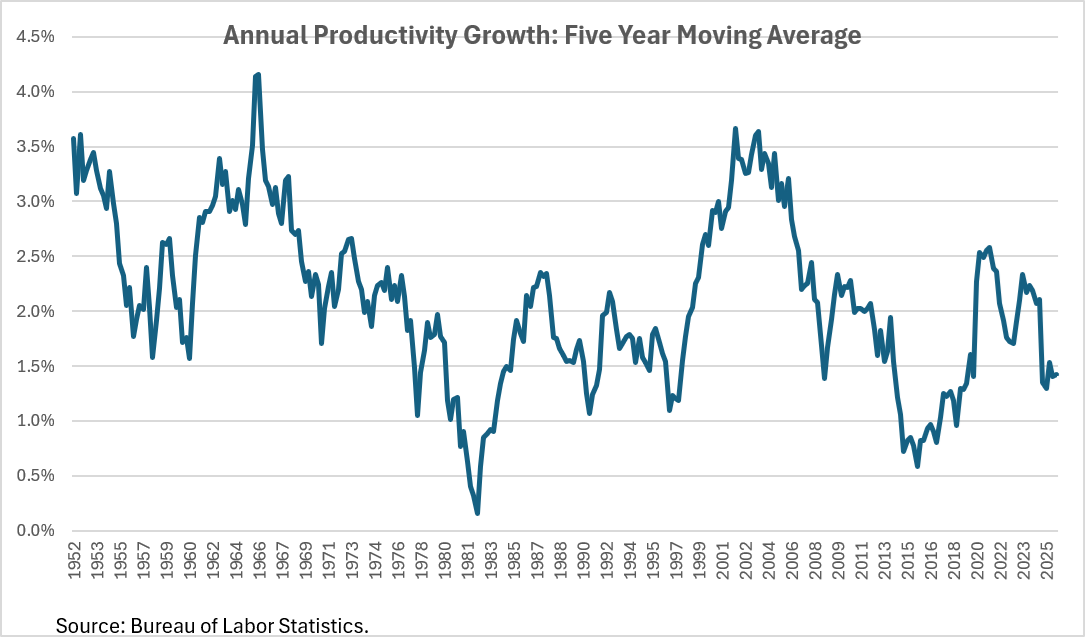
As can be seen, the recent years don’t look especially good. There was a period where the average just crossed 2.5 percent around the pandemic, before slumping again. We got back over 2.0 percent in 2023 and 2024, where there may have been some AI impact, but recently productivity growth has slumped again. The average for the last three quarters has been just 1.1 percent. (I’m assuming a 1.3 percent rate for the second quarter based on hours growing at a 1.3 percent rate and expected GDP growth close to 2.5 percent.)
It’s worth noting that even the best stretch of the recent past doesn’t come close to reaching the rates of over 3.5 percent seen at the peak of the Internet boom or the 3.0 percent growth seen through much of the 1950s and 1960s. In short, the data to date give us no reason to believe the productivity impact of AI will be earth-shaking.
It’s also worth noting that at the point where the 1990s stock bubble was hitting its peak in March of 2000, the productivity pickup had been going on for more than four and a half years. Perhaps we will still see a big uptick in productivity growth from AI, but it’s clear that in this case the stock market is way ahead of where it was in the 1990s bubble. That should not be reassuring.
The AI Bubble Monitor #4: June 29, 2026
First things first, here are the price-to-earnings ratios for key AI stocks as of last Friday (June 26), and their market capitalization:
I was going to write about productivity growth and AI this week, but I saw this Paul Krugman piece and I thought it was worth doing a detour back to Elon Musk. Just to remind everyone, I am not just arbitrarily picking on everyone’s favorite ketamine-addled semitrillionaire. SpaceX is first and foremost an AI company, according to its own registration statement. It sees more than 90 percent of its future market in AI. With SpaceX’s market capitalization hovering near $2 trillion, Elon Musk’s travails are very much relevant to the course of the AI bubble.
Musk was in the news for a number of reasons last week. He was angrily insisting his DOGE team’s destruction of USAID — feeding it into the wood chipper, as he eloquently phrased it — didn’t lead to any deaths. Since the program had provided nutrition and essential medicines for millions of people, this seemed a tall tale even by Trumpian standards.
But the more immediate issue for the future of SpaceX is that the value of the $25 billion in bonds it sold the prior week fell by $305 million, or 1.2 percent. This raises two big questions. The first is why SpaceX feels the need to borrow money at all. It can and did raise an enormous amount of money by selling shares. Only a bit more than 4.0 percent of SpaceX’s shares are now public, which should mean in principle that it can raise a huge amount of money by selling off more shares. For some reason, it has apparently chosen not to go that route.
Even more noteworthy than Musk’s odd financing choice is the fact that the market seems to be souring on SpaceX bonds. While there is plenty of overlap between investors in stocks and bonds, they are not entirely the same people. Elon Musk groupies are far more likely to be found holding SpaceX stock than SpaceX bonds.
More importantly, the nature of the bet investors place in the bond market is qualitatively different than the bets they are placing in the stock market. The bet in the bond market is simply that the company will be able to pay its bills. If SpaceX’s $25 billion in bonds were issued at a 5 percent interest rate, bondholders are betting that it will be able to pay out $1,250 million a year for the life of the bonds and then pay back the bond in full at its expiration date. If the company becomes insanely profitable, the bondholder still only gets the contracted interest rate.
By contrast, the bet on SpaceX stock is that the company will become insanely profitable. As I pointed out in my earlier piece, its current market capitalization would imply that shareholders expect the company to have around 20 percent of all after-tax corporate earnings, based on current GDP growth projections.
I actually should qualify that comment slightly. Some SpaceX investors may actually believe that the company will become insanely profitable. However, many investors may have no confidence whatsoever in Elon Musk or SpaceX. They may just believe that there are enough Elon Musk groupies to continue to drive up the share price to ever more absurd levels, which will allow them to sell at a healthy profit before reality catches up with the company and its share price collapses.
But the betting in the bond market is a different story. For some reason, investors holding SpaceX bonds, or thinking of buying into them, became less confident last week that the company will be able to pay its bills for the duration of the bonds. I confess to not having studied SpaceX closely but given that it currently is losing money hand over fist, that seems a reasonable concern.
Also, since Musk’s business model seems to depend on having a close political ally in power to steer government contracts in his direction and override laws and regulations for his benefit, the ability of SpaceX to repay bonds will fall sharply if Trumpers lose control of the Congress and the White House. For these reasons, it is understandable that investors in the bond market have concerns about SpaceX’s ability to pay its debt.
In any case, it is striking that on the one hand there are investors in the stock market betting that SpaceX will be the most profitable company in the history of the world, while investors in the bond market are questioning whether it will be able to stay out of bankruptcy.
The AI Bubble Monitor #3: June 22, 2026
Does US AI Depend on Big Companies Throwing Money in the Toilet? The Chinese Competition
Here are the price-to-earnings ratios as of Friday, June 19. At 37.16, the average increased slightly over last week.
Most of us tend to think that the people controlling billions, or even hundreds of billions of dollars, at major corporations have a pretty good idea of what they are doing with their companies’ money. But that clearly is not always the case.
For example, in 2000, Time-Warner, which was at the time the largest media company in the country, effectively sold itself for nothing to AOL. The sale went through just two months before the peak of the 1990s tech bubble and the beginning of the crash. AOL was one of the high-flyers of the bubble, with a market capitalization of more than $200 billion, which would be around $400 billion in today’s dollars.
AOL paid for Time-Warner with $165 billion of its own stock. Shortly after the merger, the stock of the combined company plunged to roughly what would have been the value of Time-Warner’s stock if it remained an independent company. AOL’s business was adding virtually nothing.
There are numerous other stories of extraordinarily bad business judgement from the tech bubble era. As I’ve mentioned before, many companies discovered that adding “dot.com” to their name was an effective way to juice their stock price.
Bad business judgement did not go out of style with the collapse of the tech bubble. Meta lost as much as $80 billion pushing its Metaverse, which it largely abandoned at the end of last year. There is some question as to how much of this is actually a loss, since some of the spending may ultimately pay a dividend with AI, but it’s clear a large share of this investment was seriously misdirected.
Is the AI Spending Party Over?
This background is worth mentioning when it comes to the AI bubble, since a key question is this: How much are businesses willing to pay for AI? Until recently, AI enthusiasts were touting the rapid growth in revenue. It seems a big factor in that growth was companies spending money on AI, even if they didn’t have a productive use for it, because they thought it meant their companies were at the cutting edge in technology.
That sounds crazy, but even large companies can often do things that are pretty crazy, as noted above. In recent weeks there have been several reports in the media of companies “tokenmaxxing,” where companies rewarded mid-level workers for using AI. This was not just small or midsize companies with poor management. Amazon, one of the largest companies in the world, had an AI leaderboard for their workers, where they could be rewarded for the amount of AI they used. Other companies were following similar practices.
Apparently, companies are now looking at their AI bills and deciding that it may not be the smartest thing in the world to encourage employees to use AI as an end in itself. This is at the least likely to mean slower growth in AI usage, if not actually reduced usage in many companies.
The change in attitudes may also lead to more cost-consciousness in choices of AI systems. This is where Chinese AI may come to be a bigger factor. If companies were just using AI to be cool, it is easy to go with the leading American companies, which would generally be Anthropic and OpenAI. The systems produced by these companies generally rank at or near the top by most measures.
But they cost considerably more than the Chinese systems, the best of which are not far behind according to most ratings. To take a few illustrative examples, the cutting-edge Anthropic system costs $15 for 1 million output tokens. The leading OpenAI model charges $30, while Google’s frontier model costs $9 for 1 million tokens.
By comparison, the leading model from Minimax costs just $2 per million output tokens, while Moonshot charges $3.00. Alibaba has a discount version available for just 60 cents per million output tokens. (Input tokens tend to cost around 20 percent as much, but the pricing follows the same pattern.)
These comparisons are not comprehensive. The US makers offer older versions at somewhat lower prices and there are many more Chinese AI makers than just the three listed here. This is another advantage that China has. It has around a dozen highly competitive AI makers, while the US has just five.
If AI consumers become more cost-conscious then they are likely to increasingly turn to Chinese AI companies. This will be the case even if the US producers can maintain a modest lead in producing cutting edge AI. The vast majority of users are not going to need cutting edge AI, just as the vast majority of computer users do not have any use for the top-of-the-line models produced by Dell or Apple.
The Chinese AI also has the advantage that it is mostly open weight. This means that users can modify the models to better fit their needs. It also means that the systems can be downloaded and run on a company’s own computers. This allows companies to protect their data; they need not fear that they are handing it over to the Chinese government, although they may be handing it over to Elon Musk or Mark Zuckerberg with the US systems.
China is Gaining Ground
The lower cost and open-weight systems are a reason that Chinese AI is gaining ground around the world and even in the United States. According to data from OpenRouter, four of the top five models for worldwide usage in May were Chinese companies. Much of this usage is in China or in third countries; however, the cost advantage is also causing Chinese AI makers to gain ground in the United States.
And it is not just small companies looking to skimp on costs that are turning to Chinese AI. Airbnb relies on Alibaba’s Qwen model because it is “fast and cheap.” Unless there is some big roadblock put in their path, it seems likely that the Chinese AI share of the US and world market is likely to grow in the months and years ahead.
It is also important to note that even insofar as the US producers can retain their market, the low-cost Chinese competition will depress profit margins. It’s hard to sell a car for $40,000 if a comparable model is available for $4,000.
Similarly, unless there is some massive productivity benefit from using US AI as opposed to Chinese models, it is difficult to see why companies would pay $15 to $30 for 1 million output tokens when they can pay top-line Chinese companies $2-$3 for a million tokens.
It’s Trump Versus China
One other factor to take into account in the international competition is that Donald Trump has decided to take a direct interest in promoting US AI over the Chinese producers. Ordinarily having a helping hand from the government might be seen as a plus in international competition, But this is not a story where the Commerce Department or other government agencies will be relying on people familiar with the industry to devise ways to favor US firms.
This is a story where Donald Trump will be looking to favor the companies where the CEOs and other top executives have curried his favor and/or made large contributions to his various collection plates. He will also be looking to harm companies that may have done something to warrant his wrath, as recently seems to have been the case with Anthropic.
While both China have many bright and hard-working people in their AI industries, the Chinese producers have the advantage that they don’t have Donald Trump on their side. There are many reasons why it already looked like the competition was going in China’s favor, but Trump might be more than enough to clinch the game.
The AI Bubble Monitor #2: June 15, 2026
SpaceX: Elon Musk’s Greatest Scam? Mr. Arithmetic Weighs In
Here are the price-to-earnings ratios as of Friday, June 12. At 35.2, the average increased slightly over last week. For reference, the average at the peak of the late ‘90s tech bubble was 43.8.
Figure 1
Last week was a big one for the AI bubble. SpaceX had the largest IPO ever and Elon Musk became the world’s first trillionaire. In fact, it was such a big deal I thought I would summon Mr. Arithmetic out of retirement to get his insights.
First, if anyone is wondering what rockets have to do with the AI bubble, you have to look at the company’s registration statement. It projects that more than 90 percent of its future market ($26.5 trillion of $28.5 trillion) is in AI. So, SpaceX is first and foremost an AI company.
Now, let’s do the numbers. The Friday close on the listed shares for SpaceX’s IPO gave the company an implied market capitalization of $2.2 trillion. Does this valuation make sense?
Ordinarily, we would first look to its price-to-earnings ratio (PE) to see how high it is. But we can’t really do that with SpaceX, since it lost $5 billion last year. So, the company has a way to go here. Clearly the company’s IPO is a bet on Elon Musk.
I know there are some who insist the guy is a visionary and a genius, but his track record has not been great, nor has his relationship with the truth. Paul Krugman gave a few prominent examples of Musk’s boasts that have not panned out in his Friday Substack. His Boring Company, which was supposed to create superfast trains between cities, has literally gone nowhere. The same goes with his Neuralink company that is supposed to give us brain implants that allow us to circumvent our normal physical processes.
He has promised us that Tesla would give us full-self-driving cars next year for at least a decade. And he was supposed to have a full system of self-driving taxis last year. Apparently, Tesla now offers limited service in Austin, Texas. By contrast, Waymo has extensive service in San Francisco, Phoenix, and a number of other major cities.
And for those keeping score on such things, Tesla’s profits were $4 billion last year, roughly 0.25 percent of its market capitalization. And the overwhelming majority of the profits came from selling carbon credits, a system that Musk’s good friend Donald Trump wants to end. In short, Musk’s track record in his business dealings has been less than stellar.
But his ventures into politics look even worse. Apart from his presidential pick (he once said he loves Donald Trump as much as it’s possible to love another man without being gay), his grasp of numbers seems to be seriously lacking. When he was allowed to invent and run a “Department of Government Efficiency” Musk said he would eliminate at least $2 trillion in waste and fraud, according to Grok, his AI system. At one point, he suggested giving us all $5,000 annual DOGE dividends, which would come to over $1.3 trillion a year.
The most cursory examination of the federal budget would have told him that savings of this magnitude are absurd. The whole budget for 2025 was a bit over $7 trillion, with the overwhelming majority going to interest on the debt, Social Security, Medicare and Medicaid, and the military.
Reducing interest payments would mean radically altering monetary policy, which he didn’t have the authority to do, and would be a radical shift, to say the least. Social Security and Medicare have been endlessly scrutinized and found to have very little fraud. Medicaid surely has some, but it is hard to detect and getting to double-digit billions would be a huge stretch — and still less than 1 percent of Musk’s target. Defense surely has fraud and waste, but Musk’s boss didn’t want him to go there.
Spending outside of these areas was well under $2 trillion. This included education, scientific research, infrastructure, the FBI and criminal justice, agriculture, and foreign aid. Musk was able to score big in cutting the last category by cutting around $20 billion (1 percent of his promised savings), leading hundreds of thousands of people in Africa to get sick and likely die from AIDS and now Ebola.
Musk also routinely initiated and/or repeated whack job crazy claims like 20 million dead people getting Social Security. (The true number is low thousands, among a population of 70 million beneficiaries.) He also claimed, against all evidence, that Democrats are arranging to have millions of undocumented immigrants vote.
Maybe Musk never believed such craziness, and these were just lies to advance his political agenda. But if someone would so easily tell whack job crazy lies to advance their political agenda, is it reasonable to think that they wouldn’t tell lies to make themselves richer?
Does SpaceX’s Future Justify SpaceX’s Current Market Cap?
The question of the day: Does SpaceX’s $2.2 trillion market capitalization makes sense? We know the thing doesn’t make money now, but maybe at some point in the future Elon will be raking in the bucks to justify this price.
Let’s say we take a 10-year horizon. In 2036, SpaceX will be 34 years old, a more established company than Google is today, so we might expect it to have profits somewhat in line with its share price, like most mature companies. But its share price should be far higher in 2036 than it is today. After all, people aren’t buying shares of SpaceX to just break even.
Historically, stocks have given somewhere close to a 10 percent nominal return. (I have argued that expecting that return going forward probably doesn’t make sense, but most people invested in this market probably do expect a return something like that.) But that is for a normal stock with real profits. People putting money in SpaceX are betting on a company that is losing large amounts of money and run by a person with an affection for ketamine and neo-Nazi propaganda. Surely, they expect a better return than the measly 10 percent you can get from investing in an airline or consumer products company.
Let’s assume your typical SpaceX investor is expecting a 20 percent annual return. (Use a different number if you prefer.) After ten years with a 20 percent annual return, SpaceX’s market capitalization will be 6.2 times its current level, or $13.6 trillion.
As a mature company, let’s say that in 2036 it will have a price-to-earnings ratio of 20, still well above the long-term average for the stock market. That would imply it would have annual after-tax earnings of $680 billion. Is that plausible?
The Congressional Budget Office (CBO) currently projects that, in the economy as a whole, after-tax corporate profits will be $4.1 trillion in 2036. That would mean that SpaceX will have almost 17 percent of all after-tax corporate profits. That is several times larger than the share that any company has ever had.
It also comes at a time when Musk’s rivals, Open AI and Anthropic, are also having IPOs expected to price them at well over $1 trillion. Don’t forget that Nvidia already has a market cap of almost $5 trillion and the rest of the magnificent 7, including Tesla, all have market caps of well over $1 trillion.
If you think that something here doesn’t add up, you would be right. But there is the possibility that the CBO is wrong — and not just by something like 3-5 percent, which would already be a big deal, but 20 percent, 30 percent or more, which would be huge and unprecedented.
We can’t rule that sort of extreme error out of the realm of the possible, but we can say some things about the world where it is true. Jason Furman, who was a top economic advisor in both the Clinton and Obama administrations, had a New York Times column on Friday warning about the disaster facing Social Security as projections show a funding shortfall beginning in 2032.
While Furman is right that we will need additional funding for Social Security, the concern he expresses at the end for the well-being of our children is utterly absurd if economic growth is going to be hugely faster than the CBO projects, because of the wonders of AI. If the price of SpaceX and other AI companies come anywhere close to making sense, then concerns about the material well-being of future generations are complete nonsense.
Can completely contradictory views of the world exist on opposite sides of the New York Times home page and no one even notices? Having been around Washington policy debates for more than three decades, I can assure people that they can.
The people involved in policy debates tend not to be deep thinkers. They can miss massive contradictions right in front of their face. In fact, the same person can even argue massively contradictory positions themselves and fail to recognize the problem.
What do you know, here’s Elon Musk warning earlier this year that there is a “1000% chance” the government will go bankrupt. Anyone up for some shares in SpaceX?
Figure 2
The AI Bubble Monitor #1: June 8, 2026
The Lay of the Land
The US economy has had two major bubbles in the last three decades. There are signs that we are in the midst of a third.
In the late 1990s there was a tech bubble, driven to a large extent by excitement over the potential of the Internet. This drove stock prices to a peak value of 43.8 times earnings (known as the price-to-earnings ratio, or P/E), according to the calculations of Nobel Prize- winning economist Robert Shiller.
This bubble began to burst in March of 2000. The S&P lost almost 50 percent of its value at its trough two-and-a-half years later in October of 2002. The NASDAQ, which included all the major tech stocks, lost almost 80 percent of its value over this period.
The collapse of the bubble was a huge hit to the economy and the labor market. Measured by output, the recession that took place in 2001 due to the collapse was relatively mild, but measured by employment, it was huge. Job growth turned negative in March of 2001.
The economy did not get back the jobs lost for four full years. This was the longest period without job growth since the Great Depression. The weak labor market also brought the strong real wage growth of the late 1990s to an end, as the real median wage rose less than 1.5 percent from 2001 to 2007, when the next recession hit.
The Collapse of the Housing Bubble
The recovery from the collapse of the tech bubble was driven by the growth of a massive housing bubble, as inflation-adjusted house prices rose by 70 percent from 1996 to 2006, after being roughly flat for the prior century. Over the years from 2007 to 2010, most of this increase was reversed.
The consequences were enormous. Residential construction, which peaked at 6.7 percent of GDP in 2005, fell back to just 2.4 percent of GDP in 2010. This drop of 4.3 percentage points of GDP would be equivalent to losing more than $1.3 trillion in annual demand in today’s economy. The loss of trillions of dollars housing wealth also curtailed consumption.
The impact on the economy was massive, as GDP growth was almost 0 in 2008, and the economy shrank by 2.7 percent in 2009. The unemployment rate peaked at 10.0 percent in October of 2009. Job growth for 2008-10 was more than 12 million below projections. Millions of people also lost their homes.
Bursting Bubbles Are a Big Deal
This recent history is important to keep in mind as we look at the AI bubble. The bubble is arguably even larger relative to the economy than the tech bubble when it peaked in 2000. According to Shiller’s calculations, the PE in the stock market, at 39.6, is slightly lower than it was at the 2000 peak. However, after-tax profits are nearly twice as large a share of GDP than they were in 2000. That means that the value of the stock market relative to the economy is nearly twice as large as it was at the peak of the tech bubble.
The current value of all corporate stock is close to $80 trillion, more than 2.5 times GDP. If PE ratios fell back to their long-term average of just under 20, it would destroy close to $40 trillion in stock wealth, an average of almost $300,000 per household. If the PE fell back to its long-term average, and the after-tax profit share of GDP also fell back toward their level of a quarter-century ago, then the loss of wealth would be even larger.
It is impossible to know the timing for when a bubble will collapse. A quarter of a century later, it is still not possible to identify any event that caused the 1990s tech bubble to collapse. It’s also not clear what caused the housing bubble to stop growing and start deflating.
With that in mind, it is possible to track the bubble, looking at the growth in the prices of the most important stocks and changes in their PE. This is what the AI Bubble Monitor will do on a weekly basis.
Figure 1
Figure 2