This is a 3-part series. Here’s Part 2 and here’s Part 3.
Chatbots can’t reliably tell facts from lies, but I still use them a lot for work. They’re pretty good already, and if we throw even more data at them, they might get a lot better.
That’s why I’m so confused.
Because for the last four years, I have bothered as many experts as I could—researchers from Harvard, MIT, UCL, and various companies—and everyone at least acknowledges that there’s a weird gaping hole in the field, way on the other end of the intelligence spectrum. And this is that, after decades of trying,
When I say “worm” I mean the most thoroughly studied animal in the world: the nematode Caenorhabditis elegans.
Nematodes are miniature worms and “the most abundant animal on Earth.” They like to live in vegetable gardens or deciduous forests (ones where the leaves change color). In these forests there are about 200 nematodes per 10 grams of soil.
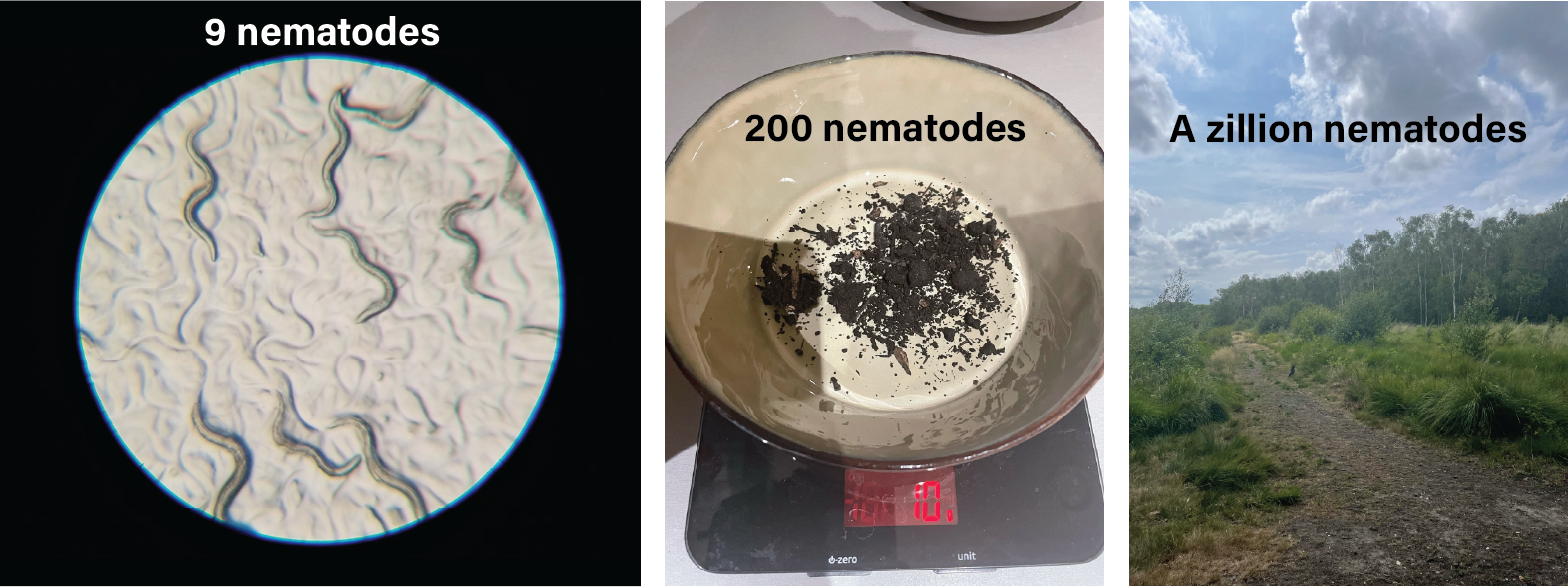
Different nematodes vary in size, but C. elegans grow up to be about a millimeter long. They eat E. coli, which suggests that, aside from having lots of experiments done on you, being a C. elegans in the laboratory might be like living in a large pile of gnocchi.
Answer: Pretty hard.
The biologist Sydney Brenner picked C. elegans as a model organism in 1965 because it seemed relatively easy to figure out.
We have 60-100 billion neurons.1 Fruit flies have about 140,000. C. elegans only have 302 neurons, which is more followers than I have on Instagram, and just like my friends on social media, there are few enough for someone to recognize each one’s name and identity.
This sort of labeling is impossible in bigger animals, where every nervous system is too different across individuals. The worm nervous system’s size and consistency meant that we could map out the whole thing pretty quickly—the first map came out in 1986, almost forty years ago, and you can see a recent version on the WormWideWeb.
Since the mapping, many have tried to build the worm. All have failed. Here’s a non-comprehensive list of worm simulation projects.
~1997: NemaSys, The University of Oregon
~1998: The Perfect C. elegans Project, Sony, report
~2004: The Virtual C. Elegans project, Hiroshima University, papers published
Early 2010s: The OpenWorm project, MIT, website
After OpenWorm, there were either fewer worm simulation efforts or people made less of a big deal out of them (just in case). Regardless, the pattern seems to be that every five years, the worm will be fully simulated in the next decade.2
In 2024, a paper came out of the Beijing Academy of Artificial Intelligence and Peking University.3 It was titled, “An integrative data-driven model simulating C. elegans brain, body and environment interactions.”
But the paper models just 136 out of 302 neurons in the worm. And the simulation can only zigzag forward. Worst of all, it doesn’t learn, which is a glaring omission since even in the incredibly stable nervous system of C. elegans, we see differences between individuals.
That gets us to the year 2025—a year in which, four months ago, WIRED published a feature titled “The Worm That No Computer Scientist Can Crack.”
The worm was never the point. It was a model, not the goal.
When I was a graduate student, I grew thousands of worms and watched them for thousands of hours. In the process, I noticed some surprising things.
Even between genetic clones, some worms are fast and some are slow. Some are sleepy or really like to eat, and some like being next to walls, which I think is a valid personality trait. It’s sad but adorable when worms get scared; they curl up into circles like Cheerios. And if they get stressed or learn too much, they take a nap. This is a tactic I admire. They take so many naps!4
And worms can move. They use an intricate set of muscles to wiggle around in complicated ways. This kind of thing is still hard for robots today—why are the most advanced robotics displays still rigid and choreographed compared to the tumult a worm goes through when you dig up plants in your garden? The robots are impressive unless we compare them to animals—we have such high expectations for animals that it’s only special when they can’t get up again.
Other things worms do: they swim towards food; they remember what makes them sick; they sleep; make decisions; they invent crazy new behaviors. Did you know that worms can hitchhike by organizing themselves into tiny worm towers that help them teleport onto bees using static electricity?
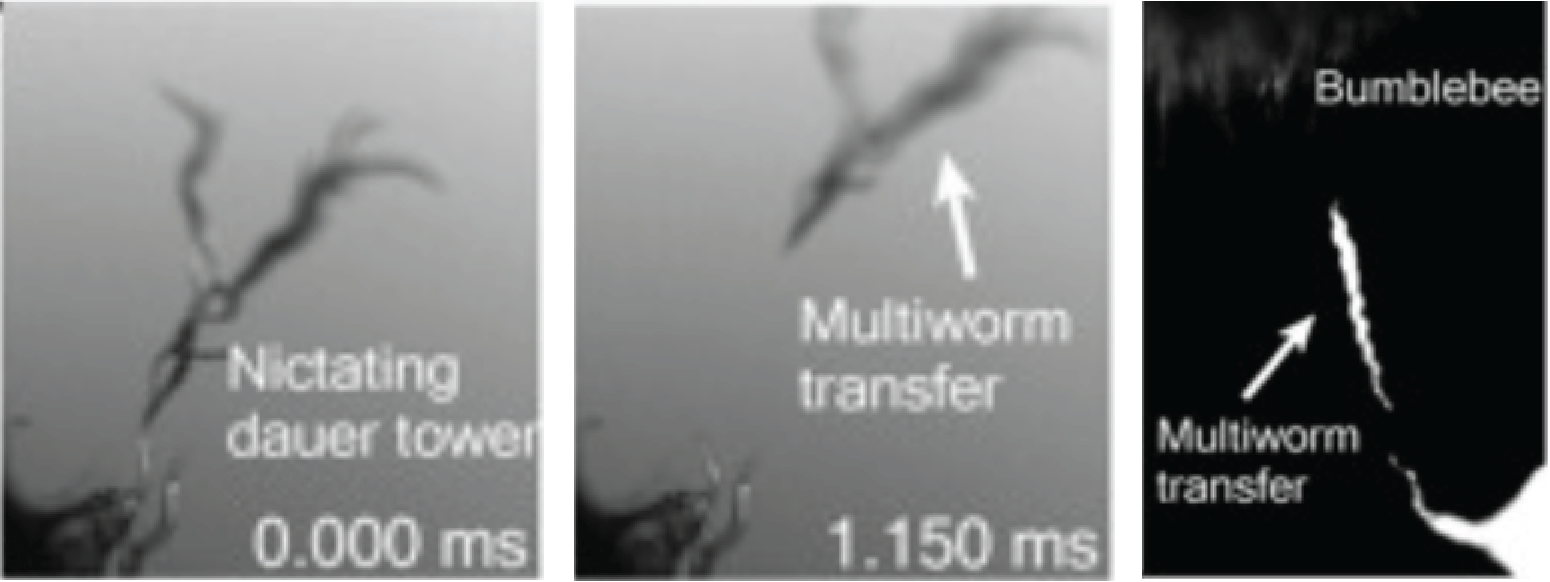
All animals, including the smallest ones, have these endlessly interesting traits—flexibility, autonomy, and inventiveness in what they do. When I say I want to build or understand a worm, these are the things I’m talking about.
But how do we go about it?
Here’s an analogy—let’s say I give you a radio.
No—I give you a thousand radios.
All of these radios are different, but they catch local stations and play sounds with a little tuning. Some are the same but different colors. Others are AM or FM or both. A few are straight-up iPhones.
Let’s say you don’t know what a radio is. You have no idea what it does, what radio waves are, or that they can carry information.
Let’s say I want you to figure out:
Can you fix a radio?
Can you build a radio?
What are radios?
My mom is a nuclear engineer who knows a lot of physics, so I asked her these three questions. I told her that this is what my job feels like—each animal has a different kind of radio in its head and/or body, and neuroscientists are trying to figure out things about them. Some neuroscientists want to fix radios; some want to build better radios. Others, like me, are just trying to understand them.5
To which she responded, in English:

But I kept asking and asking her, and eventually she conceded it might be possible to answer parts of these questions in the right circumstances.6 For context, she has built a lot of radios, because my grandpa used to make them with her when she was a kid.
Here is what she said to each question.
Out of the three tasks—fixing, building, and understanding—my mom thought the hardest was to fix one of the more complicated radios.
Specifically, she said:

This sentiment is in firm agreement with a paper from 2002, “Can a biologist fix a radio?”
In this paper, a scientist at Cold Spring Harbor named Yuri Lazebnik considers what he calls “David’s paradox.”7 David’s paradox is that:
The more facts we learn the less we understand the process we study.
… For example, the mystery of what the tumor suppressor p53 actually does seems only to deepen as the number of publications about this protein rises above 23,000.
This worried Yuri, because, as he wrote, “the notion that your work will create more confusion is not particularly stimulating”. He then remembered his high school math teacher “who recommended testing an approach by applying it to a problem that has a known solution.”
So Yuri got a radio that his wife had brought from Russia. He pretended that biologists across the world were assigned to understand and/or fix the radio.
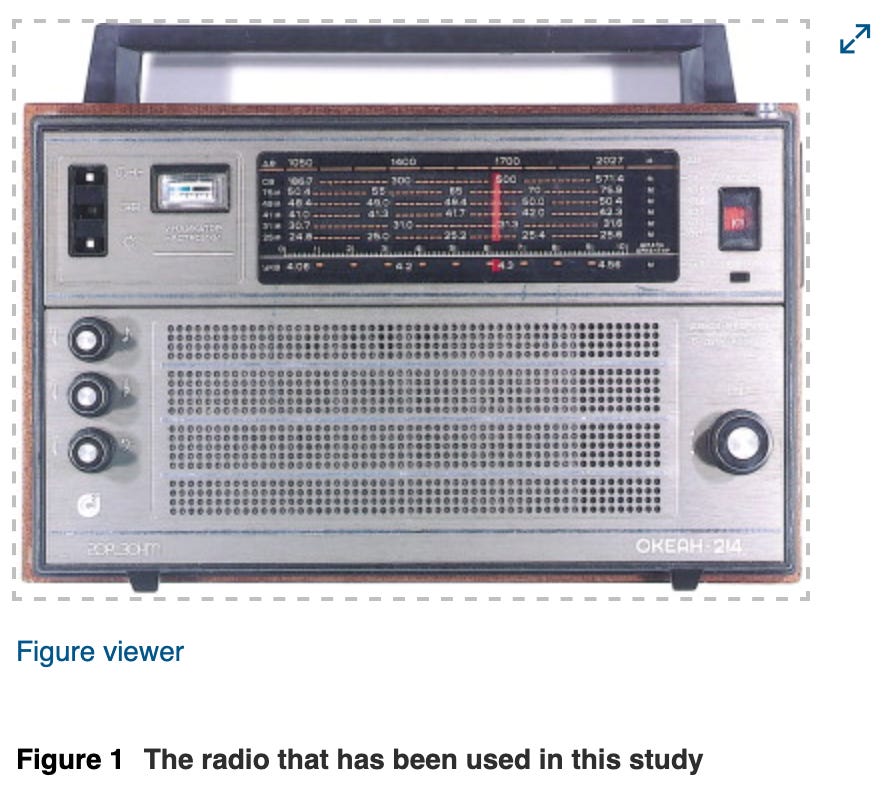
Because a majority of biologists pay little attention to physics, I had to assume that all we would know about the radio is that it is a box that is supposed to play music.
What would the biologists do?
First, they would get as many copies of the radio as they could. Then they’d shoot them “at a close range with metal particles.” Lots of these radios would break, and the biologists would see which broken components led to what kind of damage.
They’d also pick the radios apart and try to find out what pieces were necessary for them to work. Getting rid of some pieces wouldn’t do much, but “a lucky postdoc will accidentally find a wire whose deficiency will stop the music completely.”
This important wire, Yuri said, would be named and published. Researchers would discover that it was important because it connected “a long extendable object”—the antenna—“and the rest of the radio.”
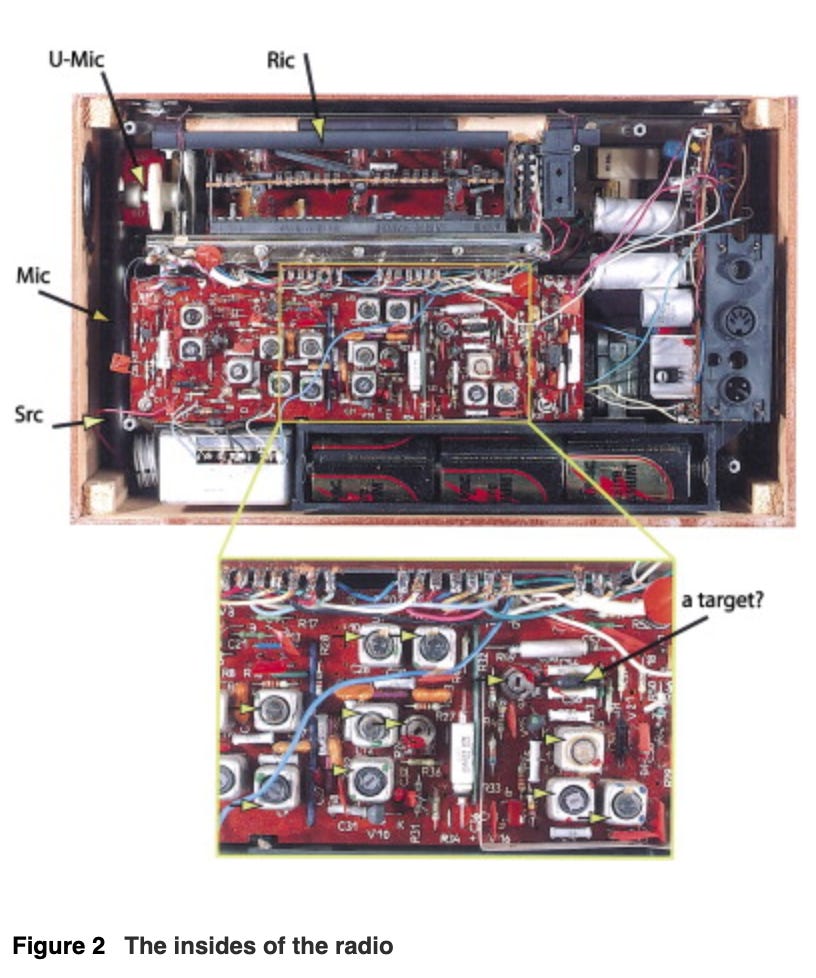
Inspired by these findings, an army of biologists will apply the knockout approach to investigate the role of each and every component. Another army will crush the radios into small pieces to identify components that are on each of the pieces, thus providing evidence for interaction between these components.
Eventually, all components will be catalogued, connections between them will be described, and the consequences of removing each component or their combinations will be documented.
So far, so good—progress has been made. Thousands of publications have been churned out. Dozens of biologists will ride this wave all the way to tenure.
But then, Yuri says, the biologists will hit a wall.
The wall will appear upon a critical mass of biologists asking,
Wait. Have we learned anything useful? Like, can we maybe fix one of these radios?
If a defect is simple, maybe they can. If a component “smells like burnt paint”, it should probably be replaced. But “if the radio has tunable components, such as those found in my old radio and in all live cells and organisms,” says Yuri, then all bets are off.
What is the probability that this radio will be fixed by our biologists? I might be overly pessimistic, but a textbook example of the monkey that can, in principle, type a Burns poem comes to mind.
As in, it is possible that a biologist could fix a radio.
But no way is it ever going to happen.
End of paper.
Fifteen years later in 2017, Yuri’s thought experiment inspired the neuroscientists Eric Jonas and Konrad Kording to write a follow-up: “Can a neuroscientist understand a microprocessor?”
The answer was again no.
This response raises the question: what are the parts to a working brain?
We’ve had the worm nervous system mapped out for forty years. We kind of know how neurons talk to each other through electrical and chemical signals. But it turns out that’s not enough.
A brief digression into neuroscience history
Back in 2012, the OpenWorm project was still in its infancy. A team of very accomplished neuroscientists, having seen that making a worm in a computer was kind of hard, decided they were going to go for a human brain instead. They wrote an impressive proposal and won 1 billion euros in funding.
A lot of other neuroscientists were very upset about this. Many thought the idea was fundamentally flawed and that it was a huge waste of money.
For instance, in 2013, a New York Times journalist asked Haim Sompolinsky what he thought about the endeavor. Haim is now partly at Harvard and won the Brain Prize in 2024 (the biggest award in the field).
“The rhetoric is that in a decade they will be able to reverse-engineer the human brain in computers,” said Haim. “This is fantasy. Nothing will come close to it in a decade.”
(Haim is not known for mincing his words.)
Haim and others are interviewed in a documentary on the rise and fall of the Human Brain Project, the greatest movie about computational neuroscience research that I have ever seen. It’s called In Silico and was filmed by Noah Hutton, released in 2020.
Hutton started as a believer—he originally planned to promote the film as a behind-the-scenes for one of the greatest scientific achievements in history. But instead, In Silico was described by a Nature Arts Review with the headline
Documentary follows implosion of billion-euro brain project
Because implode it did.
The Human Brain Project got nowhere for years.8 Publications trickled out, but an early simulation of a piece of rat brain was described by the neuroscientist Alexandre Pouget as “completely meaningless, just random activity… The claim that he simulated a rat’s cortex is completely ridiculous” (2013, New York Times).
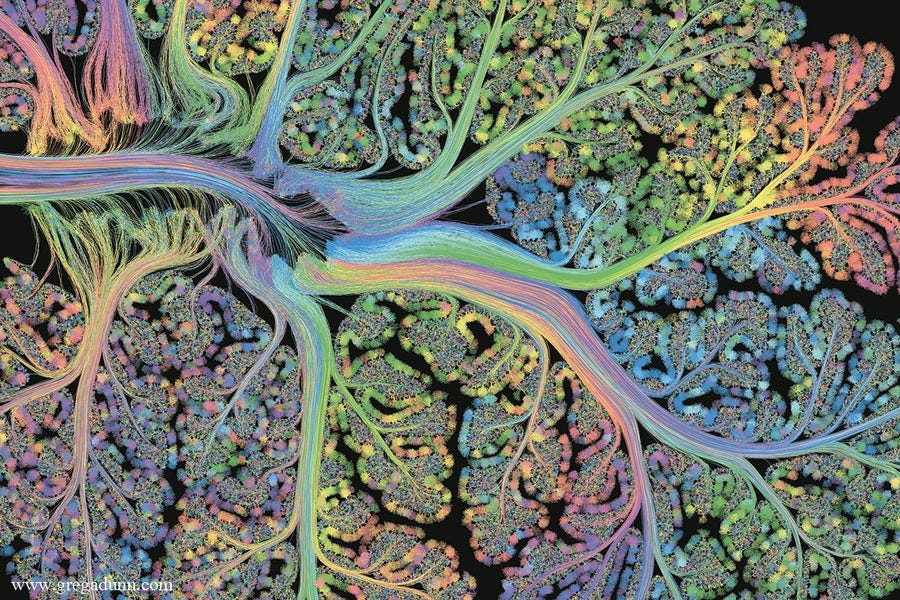
By 2023 the project had turned into a very expensive art installation.9 At least at the end of the day, neurons still look cool even if they don’t work—below is a picture not from the Human Brain Project, but a different exhibition I thought was better.
—
This is to say, we’ve had some huge, expensive, and very public failures in computational neuroscience. We’ve not only failed to simulate a human brain—we’ve failed to simulate a fully mapped 302-neuron nervous system over and over again.
My mom says to build a radio, you have to first buy radio parts at the store. But at this point, we might not even know what the radio parts are, let alone how to put them together.
How come? Why can’t we do it? What makes this little problem so weirdly hard?
This post was getting way too long, so in Part 2 and Part 3:
What many experts have said when I asked them why we can’t build a worm yet
Why some people might find a worm simulation useful, but I’m not sure I would
How the worm simulation projects so far have treated nervous systems like circuits when they probably aren’t like circuits at all