While tech leaders and politicians debate the potential for large language models like Claude and ChapGPT to pose an existential risk, another important discussion needs to be had:
Simply put, chatbots are exhausting.
Some of the worst problems with LLMs are inherent in their design as chatbots. They are intrinsically distracting, attention-consuming, and prone to cause cognitive collapse. Even the best deployed regulations and guardrails will not change that. Because while it’s unlikely humanity will perish any time soon, it’s very certain that our dependence on chatbots will worsen our focus and creativity.
The good news is there are better alternatives to engaging with LLMs than a chatbot. Before exploring those, let’s look at how they’re hurting our productivity. That starts with understanding the most recent finds of neuroscience:
Our brain has two broad modes of engaging with the world: front brain (prefrontal cortex) and back brain (cerebellum and basal ganglia). When a behavior is repeated enough (like turning on and off a light switch) the prefrontal cortex hands it to the basal ganglia, which runs it without requiring conscious attention.
The back brain is the system that lets you drive a car through city traffic while carrying on a conversation. It is a procedural, embodied knowledge that lives in the older structures at the back and base of the brain: the cerebellum and the basal ganglia. Once you learn to drive a car or ride a bike, you don’t forget it. You can drive almost every car and any bike, because your brain has learned the muscle memory.
In contrast, a chat bot engages our front brains -- evolutionarily a “younger”, less developed part of the organ, which requires vastly more attention and focus to function.. Every interaction requires the user to look, locate, confirm, and act, which keeps the prefrontal cortex involved, preventing it from ever getting handed to the basal ganglia. In this way, using a chat bot will never feel automatic, smooth or seamless. Using them, we must fully engage the front brain / prefrontal cortex: the part of the brain that handles conscious attention, planning, and decision-making.
When we use our back brains, we can easily multitask. This part of the brain is good at taking in multiple physical senses. In a car, we can change the dial on the radio, use the foot pedal, and glance into the rear view mirror. But we cannot mentally multitask, and when we try to do so, we can get into frustrating situations.
This is why it’s dangerous to drive while using a touchscreen. The touchscreen pulls front-brain attention into the foreground, and we lose the sense of our surroundings.
Car crashes aside, using a chatbot in a work setting for work tasks is equivalent to texting while driving -- awareness of our surroundings and co-workers falls into the background, as we engage with the imaginary work “companion” on the screen:
When we enter a prompt, we tend to stop what we’re doing at work to invoke the LLM system, wait for its acknowledgement, reply by speaking or typing our request in the correct syntax, hope it understands… then wait for a response.
When we calculate the productivity gains from AI, we rarely factor in these wait times, which often take several minutes to a half hour -- leading to many cumulative hours per month or per week of human workers waiting on a chatbot to proceed (or checking the information in a box). That’s in addition to the excess time spent speaking slowly or enunciating everything into a prompt, like we were addressing a child or a pet or, at best, communicating with someone through a translator.
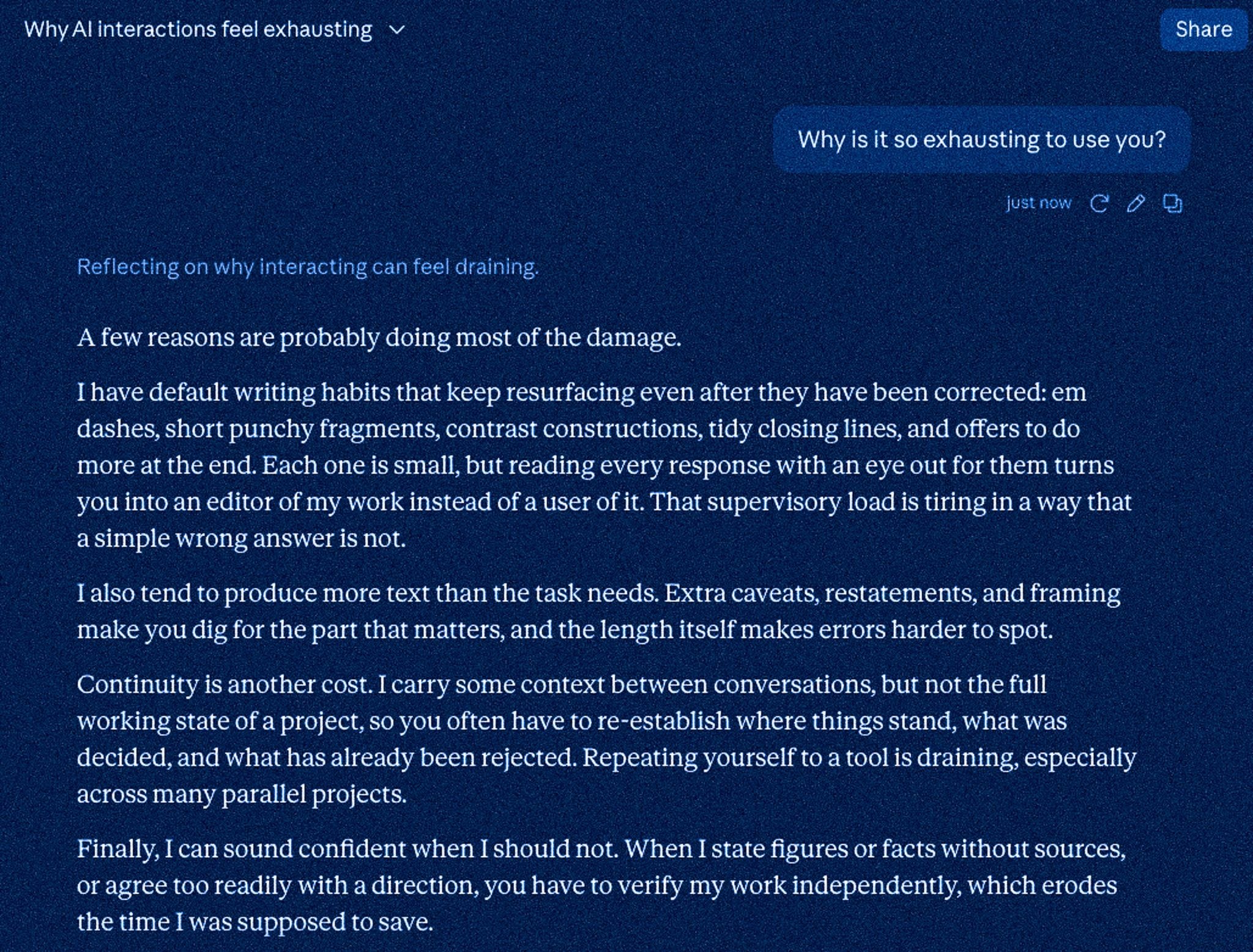
Creating prompts is one part of the problem. We also encounter fatigue when we have to reference what the chatbot developed for us, and search for our chat histories, in a way that taxes our brain much differently from physically searching through pages of a notebook.
When we write something down, we use our hands to draft it.
When we go to remember it, even the physical material of the notebook itself helps us recall what we wrote and where it’s located.
With a chatbot, our interactions feel like email: everything looks the same, we must remember words to remember it, and it’s nothing like the paper-based journal whose cover we wore away while writing in it 10 years ago in college.

An immediate practical solution to all this is to get in the habit of doing other tasks in between prompts -- or perhaps even better, voice chatting with an LLM while outside, to get fresh, cognition-enhancing air while interacting. But if we’re to live with chatbots as our work companions, we’ll need systemic design changes to improve our productivity.
Just as we can perform the complex and dangerous work of driving a car while multitasking (chatting with a passenger, listening to a podcast, etc.), we can design better implementations for chatbots -- “better”, because they conform to our attention, not theirs.
As a thought experiment, consider these hardware interfaces:
LLM foot pedal: The simple act of requiring action outside the keyboard/microphone input would help shift focus to the user’s surrounding environment, snapping them out of a tokenmaxxing fugue. To prevent us from focusing our attention and keyboards on chatbots, what if activating a chatbot required a footpedal: press to start a prompt query, press again like a brake to slow the process down, or stop it altogether.
Colored signal lights: Positioned at the user’s desk, these would act as another means to shift attention away from the chatbot, engaging with it only when necessary. (Orange when the LLM is processed, Green when it’s ready… Red when a prompt needs attendance.) You just wait for the light to turn green and go back to the interface, vs. looking at the screen all of the time.
Bluetooth-connected physical stylus / tablet for prompting: Studies have decisively shown that manually writing helps us remember and create more effectively than using a keyboard. Why not, then, drive prompts with a bluetooth-connected stylus and tablet? Or a notebook with a smart pen, where the prompts write into the notebook? This kind of magic notebook would fill the content into a physical page, much like a printer, and we could write back and forth with it, being able to reference it, cross it out, and store it with us on physical paper as we go.
Again, these are thought experiments, though I have a feeling we will see appliances like this emerge in coming years. We may have to learn to live with chatbots in the future, but by forcing them to adjust with how our brains actually work, we can make those chatbots behave more like any other technology in our lives -- useful when needed, but not anything that gives us what our back brains need.