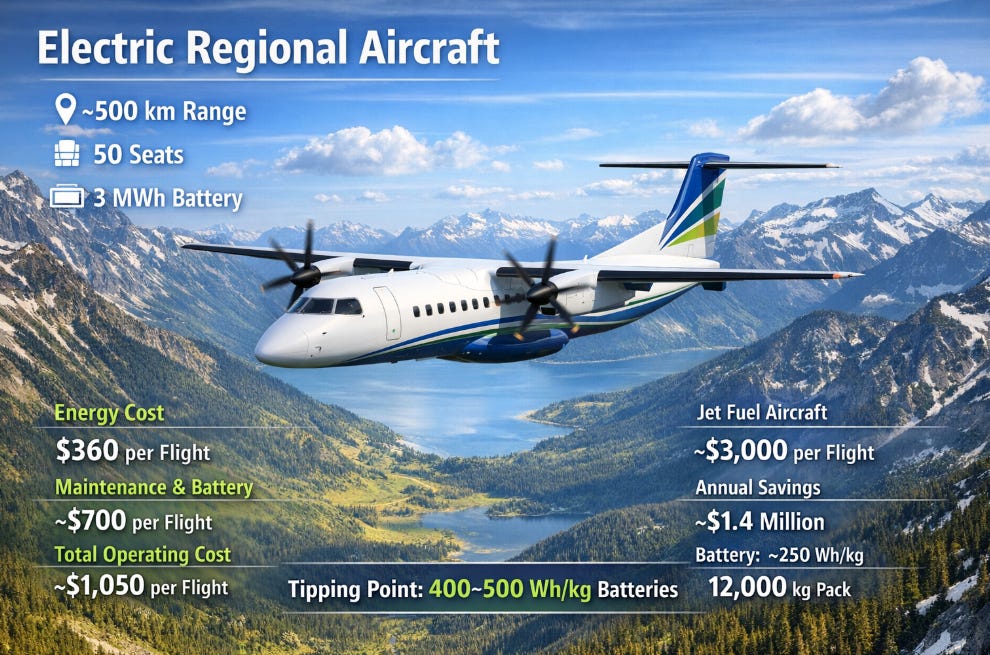
Electric aviation is often framed as a distant, speculative shift.
That’s true for long-haul.
It’s much less clear for short regional routes.
Under 500 km, aircraft fly short cycles, burn disproportionate fuel during climb, and operate high annual utilization. Those are precisely the conditions where operating economics matter most.
So the question is simple:
When does a 50-passenger aircraft flying 500 km become cheaper to operate on electricity than on jet fuel?
A 50-seat regional aircraft flying 500 km typically:
Cruises around one hour
Requires additional energy for climb and reserves
Draws roughly 2–3 megawatts during cruise
A realistic mission requirement lands in the range of:
2.5–3.5 megawatt-hours (MWh) per flight
Using 3 MWh as a practical midpoint is reasonable.
Per passenger, that equates to roughly:
~120 kWh for a 500 km trip
That’s the physics baseline.
A comparable 50-seat jet on a 500 km sector typically burns:
~2,200–2,500 litres of jet fuel
Jet fuel prices fluctuate. Using a middle-of-the-road assumption around $0.95 per litre, fuel alone costs:
~$2,200–$2,400 per flight
Direct maintenance — engines, inspections, airframe reserves — adds roughly:
~$800–$1,000 per flight
Total variable operating cost:
~$3,000 per flight
At two flights per day (about 730 per year):
~$2.1–2.3 million per aircraft annually in fuel + direct maintenance
That is the economic benchmark electric must beat.
Now assume the same 3 MWh mission.
Electricity at $0.12 per kWh:
3,000 kWh × 0.12 = $360 per flight
Electric aircraft still incur maintenance. They still have:
Landing gear
Pressurization systems
Avionics
Structural inspections
What they remove are turbine overhauls and fuel systems.
A reasonable estimate for electric maintenance:
~$500–$700 per flight
Battery depreciation depends on pack cost and cycle life.
Assume:
3 MWh battery pack
$250–$400 per kWh
~10,000 useful cycles
That works out to roughly:
$75–$120 per flight
Total electric operating cost per flight:
ComponentApproximate CostElectricity$360Maintenance~$600Battery depreciation~$100Total~$1,050
Compared to ~$3,000 for conventional.
Savings per flight:
~$1,900
Annual savings at two flights per day:
~$1.4 million per aircraft
Even with conservative assumptions, the operating advantage is significant.
Recharging 3 MWh requires meaningful power.
If an airport provides 2 megawatts of charging capacity:
3,000 kWh ÷ 2,000 kW = 1.5 hours
A 60-minute turnaround would require closer to 3–4 megawatts.
That is not impossible, but it changes airport infrastructure planning. Regional terminals are not currently wired for multiple aircraft drawing multi-megawatt loads simultaneously.
Charging is manageable — but it is not trivial.
The mission requires roughly 3 MWh of usable energy.
If today’s aviation-grade battery packs deliver about 250 Wh per kilogram, then:
3,000 kWh ÷ 0.25 = ~12,000 kg of battery
That does not mean the aircraft cannot exist.
It means you are no longer designing something similar to today’s 50-seat jets.
You would instead design a new aircraft built around a 12-tonne energy system.
That likely means:
A higher overall aircraft weight
A larger, more efficient wing
Slower cruise speeds
Possibly longer runways
More charging power at airports
In short, it becomes a purpose-built electric regional aircraft — not a direct swap for today’s jets.
If pack-level density improves:
400 Wh/kg → ~7,500 kg battery
500 Wh/kg → ~6,000 kg battery
Each step reduces the redesign penalty.
At 250 Wh/kg, the aircraft likely becomes slower and heavier than today’s regional jets.
At 400 Wh/kg, it becomes a serious engineering project.
At 500 Wh/kg, it begins to resemble a conventional regional aircraft in size and weight.
That progression is the real tipping curve.
With annual operating savings around $1.4 million, what purchase premium can electric support?
Additional Aircraft CostPayback Period$5 million~3.6 years$8 million~5.7 years$10 million~7.1 years$15 million~10.7 years
Within normal fleet lifecycles, a premium in the $8–10 million range is financeable — provided the aircraft can carry the mission without excessive weight penalties.
With today’s ~250 Wh/kg battery packs, a 50-passenger 500 km aircraft is technically possible but likely slower, heavier, and more infrastructure-intensive than current jets.
As pack-level density approaches 400 Wh/kg, design compromises shrink.
Around 450–500 Wh/kg pack-level, the operating economics become difficult to ignore.
The tipping point is not electricity price.
It is not carbon policy.
It is the moment when battery energy density becomes high enough that the aircraft does not need to grow dramatically to carry its energy.
The operating math is already compelling.
The technology curve is what determines timing.