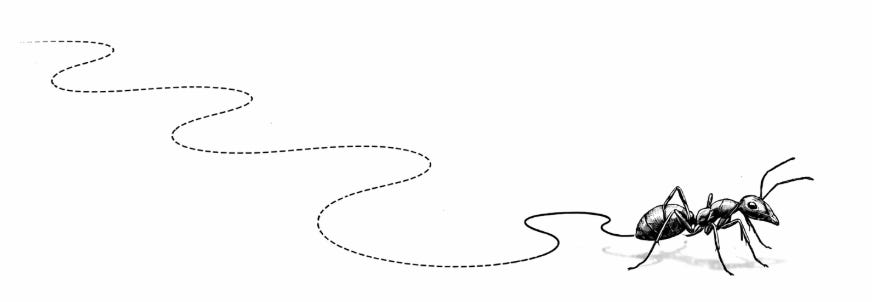
In his 1969 book The Sciences of the Artificial, Herbert Simon invites us to consider an ant making its way across a wind-swept beach. If you were to trace its path, you would see a line of immense complexity: it twists, loops, zigzags, and detours. Watched long enough, you might be tempted to attribute this complexity to the ant itself, to assume it possesses a sophisticated internal navigation system or a complex strategy.
But Simon argues this is a fundamental error. The ant is simple; it is the beach that is complex. The ant has a simple goal (get home) and simple rules (go around the pebble, climb the dunelet), but the complexity of its behaviour is merely a reflection of the complexity of the environment it must navigate. Simon’s radical hypothesis is that human beings are exactly like that ant:
“Human beings, viewed as behaving systems, are quite simple. The apparent complexity of our behaviour over time is largely a reflection of the complexity of the environment in which we find ourselves.”1
The implications of this are profound, and cut against much of what we assume about learning. If behaviour is shaped by environment, then the quality of the environment determines the quality of the behaviour. A chaotic beach produces a chaotic path. A cluttered task produces cluttered thinking. And here is the crucial point: natural environments are not optimised for learning. They are optimised for nothing at all; they simply are.
The wind-swept beach does not care whether the ant gets home. Evolution did not design the world to be pedagogically coherent. This is why the deliberate construction of artificial environments; environments designed with the learner's cognitive architecture in mind; is not a compromise, it is the entire point. The artificial is not a falling away from some natural ideal. It is an improvement upon a natural indifference to human flourishing.
Consider what “natural” learning actually looks like. Natural selection operates by a simple method: those who fail to learn, perish. It took hundreds of thousands of years for humans to discover that certain plants were poisonous, certain animals dangerous, certain strategies effective for hunting. Each lesson was paid for in corpses. The knowledge we now transmit in a single sentence; do not eat that berry, do not approach that snake; represents generations of fatal errors. This is natural learning: slow, brutal, and indifferent to the suffering of the learner.
Natural environments share several features that make them hostile to efficient learning. They offer no sequencing; the world does not present itself in order of difficulty. They provide inconsistent feedback; sometimes immediately, sometimes never, sometimes misleadingly. They contain no decomposition (more about that later); problems arrive whole and must be solved whole, with no stable subassemblies to anchor understanding. They are full of noise; irrelevant stimuli compete constantly with relevant ones. And they are profoundly indifferent to the learner’s cognitive limitations. Working memory constraints, attention bottlenecks, the fragility of encoding; nature neither knows nor cares about any of this.
The truth is that schools exist precisely because natural learning is inadequate and profoundly inequitable. We created artificial environments for learning because the natural alternative; waiting for children to stumble upon the accumulated knowledge of civilisation; is absurd and cruel. The classroom is a technology, as artificial as the printing press or the telescope. Its purpose is to do what nature cannot: transmit hard-won knowledge efficiently, without requiring each generation to pay again in blood and time for what the previous generation already knew.
For Herbert Simon, the "environment" is not just the physical world; it is the representation of the problem they are trying to solve. We often assume that when we give someone a problem, they are engaging with the deep, underlying logic of the task. Often however, they are merely engaging with the interface of the task. Simon illustrates this with a game called Number Scrabble, where players try to collect three cards that add up to fifteen. It feels intellectually demanding, requiring calculation and strategy.
But if you simply change the representation; if you arrange the numbers into a magic square; the game reveals itself to be Tic-Tac-Toe. The underlying logic is identical, but the behaviour changes instantly from slow calculation to rapid intuition. The lesson is clear: we do not solve the problem we are intended to solve; we solve the representation we are shown. Change the representation, and you change what can be thought. As Simon notes:
“All mathematical derivation can be viewed simply as change in representation, making evident what was previously true but obscure. This view can be extended to all problem solving — solving a problem simply means representing it so as to make the solution transparent." (p. 132)

Human cognition is exquisitely sensitive to representation. What can be thought depends on what can be seen, tracked, and held in mind at once. When structure is hidden, thinking becomes laborious and error-prone. When structure is made explicit, insight often follows without instruction.
This is why representation is never a neutral choice in education. Worksheets, diagrams, task layouts, examples, and interfaces are not cosmetic additions layered on top of “real” thinking. They are the thinking environment. Learners do not fail to grasp ideas in the abstract; they struggle with the forms in which those ideas are presented. Change the representation, and you often change performance without changing motivation, ability, or effort. We do not solve the problem we are intended to solve. We solve the problem as it is represented to us.

This is also why layout, design, and structure are not “surface issues.” In education, we often treat environment as superficial and mindset as deep. Simon flips this entirely. The environment is the deep structure and that environment is entirely artifical. The task environment determines what actions are likely, what errors are probable, what strategies are even available, and how much thinking is possible at all. This is why small design changes often outperform large cultural initiatives. They bypass intention and go straight to behaviour.
I find myself growing increasingly wary of the phrase “teaching and learning” because it struggles under the weight of its own ambition. It is a kind of placeholder, a verbal shrug that gestures toward everything and specifies little. It appears in policy documents, mission statements, and professional development agendas, yet it encompasses so many elements that are beyond the control of a teacher or school as to almost render the whole enterprise something nearer to weather forecasting rather than engineering. Sure, teaching and learning encompass elements like curriculum and assessment but they are also made to absorb motivation, home background, peer effects, prior knowledge, sleep, nutrition, attention, technology use, parental support, cultural capital, bees in the classroom, and a host of other variables that no school can meaningfully design or regulate.
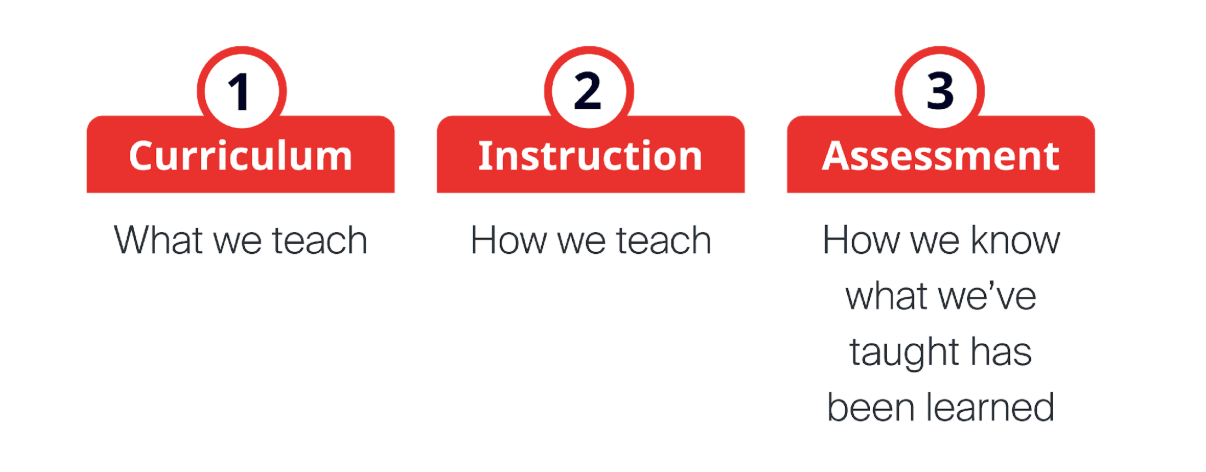
Instructional design, by contrast, is something that can be meaningfully controlled. It is specific, tractable, and accountable. A well-designed learning environment rests on three pillars: what we teach (curriculum), how we teach it (instruction), and how we know students have learned it (assessment). These are not mysterious processes accessible only to initiates; they are engineering problems, amenable to analysis, iteration, and improvement. The extent to which these three elements are aligned largely determines whether learning occurs at all.
Consider what misalignment looks like in practice. A curriculum that introduces concepts in an arbitrary sequence forces students to build without foundations. Instruction that assumes prior knowledge the curriculum never provided leaves learners stranded. Assessment that tests skills orthogonal to what was actually taught renders effort meaningless and feedback useless. In such systems, even the most motivated student is fighting the architecture itself.
Instructional design is necessarily narrower and that is precisely its strength. It deals only with what can actually be built: the selection and sequencing of content, the representations through which it is encountered, and the feedback structures that guide improvement. These are not metaphysical abstractions or aspirational slogans. They are design choices. And unlike “teaching and learning” as a catch-all, they can be specified, tested, revised, and improved. In other words, they belong to the domain of engineering rather than hope.
I would say that education has ironically fetishised the middle component here; instruction (which is what’s usually meant by ‘teaching’), but often this is merely a set of trivial activities rather than a coherent mechanism for moving knowledge from one state to another. This has led to a culture of teachers getting ideas for activities from Pinterest or Facebook and “trying them out” on their class the next day. (Imagine your dentist doing this?)
The obsession with instructional novelty has produced a strange inversion of priorities. Teachers are sent on courses to acquire new “strategies,” to diversify their repertoire of techniques, to make their lessons more interactive, more student-centred, more “21st century” (which we are now over 25% through.) Meanwhile, the curriculum they are teaching may be completely incoherent, the sequence arbitrary, the assessment disconnected from both. This is what Christine Counsell calls an “intransitive pedagogy”; a pedagogy without an object.
As I have written about before, I feel that retrieval practice is in danger of becoming unmoored from its object, the curriculum. The truth about retrieval practice is that its success is determined long before it is deployed in a classroom or study session. It is entirely dependent on how a domain of knowledge has been sequenced, designed, and rendered coherent in the first place. You cannot retrieve what was never properly encoded. You cannot space out of material that was never organised into retrievable units. The technique presupposes the curriculum; it cannot substitute for it.
This is the danger of extracting instructional strategies from cognitive science and treating them as transferable moves, applicable anywhere, to anything. Retrieval practice is not a spell you cast over content to make it stick. It is the final stage of a longer process: identify what matters, sequence it sensibly, teach it explicitly, then, and only then, retrieve it strategically. Skip the prior steps and you are simply asking students to rehearse confusion.
The implications extend beyond individual tasks to entire systems. If a curriculum offers no early feedback, no graduated challenge, no clear representation of what success looks like, then motivation becomes irrelevant. You cannot Growth Mindset your way through a poorly designed system any more than you can climb a staircase with missing steps.
The curriculum question; what we choose to teach and in what order, is logically prior to the instruction question. You cannot teach well what has been poorly selected or badly sequenced. Yet curriculum design remains curiously neglected in professional discourse, treated as someone else's problem, a given rather than a variable. Teachers inherit curricula; they rarely build them.
And on the question of curriculum design, Herbert Simon’s model of artificial systems offers another concept that deserves far more attention in educational circles than it currently receives: near decomposability. Complex systems, Simon observed, tend to be organised hierarchically, with subsystems that are relatively independent of each other in the short term but interact meaningfully over longer timescales.
A watch is nearly decomposable: you can remove the face without affecting the escapement mechanism, at least temporarily. A symphony orchestra is nearly decomposable: the strings can rehearse independently of the brass for days at a time, coordinating only when they come together for full rehearsal. And a language is nearly decomposable: vocabulary, syntax, and phonology can be learned separately for a time, yet must ultimately be integrated for fluency.
Now the point here is not to say that the whole doesn’t matter. Quite the opposite, the whole only matters because the parts can be stabilised first. Near decomposability is not a denial of integration; it is the precondition for it.
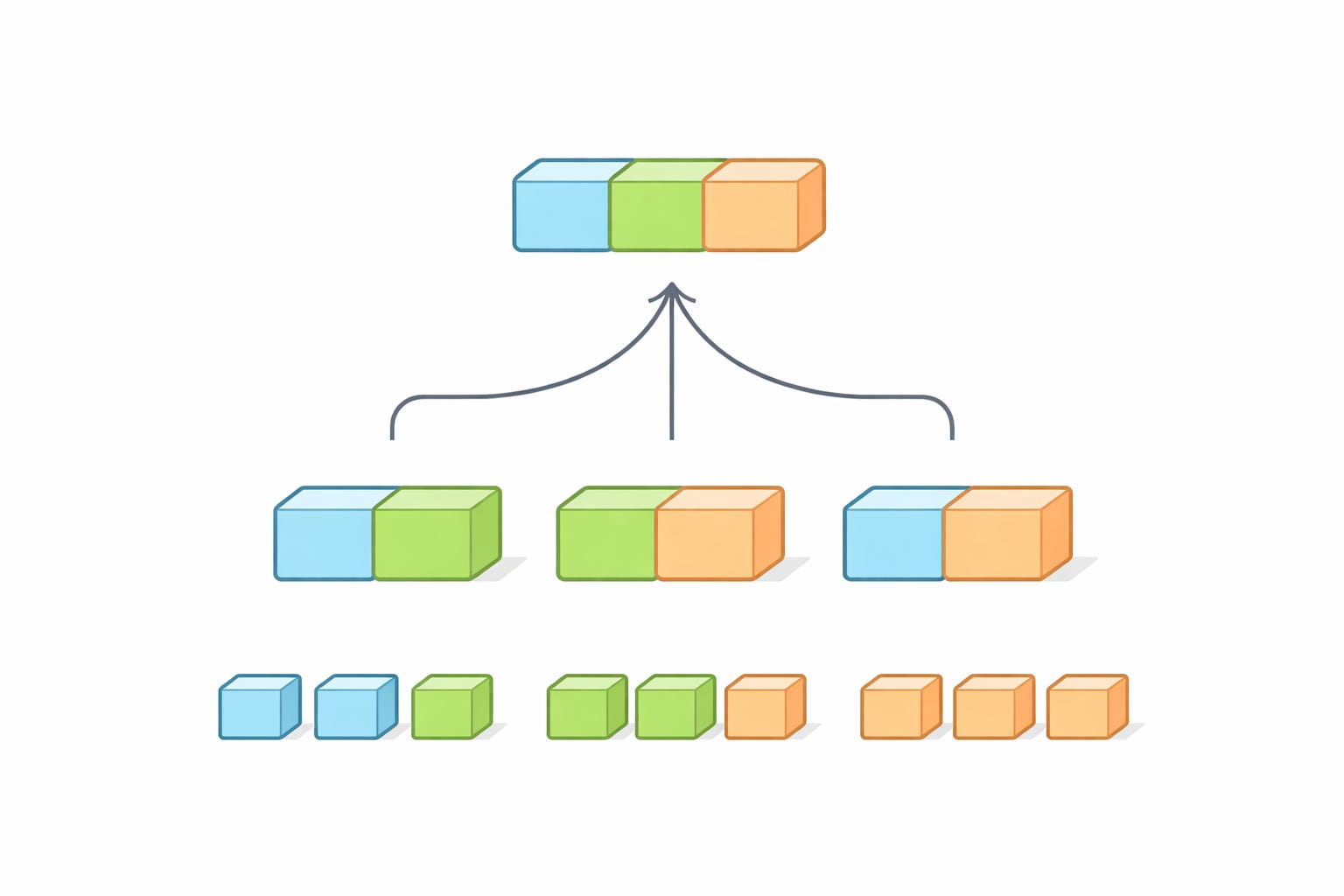
This gives us what I am calling an “instructional invariant” (a condition a system must respect or learning will degrade or collapse), and one of the most important invariants of all: complex knowledge must be built from stable subassemblies, or it will not accumulate later on.
Complex systems do not become coherent by confronting the learner with everything at once. They become coherent because those stable subassemblies can be mastered, secured, and then combined. Without that temporary independence, complexity collapses into noise. The learner is forced to juggle too many interdependent elements simultaneously, and progress stalls not through lack of effort or intelligence, but because the system’s architecture exceeds the learner’s cognitive capacity.
This is not merely an observation about how systems happen to be structured; it is an insight into why complex systems can exist at all. Simon illustrated this with his famous parable of two watchmakers in a paper called The Architecture of Complexity, through the characters of Hora and Tempus. Both made watches of equal complexity, containing a thousand parts. Tempus assembled his watches as a single integrated whole; if he was interrupted, the entire assembly fell apart and he had to start again. Hora, by contrast, built his watches from stable subassemblies of about ten parts each, which could themselves be combined into larger subassemblies. When Hora was interrupted, he lost only a small amount of work. Over time, Hora prospered while Tempus went bankrupt.
The parable is usually cited in discussions of organisational design, but its implications for learning are profound I think. A curriculum that is nearly decomposable allows students to master stable subassemblies of knowledge before combining them into larger structures. A curriculum that is not; one that presents knowledge as a seamless, integrated whole that must be grasped all at once; is Tempus’s watch. Every interruption, every absence, every moment of confusion causes the entire edifice to collapse.
This is why the romantic notion that learning should be “real world” from the outset is so often catastrophic in practice. When we ask novices to engage with authentic, complex, real-world problems before they have acquired the sub-component skills, we are asking them to build Tempus’s watch. The task is not merely difficult; it is architecturally hostile to the way learning accumulates. The student who misses a crucial early step does not simply have a gap; they lack the stable subassembly upon which everything else was meant to rest..
The best curricula, like the best watches, are designed so that component skills can be mastered to the point of automaticity before being combined. The student learning to read does not simultaneously juggle letter recognition, phoneme blending, vocabulary, syntax, and comprehension in one undifferentiated cognitive soup. Or rather, if forced to do so, that student will drown. Instead, systematic instruction builds stable subassemblies: letter-sound correspondences become automatic, freeing attention for blending; blending becomes automatic, freeing attention for word recognition; word recognition becomes automatic, freeing attention for meaning. Each level of the hierarchy stabilises before the next is built upon it.
This is also why so many educational technology platforms fail, despite their promises of personalisation and adaptability. They model learning as a smooth, continuous surface, as if knowledge were something that could be sampled, shuffled, and recombined at will. In practice, this means “adaptive” systems that merely rearrange content based on recent performance, offering what looks like responsiveness but is really just randomisation. Variety is mistaken for progress. Difficulty is adjusted, but structure is ignored. The system cannot distinguish between a learner who is struggling because a foundational subassembly is missing and one who is ready to move on, because it does not represent the knowledge domain as a hierarchy of nearly decomposable components in the first place.
As a result, failure is misdiagnosed as a temporary dip rather than a structural gap, and the learner is pushed sideways instead of being rebuilt from below. A genuinely well-designed adaptive system would not ask, “What should we show next?” but, “What must be secure before anything else can work?” Mastery checks would function not as gates to be gamed or bypassed, but as load-bearing joints in the architecture of learning. This is not rigidity; it is respect for how complex systems actually grow. You cannot build the second storey until the first is sound, and no amount of algorithmic cleverness can wish that constraint away.
It’s sort of de rigeur now in education circles to claim that the emergence of AI heralds the end of days in terms of learning but I think that’s ill-judged or at least too soon to call. Certainly if we follow the trajectory of Simon’s argument then a different and more interesting problem comes into view. The real danger is not that AI will replace learning, but that we will design AI systems with the wrong model of learning in mind.
Much of the current enthusiasm around educational AI rests on the assumption that the goal should be to mimic human learning as closely as possible. Systems are praised for being “human-like,” for approximating the way people explore, infer, make mistakes, and gradually improve. Human cognition is treated as the benchmark, the gold standard against which artificial systems should be judged. But Simon gives us good reason to be suspicious of this ambition. It assumes that because human learning is natural, it is therefore optimal.
It is not. At least not for things like reading, writing, numeracy, formal reasoning, or scientific thinking, (basically knowledge that has led to a lot of human flourishing) all forms of cognition that are recent, culturally accumulated, and biologically unnatural. Human learning in those domains is a product of evolution, and evolution is a terrible instructional designer for learning to read. It is slow, wasteful, and indifferent to individual failure. It operates through blind variation and selective retention, a process that took hundreds of thousands of years to produce language and basic tool use. The feedback is harsh, the signal-to-noise ratio is poor, and progress is purchased at extraordinary cost. From an instructional point of view, it is almost maximally inefficient.
Schools exist precisely because this is an unacceptable model for education. They are artificial systems designed to bypass the evolutionary bottleneck, to compress centuries of accumulated knowledge into sequences that can be learned in years rather than lifetimes. When we ask students to rediscover mathematics, physics, or literacy through unguided exploration, we are not honouring how humans learn “naturally.” We are forcing them to replay, in miniature, the slow and error-ridden history of the species. The artificial classroom is not a deviation from how learning ought to happen; it is a deliberate correction to how learning happens when left to the vagaries of nature.
The same logic applies to educational technology. An AI system does not need to learn like a human any more than a calculator needs to count on its fingers. If we were designing a learning system from scratch, informed by what we now know about cognition, we would not reproduce human weaknesses by default. We would correct for them. We would design around limited working memory, vulnerability to distraction, and the tendency to satisfice rather than persist. We would privilege clarity over realism, structure over spontaneity, and progression over exploration.
Many educational AI systems fail not because they are too artificial, but because they are not artificial enough. They chase naturalness when what learners often need is optimisation. They mimic surface features of human learning (trial and error, exploration, personalised wandering) without asking whether those features are pedagogically desirable. A genuinely intelligent learning system would not ask how humans learn when left to their own devices. It would ask how learning can be made faster, safer, and more reliable under real cognitive constraints.
I was reminded of this the other day watching the designers of Boston Dynamics’ Atlas robot discuss their approach to design. When asked about the robot’s unusual method of standing up; a movement that looks nothing like how humans rise; one engineer explained:
“Atlas doesn’t have to move like a person does. We’re looking for the most stable, efficient way to get up. And it turns out this is it.”
Atlas does not have to move like a person. And educational technology does not have to learn like a person. If you were designing a learning system from scratch, you would not copy human learning wholesale. You would correct for its limitations: our working memory constraints, our susceptibility to distraction, our tendency toward the path of least resistance.
None of this is an argument against effort or high expectations. It is an argument that effort and expectations are themselves shaped by the architecture within which they operate. A student who struggles with a well-designed sequence is developing genuine resilience. A student who struggles with a chaotic sequence is learning that struggle is pointless. The difference is not in the student; like Simon’s ant, it is in the surface they are traversing.
There is a quiet cruelty in constantly demanding better behaviour from students while leaving the poor environment unchanged. It assumes the problem is internal when it is structural. We speak endlessly to the ant. We exhort it to try harder, to believe in itself, to develop a growth mindset. We send it on courses about resilience. We put up posters about famous ants who overcame adversity. All the while, the beach remains as it was: windswept, cluttered, and indifferent to the ant’s good intentions.
Simon’s ant does not need motivation; it needs a different surface. And if we want to understand why students succeed or fail, we would do well to spend less time examining their internal states and more time examining the representations we have placed before them. Behaviour does not emerge from willpower alone. It takes the shape of the environment we build. The problem is rarely the ant. The problem is almost always the beach.
“The limits of the human mind are reflected in the structure of the environment in which it operates.” - Herbert Simon