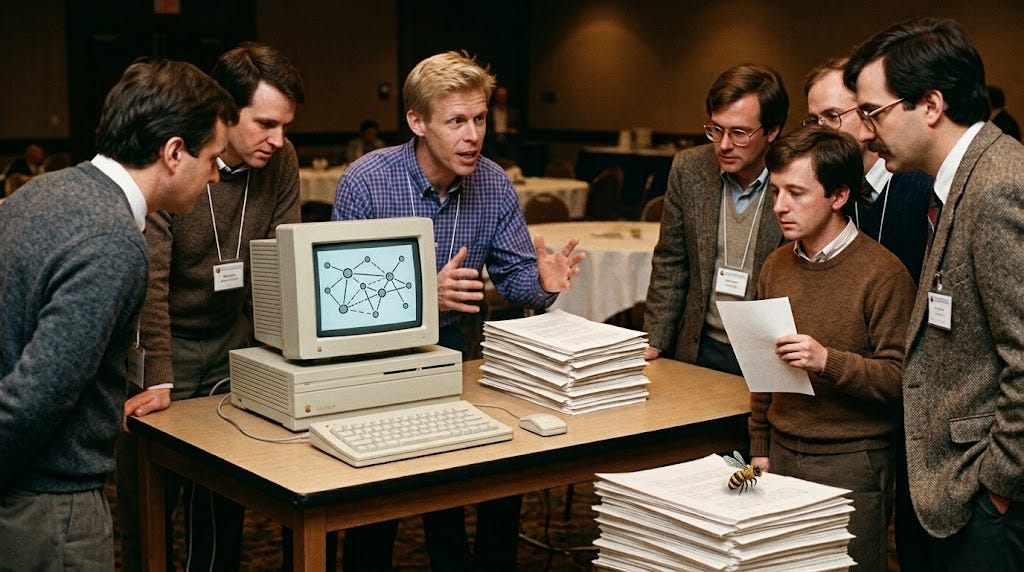
The first time I met the man who invented the World Wide Web, I was demonstrating my own project and his had just been rejected.
It was December 1991, at the ACM Hypertext conference in San Antonio — the annual gathering of the small, intense community of people obsessed with linking documents together by computer. I was a young postdoc at the MIT Laboratory for Computer Science, and I was there to show Cybermap, running on my Macintosh: a way to take a heap of unstructured documents and draw, automatically, a map of how they related to one another, from their text alone. People kept stopping at my desk to watch it run.
One of them was a soft-spoken English physicist named Tim Berners-Lee. He was not famous yet — nowhere close. He had submitted a paper to that very conference describing a thing he called the World Wide Web, and the conference had turned it down. I have to confess a detail that still makes me wince: I was on the program committee that rejected it. I do not remember the discussion. I would give a great deal to read the minutes.
So picture it. The future of human knowledge had just been told, in effect, not quite good enough for our conference — and its inventor walked over to my table, watched my little mapping program run, and asked, very politely, whether he might leave a few hardcopies of his papers there for passers-by to pick up. Of course, I said. And then he asked me something else: whether I would come and help him build this Web of his, as one of his first volunteers.
I said no.
The second no
That was the first of three times Tim Berners-Lee tried to recruit me, and the first of three times I turned him down. The second came the following year, in 1992, when he sought me out at MIT, sat with Cybermap properly, and suggested I point it at the documentation of the Web itself. I did — I ran my mapping tool across two dozen of his own design documents and drew one of the first maps ever made of the thing that would go on to swallow the world. The record of that afternoon still sits, in Tim’s own words, in the history pages of the W3C — thirty-four years old and still online, which is its own small argument for the thing he built. He asked me again. Again I said no.
The MIT I knew then was not a place of grandeur. The Laboratory for Computer Science sprawled across a warren of floors, and on the fifth, where I worked, Tim initially had no office at all — only a desk pushed against the wall of a windowless hallway. This was not coincidence. We were in the same group: David Clark’s, the man who had done as much as anyone alive to make the internet’s architecture work, and Tim arrived there first as a visiting scientist. So for a while the inventor of the World Wide Web and I were, in the flat bureaucratic sense that a university understands, colleagues on the same team. I, the visiting postdoc, had the better desk: a proper office with windows, which I shared with a colleague who would go on to grow wealthy as the technology chief of one of the first companies to sell internet access to the public. That was the strange arithmetic of that floor — the man inventing the Web at a desk with no walls, a future fortune sitting across the room from me, and all of us passing in the same windowless hallway every day.
Three things about Tim
Three things about Tim have stayed with me from those years. The first is that he was shy — which is why he never once tried to argue me into joining him, and why it was possible to say no to him three times without any awkwardness whatever. The second is that he treated everybody, without exception, at eye level: the man inventing the Web spoke to a visiting postdoc exactly as he spoke to a laboratory director, which in that building was rarer than it should have been. The third is that he answered email in minutes. In the early nineties the rest of the world took a week or two to reply, if it replied at all; a message to Tim came back before you had finished thinking about what you had sent. He talked at the same speed, and I will admit that my Swiss-German-flavoured English sometimes lost the thread of what he was saying entirely.
Decades later I would build software that measures collaboration, and one of its six honest signals — how fast you answer the people who write to you — I owe directly to watching Tim. Speed of response, I have argued in a hundred lecture halls since, is the most honest declaration you will ever make about how much someone matters to you.
The third no
The third refusal came later, and casually, in a hallway. By then he had founded the consortium that would steward the Web, and he asked whether I might be interested in running it as executive director. I understood the job to be, in essence, a glorified secretary to a standards body, and I declined again, politely.
I was too independent. I had my own ideas, my own projects, my own stubborn need to fly my own line. I know exactly how this sounds: I sat on a committee that rejected the World Wide Web, was then personally invited — three times — to help build it by the man at its center, and declined every time, to go and do my own thing. The establishment got Tim wrong; and for one conference in San Antonio, I was the establishment. I keep that memory close, because it is a reliable cure for self-righteousness every time I am tempted to cast myself as the lone visionary the world refused to understand.
It was also the first time I chose my own freedom over joining someone else’s empire. It would not be the last.
What I was doing instead
What I was doing instead was teaching a course at MIT on the animation of algorithms — a dozen students making abstract computational processes visible on screen, for the famous textbook by Cormen, Leiserson and Rivest. When the term ended, the students would not stop. Two in particular, an education master’s student from Harvard and a physics doctoral student whose thesis was on the hearing mechanics of cats, had no obvious business caring about hypertext and both cared enormously. So we made a real thing out of it: co-authors, an underlying hypertext engine two of us built by hand, a publisher found through open doors at MIT. No one told this group to form. No one paid most of them. It had no manager, no deliverable and no business case, and it produced something none of us could have produced alone.
I did not realise for another decade that this was the first Collaborative Innovation Network I ever built — the thing I would spend the next thirty years writing papers about. I had it in my hands in 1992 without knowing what to call it.
What the Web taught me
Because here is what those encounters taught me, and what I have spent thirty years confirming. The Web was not built by a lone genius in a locked room — not even by Tim. He was the spark, but the fire belonged to a loose, global cloud of volunteers who shared code, argued over protocols, and traded ideas at two in the morning, bound together by nothing but the conviction that information should be free and connected. Nobody owned it. Nobody was in charge. And it outbuilt every funded, managed, chartered competitor on earth.
I said no to the empire, three times. But I spent the rest of my life studying the swarm.
In the language of this newsletter: Tim was a Bee of the purest kind — the idea and the network to carry it, given away for free. If you missed the five animals, start here; and if you want to know which one you are in your own conversations, the Beecome app will tell you.
Next week: what happens when you put wearable sensors on nurses, bankers, and one professional jazz band.