There is the old story about the blind men and an elephant:
A group of blind men heard that a strange animal, called an elephant, had been brought to the town, but none of them were aware of its shape and form. Out of curiosity, they said: "We must inspect and know it by touch, of which we are capable". So, they sought it out, and when they found it they groped about it. The first person, whose hand landed on the trunk, said, "This being is like a thick snake". For another one whose hand reached its ear, it seemed like a kind of fan. As for another person, whose hand was upon its leg, said, the elephant is a pillar like a tree-trunk. The blind man who placed his hand upon its side said the elephant, "is a wall". Another who felt its tail, described it as a rope. The last felt its tusk, stating the elephant is that which is hard, smooth and like a spear.
One way I like to think about this story is through the lens of multi-view geometry in computer vision. That is - we have a common 3D object that is viewed separately between two camera positions. What we want is a way to convert between these different coordinate frames that preserves the same underlying reality.
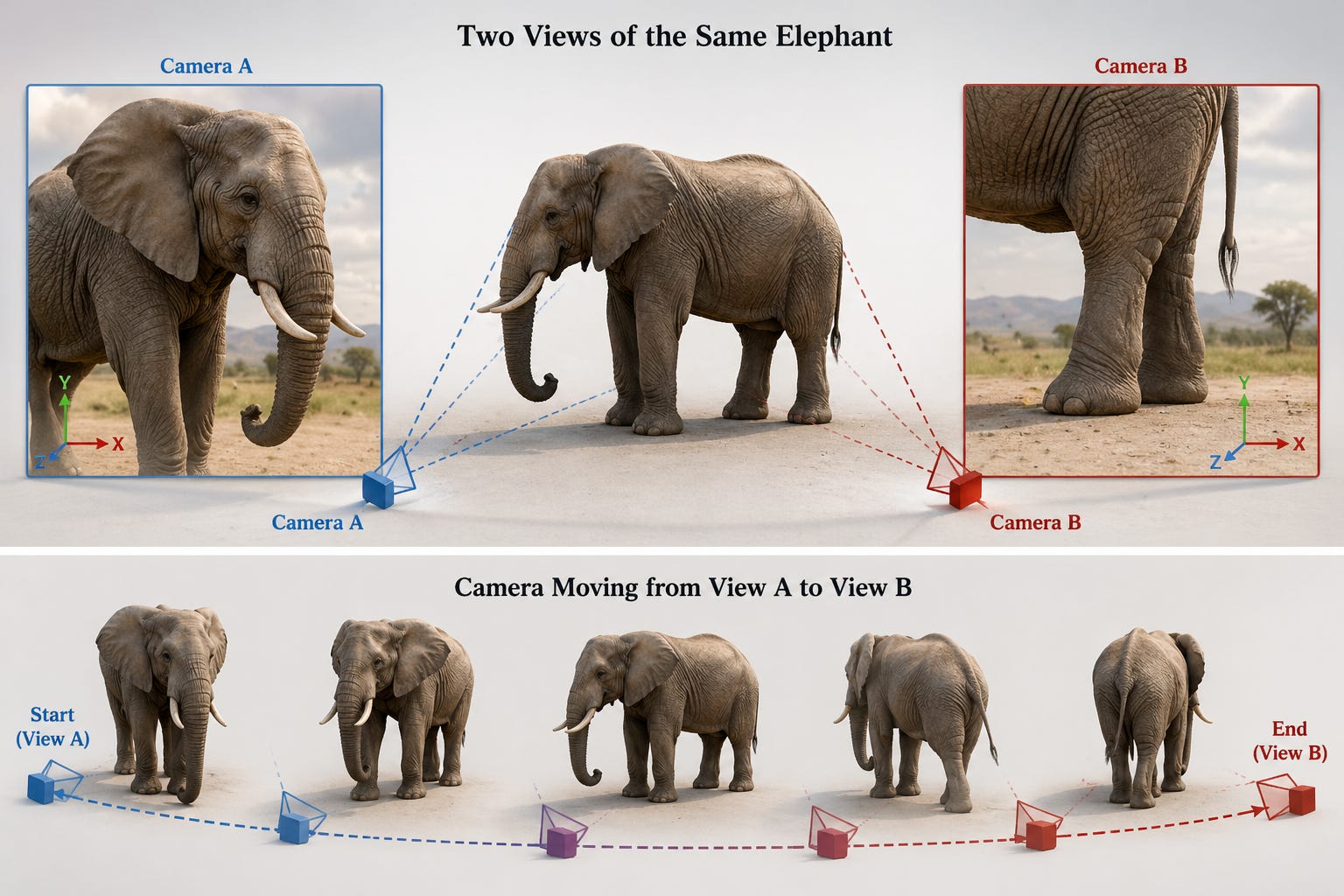
In computer vision, this boils down to a transformation matrix: something that shifts a camera view in 3D space. A translation between two different perspectives.
Now, the same principle applies when we deal with phenomena in the real world. Many academic fields study separately topics that boil down to common questions: how decisions are made (economics, psychology, computer science, machine learning, decision-science, operations research); how ideas diffuse between individuals (sociology, economics, anthropology, linguistics, epidemiology); how individuals interact under conditions of scarcity (ecology, biology, economics, game theory).
These individual lenses are like different views of the elephant. Each captures a partial glimpse using its field-specific methodology, tools, and available data - and through this, attempts to create an explanatory model that best fits the observations. Each is limited by the missing observations that are not visible to its tools.
One thing I find interesting is how often ideas are separately discovered between fields - how often ideas that are well known in one domain lay unknown in another, until one day they are independently discovered, and provided a new name in the local dialect. This should not be surprising - where two fields with little interaction separately observe a common underlying reality, it is likely that they will evolve by fitting data to develop similar analytic tools and explanatory models.
This often leads to field-specific jargon for similar mathematical ideas. There are many examples of this - from the famous Tai’s Model in nutrition science (a rediscovery of the trapezoidal rule in integration), to Mandelian Randomization in genomics (an instrumental variable method), to the menagerie of terms for precision, recall, specificity, sensitivity, type-I and type-II, false positives, and false negatives that are found in different domain applications in statistics.
This brings me to my central point. There is enormous value in translating ideas between different fields of study. By similar token, identifying when an explanatory model that has value in one domain may be used to understand problems in another can be highly useful. That is, where analogical reasoning from a different reference frame can provide new insight or enable transfer learning to a different domain.
These analogical transforms are a useful tool in problem solving. Problems that are intractable from one perspective can be much simpler when viewed from another lens. It is a common technique in mathematics to convert between different bases depending on the problem that is trying to be solved. In signals processing, we may convert problems to the frequency domain, perform some computational steps, then map back into our original domain - vastly simplifying the problem.
Similarly, analogies can be the transformation that allows us to reason through an issue in the abstract or to communicate an idea more clearly between two individuals with disparate backgrounds. They convert a concept to a shared common ground - which allows the essence of an idea to be translated more easily. As writers like George Lakoff and Mark Johnson have noted in Metaphors We Live By and Douglas Hofstadter and Emmanuel Sander in Surfaces and Essences, analogies encapsulate entire sequences of reasoning - so that a statement like ‘business is a battlefield’ contains within it the idea of competition, strategic undertakings, wars of attrition, moral casualty, tactical efforts, campaigns, generals, and conflicts. No wonder that Sun Tzu is popular with business crowds! The idea is not that business is literally a battlefield - but that there exists a conceptual similarity that hints that ideas and explanatory models that are useful in one domain may be useful in another.
This way of communicating has long been known to university lecturers, management consultants, and political speechwriters - if you want to communicate a complex idea, find a simple analogy. Better, find an analogy that can maps directly to the concepts that are well known by the audience. The connection, once made, creates a bridge to the core concepts and ideas in an unfamiliar domain - it unfurls in a mind and allows their existing strengths do the explaining for you. The best thing you can possibly hear when explaining a new topic is: “Oh, so it’s just like this.”