
You never know who’s watching, listening and translating in real time..
About a month ago, after a swift perusal of its first few pages, I bought a copy of Paul Kingsnorth’s book “Against The Machine”, in Aberdeen University’s bookshop. Its premise chimed with my growing sense of unease at how in the last few years, notably since the government’s handling of the Covid episode, every aspect of our lives has come under the control of information technology - our health, our wealth (or poverty), our education, our social lives (or what’s left of them), even our family relationships. Kingsnorth’s compelling argument is that this situation, the inexorable rise of what he calls ‘The Machine’, is simply the inevitable outcome of a process that began with the 16th century ‘enclosure’ of peasant-farmed marshlands in the east of England into industrially cultivable lands, and the ensuing industrial revolution in the north of England, a pattern that was subsequently replicated worldwide.
While not planning to go off-grid to the extent that Kingsnorth has in his retreat on the west coast of Ireland, I resolved to focus on those areas of my life that remained inherently technology-free: my walking and cycling (get thee behind me, Strava!), my vintage watch restoration side-hustle, my reading and research in Middle East history and religion.
Unfortunately, a month down the line I find myself sucked deeper into The Machine than ever before, with its tentacles probing deep into my psyche and soul. What went wrong?
I belong to the very last generation that completed its school and university educations without actually touching or even seeing a computer. That said, one of the best birthday presents I ever received as a little boy was a “Computacar”, a toy sports car that came with pieces of stiff card to be fed into the car’s chassis, onto which I could punch instructions telling the car to advance, reverse, and turn left or right.
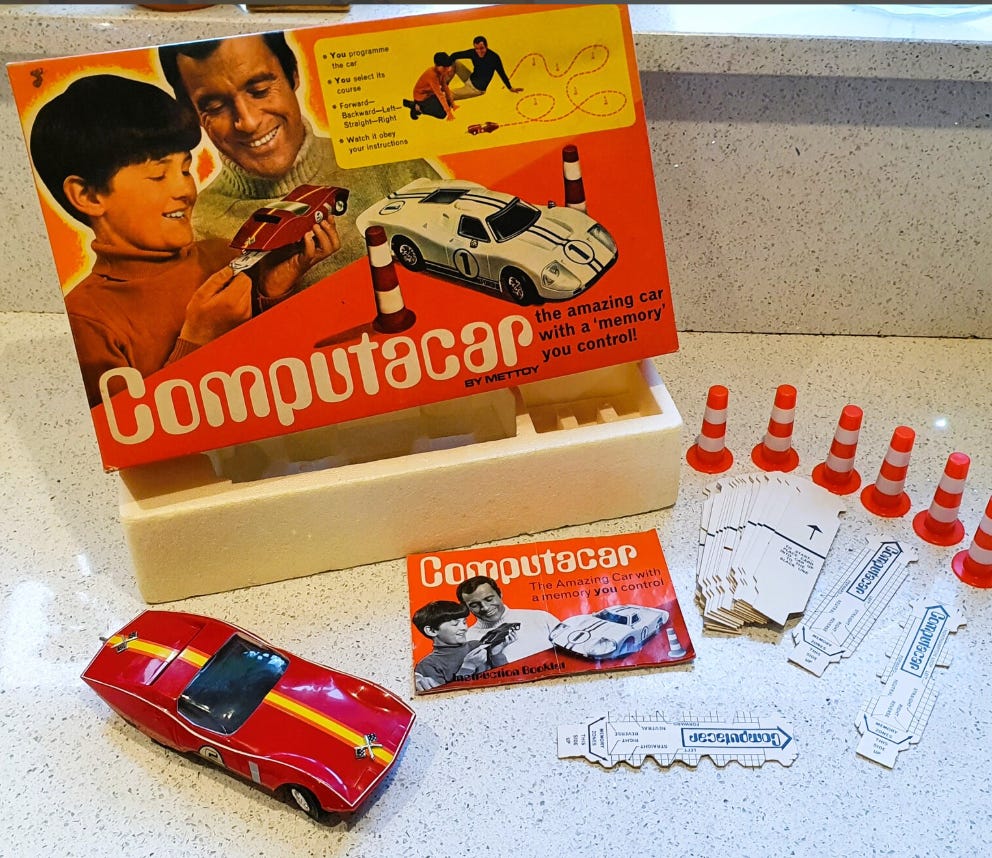
The amazing mid-60s programmable Computacar. I had the white model, with 1.2g of cardboard ROM.
Ten years later, a maths teacher at my secondary school was still teaching “computer science” by handing out pieces of 10” long card onto which the students punched holes with a biro. At the end of each lesson he gathered up the cards in a shoe box and took them off to the Big Computer at the local university, returning them the following week together with a length of ticker tape, the results of whatever the wannabe coders had ‘programmed’ into their pieces of card.
Later on, at the same university, I heard rumours that the Big Computer was connected to other Big Computers in London and even the USA, and that the computer boffins could send each other messages through the transatlantic telephone lines. I never actually saw this machine, though.
Fast-forward 60 years from when I last programmed my Computacar, I find myself encumbered by the typical trappings of the internet age: Instagram and Facebook accounts, email and WhatsApp, banking and payment apps and, of course, LinkedIn. As a freelance translator I had never taken LinkedIn very seriously, as I derived regular work from my professional network, both on- and offline, and found the endless corporate whooping, high-fiving and chest-beating tiresome. But recently I smartened up my profile, had my CV reworked by the inhouse AI app, and started to receive numerous job suggestions in a variety of fields, all apparently relating to the training of AI models.
Each announcement came with a blue button at the bottom saying “Easy Apply”, so I did. To dozens of them. I didn’t keep a record of or even pay much attention to what I was applying for, I just kept on hitting that button. Next thing I knew, I was taking interviews with a bot called ██████████. The first one I failed, probably because I told ██████████ to speak properly and stop saying things like “I’m good” when asked how she was. This was an interview for expertise in spoken and written English, after all.
Apparently I did better in other interviews, because a week later an email arrived with a contract from a company called ██████████, requiring me to commit to 30 hours' per week of “video diarisation” in exchange for a good hourly rate, more than I ever earned as a freelance translator. And then another contract arrived from a company called Mercor, albeit for a more modest wage, subcontracting me to Nvidia as an RLHF Expert French trainer (I can never remember what RLHF stands for. Right-Left High Frequency, perhaps?) to analyse and evaluate AI chatbot responses for several hours a day.
All well and good, except that it was at this point that I detected The Machine’s tentacles extending its grasp over my working day, my leisure time, and even my sense of self.
To proceed with the Nvidia contract I had not only to sign the contract, but to start the “onboarding” process. In the technology world, “onboarding” means getting hired and “offboarding” is simply a euphemism for getting fired. Getting onboarded entailed another nine steps, including opening a new email account, signing up for Slack (a souped-up corporate chat app) and joining several groups there, installing the Insightful payroll timer app, setting up an app called SuperAnnotate and getting criminal and financial background checks from local authorities. Overall, I probably spent 10-15 hours jumping through all these hoops.
Finally I was on board, and I was instructed to study and memorise screeds of instructions and guidelines (“GLs”) on how to perform Chatbot response evaluations. Mercor authorised us to spend up to 45 minutes’ billable time studying these, but it took considerably longer. I filled in a final form confirming that I had read, understood and swallowed the GLs, and sat back waiting for my first task to appear on SuperAnnotate.
I waited. And waited.
After four days’ waiting, with constant checking of websites, Slack and email, I read a rumour on Slack that there were no French tasks to be done.
Two days later I received an official notification on Slack. The client had no projects, and we, hundreds of new recruits, would all be “offboarded” shortly.
This morning I received the princely sum of $41 for my travails. At least, now that I am “off-board”, my contract has lapsed and I can tell my story.
Apparently this is the fairly commonplace experience of the hundreds of thousands of AI labourers who are onboarded and offboarded willy-nilly by these companies, as projects arise and evaporate against a backdrop of white-hot corporate mergers and acquisitions. This phenomenon is thoroughly dissected and explained by Phil Neel of The Planetary Factory in his article Lesser Gods: Labor in the AI Labyrinth Part 3:, in which the following paragraph caught my eye:
The systematic disempowerment of workers within the AI supply chain also enables the literal weaponization of these AI systems. In 2018, a small group of high-level software engineers at Google engaged in an effective work stoppage, refusing to contribute to a project designed to help the company win military contracts. This then drew attention to other military projects, including involvement in the Pentagon’s “Project Maven,” in which Google AI technology would be used to analyze drone surveillance footage.
Which brings me to my ‘other’ job. I am at present still under contract to the company involved, even if I suspect I am to be “offboarded” at any time, so have redacted all the names.
The recruitment procedure was broadly similar to that of Mercor, even to the point of successfully “onboarding”, only to find once again that there were no tasks for me and the dozens of other new recruits to do. All the English tasks had been done and the high heid-yins (that’s Scots for “the Management”) had no idea whether more were on the way. In a Kafka-esque twist, we were repeatedly told that the arrival of future tasks was contingent on the client being satisfied with the quality of current tasks - of little relevance to us, as we hadn’t done any yet.
I did however have an inkling of what the work entailed, because after passing the AI bot interview, I sat and passed a quiz on the GLs (guidelines, remember?) and performed three “screener tasks” of increasing difficulty. The tasks consisted of 15 or 30 second video clips of one, two or three people speaking, against a background of music, dogs barking, etc. They had already been automatically subtitled, but inaccurately in terms of timing, and did not differentiate between different speakers.
Our job was to assign each word (“chunk”) or group of words to a colour coded speaker, describe that speaker’s physical appearance and voice characteristics, and tighten up the accuracy of when each “chunk” was uttered. The only explanation we were given as to what we were actually doing was a single sentence - creating datasets to train AI subtitling applications to distinguish between speakers in a video, something they struggle to do at present. But more than that, although we were not explicitly told this, we were teaching it to accurately transcribe spoken language in a form that could presumably be automatically and accurately translated into other languages.
Except, once again, in the absence of any English tasks, there was no work for me to do.
After two weeks or so, I decided to push the envelope a bit. There were (and this was the first red flag) numerous Chinese, Hindi and Arabic tasks available - a backlog, even. Although engaged to handle English tasks, I do speak fluent near-native French, and passably good Arabic, scoring 88% at CEFR C2 level (the top). Whether that was good enough to do these tasks properly, there was only one way to find out. I responded to a call for Arabic speakers to do Arabic tasks as part of a higher quality “██████████” program, took a quiz on the ██████████ GLs, and was accepted.
Finally, I was deep in the heart of The Machine, and could start work.
The Arabic video clips to be worked on consisted of everything from news broadcasts, studio interviews and dubbed children’s cartoons in nice clear Modern Standard Arabic, to football matches, earnest theological discussions and Egyptian soap operas. I favoured the studio interviews and the cartoons, as the existing subtitling was reasonably accurate.

I have become a big fan of Lazytown dubbed in Arabic
The work was done on an online, client-access only OpenAI application called ██████████, for a company called ██████████ ██████████.
I did my best, which probably wasn’t good enough. I also discovered to my horror that my aging Microsoft Surface laptop, which has been absolutely brilliant over the last 9 or 10 years, has only got 4gb of RAM, while the current standard is 16gb or 24gb. This might explain why I was unable to accurately mark the start and end of each word, as the videos tended to stutter. My 12” monitor was hugely inadequate and I struggled to see and correct the diacritics on Arabic words. The fact that my Arabic keyboard consists of a set of labels stuck on the keys of my standard FR/EN keyboard made typing in Arabic painfully slow.
My tasks came back from reviewers requiring dozens of corrections, some of them linguistic, some of them on timing and descriptions. The reviewers were of course native Arabic speakers locate all over the world, with differing interpretations of the US-centric appearance and voice descriptions. Overall they were very gracious about my work, and we eventually got some tasks through to the next review stage.
However, after doing about ten tasks, I was removed from the project - possibly for telling one of the West Coast-based high heid-yins (see above) late one night that I was CET-based and that I wasn’t prepared to work long into (her) PST evening hours at the end of my own working day.
I haven’t been offboarded - yet. But it has given me time to think about the exact nature of what I have been doing, and for whose benefit it might be. We were training AI bots to watch videos and to accurately differentiate between the persons appearing in them, to correctly assign the speech it hears to those speakers, and to generate extremely accurate written Arabic subtitles that not only record who said what, but effectively differentiate between the full gamut of Arabic accents and dialects from Muscat to Morocco and transcribe them into written standard or dialectical Arabic.
Is all this really so that Arab kids can watch correctly subtitled versions of Sonic the Hedgehog?
AI giants and the US Department of War
As anyone following developments at the top of the AI tree will know, last month, many users of OpenAI’s ChatGPT abandoned the platform, switching mainly to Anthropic’s Claude chatbot. Essentially, the US government wanted all AI suppliers to authorise the Department of War to use their products to plan its military strikes on Iran. Anthropic stood its ground as regards the US government’s use of its products, and essentially got “offboarded”, and declared a “supply chain risk”.
At the same time, according to the MIT Technology Review website, “on February 28, OpenAI announced it had reached a deal that will allow the US military to use its technologies in classified settings.”
OpenAI also published a statement to the effect that while it was cooperating with the US Department of War, this was within the limits of national law, and that it would not allow the DoW to use OpenAI products in the following manners:
No use of OpenAI technology for mass domestic surveillance.
No use of OpenAI technology to direct autonomous weapons systems.
No use of OpenAI technology for high-stakes automated decisions (e.g. systems such as “social credit”).
Convincing as this may be, we all know that laws change, and that “mission creep” rapidly brings off-limit technologies within the limits of acceptability.
And there I was, training OpenAI’s ██████████ product to produce datasets that enable AI applications to parse videos - any videos, even of poor quality - in order to generate accurate and reliable transcripts of what is said, in Arabic of any dialect, by multiple speakers, even against a sea of background noise.
Now, even if we were to accept that the US Department of War will abide by the legal restrictions on OpenAI’s products, it would be naïve to assume that America’s partners will do the same.
The AI industry itself is, at times, brutally honest about the vulnerabilities of the systems it is building. According to the Sapien.io website: There’s no trust primitive. There is no way to prove who made the judgment. No way to verify how it was made. No way to assess whether the source was credible.
Which brings me to the situation depicted at the head of this article. We have seen how Israel carried out terrorist attacks on civilians in Lebanon and Syria using boobytrapped pagers, and multiple assassinations in Iran using Iran’s CCTV system. I have no evidence that the products I worked on are or will be intended for military use, but is it fanciful to imagine that an OpenAI-trained product operated via a mobile phone could be used to film and livestream individuals having conversations in public places, relaying a transcription and translation in real time back to an AI-run (or human) command centre that decides, on the basis of what it is “hearing”, whether to launch a drone or missile to “eliminate” those individuals?
Worse, could such a system observe young children discussing the latest Lazytown video, misinterpret their speech (based on faulty datasets produced by bumbling amateurs such as me), and identify them as a threat to be eliminated?
The children among the 3,250 people maimed or killed by Israel’s Lebanon pager attack might fear so.
So the main competitor (Anthropic) of the company whose product I had been training (OpenAI) was simultaneously being blacklisted by the Pentagon for refusing to enable autonomous weapons AND being used by the same Pentagon to plan strikes on Iran. You couldn't make this stuff up, as they say.