Recently, the Mistral models have taken the LLM world by storm. The Mistral Mixture of Experts (MOE) 8x7b model outperforms other models in it’s weight class such as LLamA 2 70B and GPT 3.5. Here’s a quick review of it’s performance on different LLM benchmarks:

And even the smaller Mistal 7b model seems to be “punching well above its weight class, taking on LLM giants”, and emerging as the Best [small) OpenSource LLM Yet. Can we understand why ?
In this post, I conjecture why Mistral 7b works so well–based on an analysis with the open-source weightwatcher tool, and drawing upon the Sornette’s theory of Dragon Kings
Here’s a Google Colab notebook with the code discussed below
A) Analyzing Mistral 7b with weightwatcher
Let’s run Mistral-7b through its paces with the weightwatcher tool. This time, however, we are going compare the standard results with one of the advanced features of the tool, the fix_fingers option (described in this earlier blog post).
Here are the steps we take:
A.1) Download Mistral-7B-v0.1 base model to a local repo:
!git clone $base_model_html
Notice that this repo contains the base model in both as both safetensors files and pytorch_model.bin files; we can remove the latter and just keep the 2 safetensors files.
A.2) Run weightwatcher with the fix_fingers=’clip_xmax’)
import weightwatcher as ww
watcher = ww.WeightWatcher()
details = watcher.analyze(model="Mistral-7B-v0.1", fix_fingers='clip_xmax')
The resulting details dataframe wlll contain 2 columns
- raw_alpha: the estimated Power Law (PL) exponent alpha, without applying fix_fingers
- alpha: the ‘fixed’ alpha, adjusted for fingers (i.e possible Dragon Kings)
A.3) Compare the 2 alphas
We analyze the results weightwatcher power law qualiy metric alpha by making a histogram of the raw (default) alpha, and the (fixed) alpha.

We see that the raw_alpha and the ‘fixed’ alpha look very different. The raw_alpha have a very wide distribution, with many layer raw_alpha >> 6 , with 1 even as high as 40! And the average <raw_alpha>=~5.7, which is just at the edge of the safe range (we want the average layer <alpha> in [2,.4])
The ‘fixed’ alphas, however, are very different. The distribution is much sharper, with very few ‘fixed’ alpha > 6, and the average fixed <alpha> =~ 4.8. Under the lens of the weightwatcher HTSR theory (described in our seminal paper), this is model looks much better.
A.4) Compare to other base models
Here are the same plots for the LaAMA-7b and Falcon-7b base models:

Notice that the raw_alpha and the ‘fixed’ alphas look almost identical. And the layer averaged alphas are also almost identical. So it not necessary to use the slower fixed_finger options when running weightwatcher.
So what’s going on ?
B) Fingers and Power Laws
So-called ‘fingers’ are large positive outliers that arise when computing the Empirical Spectral Density (ESD) 


B.1) Plot a layer ESD with weightwatcher
Let’s pick a layer with a prominent ‘finger’ and plot the ESD.
watcher.analyze(layers=[139], plot=True)
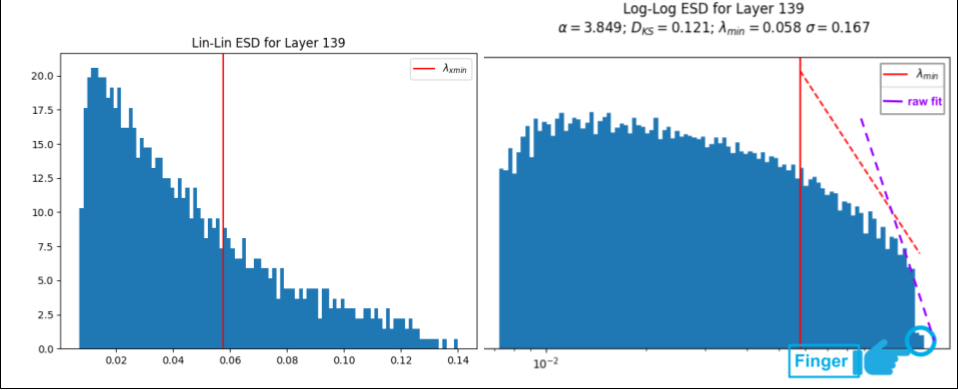
When we add plot=True, weightwatcher will generate several plots for each layer, such as the 2 plots above. The plot on the left is a histogram of eigenvalues for layer 139 (the ESD), and on a linear-linear scale, depicting a typical Heavy-Tailed (HT) ESD, The one on the right is the later ESD, this time on log-log scale, along with the PL exponent 

The finger is in the lower right side of the log-log plot, and looks like a small ‘shelf’ at the far end of the ESD. The finger consists of 1 or more spuriously large eigenvalues 


B.2) Stability analysis of fix_fingers option
How can we tell if the ‘fixed’ alpha is stable ? There is a plot for this too.
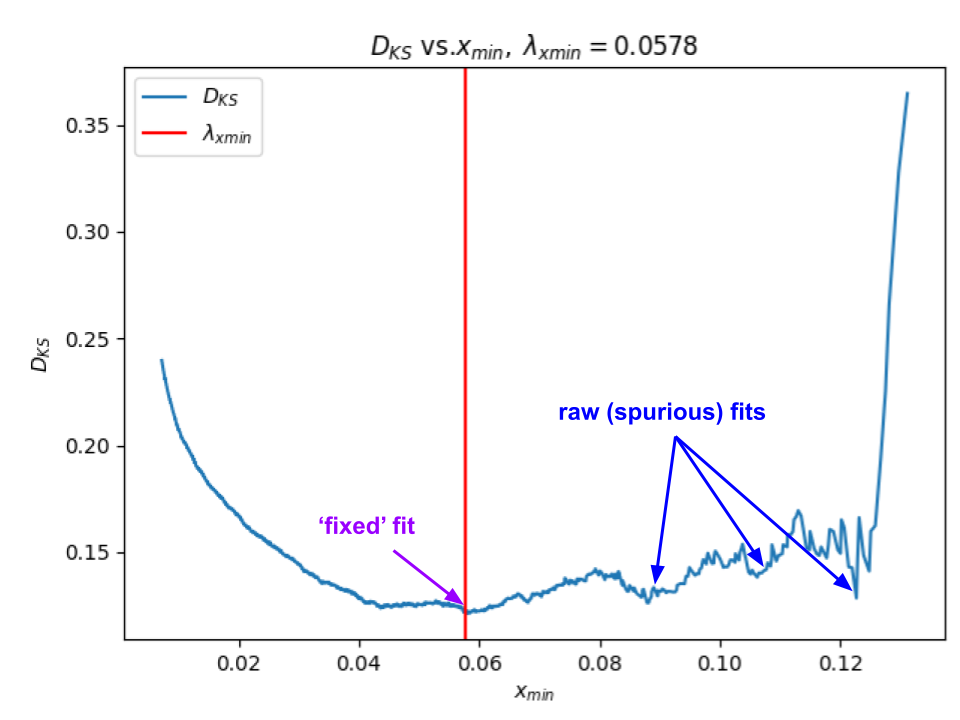
The plot on the left helps us evaluate the stability of the weightwatcher power law (PL0 fits. It plots the choice of the start of the PL tails (red line) against the qualty of the PL fit (Dks, the Kolmogorov–Smirnov distance between the data and the fit)
Good fits show a single, easily-found global minima. Bad or spurious fits have lots of close or degenerate fits
In this plot for the Layer 139 PL fit, we see a realtively convex envelope near the choice of 
B.3) Comparing alpha to other weightwatcher metrics
The alpha metric is one of a number of weightwatcher layer quality metrics. It is the most inteesting because it lets us identify the Universality class of the layer. That is , is the layer well fit ![(\alpha\in[2,6])](https://s0.wp.com/latex.php?latex=%28%5Calpha%5Cin%5B2%2C6%5D%29&bg=%23ffffff&fg=%23000000&s=0&c=20201002)


A good metric to compare against is the rand_distance metric. This metric computes how far a layer weight matrix W is from being a random matrix–the larger the distance, the less random (or more correlated) W is. Generally speaking, smaller alpha means larger rand_distance. We can compute rand_distance using therandomize option:
details = watcher.analyze(plot=True, fix_fingers='clip_xmax', randomize=True)
alpha vs Rand_Distance
We can now plot the raw_alpha vs. rand_distance , and the (fixed) alpha vs rand_distance.
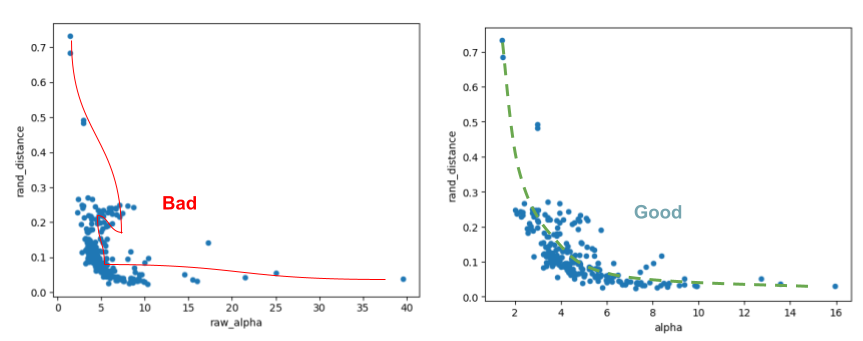
Once again, we see that the raw_alpha and the ‘fixed’ alpha cases look very different. The raw_alpha is is not even a proper function of rand_distance, and shows a stange circular trend red line. On contrast, while not a perfect relation, the ‘fixed’ alpha at least shows a noisy but proper trend green line.
Both the metrics are noisy estimators, but by cimparing them, we can see that the fixed_alpha is a more consistent estimator of the Heavy-Tailed (HT) quakity metric alpha for each layer.
C) Fingers as Dragon Kings
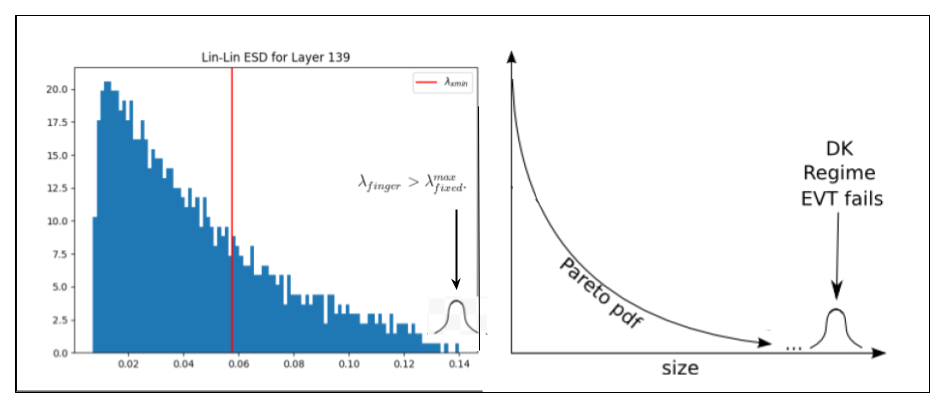
Why do we observe so many outlier eigenvalues ? Here, I posit the conjecture that these spuriously large eigenvalues correspond to Dragon Kings (DK). The Dragon King Theory was first postulated Professor Didier Sornette to explain the appearance of enormously large outliers in the power law fits of a wide range of self-organizing phenomena.
Dragon Kings (DK) are thought to arise as a result of some kind of coherent collective event or some other deterministic mechanism that can act like a dynamical attractor, accelerating the learning for the features associated with those specific eigenvectors at the far end of the ESD.

In particular, in Dragon Kings are thought to arise in quasi-critical systems exhibiting Self-Organized Criticality (SOC)–such as in the avalanche patterns observed in biological, cultured neurons!– due to the inherent dynamics and interactions within the system that push it to a critical point.
This can be due to long-range interactions and./or feedback loops, that, when activated, lead to the emergence of these extreme signatures.
When it comes to neuro-dynamics of, sometimes Dragon Kings help, and sometimes they hurt. In some cases, they are thought to suppress neural function, and, in others, they are characteristic of proper function. See this 2012 paper for a brief review; there are many recent scientific studies on this as well.
But most importantly, and in the context of training an LLM, the appearance of Dragon Kings indicates that some unique dynamical processes is generating these extreme eigenvalues and that this is fundamentally different from the goings on the normal dynamics of the SGD training processes for LLMs.
In an LLM , when do DKs hurt and when do they help ? I suspect that when they arise in the ESD like they do in Mistral-7b, they may indicate better performance. But I suspect may also appear as Correlation Traps, and, in this case, they may hurt performance.
I am postulating that it is this unique process, whatever it is, that is giving Mistral-7b (and the MOE 7x8B model) such remarkable performance. And if correct, it’s possible we could identify the underlying driving process and amplify it during training.
D) Testing the Dragon King Hypothesis with weightwatcher
WeightWatcher is a one-of-a-kind must-have tool for anyone training, deploying, or monitoring Deep Neural Networks (DNNs).
As we more and more powerful open source LLMs emerge, it will be possible to test this Dragon King Hypothesis by running the open source weightwatcher tool. I encourage you do this yourself, and / or join our Community Discord and submit some LLMs to test.