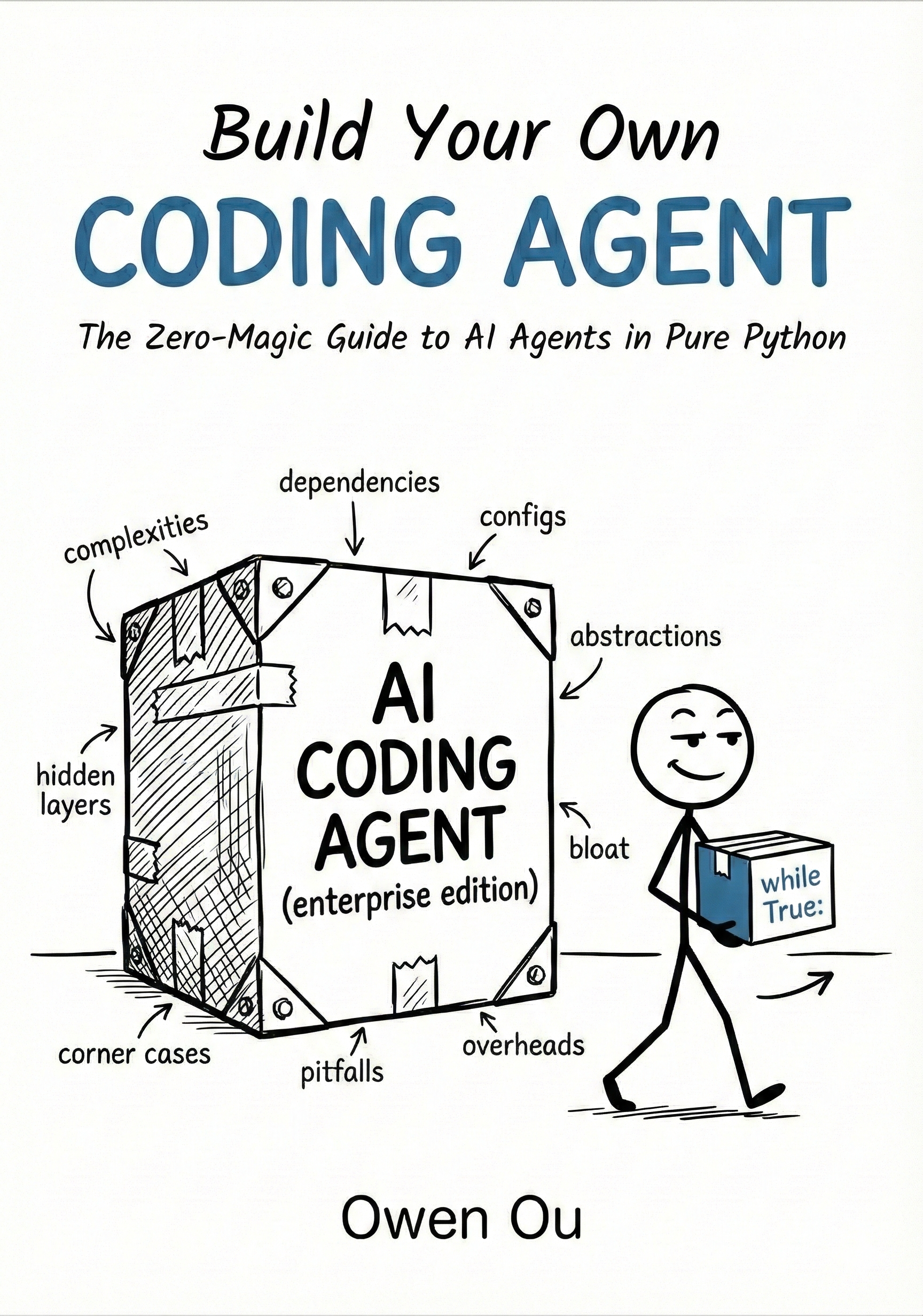
Not Magic.
Just a While Loop.
You've tried the frameworks. You've watched your LangChain app hallucinate its way into disaster. There has to be a better way.
Build Nanocode — a production-grade AI coding agent — from scratch.
Pure Python. A single file. Code you can debug with print().
12 chapters 3 LLM providers Full test suite
What You'll Build
An agent is just four things. You'll build each one from scratch.
1
The Brain
A stateless API call — Claude, DeepSeek, or Ollama
2
The Tools
Read, write, and surgically edit files. Execute shell commands. Search code and the web.
3
The Memory
A Markdown scratchpad injected as the system prompt. Persists across sessions.
4
The Loop
A while True that runs tools, self-corrects errors, and asks permission before dangerous ops.
Can it actually code?
The Final Exam: In Chapter 12, the agent builds a complete Snake game in Pygame — without the user writing a single line of code.
You speak the plan. The agent writes, runs, debugs, and fixes the code until the game is playable.
python snake.py — generated by Nanocode
Chapters
From "Hello World" to a game-building AI — one chapter at a time.
Part I — The Brain
- 01 The Zero Magic Manifesto Read free
- 02 The Raw Request Read free
- 03 The Infinite Loop Read free
- 04 The Universal Adapter
Part II — The Hands
- 05 The Tool Protocol
- 06 The Scratchpad (Memory)
- 07 The Safety Harness (Plan Mode)
- 08 The Context Pipeline (Map & Search)
- 09 The Reality Check (Running Code)
Part III — The Frontier
- 10 Going Dark (Local Models)
- 11 The Extension (Web Search)
- 12 The Capstone (Building a Game) Read free
Appendix
- A Streaming Responses
FAQ
Do I need AI/ML experience?
No. If you can write Python, you can follow this book. Every AI concept is explained from scratch with physical metaphors — no math, no theory papers.
Does it work with GPT or other models?
The book covers Claude, DeepSeek, and Ollama. The Adapter Pattern (Chapter 4) makes adding new providers trivial — you'll understand exactly how to wire up any LLM API.
Is this just another toy project?
No. By Chapter 12, your agent builds a complete Pygame game autonomously. The architecture handles real files, real shell commands, real errors — with safety modes and persistent memory.
What do I need to get started?
Python 3.10+ and three dependencies: requests, python-dotenv, and pytest. That's it.
Can I test without burning API credits?
Yes. You'll build a FakeBrain test double that lets you run full pytest suites instantly — verifying complex agent logic without making a single API call.
Can I download the source code?
Yes. The complete source code for every chapter is available on GitHub. Each chapter has a runnable snapshot so you can jump in at any point.
About the Author

J. Owen
J. Owen has spent over a decade building developer tools, CLI utilities, and backend platforms used by millions of engineers daily. He wrote this book to demystify AI agents for working professionals, bringing pragmatic systems engineering to the world of LLMs.
"If you can't debug it with print(),
it doesn't belong in production."