It’s been more than three years since the ChatGPT moment hit and accelerating AI investment and hype has continued ever since. Is 2026 the year that this all changes? Let’s find out. But first, let’s check in on where we are today.
We’re witnessing the classic signature of technology-led innovation: usage climbing, performance improving, and costs dropping every few months. This mirrors the trajectory of previous transformative technologies like PCs, the internet, and mobile phones.
The current buildout rivals the late-90s broadband expansion. Hyperscalers (AWS, GCP, Azure, Oracle) are investing heavily in compute infrastructure, while AI-focused companies like NVIDIA and OpenAI are pouring resources into model development and in some cases even infrastructure of their own. A key question emerging is the balance between local and cloud-hosted deployment strategies.
Healthcare, legal services, customer service, consulting, and software engineering are experiencing the earliest and most profound disruptions. Each sector is finding unique applications that leverage AI’s ability to process and generate information at scale.
The productivity gains are reshaping professional boundaries. Software engineers can now work faster and across broader portions of the stack, including infrastructure and design. Infrastructure engineers manage larger resource pools and more complex software ecosystems. Designers build functional prototypes without engineering support. Subject matter experts can create working software solutions independently.
Transformer models may be reaching their performance and scaling ceiling, raising questions about the path to AGI and superintelligence beyond current paradigms.
While generative AI captures headlines, the more transformative capability may be content understanding rather than creation. Building comprehensive institutional knowledge bases and answer systems represents the highest-potential use case across industries.
AI capabilities manifest across three distinct deployment patterns:
AI Workflows: automate predefined tasks with flexibility that traditional automation couldn’t achieve
AI Co-Pilots: assist humans in decision-making while keeping humans as the primary decision makers
AI Agents: operate autonomously, making decisions and taking actions independently, potentially evolving from rigid workflows into adaptive systems
MCP promises to streamline tool and API integration for agents, saving development time. However, it introduces tradeoffs around consistency, latency, costs, security, and privacy that need careful consideration. Actual real world impact is limited today.
My area of focus is advertising, so let’s talk about it for a minute. The advertising landscape is being reshaped through AI model optimization (the new SEO), sophisticated contextual understanding, synthetic audience generation, and AI-generated creative. The emerging concept of AdCP (Advertising Context Protocol) may represent the next frontier, but like MCP its impact is limited today.
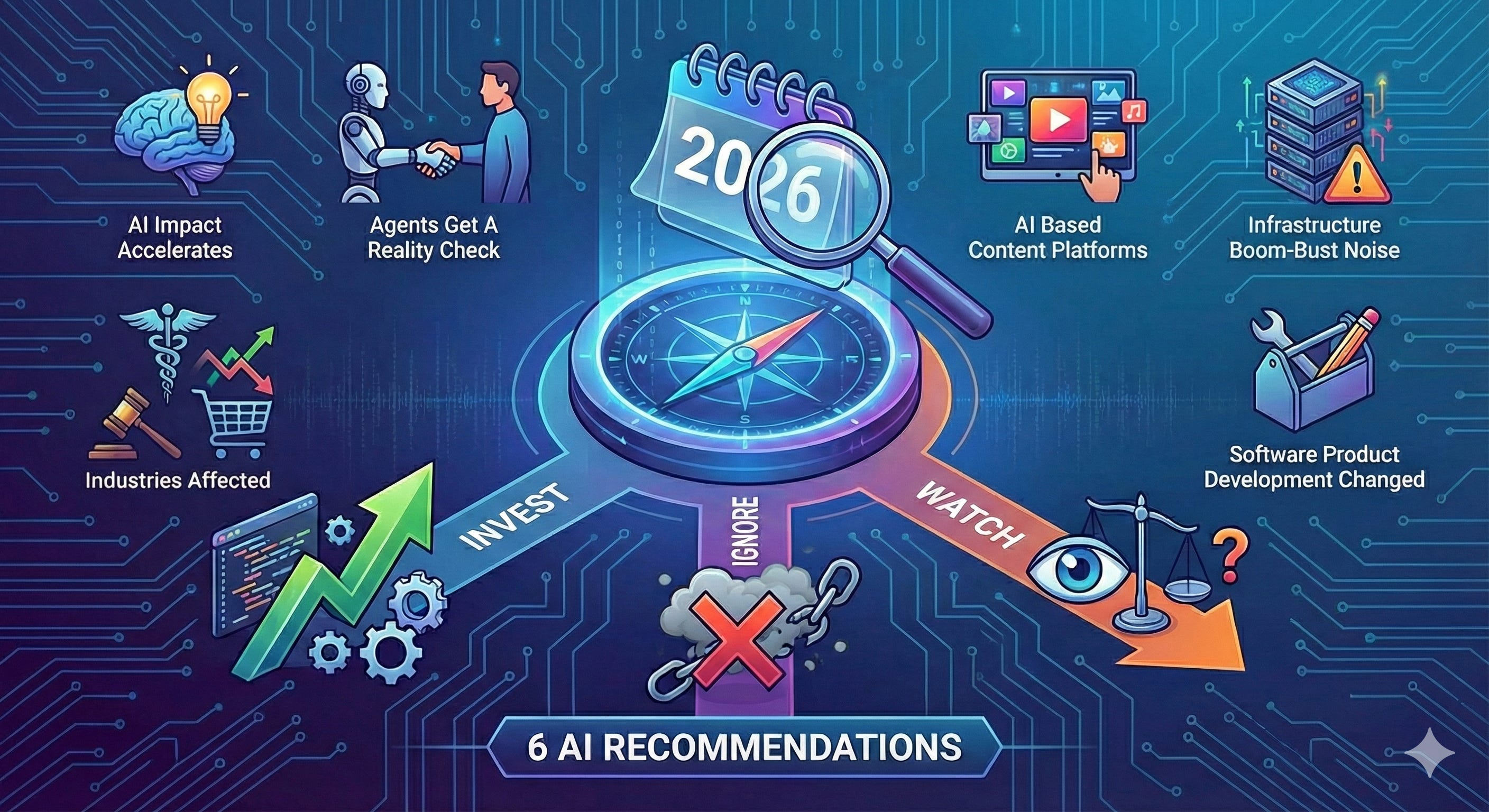
And finally, here are my six recommendations for where to invest, what to ignore and what to watch in AI for 2026…
I expect market dynamics will lead to a slowdown in headline foundational advances in 2026. The cause will be a lack of moats and ROI for foundational model training. The good news is that even with the coming diminishing returns (still minimal evidence today BTW) we have many years ahead to exploit the current technology to its fullest. So despite this, AI’s actual real world impact in 2026 will continue to accelerate. The foundation model development dynamics is only something to watch if you are directly investing in AI foundation models.
Recommendation: Expect a slowdown in foundational model advances in 2026. Don’t assume ever improving models will fix your broken product and build thoughtful, user focused AI products that already work well with current foundational technology.
The rush to fully autonomous agents is mostly misguided. Even if the foundation models are ready to host agents (getting closer), the pricing, performance, tooling, monitoring, security, privacy and other factors are largely not. Agents, when applicable, are the last step, not the first. Even when technical capabilities are ready, there are many tasks that humans and organizations are not ready to hand over just yet, if ever. Automated workflows and co-pilots can and should be a valid end state for many tasks. Many projects and services that have started out as fully autonomous agents will either fail or morph into something closer to a series of workflows or co-pilots. This is not a failure but a reality of technology–task fit. Agents will have a massive impact long term, but in 2026 you will see that labeling your business or product as an Agent will become a negative signal.
Recommendation: Choose the right automation level for your specific technology–task fit. Work your way up to building an agent, rather than starting out with an agent. Consider un-labeling your agent branded product or service unless it is truly agent required as it is becoming a negative signal.
The Sora 2 app was just the beginning. New major AI based content platforms will spring up in 2026 where a large portion of user time will be spent interacting with and consuming AI generated content. For human sourced publishers and the open web, this will continue their decline in relevancy. For the ad industry, this will begin to drive a shift in ad formats where content and ads will begin to bleed together.
Recommendation: The Sora 2 app was just the beginning, and new major AI based content platforms will proliferate in 2026. If your career or business relies heavily on human produced content generation or traditional advertising, start making investments now on how you can add value in an AI generated content world.
A capacity-demand tipping point combined with malinvestment will likely lead to a broad industry setback at some point. Will this happen in 2026? Not likely, unless we see a broad based economic crisis. If you are an infra company or over-levered, it’s worth worrying about, but for the rest of us it’s best to ignore. The long term gain is that this capacity build out will benefit the entire tech industry long term, even if there is a temporary setback.
Recommendation: Unless you are over-levered or investing directly in infrastructure, ignore the infrastructure boom-bust noise entirely.
AI’s effect on software engineering, product and design roles is highly understated. Junior engineers that can only write application code are devalued, while the most senior engineers are more valuable. Pure product and design roles without true SME are devalued while SMEs that can be hands-on are more valuable. Product and engineering organizations should be decoupled from expertise based hierarchies in favor of cross functional goal and task focused teams. My personal productivity has increased 2.5x in the last year and it’s only accelerating. We’re already seeing the hiring effects in 2025, and in 2026 we will start to see radical transformation in how software product development organizations are structured.
Recommendation: If you come from a product or engineering discipline, focus on developing a particular business or industry expertise, not just an engineering or product discipline. For SMEs, start using the latest AI tools to get deeper into design and product development, something that is no longer time prohibitive.
Some industries will be completely upended, others will be created, while others will be more or less the same but with some nice new tools. Some reasons for lack of change could include regulations and physical requirements. Besides current trends where it’s already clear, there are no experts here - we can’t reliably predict how this will shake out. For those that have already been affected, expect an even bigger change in 2026 as real world AI applications are just starting to hit their stride.
Recommendation: If your industry is already in a steep decline, don’t bet on a rebound. Consider what a much smaller version of it will look like and whether your skills still stand out. If it’s not obvious where you fit in, seriously consider switching industries. Since we can’t reliably predict which industries are the best bets, you are better off picking the ones where you have the most immediate skills or interest.