If you’re a part of the Couchsurfing community, you’ve no doubt heard the news.
And you’ve certainly seen the outrage.
If you log in to your Couchsurfing account today, this is the screen you will see:
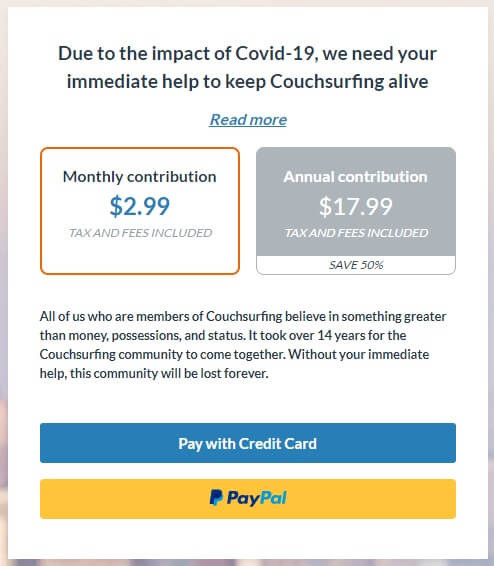
What’s more, everyone has been locked out of their accounts until they pay the monthly fee. All our friends lists, messages, groups, photos, profiles and references are now locked behind this paywall.
Many of us have seen this coming, but after nearly two decades of helping people travel the world for free, it’s official. Couchsurfing is no longer free.
To be 1,000% clear – I am not against paying fees, and I’m not at all against paying a fee for Couchsurfing.
I prefer it actually. I already pay monthly subscriptions for Spotify, Headspace, multiple blogging tools, multiple WordPress plugins, Audible, a couple of premium newsletters – quite a lot of stuff, actually. I prefer it this way, because when you pay for things like these, they’re usually way better than the free stuff.
What I do care about is who I pay this money to, and how they use it.
Over the last few years there have been many “incidents” between Couchsurfing HQ and the community, and “Couchsurfing is dead” was chanted by many longtime members. But most of us let it slide. We tolerated one more stunt, because we love this community that much.
However, I think this one is finally going to nail the coffin shut.
Again – it’s not about the $3.
None of us care about the $3.
In the words of The Count Of Monte Cristo: There’s a history here that you don’t understand!
So let me rewind and recount this Couchsurfing story from the beginning, since it’s quite a long and dirty one.
Couchsurfing and the many “Incidents”: From 1999 until today
The idea was born in 1999 by an American programmer named Casey Fenton. When travelling to Iceland he found it too expensive to book a hotel, so he randomly emailed 1,500 University of Iceland students from a hacked email list and asked for a couch to crash on.
He got about 100 offers, and this sparked the idea of creating a website.
In 2003 he founded Couchsurfing as a non-profit, and officially launched the site in 2004.
Couchsurfing took over the travelsphere and became one of the most popular travel sites in the world. But rather than blooming because it was such a beautiful site (it wasn’t) it bloomed because of what it stood for.
Casey Fenton regularly said the goal of Couchsurfing was to create a better world, one couch at a time. As many of you have experienced, the backpacking culture is not guided by money, but by trust and generosity and openness, so the Couchsurfing mission resonated. Everyone loved Couchsurfing.
There was no money in it, obviously, so from 2006 to 2011, the site was built, coded and moderated entirely by volunteers. The events and groups were also moderated entirely by volunteers. Volunteers from every continent donated tens of thousands of hours of work to keep the site operational and the community growing.
Many consider this period the golden era of Couchsurfing. Nobody made any money from the site, it was funded purely by donations and 100% a labour of love by travellers around the world. “Hosting” and “surfing” quickly became dictionary terms in the backpacker community. And the community was rich. Any time you were in a new city you could just post in the groups, who’s around this afternoon? And instantly you’d have awesome people to hang out and explore with. I started travelling full time in 2011, and was neck deep in the backpacking community. Couchsurfing was central to the culture. It was everywhere.
Even in my hometown I used it – after a surf one morning, I felt like hanging around to enjoy the beach. Logged onto Couchsurfing and what do you know? There’s a Couchsurfing event going on. I found them and spent all day lounging on the beach chatting. For those years, the site thrived.
In May 2011 came the first “incident” that started to split the community. Couchsurfing abandoned its non-profit status and changed to a for-profit corporation. Many of the volunteers that had dedicated much of their lives to the site protested. Why did they need to be for-profit? Where was the profit going to come from?
But this was just a precursor to the second “incident” that happened four months later. In August 2011 the founders accepted $8 million dollars in a Series A funding round. One year later they took an additional $15 million in a Series B. The beloved site that had operated solely on volunteer hours and donations for eight years raised $23 million of venture capital in 12 months.
I guess from here, it’s not too hard to guess how the story goes. Probably because we’ve seen this story a thousand times before. When venture capitalists put $23 million into something, they expect to get much more than $23 million back out.
(according to former CEO Jennifer Billock’s Linkedin, the company was sold again to a private equity firm in 2015, so technically we don’t even know who the owners are right now):

Almost the entire community was against this (except maybe the founders, and the new owners) but Couchsurfing assured the community nothing would change.
“We are confident that we will find a way to generate money that doesn’t hinder the amazing experiences that CouchSurfers have,” they wrote on their blog.
Yet many things started to change.
The third “incident” was a big one, but inevitable. Couchsurfing started hiring and staffed their own team to rebuild the site, moderate the forums and events and groups, and basically told the volunteers that had dedicated the last six years of their lives to the site they weren’t needed anymore.
Not to mention, those volunteers that had worked endless hours on the site for years got none of that big payday money. Couchsurfing was now a for-profit company, and this company now owned all the code and the site, and all the profit being made from it went into the pockets of the new owners and staff. The people who actually built the site got nothing.
This was doubly damaging because the new staff at Couchsurfing weren’t Couchsurfers, so they had no idea how the community actually worked. After they completely rebuilt the site they emailed everyone saying “Yay, look how great the new site looks!”
And yes it probably looked nicer, but it also damaged the community in a way that wouldn’t become clear until years later. For years Couchsurfing volunteers had built and nurtured “city groups”, with regular meetups and many years of friendships. The site was redesigned and overnight those communities were gone. To give you a comparison, imagine if Facebook rehauled their site, and overnight every single Facebook Group disappeared. That’s exactly how it was with the new Couchsurfing. In their place they built generic city pages with events and forums.
While trying to turn it into a fancy Silicon Valley website, they destroyed the communities people had spent years building that made Couchsurfing Couchsurfing.
Those were the foundations of Couchsurfing and looking back now at the big picture, I think this was where the downward spiral really began. Even when they turned for-profit and ads started going up everywhere, the community still survived. But once they imploded the original communities that the site had been built on, it meant the membership started to disband and finally give up on site (or become much less active), and newer, less loyal members started to make up the core membership. As we’d start to see, the site is nothing without a critical mass of loyal members.
The fourth “incident” was when Couchsurfing tried to start charging fees to surf. This was where they really crossed the line and one of the few times I saw massive pushback from the membership.
This was a notification I got in 2016 when a host confirmed I could stay with them:

Again – I have no issue with paying a small fee like this.
Hosts invest a lot of time and money into hosting. Hosts often pick surfers up from train stations or bus stops, feed them, drive them around, do laundry, provide water and internet and power and linens. I’ve done my share of hosting. It cost money. Always.
So the fee wasn’t the problem. The problem was hosts were going to put all this effort into hosting, and then the fee wasn’t even going to the host!
Even then, most hosts would never want to receive a fee anyway. Couchsurfing resonated with us because there was no money involved. If people wanted to pay to stay somewhere, they could go to a hostel. Couchsurfing was supposed to be different.
To make this a double insult, we all knew exactly where those fees were going. This was 2016 and Couchsurfing were leasing some fancy new offices over in San Francisco:


We were all sleeping on floors and couches while these guys were playing nice in Silicon Valley. But that still wasn’t the worst part.
What made the move triply bad was Couchsurfing had promised they would never do this. After taking their VC millions in 2011, they published a blog post that said (I quote):
“CouchSurfing will never make you pay to host and surf. It’s against our vision to exclude anyone from having inspiring experiences for financial reasons, and that’s not going to change just because our methods of generating revenue do.”
-Couchsurfing 2011
As you can imagine, the move generated a big uproar (again) from the community, including from myself and other friends of mine on the site:
@couchsurfing 2/2 and we want cs to succeed as mch as u do. This is not what cs is about. You’ve lost touch with who we are. Talk to us.
— Bren (@brenontheroad) December 14, 2016
They never replied to me or anyone I know, but to my surprise and to Couchsurfing’s credit, they pulled this idea after a month or so and surfing remained free.
Until now.
This fifth “incident” happened a few weeks ago where Couchsurfing suddenly locked everybody out of their accounts.
It didn’t matter if you were one of the most active members of the community and had thousands of positive references and hosted hundreds of surfers per year, and even if you had paid for lifetime verification.
As soon as we logged in, we were asked to pay a monthly $3 fee to access our profiles again:

All our friends lists, photos, references, groups, were suddenly held hostage behind a paywall.
After promising Couchsurfers would never be forced to pay to host or surf, we were now being forced to pay just to log in.
When I saw this I was obviously disappointed (again), not because of three dollars, but because of how we got here. Because how did we get here? $23 million squandered over the years on CEO’s we never asked for and who never talked to us, fancy offices nobody needed, being bombarded with ads on every page of the site and app (which still doesn’t work properly), numerous other money grabs over the years which I won’t even go into right now, all the other “incidents” I haven’t even mentioned, and finally it had come to this. Locking us out of our beloved community for $3 per month.
Which led to the biggest question of all…
Where has all the money gone???
Despite painting themselves right now as a company that has always been frugal, and all their staff are now valiantly working from home in the spirit of Couchsurfing and living on ramen, that’s not the case.
In fact, I’m quite certain Couchsurfing has earned PLENTY of money over the years.
Don’t forget, I’m not just a travel blogger, I’m also a Chartered Accountant. This kind of thing used to be my job (and now I also know a little about websites). So maybe I can find the money. Let’s have a look.
How much does Couchsurfing make from verifications?
They said on their socials last week that only 4% of active members pay to verify their profiles, which usually costs around $30 per year (it differs between countries). So let’s take a guess.
Of its 12 million members, it’s estimated there are 400,000 active hosts, and you could guess an equal amount of active surfers, giving them ~800,000 active members.
At 4% that’s 32,000 verified members, $30 per active member, that’s around $960,000 per year in verification fees (a guesstimate of course).
I have also seen the 2008 financial statements, shown to me by the volunteer accountant from back when CS was a non-profit (us legacy CSers stay pretty tight 🙂 Even then they were bringing in a million per year in verification fees/donations, but with a tiny fraction of the members they have today.
So I would say $960,000 per year is almost certainly an underestimate.
How much does Couchsurfing make from ads?
CS makes money from ads. Every Couchsurfer will tell you there are more ads on the site than Couchsurfers.
In fact, I can just show you. Here’s what a Couchsurfing profile currently looks like:

That’s pretty much as many ads as Google will allow you to put on a page (header, footer, left and right sidebars, and maybe one more in-content).
In other words, they are maxxing their ad space allowance.
How much is that in dollars?
We would need to know their traffic. But we can make a rough guess using some tools.
Here’s the current Couchsurfer Alexa score, which ranks a website’s traffic/engagement on the internet. It’s the 10,000th most popular site on the web currently:

But you can see that 90 days ago (before Covid 19) their rank was actually 4,000 (that is very high).
I don’t pay for Alexa premium so it’s hard to find a perfect comparison, but to give you a yardstick, that puts it significantly higher than a mainstream travel site like The Travel Channel, which ranks around #16,000:

And a few months before Covid hit, it was ranking almost on par with the NZ Herald – New Zealand’s largest newspaper:

That’s a lot of traffic. Millions of page views a week.
We can cross check this with more tools (blogging tools are so much fun, hey?)
Here’s their score in SimilarWeb, which ranks sites purely on traffic:

Couchsurfing ranks 32,000 globally, and is the 42nd most popular travel site in the world.
More importantly, it had 1.39 million visits in April. Look at the graph though! Before Covid when people were travelling, they were actually doing 4.5 million visits per month.
You can also see they get ~5.5 page views per visit. Do some math, and that adds up to around 25 million page views per month.
Just to cross check again and make sure we’re in the right ballpark, here’s the Travel Channel SimilarWeb results:
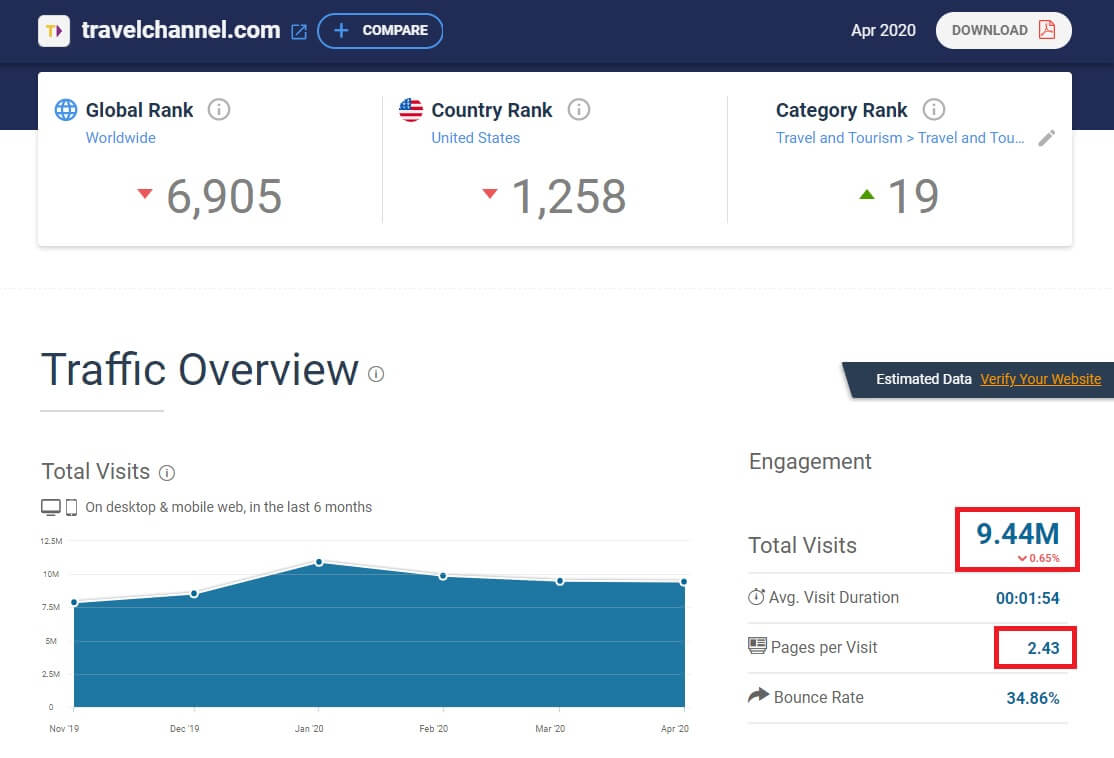
Their traffic (very interestingly) hasn’t been affected by Covid. They’re doing around 22 million page views a month. Similar to Couchsurfing a few months ago.
Couchsurfing said last week they will remove ads as part of their new revenue model, but up until last month, we can make a reasonable estimate that Couchsurfing was making as much (or possibly more) money in ads than The Travel Channel, one of the largest mainstream travel sites.
(Note: Based on my own sites, SimilarWeb isn’t super accurate, but tends to underestimate rather than overestimate. So their traffic is possibly even higher).
How much ad revenue is that, exactly?
I know on a blog like mine, 100,000 page views brings in about $1,000 USD. And that’s not with ads in every corner of the page.
If you really pump out the ads like CS is doing, you can get up to $2,000 per 100,000 page views pretty comfortably.
Let’s just give a conservative $1,500 per 100,000 views.
Over 25 million page views, that’s $375,000 per month, or $4.5 million per year.
So where’s the money?
$1 million a year in verification fees. $4.5 million per year in advertising. $23 million in venture capital. Nine years. Where is it?
The only way we’ll know is if they release their financial statements. The community has asked for this numerous times (in fact, we’ve asked numerous times just to be talked to) and we’ve had nothing to date, so I don’t expect we’ll ever see them.
But I can tell you where that money didn’t go:
It didn’t go to hosts, who are the foundation of Couchsurfing.
It didn’t go to volunteers who have spent thousands of hours organising events and keeping the community alive.
It didn’t go to the volunteers who spent thousands of hours building the site for the first seven years of Couchsurfing’s life.
It didn’t go to bloggers, influencers and unofficial ambassadors like myself, who for years recommended the site to friends, readers, fellow travellers, while also putting together beginner guides like this to grow the community.
We can also guess it didn’t all go into the site, which is a pretty standard membership site and doesn’t (or shouldn’t) cost $5 million per year to maintain.
So where else could it go? Our best guess is it went to the investors, staff and executives who, in all honesty, haven’t added millions worth of anything to the community since they took over in 2011.
Of course my numbers are estimates and may be wrong; Maybe it’s only $4 million per year. Or even $2 million. Or maybe it’s way higher. Does that change anything? Not really.
It breaks my heart to finally say it, but I have to.
I’m breaking up with Couchsurfing
I’ve resisted this day for a long time. For many of those years on the road, I considered Couchsurfing a part of who I was. It was like a badge we wore, we were so proud of it. The site really did give me so much, friendships, lessons, and changed me as a person. But I guess we all part ways eventually.
Under different circumstances and different leadership, I’m sure many of us would have gladly paid $3 per month or even $5 or even $10 to support the community we have built over the years, but after this many years of second and third and tenth and eleventh chances and being let down year after year, we can’t do it anymore.
It’s like having an ex that says they’ll change and stop treating you like ass so you keep getting back together and they’re still treating you like ass ten years later. Well, for many of us that ex is Couchsurfing.
It’s heartbreaking because with the community we had, we really could have been something great and different, a free community that thrived and built something revolutionary like Wikipedia or Afrikaburn. In fact for a few years, that’s exactly what we were. But unfortunately it has ended up as ten years of so much hope and so many disappointments. It’s a fool me once fool me twice (or ten times) scenario now, and I don’t want to be the fool anymore.
Let me give them some credit where it’s due. I used CS heavily up until around 2018, and met some of my closest friends on the site. I can attribute dozens of my best ever travel experiences directly to Couchsurfing.
The site has changed my life.
Of course we knew there were people earning huge salaries off our community, while we all slept on floors and tried to show people money wasn’t everything – that disconnect wasn’t lost on us.
But we let it slide and stayed on board, because the site meant so much to us. To be fair, it still gave us what we needed. The site was used by us to meet people and find hosts and connect with other travellers, and in that sense it worked just fine. As long as they didn’t change things too much, we tolerated it.
But I think now it really has changed too much.
When Couchsurfing released the news of this latest move, I was sure it was just another money grab hiding behind the excuse of Covid 19, and this was also the word recently on reddit by a former CS employee:
“Some time ago, I joined as an employee of CS because I was passionate about this project.
Unfortunately, I was only able to make a small dent, as the profit incentives were quite misaligned.
I was quite disappointed by the leadership. Don’t blame the employees. I know many of them were true couchsurfers and had real heart. (Read the glassdoor reviews, skip past the obviously fake ones). I doubt that most of the leadership has ever even couchsurfed in their life.
The leadership sees a golden goose and doesn’t love it. That’s it. This latest thing is a cash grab.
And bird for bird, this one needs to die so a new phoenix can rise from the ashes.
The concept of couchsurfing has been released into the world, and like the best ideas, the idea itself will never die.
XO. Stay Safe. Stay Curious. Stay Awesome.”
I can’t confirm that post is actually from a CS employee, but it lines up with a lot of what we’ve heard through the grapevine. The employee reviews on Glassdoor are similar.
Will Couchsurfing survive?
I guess this isn’t a surprise; this is what happens when you take big investor money. Investors aren’t interested in hearing how many nice travel stories they’re creating. They’re interested in profit.
And of course that’s not always evil – you can do it and can do it the right way.
Couchsurfing is really just a social network after all – people connecting people. And it’s not impossible to do that for free; Facebook, Instagram, Twitter, Snapchat, Google, all do it, all are much more complicated than Couchsurfing and have never charged me a cent. For some reason, Couchsurfing just never figured it out.
So my guess is this ends in two ways. Either CS is lying and they have plenty of money, and a few people are going to get even more rich off all the new fees. Or they’re not lying, they really are going broke, and soon they’ll disappear. Maybe a combination of the two.
Either way, I can be certain Couchsurfing will no longer be the Couchsurfing we knew and that spirit will move elsewhere. If the site continues, it will be a different type of travel community. The entire premise of Couchsurfing was that money was irrelevant, and anybody with a free spirit could be one of us. Obviously that is no longer true, so it may become more like an upper middle class, millenial, glamping, Airbnb hybrid kind of high society place with a membership fee.
Maybe that type of thing will thrive, I really don’t know. If it does, all my best wishes to them.
However I am also going on record today to say:
I will not be paying the Couchsurfing monthly fee (at least not under the current management), meaning I will no longer be using Couchsurfing and Couchsurfing is no longer a service I am recommending.
I know I have been a champion of the Couchsurfing brand for almost a decade, have promoted them endlessly on my blog, to many thousands of people, but as always things change and it’s time to explore something new.
The site is still active and anyone is still welcome to sign up and pay the fee and use it, but my recommendations will now move elsewhere.
What’s comes after Couchsurfing?
It’s important to remember Couchsurfing isn’t just a website; it’s an idea, and a set of values, and a community.
Ironically Couchsurfing said this quite well in their lockout message:
“All of us who are members of Couchsurfing believe in something greater than money, possessions, and status.“
This is true and while Couchsurfing itself no longer embodies this ethos, the members still do and communities can be rebuilt anywhere, from the ground up, just like we did before.
There are three active communities up and running already.
The first is BeWelcome. This is a site very similar to Couchsurfing (pretty much the same) and is run by volunteers on a donation target of $1,500 per year. It was founded in 2007 and has around 130,000 members.
The second is TrustRoots. Most people I’ve met talk quite highly of TrustRoots, which has about 36,000 members and is also very similar to Couchsurfing. I am unsure of their budget but they are a registered UK non profit.
What do I think of them? They’re both great. They’re also both very anti-profit, possibly to the point it is hampering their potential. I don’t think profit is dirty, I just think obsession with it is. I think they could also use someone at the helm who can really push the site full time – something that Couchsurfing had for its early years. Regardless I think with a little push in the right direction, both have the potential to do quite well. Maybe neither of them want to be the next Couchsurfing anyway, and are happy where they are.
A third site being developed right now is Couchers.org. They’re open about their goal of replacing Couchsurfing as the go-to site for surfing and hosting. What the team has put together so far looks great. If you’re a CSer, I’d highly recommend signing up for the beta. Watch this space – it looks promising.
There is also a fourth option, which is Facebook Groups. I’m already a member of several Couchsurfing Facebook Groups, and a lot of activity happens in there, including finding hosts and surfers. I think this will grow as people migrate off the platform and into these groups to stay in touch. If you search for a Couchsurfing Facebook Group in your city, you’re likely to find one.
The fifth option is your own travel network. When we Couchsurf, what are we actually trying to find? People. Usually people to stay with, or people to hang out with. And we don’t need millions of people, usually we just need one.
In fact, in many countries I visit these days, I always have an old travel friend who is happy to let me crash, or will say “I know someone that lives there, let me hook you guys up!” And their friends become my friends, and the circle grows. This is really Couchsurfing in its purest form, travellers helping travellers connected by other travellers, and you don’t need a website with millions of members (or dollars) to do it.
The sixth option is the space itself evolves, and it kind of already is. This is likely where I’m heading. If people actually want to pay to join a travel site, I would recommend something that gives you more than just a basic social network. The best example I know of is NomadList.
It’s a community of people who actually live and work on the road full time, and not only do you get access to tons of useful info, you’ll be mixing with other web entrepreneurs like bloggers, Youtubers, programmers, freelancers etc too.
Since this lifestyle is growing rapidly I think NomadList will actually become huge. You can also find people to crash with, and I’m sure a lot of the members were Couchsurfers too back in the day (CS is mostly centred around younger backpacker student types). I also love that its founder levels.io is super transparent about running it, building it, how much it earns etc. I’ve pretty much watched him build it from the ground up on Twitter over the last few years. Been very cool to see. The site is free to use, but also has a premium membership.
Going forward I will probably use all of these resources in some way, and continue to report to you on my experiences and which ones have worked best.
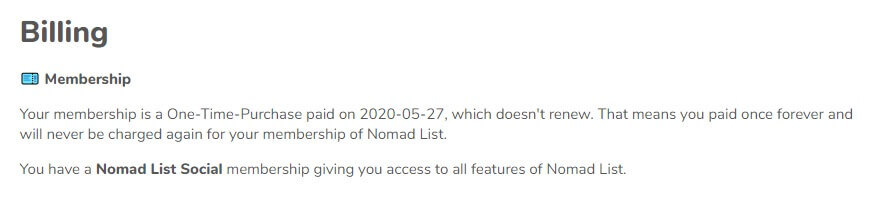
Lastly, I’ve also donated 2x the yearly subscription Couchsurfing was asking for to BeWelcome and Couchers (will do the same for TrustRoots once they’re accepting donations) and I’ve also paid for a lifetime membership at NomadList.
Just to show that it was never about the money 🙂


Sending love always!
B
Disclaimer: The figures in this article are all guesstimates. I do not have access to Couchsurfing’s financial statements and everything is a best estimate based on the information and tools mentioned.
Photo credit: Bob Dass @ Flickr