In June, the International Ski and Snowboard Federation (FIS) created a bold plan: make ski racing safer.
Well, not really. That plan has always been around. But they had a brand-new strategy for pulling it off.
FIS has implemented a variety of safety measures over the years, most of which have been deeply beneficial. From introducing mandatory cut-proof undergarments last season to replacing outdated hay bales with modern A and B-nets decades ago, the sport has come a long way.
But FIS’s safety track record is far from perfect. In the 1970s and ’80s, the federation flip-flopped repeatedly on air permeability rules in an elusive attempt to regulate rubberized speed suits. Most notably, in 2013—after conducting just a handful of tests with retired athletes—FIS decided that a longer ski would be safer. They implemented a punishing 35-meter ski radius rule in Giant Slalom (GS) and increased the radius and length in speed disciplines.
The only problem? It didn’t decrease injuries.
Instead, back injuries in GS skyrocketed. Furthermore, the new speed skis actually ended up being faster than the previous models. Once Pandora’s box was open, ski manufacturers simply kept making longer and longer speed skis—some of which sit almost 10 centimeters above the minimum legal limits today.
Meanwhile, the fight against the GS skis lived on as back injuries mounted alongside the sport’s already high rate of knee and leg trauma. In 2017, after four years of bitter fighting over the rule’s effectiveness, FIS finally relented. They rolled the GS radius back down to 30 meters—a rare admission of error, leaving it just 3 meters larger than it was in 2012.
This spring, history repeated itself. Armed with even less safety testing than they had in 2013, FIS chose to implement strict weight limits on skis.
FIS conducted zero studies on active athletes. They looked at no historical data to find correlation. For years, they have delayed far less controversial safety measures—for instance, taking years to mandate cut-resistant technologies after they became available. Yet, this ski weight limit was proposed and passed in a matter of weeks. Athlete input was never requested.
Instead, they relied heavily on analogies.
They argued that modern skis were now “driving the racer” rather than the other way around. They publicly lamented where ski design had headed since 2013—conveniently forgetting that it was their own 2013 mandate that pushed manufacturers toward those exact designs. They argued that women couldn’t handle the large skis of today, forgetting that female athletes like Lindsey Vonn and Maria Riesch were dominant on men’s skis over a decade ago.
Behind closed doors, it became clear they had been secretly weighing athletes’ gear all season. During the meetings, they threw a graphic up on the board. It highlighted top-tier results, pointing out one specific racer who consistently ran the heaviest setups on the women’s World Cup tour.
I confess, Your Honor: It was me.
The Physics of Being 81 Kilograms
Let me explain. I have long run one of the heaviest setups on the World Cup tour. I ski on Atomic, a brand built in Austria that has never shied away from engineering a robust, heavy ski.
For me, this setup is a physiological necessity. By the time I was in high school, I was 5’8”. These days, I consistently sit over 81 kilograms (about 180 pounds). I have yet to meet a woman on the World Cup tour who admits to weighing more than I do, and I have met men on tour who are smaller than me.
I use that mass to my advantage. I am not always the most technically fastidious skier on the mountain, but I am one of the strongest. I rely on raw power instead of a delicate, light touch.
I’ve always loved ski racing because the clock doesn’t care what you look like. When other girls whispered that I was “fat” at the finish line in high school, the clock never punished me. In fact, physics actively rewarded me. While objects of different weights fall at the exact same rate in a vacuum, their momentum on snow is entirely different. My mass carries me further and faster across the flats. While my larger cross-section hurts my aerodynamics—I have long been notoriously terrible in a wind tunnel—my momentum makes up for it.
More mass equals higher momentum, which means higher sustained speed through flat transitions.
But when a downhill course gets bumpy, that mass requires a matching counterweight. I need a larger, more robust ski to act as a physical shock absorber. Under my weight, a lighter ski will ripple and chatter violently over high-speed bumps. A heavier, denser ski cuts through them, staying straighter and transferring far fewer of those destructive kinetic forces up into my legs, my back, and eventually, my head. To help disperse these brutal vibrations, I have long utilized a heavy, robust plate placed directly on top of the ski itself.
My skis might be too much for a smaller athlete to handle, but their structural mass is exactly what keeps me safe. When your equipment dampens the vibrations underfoot, you don’t get bounced as hard. You can actually see, react, and ski the injected ice surface beneath you.
Yes, heavier skis could be less safe in certain scenarios, but where you place the weight matters immensely. Weight close to the foot is much less problematic than weight out at the end of the fulcrum at the tip and tail. FIS didn’t do any longitudinal tests on safety; they simply weighed skis last season and went with their gut.
I don’t have a multi-million dollar scientific study proving that top-level athletes over 80 kg are safer on a heavier ski. But FIS doesn’t have a study saying the opposite, either.
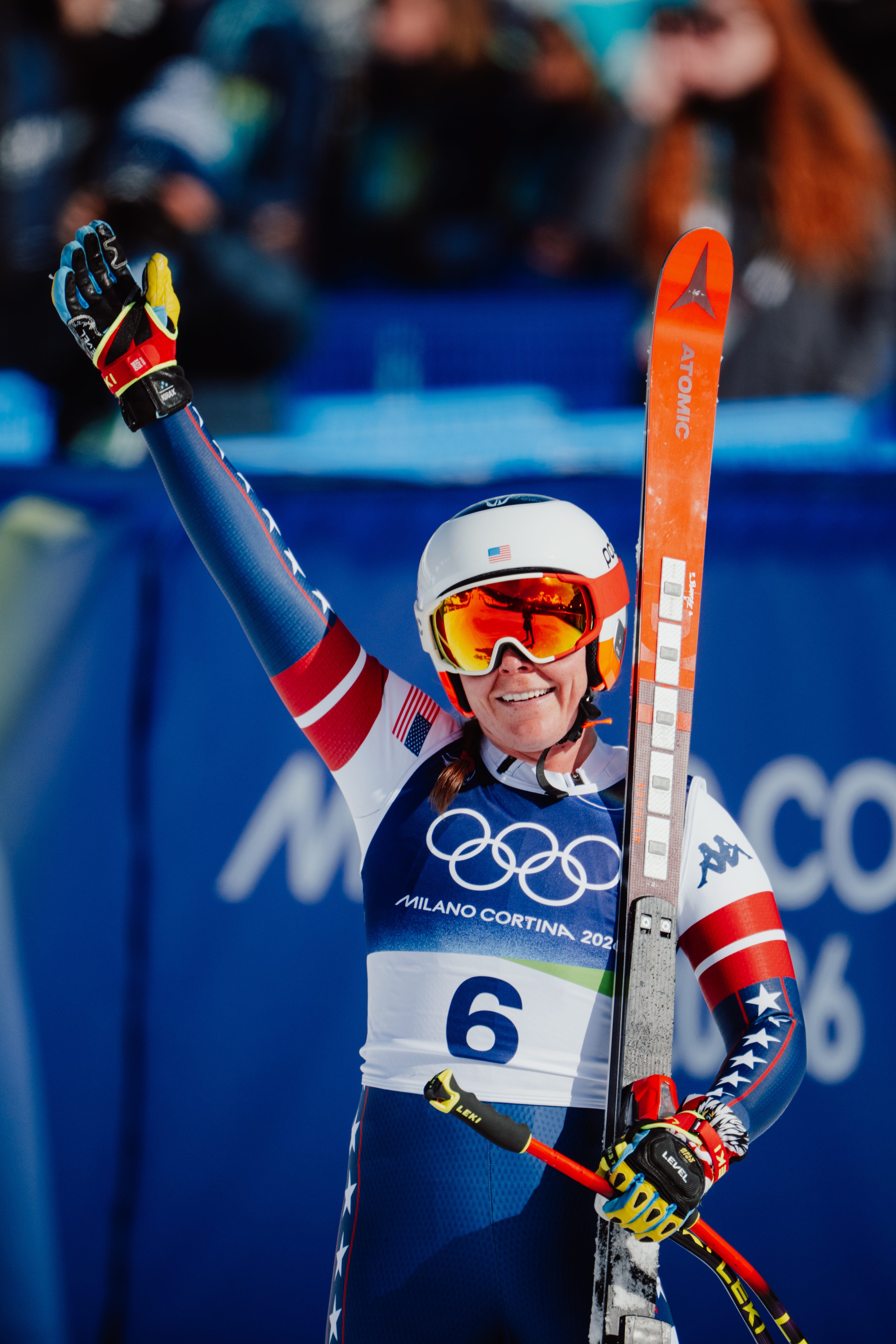
Me and my skis at the Olympics
The “Wembanyama” Precedent
Ultimately, FIS’s analogies worked on just enough of the skiing world. The National Ski Associations voted to pass the new ski weight restrictions.
After looking at a graphic highlighting a single top athlete who sat above the proposed limits, the committee chose a weight cap just a couple hundred grams below the weight of my personal skis. Conveniently, this cap sits just above the weight of everyone else’s gear.
I would guess many nations voted for it simply because they had nothing to lose—it didn’t affect a single one of their own athletes. It was an easy move to clip the wings of a competitor at zero cost to themselves.
This rule is the equivalent of NBA owners passing a regulation that bans basketball shoes over a size 20.
Sure, almost every player in the NBA is well below that limit. Most teams would be completely unaffected. Except Victor Wembanyama is a physical outlier—the only player in the league who actually needs a shoe that large. “Wemby” isn’t wearing size 22.5 shoes to unfairly take up more floor space on the court for fun; he wears them because he is a giant.
It is incredibly difficult for me not to view this as a targeted attack. I can think of half a dozen athletes on the World Cup tour whose unique setups could be weaponized with targeted rules. FIS may believe they are acting in the interest of safety, but without requiring scientific research, nations can now propose rules against their competitors’ unique equipment pieces. This stifles innovation and creates a political tit-for-tat, where the country with the most resources and allies can simply legislate away their foes.
You only have to look back at the politics of 2013 to find context. Behind closed doors, the unspoken motivation for the 35-meter GS radius rule was that classic European ski nations absolutely hated watching Ted Ligety dismantle them. The mission was simple: alter the rules to harken back to a time when they were on top.
That plan backfired massively. Ted won the GS crystal globe the very next year by some of the largest margins in ski racing history. Yet despite being faster on the new gear, Ted still fought the federation on the physics of the rule. Tragically, he eventually succumbed to the exact type of severe back injuries that those straight, unyielding skis were warned to cause.
I got caught in the crossfire of an administrative power play masquerading as athlete welfare. FIS wanted to slow down the sport, but instead of engineering a safer environment, they simply engineered a disadvantage for the outlier. Physics doesn’t care about politics, but unfortunately, the committee room does.
FIS is extremely insulated from criticism but if you live in a nation that voted for these rules consider writing to your NSA. Italy, Switzerland, Germany, Norway, Slovenia are the major nations I know of who voted for these weight restrictions(USA, CAN, FRA and AUT voted against the rules). And please share this piece if you can.
Sincerely,
The largest female ski racer on the World Cup Tour