Évariste Galois discovered the foundations of group theory, threatened the King of France twice, joined a paramilitary movement bent on toppling the government, spent one night cracking a 350-year-old mathematical problem, and then died in a duel the very next morning for the sake of a woman. He was 20 years old.
Youth is a force of nature. It possesses men and propels them to commit great and terrible things. One only needs to trace the thread of history to find that the knots were tied by people in their 20s and early 30s doing their Great Work while their spirit burned hot.
This has been a major source of grief for the perpetually adolescent but rapidly aging millennial and zoomer generations. Time ticks mercilessly, gnawing away mounds of flesh from their potential and closing doors behind them forever, and yet the fact is that everyone will bury their head in the sand and scream a muffled: “35 is still young!”
Young for what, is my question. What were you planning to do anyway?
To me, all of this sounds like misplaced cope for an imaginary failure; the assumption is that you could’ve done more with your time and instead you took a wrong turn, or external factors derailed your trajectory. You were meant for greatness and now it’s all over!
Ah, the rare double cope: “If the conditions were perfect, I could’ve made it.”
Great men achieve great things when they’re young not because they’re young, but because they’re great.
Despite the “suboptimal” environment.
I know it sounds like I contradict myself here, but the fact that you think it’s a contradiction betrays your assumptions — one could call it dishonesty — about yourself.
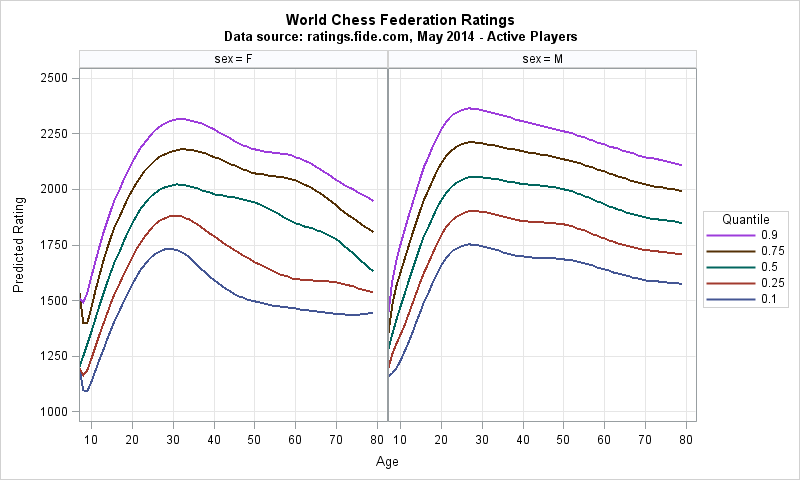
Almost no one becomes a chess grandmaster after the age of 301. The elo of most chess players stagnates and begins to drop around ~30-40. There’s obviously a measurable cognitive decline that occurs once you’re firmly into middle age. Often people will use this tidbit to place a time-barrier between you and your potential, conjuring the illusion that you always had a choice but you needed to make the right one before you turned 40. Two problems with that:
You were never good enough to become a GM.
You never really wanted to become a GM.
Replace the GM title with any other achievement you once thought you desired but life was too cruel to deliver.
If it stings to realize that life isn’t a sandbox RPG game with infinite choices (“I could’ve been a GM if I really tried.”), then I must inform you that you were exposed to a lethal dose of new-age magical thinking. This in turn clouded your true desire, which arises out of the interaction between reality, self-awareness, and your inherent limitations.
It’s not that you didn’t take advantage of your youth. Youth still had the expected effect on your development, and the mini-existential crisis you’re having is unrecognized grief for the person you thought you were going to be by middle age.
But nothing else was meant to happen other than what happened. The boat you think you missed had no room for you anyway. The delusion that you can have so much control over your life to determine your fate as long as you make the right decision, is what creates the uncomfortable feelings of “too late” and aging out. You see your 20s as this major pivot point because it’s the first time your parents aren’t in the cockpit and you mistakenly assume that from now on you can fly wherever you want.
The Peter Pan syndrome contains a bizarre paradox: you feel the desire to stay a kid forever only when you feel older than you are. Yet, youth has no awareness of time; it’s only the perpetually adolescent that are keenly aware of - and subsequently resist - their age. This is why I say that a 30 year old is spiritually younger than a 25 year old.
The effect of time on your perception of reality is relative to your understanding and experience of reality. Every year represents a smaller and smaller % of your life compared to your early twenties; the experiences you’ve accumulated by the time you’re older contextualize your current standing in the larger trajectory of your existence, and suddenly you realize that relatively to your station right now, life can stretch very far.

But a sensitive young man has to suffer the subtle tension of feeling like he is at the end of his life and twenty at the same time. He views everything as serious and fragile while grieving for aging out and struggling to prevent his youth from slipping away. There’s an urgency to capture an ineffable quality everyone else has but, for some reason — ranging from conspiracy(not) theories to childhood trauma, — he missed out on. A competition he didn’t even get to participate in. A puzzle he didn’t figure out on time. It is here that the Peter Pan paradox manifests: he’s chronologically young, he feels old, and so he expects to die now but in 50 years; spiritual seppuku.
I hate writing this part because it implies I have a spiritual panacea I can inject straight to your soul through the screen. But I’m “young” so everything I say is marred by my own ongoing existential conundrums; by no means should you consider this part advice.
Now that I’ve absolved myself of responsibility, l can preach the following without shame.
1) I give you 3 years to chase your dreams.
Gymbros have this term called fuckarounditis. It describes people who lift day in and day out but without a proper program. They use the same weight, the same reps. They try a different exercise every day. After 3 years, they’re still newbies.
If you stagnate and end up with fuckarounditis for more than 3 years, it’s time to hang up the mantle. It’s over man, forget it. Your predictions were wrong; the things you chased weren’t your dreams. Your dreams must align with the qualities of the Organism.
When you catch yourself doing everything else but your dreams, it’s a good sign that maybe you should be doing something else. Because what you do, not what you think or feel, is who you are.
So, 3 years… or until you’re 27-33, whichever comes first:
2) Astrology chicks tell me that your Saturn return at the age of ~27 is an important rite of passage. That barrier, albeit arbitrary, is a potent source of insight.
Saturn was at some point conflated with the God of Time (Chronos(time)→Kronos→Cronus→Saturn). It’s a pertinent attribute regardless because the symbolism implies that no matter who you thought you were, time will rout out your false nature. Specifically at some point in your late 20s.
It’s in that moment your existence becomes dense. All of your decisions begin to manifest quickly since your psychological and material conditions provide a scaffolding that rapidly limits outcomes. Simply put, one decision influences many aspects of your life in a stigmergic fashion.
3) When you find your talent, you’ll notice many early wins.
Some people claim that what you were interested in as a child is a prototypical version of your true desire and talent. There’s certainly some truth to it (see the Self and Organism essay I linked above) but a more accurate way to assess your talents is straightforward: when you’re good at something, you amass many wins early on, effortlessly.
It goes back to the idea that life isn’t a sandbox. You don’t choose what you’re good at. More effort won’t equal better outcomes; if you believed that, then the logical next step is to magically wave your hands and change your behavior2, personality, and material conditions.
4) Check in with the emotions you want to feel right now.
It’s not just greatness or some other notion of transcendental achievement you’re after, surely. There are other important life metrics that many sensitive young men feel like they’re missing out on. Late bloomers in particular see the shadows of the future past dancing around them. A wife, kids, family, a stable career.
These are valid goals and a valid concern when they seem distant. But let’s pause for a moment.
Rumination of this sort is but another manifestation of avoidance. Avoidance of what, you might ask? Well, there are certain emotions that you want to be feeling right now but you don’t. Your resistance to negative sensations is the avoidance that manifests as this intense yearning for a different life.
What you want and what’s happening don’t align. To put it even more plainly:
Your fear and anxieties are unrelated to your past or future; they reflect the current conditions of your life.
Instead of looking for what can go right or what went wrong, it’s more important to sit with the negative sensations and then carry on. At least in my case, what that means is that every time I “imagine” or daydream some ideal future but then snap back to reality, every small step toward that future feels like a failure because the fantasy involves thousands steps being taken already. I go in depth about this in the 10xEnergy essay.
5. Commitment and responsibility are dirty words for the sensitive young man.
And yet, it’s precisely what he needs the most: more relative deaths.
The paradox is that the more he avoids these “relative deaths” (closure, risk, loss) the closer he is to absolute death because he prevents life from blooming. I’ve said this many time to myself but if doors aren’t closing behind you, you aren’t committed enough. You aren’t moving in the right direction because you like to keep your options open.
Which is why taking on more and more responsibility feels like a prison to those who always want to be in control and freedom to those who can let go and let the natural process unfold.
I once pointed out to a friend that his constant defeatist attitude (“I’m worthless, I don’t deserve this, I’m a victim of society’s harsh ways.”) is a coy defense mechanism that makes him feel better since surely no one worthless should bear any responsibility, right?
Youth is a force of nature. It possesses men and propels them to commit great and terrible things. To clasp is tightly in your hands and never let go is a confession that you don’t understand what it means to be young.
I’m certain many readers will instinctively point out that the premise of this essay is weak. There are exceptions of old, crusty men and women achieving great things. There’s still enough time for me!!
My response is that you must die already. You’ve been animating the corpse of an imaginary life for too long, my sensitive young man….
(And maybe read the essay one more time)