In the sprint to build humanoid robots, the common industry choice is to equip a humanoid with a close replica of a human hand. There is an intuitive logic to it: humans are very capable with both fine- and gross-motor skills; tools are already designed around human hands; and they provide access to vast amounts of demonstration data as a jumping off point.
Making a useful humanoid hand, however, is about much more than theoretical capability. In practice, hand design is a ruthless tradeoff. Dexterity, strength, ruggedness, cost, repairability, and sensing all compete with each other. The real challenge is in designing a hand that:
- Is capable of a vast array of useful tasks, including using tools.
- Is strong and rugged enough to handle the punishing reality of real work in industrial and logistics environments.
- Has minimal cross-embodiment to human demonstration.
- Can be cleanly simulated for sim2real learning and synthetic data generation.
- Can be mass manufactured and repaired reliably at low cost.
This new generation hand for our Atlas® robot is our solution to that tradeoff: 13 degrees of freedom (DOF), directly actuated, built for high fidelity simulation to enable sim-to-real RL, designed from the ground up for dexterous physical work. It is a companion to the new generation of Atlas, an agile humanoid robot with a 100lb+ payload and the simplicity necessary for mass manufacturing.
The Hand Architecture Basics
Atlas’ previous seven DOF hands were designed to grasp a large variety of objects. This new generation is designed to manipulate them. We have moved to four fingers, including a more dexterous thumb, with a total of 13 DOFs, maintaining highly transparent direct actuation at the joints, all with a single actuator type. As in Atlas’ body, these actuators are completely encapsulated, with no fragile cables crossing joints.
Size is one of the main constraints in the design. Atlas is meant to use objects and reach into spaces sized for people. We also wanted a minimal cross-embodiment gap from human manipulation data. As a result, the hand is similar in size to a large human hand, which heavily drives the size of the actuators. Thanks to several unique actuation technologies we’ve maintained similar strength to the previous hand—capable of carrying a 100lb+ loaded minifridge. A hand intended to use human tools in physically demanding tasks needs to be strong.
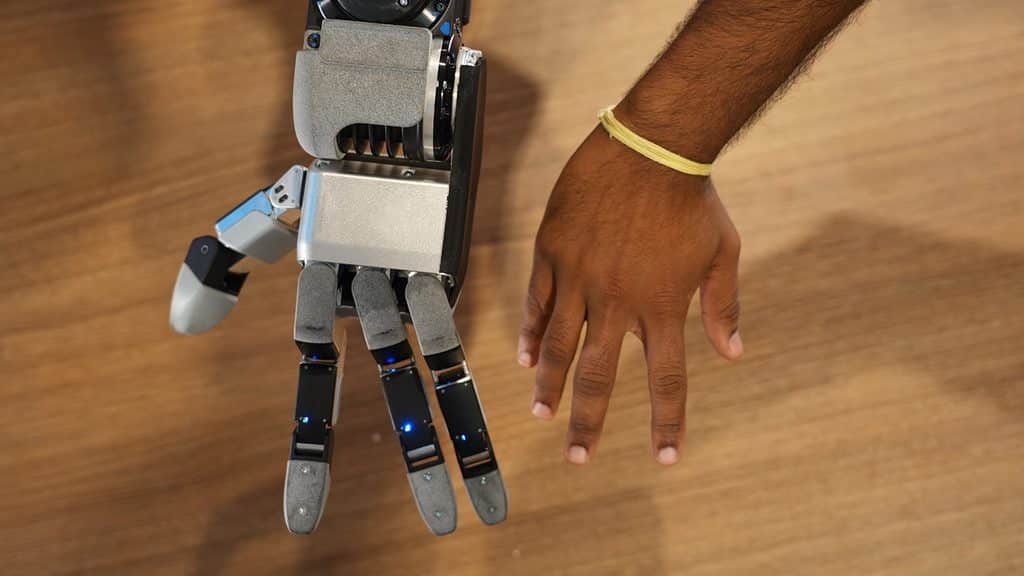
Backdrivability and transparency of the actuators are core to the design philosophy of the entire robot. It is what allows us to rely on proprioception for agile dexterous behaviors. Complementary to proprioception, we have equipped the hand with dense pressure tactile sensors that cover the fingertips and palm that make it possible to pick on small contact signals.
Finally, we have optimized the kinematics for in-hand dexterity. The four DOF opposable thumb has a much more anthropomorphic configuration and all other fingers have three DOFs configured to allow finger splaying and full control of their fingertips. This gives Atlas a leap in dexterous hand behaviors, now capable of:
- Sliding the fingertip of the thumb along the length and across the width of all other fingers
- Dexterous pinch grasps between the thumb and any of the other fingers
- Dexterous tripodal grasps
- Triggered tool grasps, like drills, power torque drivers, grinders, nail guns, and welding torches
The Missing Finger
A reasonable question: Why not a fifth finger? Adding a pinky is not hard given the modularity of the design and it would certainly take the hand closer to a human hand. In the early days of design this was a large debate among the team. If the goal is function, what does the pinky add? At one point our CTO Zack asked the team to tape their pinky and ring finger together for a day and report back on what they weren’t able to do. At the end of the experiment we had agreement: no pinky.
Four fingers and 13 DOFs already unlock in-hand reorientation, recovery from a slipping grasp, and handling tools while pressing their triggers. Hand design is a tradeoff and an extra finger means three more actuators, with the corresponding extra cost, volume, and probability of something breaking. This hand is a long-term bet, looking forward to the fight to manufacture reliable hardware at large scale and low cost. It remains true: If you want to ship great products, the best part is no part.
Built for Simulation and RL
Direct human imitation is a huge leg up for training manipulation. Today, some of the best options to scale data collection for dexterous manipulation involve hand wearable devices, like gloves or Universal Manipulation Interfaces (UMIs). When designed correctly, these wearables are intuitive enough for demonstrators to perform tasks naturally and are equipped with sensors to capture the most relevant signals during manipulation like contact events and the fast modulation of pressure distribution.
However, direct imitation has its limitations, which are as relevant to dexterous manipulation as they are to whole body humanoid control. Whole body behavior for a humanoid is always deployed on top of a whole body controller that takes care of the high rate dynamics of behaviors such as balancing, recovery steps when tripping, and compensation for forces like gravity, self-collisions or external shoves. Importantly, today these whole body controllers are always trained with RL in simulation.
Dexterous manipulation behavior is similar. Learning from human demonstration at scale is best suited to capture the complexities of the visual context in which manipulation is executed, but at its core, fast and agile dexterous manipulation is also a byproduct of high-rate closed-loop control and force regulation. Wearable devices don’t capture the relevant action signals to controlling a dexterous hand, only proxy signals that are more relevant to the pretraining of the intuitive physics of manipulation than to the deployment of performant dexterous policies. As in the case of whole body control, we believe that RL in simulation is an essential component to solve dexterous manipulation.
This has had a large impact in the design of this hand. In many ways the hand is built for sim2real transfer and RL. The rigid-drive actuation and backdrivable transmission, along with controls innovation to compensate for cogging and friction makes it possible to simulate the hand with high dynamic fidelity. This fidelity in turn makes RL more effective at training robust control policies with exposure to randomizations of motor torque profiles, surface friction coefficients, object geometries, and task disturbances.
We have initial results showing promising sim2real transfer in dynamic tasks. These behaviors are trained directly in simulation with domain randomization and rolled out in hardware relying only on high rate actuator proprioception for feedback. We are excited about the trajectory of this line of work and ongoing efforts to massively scale this process.
The Value of Dexterity
It is worth asking, why do humanoid hands need to be dexterous at all? After all, a lot of the tasks that have been successfully automated today in industry involve what look like rigid pick-and-place tasks. There’s two main answers to this:
- Existing automation solutions rely on very carefully controlled part presentation and highly specialized grippers for specific parts. But the promise of a humanoid is generalization and flexibility—picking and placing any part from any configuration and in any type of presentation, in a shelf, crate, box, slot, cubby, or pile, requires a more dynamic, dexterous approach. If you’re building specialized fixtures, end effectors, and work cells for robots, you’re compromising your value case.
- When we look beyond what has been automated today, the need for dexterity is even more clear. The majority of these manual processes involve dexterous skills like using tools, handling deformable cables, or bin picking.
Tool use is at the top of our list
A truly general purpose hand is not really an achievable goal, because hands are a ruthless design tradeoff. Any possible design is better suited to some tasks and worse to others. Sometimes you would prefer to have softer fingers to not scratch surfaces, and sometimes harder fingers, like pliers, to apply larger forces. Sometimes you would prefer smaller fingertips like pincers and sometimes larger like tongs.
The human hand is not an exception, Aristotle called it the “tool of tools”, not a complete instrument on its own, but rather one that unlocks possibilities through tools. Tools act as multipliers. The ultimate general-purpose dexterous manipulator will not be an over-complicated hand, but one that is reliable and is capable of using tools. The dexterity necessary to use tools is a core capability necessary to turn humanoids into the general purpose machines of the future—one that we are very interested in and one that has driven many of the decisions leading to the design we present today.