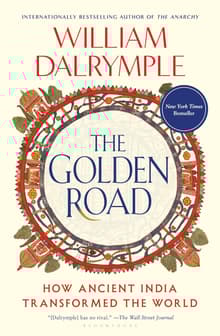
I was fascinated by this book by William Dalrymple, a Scottish historian who has written widely about the Indian subcontinent.
He explains in intriguing detail how India and Indian civilisation contributed so much to the world—from the religions (like Buddhism and Hinduism) that took root in Cambodia, Sri Lanka, China and Indonesia, from the creation of the numerals that we use today and mistakenly refer to as Arabic numerals, from the exotic goods that flowed out of India and drained the gold of the Roman Empire.
He creates a plausible case for the Indian subcontinent being responsible for transforming the technology and culture of the ancient world,
Reading Dalrymple’s book gave me the insight and confidence to publish my own book, which complements and supplements the stories and ideas discussed in his book.
THE INSTANT SUNDAY TIMES BESTSELLER A Waterstones and TIMES HISTORY BOOK OF THE YEAR A SPECTATOR and History Today BOOK OF THE YEAR
A revolutionary new history of the diffusion of Indian ideas, from the award-winning, bestselling author and co-host of the chart-topping Empire podcast
'Richly woven, highly readable ... Written with passion and verve' Spectator 'Dazzling ... Not just a historical study but also a love letter' Guardian 'An outstanding new account ... The most compelling retelling we have had for generations' Financial Times
India is the forgotten heart of the ancient world.
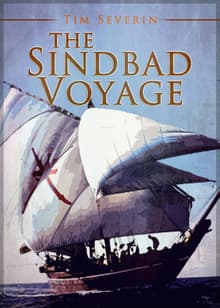
Tim Severin was a British explorer who postulated that the ancient Omanis of northwest Africa used to sail their “sewn plank boats” (known as Dhows) far across the Indian Ocean.
He challenged the Eurocentric view that both he and I had grown up with—namely that the Indian Ocean was a void and was only discovered when Europeans like the Portuguese, Dutch, and British arrived in their large sailing ships.
Severin believed that the Omanis (the people of the Sindbad stories) were building and sailing dhows as far back as the beginning of the Common Era—and to prove his theory, he built such a ship using the ancient boat-building techniques and sailed it from Sohar in Oman to Guandong in China.
I read the book with a sense of wonderment—he did not simply challenge the accepted view, he put his money (and his life) where his mouth was—and undertook the hazardous journey himself to prove that it could be done—and had been done.
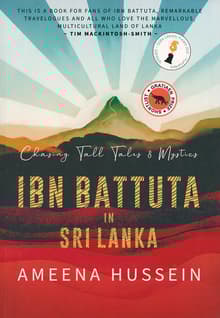
I came across Ameena Hussein’s book when I was looking for information about early travellers to Sri Lanka.
I was engrossed while reading the story of how she herself journeyed through Sri Lanka, following the footsteps of this Moroccan traveller as described in his own book Al Rihla (The Journey). Ibn Battuta arrived on the island in the 14th century, visited many places (including the famous "Mountain of Adam"), and recorded his travels for posterity.
I loved her descriptions of the places that she visited, painting an evocative picture of these places and describing her own travels in the 21st century, looking for traces of Ibn Battuta.
I loved this book because Brohier’s descriptions of the foods and festivals of her people—the Dutch Burghers (descendants of the Dutch who ruled Sri Lanka for about 150 years from 1656 to 1796) brought back memories of my own childhood in Sri Lanka.
She describes in detail how the various flavours and recipes were brought to Sri lanka by the many traders, travellers, and colonial trespassers who made their way here—resulting in a delicious melting pot of foods.
I remembered the dishes made by our Burgher neighbours and friends, and I was pleased to find recipes for many of the tasty dishes we used to enjoy in the “good old days" of my childhood.
I am recommending this book because it provided me with information that few people in the Indian subcontinent (and indeed in the world) today are aware of.
In days long gone, there were Jewish traders who lived and traded with the people of the western Indian sub-continent—trading in spices like cinnamon, rugs, arsenic, etc.
Shlomo Goitein used the documents that were serendipitously discovered in the geniza of the Cairo synagogue to piece together, from the letters written by the Jewish traders who lived in the lands around the western Indian Ocean (present-day Yemen, Oman, India, and Sri Lanka) during medieval times, the story of their lives and times.
I was fascinated by the stories in Goitein’s book—it was almost as if these ancient merchants were talking to me from beyond the grave!
Modern international business has its origins in the overseas trade of the Middle Ages. Of the various communities active in trade in the Islamic countries at that time, records of only the Jewish community survive. Thousands of documents were preserved in the Cairo Geniza, a lumber room attached to the synagogue where discarded writings containing the name of God were deposited to preserve them from desecration. From them Professor Goitein has selected eighty letters that provide a fascinating glimpse into the world of the medieval Jewish traders. As the letters vividly illustrate, international trade depended on a network of personal…