Let’s be honest, aren’t we all insanely curious to know how other species do it? Oh, be careful what you wish for.
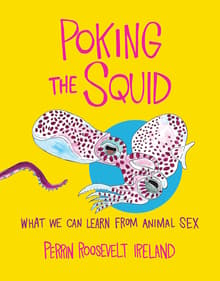
This ribald, sex-positive survey of the erotic, even kinky proclivities of our fellow animals had me in stitches—when it wasn’t blowing my mind.
Queer sex? Check. Female orgasms? Check. Literal gender fluidity? Check. Divorce, infidelity, oral sex… turns out, anything humans do, other animals thought of first and sometimes take further. As a bonus: Colorful, playful, graphic-novel-style illustrations mean you don’t need to imagine seahorse sex.
For too long, science has ignored and obscured the multiplicity of animal sexual behaviour. With vivid, often funny and always beautiful watercolour illustrations in a work of graphic nonfiction, artist Perrin Roosevelt Ireland examines how animals express and have sex. With the help of her cats Ursula and Pudge, she takes us on a wild biodiversity ride from queerness, infidelity and divorce to consent, sexual cannibalism and sex change. Ireland interviews researchers at the edge of this new science and brings readers along as she learns the latest discoveries. In vivid comics of seahorse dads, polygamous albatross, and gender-fluid barnacles,…
I will read anything by Mary Roach because she’s hilarious.
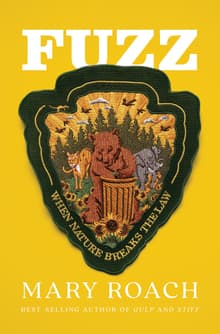
But in particular, she’s an expert at uncovering the unexpectedly bizarre, surreal hidden side of any topic: death, astronaut training, digestion, and… human-animal conflicts.
Animals do what they do, and many a time, humans want to arrest (and even kill) them for it. And we have tried. For centuries. With wildly uneven results. And with each story of people going to battle—vainly, quixotically—with vandalous seagulls and crows, hungry bears, uninvited elephants, poisonous beans, and home-invading macaques, I think, Holy sh*t!
What's to be done about a jaywalking moose? A bear caught breaking and entering? A murderous tree? Three hundred years ago, animals that broke the law would be assigned legal representation and put on trial. These days, as New York Times best-selling author Mary Roach discovers, the answers are best found not in jurisprudence but in science: the curious science of human-wildlife conflict, a discipline at the crossroads of human behavior and wildlife biology.
Roach tags along with animal-attack forensics investigators, human-elephant conflict specialists, bear managers, and "danger tree" faller blasters. Intrepid as ever, she travels from leopard-terrorized hamlets…
We already know that most species possess the same five senses we do, but use them in different ways.
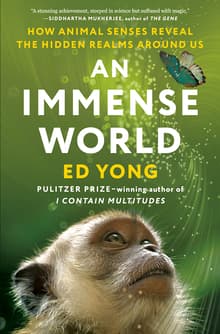
But did you know that animals have other, completely different senses, ones that detect odors, heat, sound, electricity, pressure, tastes, and the Earth’s magnetic field in ways we physically can’t?
I found it hard to finish this book because every time I read something astonishing—that hammerhead sharks sense the electrical fields of prey, that monarchs taste with their feet, that octopus arms think and act independently, that dolphin sonar can see inside bodies—I had to stop and wonder WTF that must be like.
'Wonderful, mind-broadening... a journey to alternative realities as extraordinary as any you'll find in science fiction' The Times, Book of the Week
'Magnificent' Guardian
Enter a new dimension - the world as it is truly perceived by other animals.
The Earth teems with sights and textures, sounds and vibrations, smells and tastes, electric and magnetic fields. But every animal is enclosed within its own unique sensory bubble, perceiving only a tiny sliver of an immense world. This book welcomes us into previously unfathomable dimensions - the world as it is truly perceived by other animals.
One of my biggest animal-related holy sh*t moments was when I first read paleontologist Jack Horner’s plan to turn a chicken into a dinosaur.
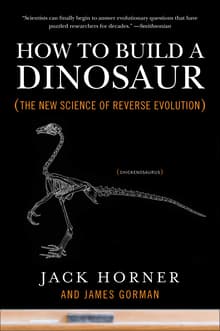
Not an extinct dinosaur a la Jurassic Park (a movie he consulted on), but a living, breathing, ready-to-roar brand-new dinosaur. How, you ask, can he do that without, say, cloning preserved dino DNA in blood stolen by an amber-trapped mosquito (BTW, an impossible theory)? Obviously, by reverse engineering a chicken embryo.
By altering the embryo’s chemical instructions, those same genes—instead of building a barnyard icon—can theoretically develop a snout with teeth, arms with claws, and a long tail. Yeah, yeah, yeah, this dinosaur will still have a chicken’s stature and feathers, but it could mess you up. Why, oh why do this? Because Horner thinks that success will prove, once and for all, that genetic change drives evolution. Holy sh*t!
A world-renowned paleontologist reveals groundbreaking science that trumps science fiction: how to grow a living dinosaur.
Over a decade after Jurassic Park, Jack Horner and his colleagues in molecular biology labs are in the process of building the technology to create a real dinosaur.
Based on new research in evolutionary developmental biology on how a few select cells grow to create arms, legs, eyes, and brains that function together, Jack Horner takes the science a step further in a plan to "reverse evolution" and reveals the awesome, even frightening, power being acquired to recreate the prehistoric past. The key is…
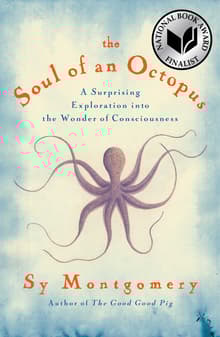
I’m a sucker for animals. So is, pun intended, Sy Montgomery.
One thing I feel, above all, is awe and gratitude for the wondrously diverse beings who share this beautiful planet with us, and this gorgeous book submerged me in these emotions from first page to last.
One day, Sy decided to make friends with Olivia, a giant Pacific octopus, and despite all the barriers to connection one could imagine between two species, damn if they don’t succeed. Why? Because Sy isn’t the only one desiring companionship, friendship, and love, Olivia does, too. Just writing about it makes me tear up.
'Sy Montgomery's The Soul of an Octopus does for the creature what Helen Macdonald's H Is for Hawk did for raptors' New Statesman 'Charming and moving...with extraordinary scientific research' Guardian 'An engaging work of natural science... There is clearly something about the octopus's weird beauty that fires the imaginations of explorers, scientists, writers' Daily Mail
In 2011 Sy Montgomery wrote a feature for Orion magazine entitled 'Deep Intellect' about her friendship with a sensitive, sweet-natured octopus named Athena and the grief she felt at her death. It went viral, indicating the widespread fascination with these mysterious, almost alien-like creatures. Since…